


More news on this day
A United Airlines flight from Washington to Newark made an abrupt turn back to its departure airport this week, with passengers describing an initially confusing midair diversion that ultimately traced back to an unexpected but non-critical issue in the cabin.
Get the latest news straight to your inbox!
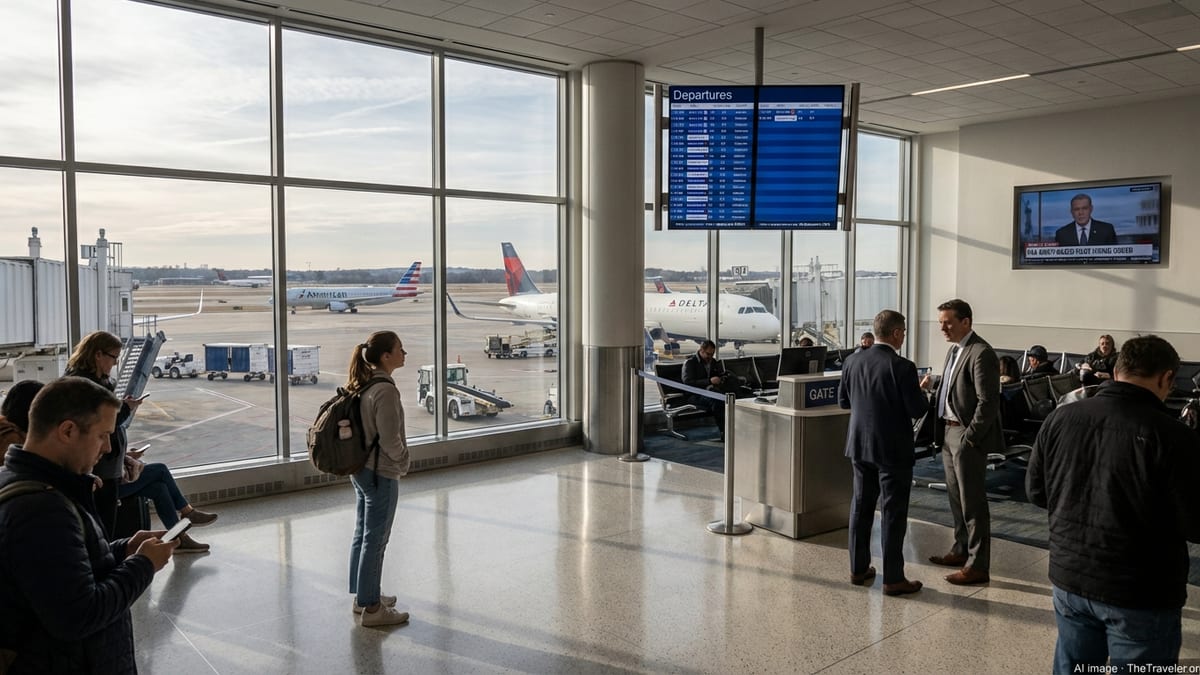
Flight UA2669’s Short-Lived Journey to Newark
United Airlines Flight UA2669 was scheduled to operate from Washington to Newark on a Boeing 737-924ER, a stretched version of the 737-900 commonly used on high-demand domestic routes. Tracking data shows the aircraft departing Washington as planned before leveling off and beginning a turn that took it back toward the capital instead of continuing north to New Jersey.
Publicly available flight-tracking information indicates that the jet did not climb to its typical cruising altitude for the brief route and instead remained within a band often associated with early stages of flight or precautionary returns. For passengers on board, the change in course, unaccompanied at first by detailed explanation, created a sense of uncertainty about what might be wrong.
Despite the diversion, the aircraft landed back in Washington without incident. There were no immediate reports of injuries, and the return was conducted in an orderly fashion, consistent with precautionary operational decisions rather than a full-scale emergency.
Ground handling information and schedule updates later showed the flight listed as diverted and then canceled, with passengers moved to later departures to complete their journeys to the New York metropolitan area.
A Cabin Condition That Prompted a Precautionary Turn
Subsequent reporting and data from aviation-tracking and operations platforms suggest the reason for the sudden turnaround was linked to a cabin condition that did not compromise the fundamental safety of the aircraft but raised enough concern for the crew to discontinue the flight. In similar recent cases involving United and other major carriers, factors such as unusual odors, possible minor pressurization irregularities, or problems with cabin systems have prompted crews to return to departure airports for checks rather than continue to destination.
In this instance, early indications point to an issue consistent with those scenarios: something in the passenger cabin environment that required attention from maintenance teams on the ground and that crew members judged unwise to ignore on a relatively short sector. Aviation analysts note that such decisions are increasingly common as airlines emphasize a conservative approach to in-flight anomalies, even when aircraft systems remain fully controllable.
Passengers on UA2669 reportedly experienced a normal landing and taxi back to the gate. The return allowed technical staff to inspect the aircraft and either address the reported condition or position the jet for more in-depth maintenance away from the day’s tight departure schedule.
Industry observers say that for crews, choosing to turn around is often less about an immediate danger and more about reducing uncertainty. If an issue cannot be conclusively diagnosed in the air, returning to a familiar base with full support services can simplify both safety management and subsequent passenger handling.
Growing Scrutiny of Diversions and Turnbacks
The diversion of UA2669 comes amid heightened public attention to airline incidents of all kinds, from major structural problems to relatively minor technical or cabin-related events. In recent months, travelers have seen multiple reports of flights turning back soon after departure or diverting to intermediate airports for reasons ranging from sensor messages to medical events in the cabin.
Data compiled from open aviation databases and safety reports shows that such diversions remain a very small fraction of total flights but are highly visible because they disrupt travel plans and often appear on social media in real time. Turnbacks that occur within the first hour of flight are especially common on routes from East Coast hubs, where aircraft remain within relatively close reach of multiple diversion airports and maintenance bases.
United’s 737-900 and 737-924ER fleet in particular operates some of the busiest domestic city pairs in the United States. With high utilization and frequent short hops, these aircraft are more likely to encounter small issues that prompt operational caution, such as system alerts, cabin equipment malfunctions, or passenger-related situations that are easier to resolve on the ground.
Aviation safety specialists point out that modern monitoring tools and strict maintenance protocols can generate alerts even for minor deviations from expected performance. While this may result in more diversions for non-critical reasons, they argue it also demonstrates a system that errs on the side of redundancy and caution.
What the Diversion Meant for Passengers
For travelers booked on UA2669 to Newark, the return to Washington translated into delays, missed connections, and a scramble for rebooking. Airline schedule data shows that passengers were shifted to later flights to the New York area, including services into Newark and, in some cases, other nearby airports served by United and its partners.
Many travelers on short-haul routes like Washington to Newark choose those flights specifically to make onward connections to long-haul services from the New Jersey hub. When an aircraft returns to its origin, those connections can quickly unravel, creating a cascade of rebookings that extends across the airline’s network and, in some cases, onto competing carriers.
Published guidance from airline and aviation consumer resources recommends that passengers affected by diversions promptly use mobile apps or airport kiosks to secure new itineraries, rather than waiting in line at a service desk. On days when operations are already tight, acting quickly can make the difference between same-day arrival and an unplanned overnight stay.
Although UA2669’s diversion did not involve a serious safety incident, the episode underscores how even relatively minor technical or cabin events can reverberate across hundreds of travel plans. For passengers, the experience can be frustrating; for airlines, it is an increasingly visible aspect of an industry that prioritizes caution in the face of any in-flight uncertainty.
Context for United and Boeing 737-900 Operations
The Boeing 737-924ER is part of United’s broader 737-900 family, an important workhorse on domestic and near-international routes. Recent filings and fleet data show that United continues to rely heavily on this model, pairing it with newer 737 variants and widebody aircraft on its most heavily traveled corridors.
In parallel, diversions and returns involving a range of aircraft types have drawn renewed attention to the day-to-day realities of airline operations. Industry databases and news coverage in the past year have highlighted events from precautionary landings due to system messages to midroute diversions prompted by onboard security concerns unrelated to the aircraft’s mechanical condition.
Analysts emphasize that while mechanical and cabin-related issues can inconvenience travelers, the overall safety record for major U.S. carriers remains strong. Flight diversions such as the UA2669 turnback are often cited as examples of the system working as intended, with crews empowered to take conservative actions whenever something does not appear standard, even if the underlying problem later proves minor.
For travelers planning future trips, the UA2669 episode serves as a reminder that modern air travel operates within a tight safety envelope, where a brief and puzzling turn in the sky may, in fact, reflect a decision to keep routine concerns from ever becoming emergencies.