


More news on this day
The U.S. Mission in the United Arab Emirates has issued a fresh security alert dated October 18, 2026, advising American citizens in the UAE and those transiting the country to exercise increased caution amid what officials describe publicly as a complex and volatile regional security environment.
Get the latest news straight to your inbox!
New Alert Highlights Regional Tensions and Iran-Linked Risks
The October 18 alert from the U.S. Mission to the United Arab Emirates forms part of a coordinated series of advisories issued across multiple Middle Eastern countries, reflecting concern over the potential for Iran and groups aligned with it to target U.S. interests and locations associated with Americans. Publicly available summaries of the notices state that missions in Saudi Arabia, the UAE, Kuwait, Jordan, Bahrain, Oman, Iran, Qatar, Iraq, Lebanon, Yemen and Israel or Jerusalem all released similar language on the same date, emphasizing a shared regional risk picture.
According to open-source reporting that has reviewed the text of the alerts, missions warn that Iran and groups supportive of Iran may seek to strike U.S. interests overseas or locations linked to the United States and Americans worldwide, including businesses and institutions with a perceived U.S. connection. The UAE alert mirrors that broader message, pointing to the possibility of attacks beyond active conflict zones.
The new notice comes against the backdrop of an already elevated U.S. State Department Travel Advisory for the United Arab Emirates. As of August 29, 2026, the UAE is listed at Level 3, Reconsider Travel, due to terrorism and armed conflict, including earlier episodes this year involving large-scale missile and drone launches and threats against sites associated with U.S. and allied interests.
Regional media coverage notes that the latest alert builds on a pattern of warnings issued since late summer, when the U.S. Mission in the UAE urged Americans outside the Middle East to seriously reconsider nonessential travel to or through the region, citing the risk of rapid escalation and spillover from conflicts involving Iran and its partners.
Warnings on Flight Disruptions and Airspace Closures
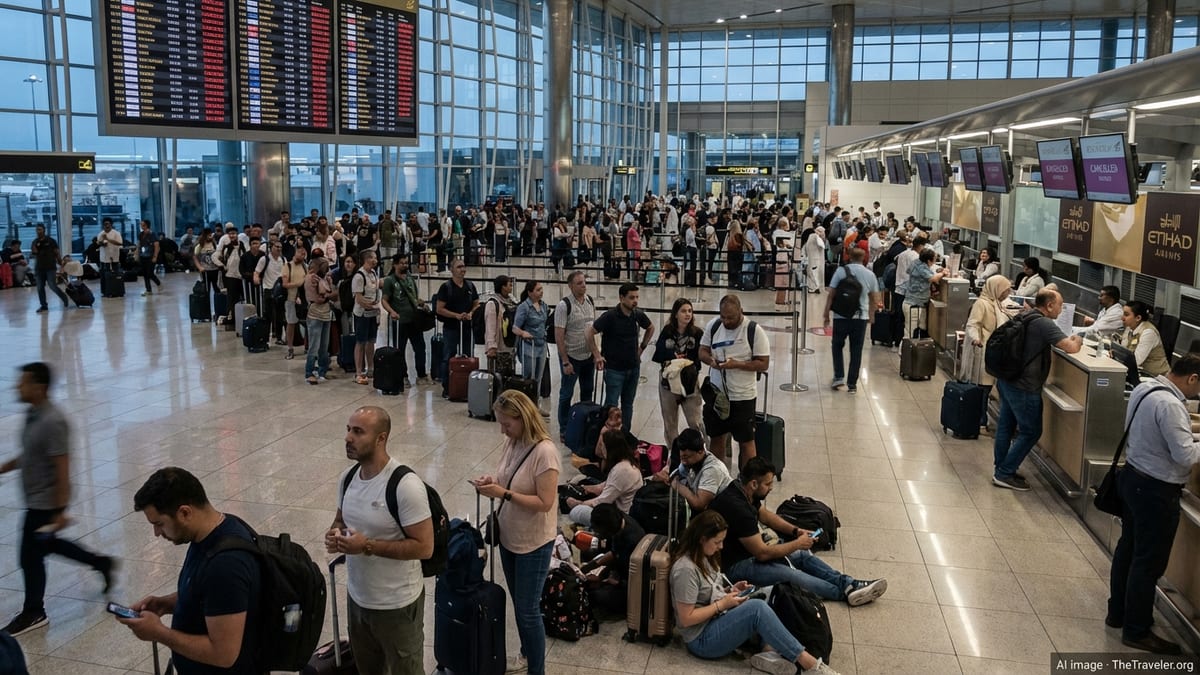
In addition to the threat of targeted attacks, the October 18 alert for the UAE places particular emphasis on potential disruption to air travel. Public summaries of the mission’s message describe a scenario in which flight cancellations, diversions and airspace closures could occur with limited notice, a concern echoed across the simultaneous alerts issued in neighboring states.
Coverage by regional and international outlets indicates that Americans are advised to monitor the status of flights directly with airlines and local airports rather than relying on day-of departure assumptions. Travelers are encouraged to allow additional time for security screening, stay attentive to airline notifications and be prepared for last minute gate changes or rerouting, especially on routes that cross or approach high-tension areas in the Gulf and Red Sea regions.
The alert references broader aviation concerns already reflected in existing notices to air missions about flying over or near parts of the Persian Gulf and Gulf of Oman. While major hubs in Dubai and Abu Dhabi continue to operate, industry reporting points out that carriers could adjust schedules quickly in response to shifts in the security environment, government guidance or changes in insurance and operational risk assessments.
Travel risk advisory services tracking the alert note that disruptions may not be limited to direct attacks or closures. Indirect effects such as congestion at alternative airports, knock on impacts to connecting flights and temporary shortages of seats on popular exit routes are also being highlighted to clients planning regional itineraries.
Advice for Americans Living in or Visiting the UAE
The U.S. Mission’s October 18 alert reiterates a set of behavioral recommendations that have appeared in earlier messages this year, tailored to the heightened regional situation. Publicly accessible summaries indicate that Americans in the UAE are urged to maintain a high level of situational awareness, avoid demonstrations or large political gatherings and review personal security plans, particularly in major urban centers such as Abu Dhabi, Dubai and Sharjah.
In line with longer standing State Department guidance, the alert also underscores that terrorist actors may attempt attacks with little or no warning on locations that draw foreign visitors. These include hotels, shopping malls, entertainment districts, transportation hubs, places of worship and sites associated with Jewish and Israeli communities. Earlier alerts specific to the UAE this year highlighted concerns about locations connected to those communities, and the new regional message appears to keep those vulnerabilities in focus.
Americans are encouraged, through publicly available guidance, to enroll in the Smart Traveler Enrollment Program, which allows the mission to distribute future alerts by email and helps consular staff contact U.S. citizens in an emergency. The wider Level 3 advisory for the UAE continues to recommend that travelers plan for contingencies that do not rely solely on U.S. government assistance, including having access to funds, up to date travel documents and a realistic route to depart should commercial options become limited.
Security analysts consulted in open reporting note that while daily life in the UAE’s main cities remains largely normal, the alerts are designed to prepare travelers and residents for the possibility that the regional picture could deteriorate quickly, even if no immediate incident is visible on the ground.
Impact on Travel Planning, Tourism and Transit Routes
The UAE’s role as a global transit hub means that the October 18 security alert may affect not only those whose final destination is the country, but also travelers who would ordinarily pass through Dubai International Airport or Abu Dhabi International Airport en route to other regions. Airlines based in the UAE serve long haul routes between North America, Europe, Asia and Africa, making any prolonged disruption in local airspace significant for international connectivity.
Travel industry reporting following the release of the alert notes that carriers and tour operators are reviewing contingency plans, including possible rerouting around higher risk corridors and adjustments to schedules during periods of elevated tension. Insurance and risk advisory firms that track official government alerts have flagged the latest message as a factor that policyholders should consider when evaluating coverage for trip cancellation, interruption or emergency evacuation services.
For leisure travelers, the Level 3 advisory and the October 18 alert do not amount to a blanket ban on visiting the UAE, but they do signal that nonessential trips should be weighed carefully against current conditions. Industry analysts quoted in regional news coverage suggest that business and transit travel is likely to continue, but with added emphasis on flexibility, refundable bookings and awareness of alternative routing options.
Locally, hotels, shopping centers and major attractions in Dubai and Abu Dhabi remain open, and there have been no broad closures reported in connection with the alert. However, travelers are being encouraged through public guidance to stay attentive to local announcements, follow any instructions from security staff at venues and avoid lingering near high profile government or diplomatic sites unless necessary for official business.
What the Alert Means for Future Trips to the UAE
The October 18 security alert for the UAE is the latest in a series of notices that collectively present a picture of an increasingly complex Middle Eastern security landscape, in which localized conflicts can quickly have wider travel and economic effects. For prospective visitors, the key message is that conditions are fluid, and that information that is accurate at the time of booking may change before or during a trip.
Publicly available advisories from the U.S. government and allied states emphasize that travelers should regularly check for updates in the weeks and days before departure rather than relying on a single snapshot of risk. This includes monitoring official travel advisories for the UAE, reviewing recent security alerts from the U.S. Mission and consulting airlines about any planned or potential route changes.
For Americans already in the country, the alert underscores the importance of registration with consular services, maintaining communication with family members outside the region and having a basic plan in place for sheltering in place or relocating temporarily within the UAE if conditions require. Travel risk specialists writing about the alert stress that such preparation does not imply that an incident is imminent, but that it can significantly reduce confusion and anxiety if the regional situation shifts rapidly.
As of October 19, 2026, flights continue to operate to and from the UAE’s major airports and the country’s tourism infrastructure remains functioning. The new alert, however, positions the UAE clearly within a broader network of U.S. security warnings spanning twelve locations across the Middle East, signaling that travelers should approach upcoming journeys with a higher degree of vigilance, flexibility and attention to official updates than in calmer periods.