


More news on this day
Value Group plans to use the 27th Annual GHI Conference at Olympia London from 1 to 3 December 2026 to debut an expanded version of its RUBIK IROPS disruption-management platform, targeting airlines and ground handlers that want more tightly integrated tools to coordinate passenger recovery during major operational disruptions.
Get the latest news straight to your inbox!
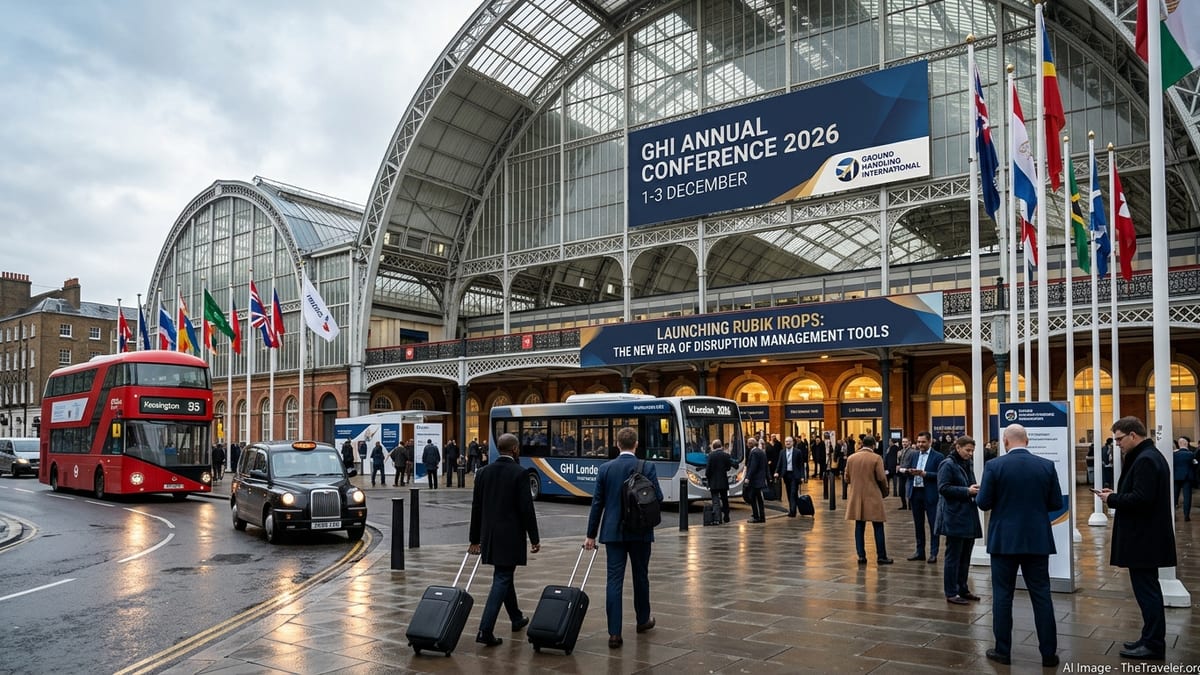
GHI London 2026: timing, venue and who will attend
The 27th Annual GHI Conference is confirmed to take place from 1 to 3 December 2026 at Olympia London, with the main activities hosted in the historic venue’s National Hall. Event listings and organiser information show conference days running from Tuesday to Thursday, broadly from morning through late afternoon, accompanied by evening networking functions and dedicated awards events. Delegates access a mix of panel discussions, briefings and case studies alongside exhibition time and pre-scheduled meetings on the show floor.
Ground Handling International positions the London gathering as its flagship global conference for the ground handling community, describing it as a primary annual meeting place for ground handlers, airlines, airports, IT suppliers and ground support equipment manufacturers. Information published by GHI on its 2025 edition indicates that the event hosted around 1,100 industry stakeholders, including more than 100 airlines and over 90 exhibiting suppliers, and the organiser is marketing similar scale for the 2026 London move. Those figures, drawn from the most recent completed conference, provide the closest indication of the scale that exhibitors such as Value Group can expect this year rather than a finalised 2026 headcount.
The London edition also marks the start of a formal partnership between GHI and the Airport Services Association (ASA), with ASA confirmed as a strategic event partner for the 2026 conference and future regional meetings. Conference materials highlight joint panels focused on regulatory developments, handler safety and workforce challenges, signalling that the 2026 programme will frame product launches such as the expanded RUBIK IROPS within broader debates about how airlines and handlers share responsibility for disruption response, compliance and passenger care.
What RUBIK IROPS is designed to do during irregular operations
RUBIK IROPS sits within Value Group’s broader RUBIK technology ecosystem and is designed specifically for irregular operations, or IROPS, when airline schedules are significantly disrupted and large numbers of passengers need to be rebooked, accommodated or otherwise supported. Publicly available descriptions from Value Group and aviation briefings describe RUBIK IROPS as a dashboard-led environment that consolidates information on flights, passengers and applicable rules into a single operational workspace for disruption management teams.
In practical terms, that means pulling together data from airline reservation systems, departure control, operational control and customer records to show, for each disrupted flight or connection, how many passengers are affected, which itineraries are at risk of misconnection and what options exist for reaccommodation within the airline’s own network or on partners. Value Group materials emphasise that airline-specific policies on care and compensation, including entitlements under passenger rights regimes, are configured in the system so that front-line or back-office teams can see which travellers require rebooking, hotel rooms, meal vouchers or surface transport, and under what conditions.
The platform is intended to support the full workflow of a major disruption event, from identifying at-risk passengers and proposing rebooking options through to assigning accommodation and tracking whether contracted suppliers such as hotels and transport companies have delivered the promised services. Rather than relying on separate spreadsheets, email chains and messaging apps at each station, RUBIK IROPS is promoted as a way to give airlines and their ground handling partners a shared status view across multiple airports, helping them coordinate a network-wide recovery and maintain a consistent digital record of what support was offered to each passenger and when.
What is known so far about the expanded RUBIK IROPS suite
Value Group has confirmed its intention to showcase an expanded version of RUBIK IROPS at GHI London 2026, but has not yet released full public technical specifications or a detailed feature list for the upgraded suite. Recent interviews and briefings with the company’s leadership ahead of the conference describe the expansion primarily in terms of deeper system integration and more structured collaboration workflows between airlines, ground handlers and local suppliers, rather than as a complete redesign.
From the information available, the central development appears to be an enhanced integration layer connecting RUBIK IROPS more tightly with airline reservation systems, operations control tools and third-party providers such as hotel aggregators and transport partners. The goal is to reduce manual cross-checking by allowing data on disrupted passengers, available seats, rooms and vehicles, and applicable rules or service levels to flow into the IROPS workspace in near real time. This would, for example, allow a ground handler at a station to see immediately which passengers are already rebooked, which still need hotel rooms, and what options exist within contracted inventories, while an airline’s central team in another city oversees the same event using the same underlying data.
The company also presents RUBIK IROPS as a shared operational environment rather than a tool confined to a single department. Value Group’s public messaging around the London showcase suggests that the expanded suite will place greater emphasis on role-based access controls, task allocation and visibility across stakeholders. That could include, for instance, clearer task lists for handlers working at the airport, separate views for airline customer care teams managing communication, and oversight dashboards for central operations managers monitoring recovery progress across multiple stations. At the time of writing, these elements remain described at a conceptual level, with Value Group indicating that more detail will be provided in customer briefings and live demonstrations at Olympia rather than through pre-published release notes.
Conference themes that intersect with disruption management
The 2026 GHI Annual Conference agenda, as outlined in organiser and partner materials, gives prominence to subjects that intersect directly with IROPS management, including new and forthcoming European ground handling rules, safety performance on the ramp, sustainability in ground operations and workforce pressures. Panels on regulatory change are expected to look at how evolving standards and regional rules affect contracts and accountability between airlines, handlers and airports, particularly in areas such as minimum service levels, training and reporting requirements during operational disruption.
Within this context, tools like RUBIK IROPS are being assessed not only for their ability to speed up rebooking and passenger care, but also for how effectively they document each step of the disruption response. Passenger rights regulations in various jurisdictions, as well as ground handling standards, increasingly require airlines and their partners to demonstrate after the event what assistance was offered, when communications were sent, and how special categories of passengers were supported. Platforms that centralise operational and care records may help operators demonstrate compliance more efficiently than disparate manual logs, although the degree to which any particular system delivers that benefit will depend on how thoroughly it is implemented and used in practice.
Workforce and skills shortages remain a recurring theme on the GHI programme, with dedicated sessions on human performance and the next generation of ground handling professionals. Many handling companies and airports in Europe and beyond have reported tight labour markets for ramp operations, passenger services and specialist roles such as operations controllers. Under those conditions, disruption-management platforms are being positioned as a way to standardise complex workflows, automate eligibility checks and highlight critical passenger information, potentially allowing smaller or less experienced teams to manage large-scale disruption events with more consistency than would be possible using ad hoc tools alone.
How GHI’s meeting structure will shape the RUBIK IROPS launch
The official GHI 2026 conference programme focuses on themes and panel topics rather than product-specific keynotes, and at the time of publication there is no separate public listing for a RUBIK IROPS main-stage launch session. Instead, the structure of the event suggests that most of Value Group’s detailed demonstrations will take place through stand presentations and scheduled one-to-one meetings rather than formal press conferences or plenary announcements.
Registered delegates receive access to a personal page and conference app that allow them to request and accept meetings, view the delegate list and manage their diaries around the session schedule. Suppliers typically use this system to arrange 15, 25 or 55 minute one-to-one meetings in purpose-built booths on the show floor, as well as shorter speed networking sessions designed to connect airlines and handlers with potential partners. Exhibitor information around the 2026 conference indicates that around 90 ground support equipment and IT providers are expected to showcase their products and services, positioning Value Group’s stand within a concentrated cluster of operational decision makers.
In this format, airlines, airports and ground handling companies interested in the expanded RUBIK IROPS suite are likely to get the most insight by booking time with Value Group’s team in advance, bringing specific disruption scenarios and integration questions to those meetings. The lack of a published, product-specific conference session at this stage does not necessarily mean that the launch is minor, but reflects GHI’s long-standing emphasis on thematic panels and B2B matchmaking rather than on large-scale product reveals on the main stage. As with other exhibitors, any firm commitments on timelines, integrations or deployment models are expected to be discussed bilaterally during these meetings rather than in broad public statements.
What airlines, handlers and travellers should watch next
For airlines, ground handling companies and airports planning to attend GHI London 2026, the immediate practical step is to check the latest exhibitor list, floor plan and meeting tools via official conference channels to confirm Value Group’s stand location and available slots. Exhibitor positions, sponsorships and session timings can be updated in the run-up to the event, so delegates should rely on the organiser’s most recent digital information rather than earlier marketing materials or third-party listings when planning their schedules.
Operational and customer care teams evaluating RUBIK IROPS or comparable disruption-management platforms may find it useful to prepare concrete case studies of past IROPS events to discuss on site. Examples could include severe weather at a hub, prolonged air traffic control restrictions or extended technical issues on key fleets or routes, alongside questions about how the platform would support multi-station coordination, regulatory reporting and communication with contracted accommodation and transport providers. Clarifying in advance which internal systems need to be integrated, what degree of automation is acceptable for rebooking and care allocations, and how responsibilities are divided between airline staff, handlers and Value Group’s own operations centre will be key factors in any procurement decision.
For individual travellers and corporate travel managers, the London announcement does not immediately change how flights are booked or how disruption information is delivered, since RUBIK IROPS is positioned as a behind-the-scenes coordination tool rather than a consumer-facing app. In the medium term, however, the way airlines and handlers adopt and embed such systems can influence the experience during major disruptions, including how quickly rebooking offers arrive, how clearly entitlements are explained and how consistently accommodation and transport arrangements are handled across different airports. Passengers flying in late 2026 and 2027 should continue to rely on official airline channels, booking intermediaries and airport information for real-time updates, while recognising that the underlying tools used to manage disruption, including expanded suites like RUBIK IROPS, may still be in various stages of rollout and refinement at different carriers.