


More news on this day
A powerful coastal storm swept up the U.S. East Coast on Thanksgiving Day, November 26, 2026, unleashing high winds, heavy rain and coastal flooding that disrupted one of the year’s busiest travel periods, led to hundreds of flight cancellations and delays and prompted the first-ever weather-related postponement of New York City’s Macy’s Thanksgiving Day Parade.
Get the latest news straight to your inbox!
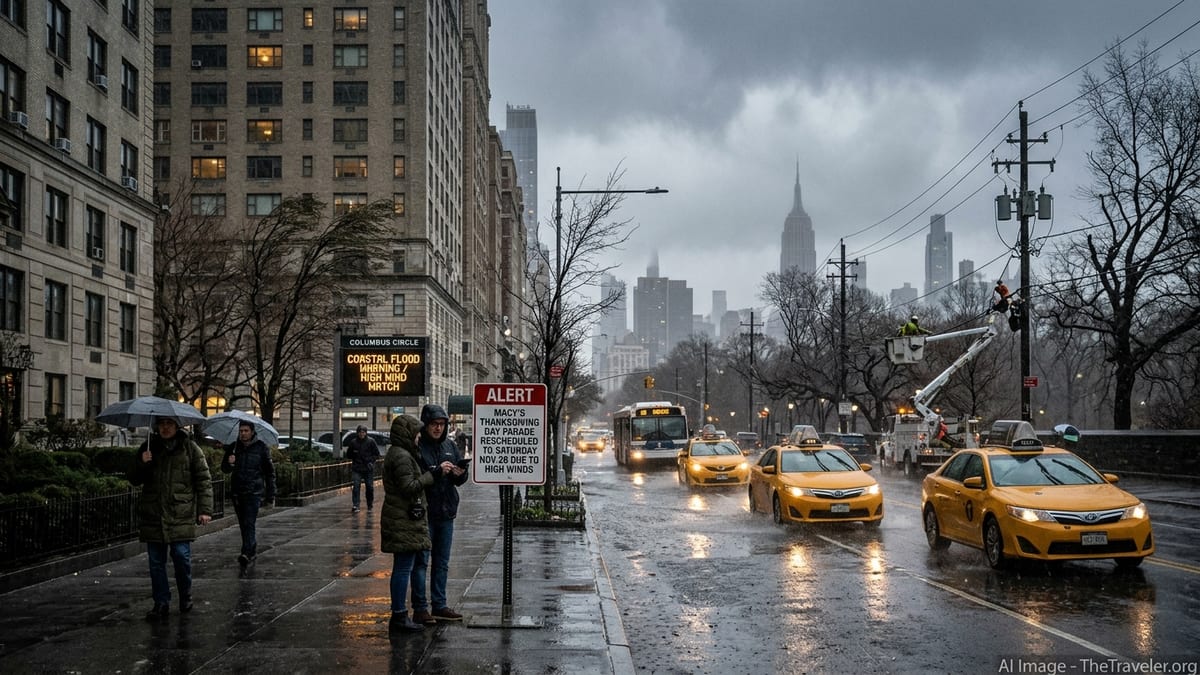
Storm track, warnings and areas most affected
The storm, described by U.S. forecasters as a powerful coastal low, tracked northward along the Mid-Atlantic and Northeast seaboard through Thursday, bringing a swath of hazardous weather from the Carolinas to New England. The National Weather Service placed large stretches of the coastline under high wind, coastal flood and storm warnings, with advisories in effect from at least Virginia Beach through the New York City metropolitan area and into parts of southern New England.
Forecasters highlighted the risk of damaging wind gusts along the immediate coast and barrier islands, particularly in New Jersey, Long Island and coastal New England, where peak gusts of 50 to 60 miles per hour were widely forecast and some exposed areas were warned to prepare for even higher values. The Weather Prediction Center and local forecast offices also warned of periods of intense rainfall that could cause flash flooding in urban corridors and low-lying areas, particularly from the Washington, D.C., and Baltimore region northward through Philadelphia and New York City.
By Thursday afternoon, coastal flooding and heavy rain were being reported in multiple Mid-Atlantic and Northeast communities. Local and federal briefings pointed to a combination of astronomical high tides, onshore flow and the storm’s slow movement as factors driving water into bays, inlets and river mouths. While full damage assessments were still under way by early evening, weather and emergency management agencies cautioned that water levels in some tidal locations could remain elevated into the overnight hours between November 26 and 27.
Power outages, infrastructure impacts and conditions on the ground
The storm’s high winds and saturated ground translated quickly into widespread power outages. By mid-afternoon on Thursday, outage tracking services reported that hundreds of thousands of customers along the East Coast had lost electricity, with particularly high concentrations in Virginia, Maryland and Pennsylvania. In Virginia, state-level figures showed well over 150,000 customers without power at one point, while Maryland’s tally also climbed into the hundreds of thousands as trees and limbs fell onto distribution lines.
Media and official briefings from several states pointed to scattered infrastructure impacts tied to the storm. In Pennsylvania, a hospital in the Philadelphia region reported a partial power outage on Thursday afternoon, though backup systems and restoration efforts meant patients did not need to be relocated, according to local reporting. In New York City and coastal New Jersey, local authorities and residents reported instances of street flooding and short-duration water rescues from vehicles caught in rapidly rising water, consistent with pre-storm warnings about heavy rainfall and vulnerable drainage systems.
In the Washington, D.C. suburbs, the Washington Suburban Sanitary Commission asked about 1.9 million residents in Montgomery and Prince George’s counties in Maryland to limit water usage to essential needs only on Thursday. The utility cited intermittent power disruptions at its facilities linked to the storm and urged customers to postpone laundry, limit dishwasher use and reduce nonessential flushing while crews worked to stabilize operations. Similar precautionary measures were echoed by other utilities up and down the coast, which advised customers to prepare for the possibility that restoration in harder-hit pockets could extend into Friday.
Historic disruption to Thanksgiving parades and events
One of the most visible impacts for travelers and visitors was the disruption to major Thanksgiving events. In New York City, Macy’s confirmed that the 100th edition of its Thanksgiving Day Parade would not take place on Thursday and instead was rescheduled for Saturday, November 28, at 8:30 a.m. local time. Organizers and city officials cited the risk from sustained high winds and gusts funneling between Manhattan’s tall buildings, explaining that conditions could have posed safety issues for the parade’s signature large balloons, as well as for spectators and participants lining the route.
The postponement marked the first time in the parade’s century-long history that the entire event has been moved from Thanksgiving Day because of weather, according to statements from Macy’s and city officials. While there have been previous years when balloons were grounded or modified because of wind, officials stressed that forecast gusts in excess of city safety thresholds required a more sweeping response. On Wednesday evening, November 25, crews began deflating balloons on Manhattan’s Upper West Side and returning them to New Jersey for storage and later reinflation ahead of Saturday’s rescheduled march.
Further south, Philadelphia’s long-running Thanksgiving Day parade was fully canceled for 2026 due to the same storm system. Local broadcasters and city authorities confirmed that the 6abc Dunkin’ Thanksgiving Day Parade, billed as the nation’s oldest Thanksgiving parade, could not proceed safely under the combination of strong winds, heavy rain and the possibility of localized flooding along the route. For visitors who had traveled to both cities specifically to attend these events, tourism bodies and organizers pointed to alternative indoor activities and encouraged travelers to monitor official channels for updated schedules and security information for Saturday’s rescheduled New York parade.
Flight delays, cancellations and wider travel disruption
The storm hit on a day that is traditionally one of the busiest for U.S. air travel, creating an additional layer of disruption for passengers moving along the East Coast and through major connecting hubs. Data from national flight-tracking services on Thursday evening indicated that more than 400 flights involving U.S. airports had been canceled on November 26, with some tallies reporting more than 420 cancellations, and at least 1,800 to around 2,000 additional flights delayed.
New York-area airports including LaGuardia, John F. Kennedy International and Newark Liberty International saw a concentration of weather-related disruptions due to reduced arrival and departure rates in high winds and rain. Washington Reagan National and Baltimore/Washington International also reported significant delays, while hubs farther afield experienced knock-on effects as aircraft and crews were displaced from their intended schedules. Industry-focused tracking sites noted that airlines had already reduced some capacity for Thanksgiving Day compared with the surrounding peak days, but the storm’s timing still meant that many passengers faced missed connections and extended airport waits.
At ground level, transport agencies in the Mid-Atlantic and Northeast issued advisories about hazardous driving conditions, warning of ponding on roadways, reduced visibility and the potential for downed branches or debris. Some commuter rail and regional transit operators around New York and Philadelphia also reported scattered delays caused by weather and power issues, though core services continued to operate through the day. Travelers moving by car were urged by state transportation departments to allow extra time, reduce speed in heavy rain and check live traffic updates before setting out, particularly on coastal routes vulnerable to tidal inundation.
What travelers should expect into Friday and across the country
Forecasts issued late on Thursday indicated that the worst of the coastal storm for the Mid-Atlantic and much of the Northeast would gradually ease through the overnight hours into Friday, November 27. The National Weather Service expected rain to taper from south to north as the low moved away from the coast, with winds slowly diminishing by Friday in most major population centers. However, pockets of coastal flooding, especially at high tide, and lingering travel disruption were still considered likely early on Friday, and some interior New England locations faced a period of wintry mix or wet snow as colder air wrapped into the departing system.
For air travelers, airlines signaled that operations were expected to improve on Friday, but that residual delays were possible as carriers repositioned aircraft and crews and worked through backlogs from Thursday’s disruptions. Many major airlines issued weather-related travel waivers earlier in the week, allowing customers booked to or from affected East Coast airports around November 26 to change flights without standard change fees or fare differences within certain windows. Passengers were advised to confirm the latest status of their flights directly with their airline’s app or website before heading to the airport and to be prepared for adjusted departure times even after conditions improved.
Beyond the East Coast, federal meteorological outlooks pointed to a series of Pacific storm systems expected to move into the western United States into the weekend and the following week. These systems were forecast to bring periods of rain, mountain snow, strong winds and coastal flooding and high surf to parts of California, Oregon and Washington, as well as to some interior western states. Travelers planning trips that combine East Coast and West Coast destinations around the Thanksgiving and early holiday period were urged to follow updated regional forecasts, stay aware of any new advisories affecting mountain passes or coastal roads and build additional time into itineraries that rely on tight connections or weather-sensitive routes.
Tourism boards, airports and local governments across the affected regions emphasized that conditions remained highly variable by location and could change quickly with the passage of individual storm bands and tidal cycles. Visitors currently on the East Coast were encouraged to check local government, transit agency and airport information channels for the latest on parade logistics, road closures, transit service changes and attraction openings for the days following Thanksgiving, and to treat preliminary forecasts for further systems as guidance rather than certainty until closer to travel dates.