


More news on this day
Thanksgiving Day air travel across the United States is running into a mix of weather disruptions and lingering operational knock‑on effects, leaving many passengers facing delays even as overall cancellation rates remain moderate compared with the busiest days of the holiday period.
Get the latest news straight to your inbox!
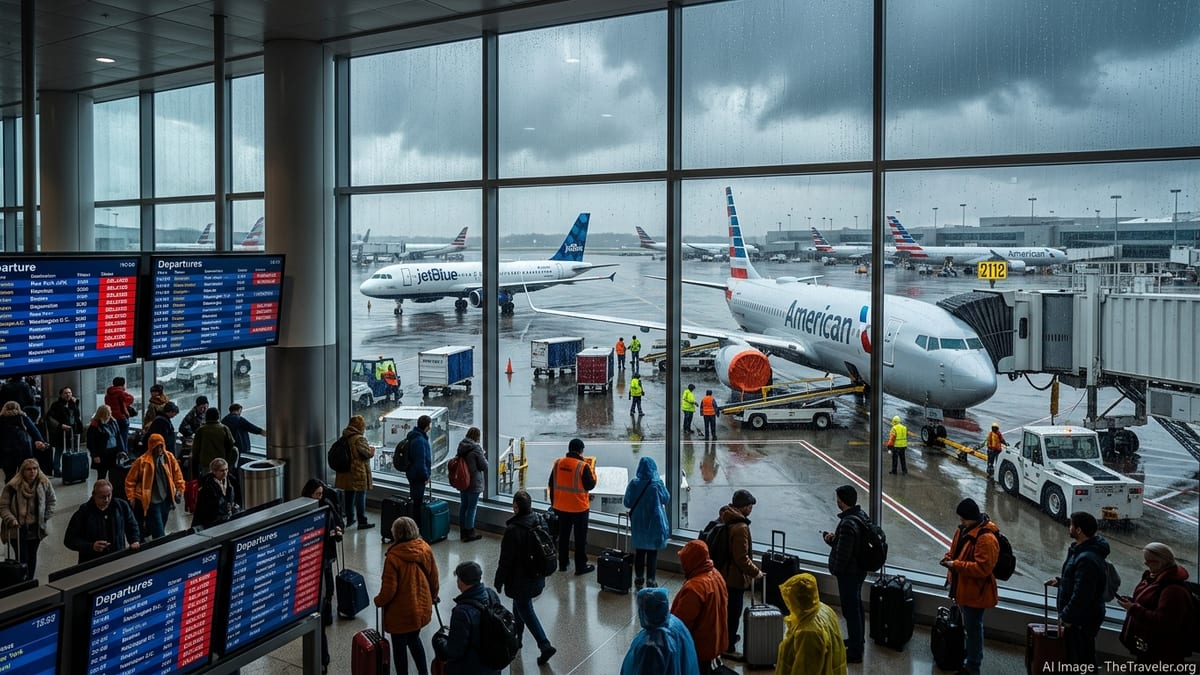
Storm systems, flooding and a historic parade postponement frame the travel day
On Thursday 26 November 2026, a large storm system brought heavy rain, strong winds and coastal flooding to parts of the East Coast and Mid‑Atlantic, affecting both local travel and major aviation hubs. The same conditions prompted the first recorded postponement of the Macy’s Thanksgiving Day Parade in New York City, highlighting the severity of the weather bearing down on one of the busiest travel regions in the country.
National Weather Service alerts on Thanksgiving morning focused on urban and coastal flooding, hazardous crosswinds and reduced visibility along portions of the I‑95 corridor and nearby airports. Those conditions typically force air traffic managers to space out arrivals and departures for safety, which can quickly translate into rolling delays as aircraft and crews fall behind schedule and miss their planned rotations.
By early afternoon on Thanksgiving, flight‑tracking services were reporting several thousand delays and a smaller number of cancellations across the U.S. network. Many of the longest holdups were clustered at large East Coast and Florida airports affected by bands of heavy rain and gusty winds, while airports with clear weather such as Dallas Fort Worth saw fewer systemic issues, underscoring how localized weather can still ripple through a national schedule.
Runway incident in Miami adds pressure after a week of disruptions
Weather was not the only obstacle for Thanksgiving travelers. On Wednesday night, 25 November, a FedEx cargo aircraft overran a runway at Miami International Airport, temporarily closing all but one runway. No injuries were reported, but the closure forced air traffic controllers to meter arrivals and departures into Miami, and the Federal Aviation Administration reported hours‑long delays in the immediate aftermath.
While Miami had reopened more capacity by Thanksgiving morning, the compressed runway operations created a backlog of late‑arriving and repositioning flights at the start of the holiday. Because Miami is a major hub for flights to and from Latin America and the Caribbean, knock‑on effects extended to connecting passengers and crews scheduled to operate onward domestic segments on Thursday.
The Miami incident came on the heels of an FAA‑ordered nationwide ground stop on 13 November following a systems issue, as well as separate technology outages at individual airlines in the days leading up to Thanksgiving week. Although those earlier events were resolved before the main holiday rush, they left some carriers rebuilding schedules and aircraft positioning as peak travel demand ramped up, which can limit their flexibility to recover quickly once fresh weather or operational problems arise.
Delays outweigh cancellations as TSA screenings stay near record levels
Transportation Security Administration figures show that U.S. checkpoints processed more than 2.8 million passengers on Wednesday 25 November, the day before Thanksgiving, one of the highest daily counts so far in 2026 and slightly ahead of the equivalent weekday in 2025. TSA has projected that total passenger volumes between Tuesday 24 November and Monday 30 November will reach roughly 17 to 18 million, with Sunday 29 November expected to be the single busiest day.
Historically, Thanksgiving Day itself sees fewer scheduled flights than the surrounding days as airlines trim frequencies on the holiday. Early data for Thursday indicates that the pattern is holding, with fewer overall departures than Wednesday and Sunday but with a noticeable share of them running late. Flight‑tracking tallies and live FAA status pages suggest that the nationwide cancellation rate through early afternoon is in the low single digits, while the proportion of flights delayed by at least 15 minutes is significantly higher.
For passengers, this means that many flights are departing and arriving, but not always at their planned times. Extended delays can disrupt onward connections and push some late‑evening flights close to crew duty limits, increasing the risk of last‑minute cancellations for the final bank of departures. Travelers on multi‑segment itineraries, especially through weather‑affected hubs, are experiencing a more challenging Thanksgiving Day than those flying nonstop on routes where conditions have remained relatively stable.
Regional picture: East Coast and Florida hardest hit, other hubs steadier
Impact on travelers varies widely by region. East Coast airports exposed to the Thanksgiving storm system, including major hubs in the New York area and parts of the Mid‑Atlantic, have seen the highest concentration of weather‑related delays. Bands of heavy rain and low clouds have reduced arrival rates and pushed average departure delays into the dozens of minutes at times, particularly in the late morning and early afternoon when traffic is densest.
In Florida, the combination of the Miami runway constraints and rain bands associated with the broader system have created additional pressure. Connections through Miami have been vulnerable to missed onward flights, and some travelers heading to Caribbean and Latin American destinations have reported extended layovers or reroutes as airlines work within the available runway capacity and crew limits.
By contrast, major inland hubs such as Dallas Fort Worth have so far reported relatively routine operations, with only scattered delays largely tied to late‑arriving aircraft from other parts of the network. The calmer picture at those airports reflects both more favorable local weather and the typical Thanksgiving Day reduction in scheduled frequencies, which provides a modest buffer when disruptions elsewhere push aircraft off their planned tracks.
What Thanksgiving travelers should check as the long weekend continues
With the main Thanksgiving meal day now under way, attention is turning to the return peak and the days that historically see the heaviest traffic and highest disruption risk. Official delay statistics for the current holiday period will only be published weeks from now, but recent Department of Transportation data for earlier years shows that the Sunday after Thanksgiving consistently posts the highest share of delayed arrivals, even when Thanksgiving Day itself appears comparatively manageable.
Travelers with flights scheduled from Friday 27 November through Monday 30 November are being urged by airlines and regulators to monitor their itineraries frequently, as residual delays from Thanksgiving Day can cascade into subsequent rotations. Live FAA status dashboards for major airports, airline apps and text alerts remain the most up‑to‑date sources of information on ground stops, arrival management programs or significant schedule changes as they are implemented.
Passengers whose flights are canceled, or significantly delayed or rescheduled, should also be aware of their rights and options. Under existing U.S. Department of Transportation rules, if an airline cancels a flight or makes a substantial schedule change and the traveler chooses not to accept rebooking, they are generally entitled to a refund to the original form of payment, even on non‑refundable tickets. Separate customer service commitments introduced by many large U.S. carriers after previous holiday meltdowns may provide additional travel credits, meal vouchers or hotel accommodations in certain disruption scenarios, although these policies vary by airline and typically apply only when the cause is within the carrier’s control rather than extreme weather or air‑traffic‑control restrictions.