


Hours stuck at Frankfurt, a missed connection in Paris, or an overnight delay at London Heathrow can turn a European trip into a nightmare. What many travellers still do not realise is that European Union law often turns those lost hours into real money. Under Regulation EC 261/2004, usually called EU261, passengers on many flights to, from and within Europe can claim fixed cash compensation of 250, 400 or 600 euros when flights are heavily delayed or cancelled and the airline is to blame. This guide explains who is covered, what counts as an “extraordinary circumstance,” and how to turn a frustrating disruption into a successful compensation claim.
Get the latest updates straight to your inbox!
Who is covered by EU261 and when it applies
EU261 applies based on where your flight departs and where your airline is based, not on your nationality or the price of your ticket. Any passenger departing from an airport in the European Union, plus Iceland, Norway and Switzerland, is covered no matter which airline operates the flight. A New Yorker flying Ryanair from Milan to Barcelona is just as protected as a German citizen on Lufthansa between Munich and Athens.
For flights arriving in Europe, EU261 covers you if the operating airline is based in the EU, Iceland, Norway or Switzerland. For example, a São Paulo to Lisbon flight on TAP Air Portugal or a New Delhi to Vienna flight on Austrian Airlines is covered. The same routes on LATAM or Air India would not be covered on the inbound leg, although the return flights departing Europe would be.
Coverage also includes most connecting itineraries that start in Europe on a single booking, even if the final destination is far away. A common example is a passenger flying from Amsterdam to Nairobi via Istanbul on Turkish Airlines under one ticket. If a long delay on the Amsterdam to Istanbul leg causes a missed connection and late arrival in Nairobi, EU261 can still apply because the journey departed from the EU on a single contract of carriage.
There are a few notable exceptions. Flights operated entirely outside Europe and departing from a non-European airport on a non-EU airline are outside the scope, even if you booked them through a European website. Charter flights, low cost airlines and reward tickets are still covered as long as the departure and airline conditions are met, which is why passengers regularly claim compensation from carriers such as Ryanair, easyJet and Wizz Air for delays on intra-European routes.
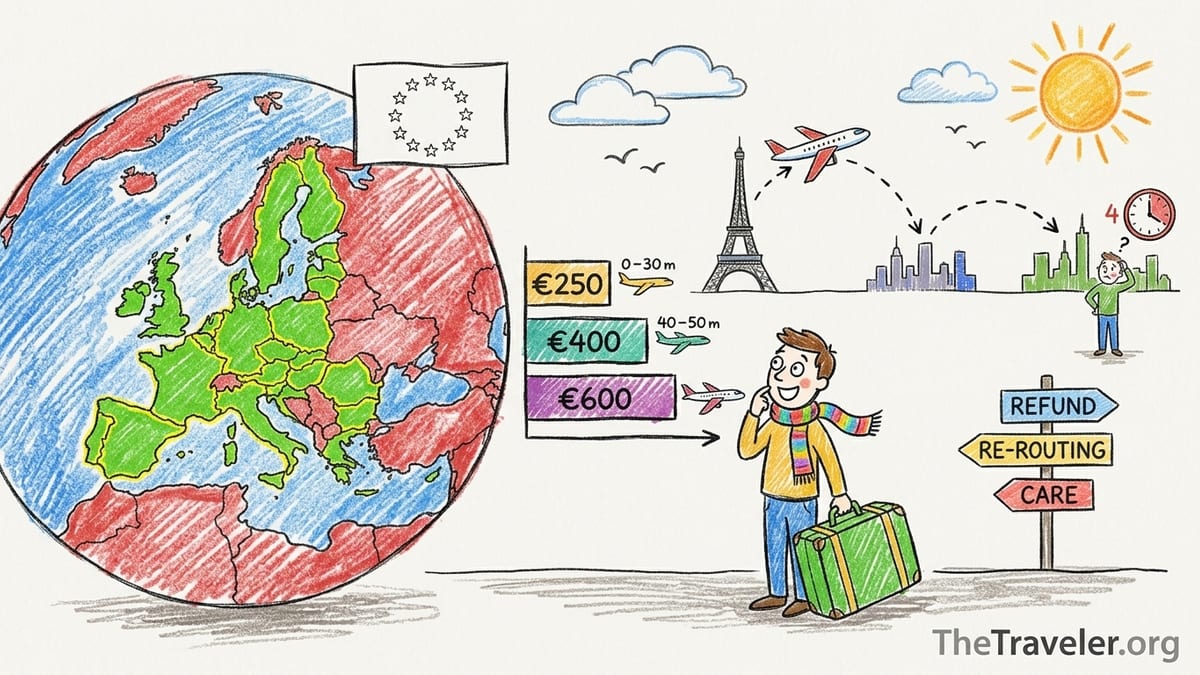
How much you can claim: 250, 400 or 600 euros
When the rules apply and the airline is responsible, EU261 sets fixed compensation amounts that depend on the “great-circle” distance between your departure and final destination. For shorter routes of up to 1,500 kilometres, such as London Gatwick to Barcelona or Paris Orly to Rome, the compensation is 250 euros if you reach your final destination at least three hours late.
For medium-haul flights between 1,500 and 3,500 kilometres, such as Munich to Athens at about 1,517 kilometres or Paris to Marrakech at around 2,100 kilometres, the compensation rises to 400 euros for delays of three hours or more. Within the EU, once a flight distance exceeds 1,500 kilometres, the 400 euro band applies even if the route is much longer, which covers examples like Copenhagen to the Canary Islands.
The highest level of compensation, 600 euros, applies to long-haul flights of more than 3,500 kilometres that either depart from the EU to a non-EU destination or arrive in the EU on an EU carrier. This covers many popular routes such as Frankfurt to New York, Madrid to Bogotá or Vienna to Tokyo. On these flights, if you arrive more than four hours late and the airline is at fault, a single delayed economy ticket can be worth 600 euros in compensation, regardless of whether you paid a budget sale fare or a flexible business class price.
There is also a reduction rule that airlines sometimes use in practice. If they re-route you and get you to your final destination not too far behind schedule, they may cut the compensation by 50 percent on the 250, 400 and 600 euro bands. For instance, if a passenger from Brussels to Lisbon is rebooked and ultimately arrives just under two hours late on what would normally be a 250 euro claim, the airline can lawfully reduce that to 125 euros. On a long-haul EU to non-EU route, arriving under four hours late after re-routing can reduce a 600 euro claim to 300 euros.
Delays, cancellations and missed connections: what triggers compensation
Compensation for delay is based on when you arrive at your final destination, not merely when you depart. A flight that leaves Paris Charles de Gaulle one hour late but makes up time and lands in Rome within 15 minutes of schedule will not trigger compensation. In contrast, a flight that departs on time from Amsterdam but is held in the air or diverted, leading to an arrival more than three hours late in Madrid, can qualify despite the on-time take-off.
For cancellations, compensation depends both on how much notice the airline gave and the replacement travel offered. If a flight from Berlin to Lisbon is cancelled two days before departure and the airline offers a re-routing that delivers you more than two hours later than originally scheduled, cash compensation can be owed in addition to a refund or alternative flight. If the same cancellation occurs 14 days or more in advance and a similar schedule is offered, cash compensation may not be due, although you still have the right to a refund if you choose not to travel.
Missed connections are one of the most common real-world triggers for EU261 compensation, particularly on hub routes via Frankfurt, Amsterdam or Paris. Suppose a passenger flies Stockholm to Frankfurt to Los Angeles on Lufthansa under one ticket. If a technical problem on the Stockholm to Frankfurt leg causes a late arrival that makes it impossible to board the transatlantic flight, and the passenger reaches Los Angeles more than four hours late, compensation is calculated on the full distance from Stockholm to Los Angeles, not just the first leg. That can push the claim into the 600 euro band even though the delay occurred on a short European sector.
Denied boarding due to overbooking is covered in a similar way. If you arrive at the gate on time for a London Heathrow to Madrid flight on British Airways but are involuntarily bumped because the airline sold more seats than are available, you can usually claim 250 euros plus a choice of refund or re-routing, along with care such as meals and hotel if needed. Voluntarily giving up your seat in exchange for a voucher typically waives these rights, which is why frequent travellers scrutinise any paperwork before accepting an airline’s offer.
Extraordinary circumstances: when airlines do not owe compensation
EU261 allows airlines to avoid paying cash compensation if they can prove that a delay or cancellation was caused by what the regulation calls “extraordinary circumstances.” These are events that are truly outside the airline’s control, such as air traffic control strikes, airport closures due to security incidents, volcanic ash clouds or severe storms that make flying unsafe across a region. For example, when a powerful winter storm shuts down much of northern Europe and Copenhagen Airport temporarily suspends operations, even large delays or cancellations on flights to and from the airport are unlikely to generate EU261 cash compensation.
The boundary between extraordinary and non-extraordinary events is often contested, and European court decisions have gradually clarified it. Technical problems found during routine maintenance are now considered part of an airline’s normal operations. Cases involving carriers such as TAP Portugal and Jet2 in national and European courts have specifically held that unexpected component failures or ordinary wear and tear are not extraordinary, meaning airlines usually owe compensation when they ground an aircraft for these reasons and cause long delays.
Strikes are another heavily litigated area. A strike by airport security staff or air traffic controllers that hits every airline at a given airport is generally treated as an extraordinary circumstance, shielding carriers from compensation claims. However, court rulings have found that many strikes by an airline’s own employees, such as pilots or cabin crew striking over pay or working conditions, are not automatically extraordinary because they are within the airline’s sphere of control. When an airline like SAS or Eurowings experiences an internal staff strike that was reasonably foreseeable and leads to mass cancellations, passengers have successfully claimed EU261 compensation in several well publicised cases.
Other borderline examples include bird strikes, fuel contamination, lightning strikes and sudden runway closures. European case law has found that a bird strike during landing, or fuel spilled on a runway by another aircraft that forces a temporary closure, can count as extraordinary circumstances for the specific flight directly affected. However, long knock-on delays later the same day may not be protected if the airline failed to take reasonable measures to reduce the impact, such as bringing in another aircraft or crew. This is why experienced travellers often ask airlines to specify exactly which “extraordinary circumstance” is being claimed and on which flight it occurred.
What airlines must provide during the disruption
Separate from cash compensation, EU261 requires airlines to provide care when flights are heavily delayed or cancelled, regardless of the cause. Once your delay passes certain thresholds based on distance, you are entitled to meals and refreshments in reasonable relation to the waiting time, hotel accommodation if an overnight stay becomes necessary, and transport between the airport and the hotel. For example, on a late evening delay of more than three hours from Dublin to Madrid, Ryanair should provide drink and meal vouchers and, if the flight slips to the following morning, a hotel near Dublin Airport plus shuttle or taxi costs.
In practice, airlines often issue food vouchers that can be used at airport restaurants like Burger King or Pret A Manger, or they may ask passengers to keep receipts and submit them later. During severe disruptions, especially at busy hubs such as Heathrow or Amsterdam Schiphol, passengers sometimes find hotel rooms sold out near the airport. In such cases, buying a room further away and claiming the cost later is still possible, though regulators and consumer groups advise keeping choices reasonable and avoiding luxury options far above normal airport hotel rates.
When a flight is cancelled or badly delayed, the airline must also offer you a choice between a refund of the unused ticket and re-routing at the earliest opportunity or at a later date convenient to you, subject to seat availability. A traveller on a cancelled Barcelona to Zurich flight, for instance, can choose a full refund and book a new trip on another airline, or accept a re-routing via Geneva or Munich. Accepting re-routing on a different date that suits you does not strip you of the right to cash compensation if the original cancellation met the criteria and was not caused by extraordinary circumstances.
Importantly, the duty of care applies even when the underlying cause is extraordinary, such as a major snowstorm or airport closure. You might not receive the 250, 400 or 600 euro cash payment, but the airline still has to look after you with meals, accommodation and rebooking options. Travellers caught in large-scale disruptions, such as the volcanic ash events that periodically affect flights over the North Atlantic and Europe, have successfully reclaimed several nights of hotel stays and meals from airlines even where cash compensation was denied.
Real-world claim examples passengers have reported
In recent years many passengers have successfully claimed EU261 compensation from both European and non-European airlines operating flights from the EU. One widely shared example involved a traveller on an American Airlines flight from Barcelona to Philadelphia that left more than 12 hours late due to a technical issue with the aircraft. Because the flight departed from the EU and the delay was not caused by extraordinary circumstances, the passenger filed an EU261 claim directly with American Airlines and reported receiving the full 600 euros within a couple of weeks.
Another frequently discussed scenario concerns transatlantic flights on Delta or United that originate in European cities such as Paris or Amsterdam. Travellers have described using the airlines’ online complaint forms to file EU261 claims after arrival delays of four hours or more. In one case, a passenger on a Paris to United States route reported that after submitting documentation of a cancellation and citing EU261, Delta approved compensation equivalent to several hundred euros, separate from any travel vouchers originally offered as goodwill.
Not all experiences are smooth. Claimants regularly report resistance from certain carriers, particularly low cost airlines and some non-EU operators, who may initially blame “weather” or unspecified “operational reasons” without detailed proof. For instance, Ryanair passengers delayed more than seven hours on a Dublin to mainland Europe flight have described receiving template refusals that cited bird strikes or adverse weather even when the local conditions appeared normal. In such cases, passengers often escalate to national enforcement bodies, alternative dispute resolution schemes or small claims courts, and some ultimately succeed once independent authorities review the flight data and weather reports.
The variety of real outcomes underlines an important practical lesson. Two passengers on similar delays can have very different experiences depending on how clearly they present their claim, whether they keep boarding passes and screenshots, and how willing they are to escalate beyond the airline’s first response. Consumer organisations in countries such as the United Kingdom, Germany and the Netherlands encourage travellers to be persistent and to treat the airline’s initial rejection as only one step in a longer process.
Step by step: how to file a strong EU261 claim
The most effective claims start while you are still at the airport. As soon as a major delay or cancellation occurs, note the scheduled and actual departure and arrival times, keep your boarding pass and booking confirmation, and take photos of the departure board showing the disruption. If airport staff make announcements about the cause, such as “technical problems with the aircraft” or “crew shortage,” write down the wording and the time. These details can become crucial months later if the airline tries to reclassify the reason as bad weather or air traffic control.
Once you are home or at your destination, submit a written claim directly to the operating airline, not just the company that sold the ticket. Most major carriers, including Lufthansa, Air France, KLM and British Airways, have online forms specifically for EU261 or “flight disruption” claims. Your message should clearly state that you are seeking compensation under Regulation EC 261/2004, list your flight number, booking reference, dates, route, and the exact arrival delay at your final destination. Many successful claimants also quote the compensation band they believe applies, for example 400 euros for a Berlin to Lisbon delay of more than three hours.
Attach supporting documents such as boarding passes, e-tickets, hotel invoices from forced overnights and receipts for meals when the airline did not provide vouchers. Keeping your tone factual but firm tends to work better than emotional language. Travellers who mention that they are prepared to escalate to a national enforcement body or alternative dispute resolution scheme if necessary often report quicker responses. For example, UK-based passengers dealing with a refusal from a carrier like easyJet may reference the Civil Aviation Authority and its approved arbitration services as their next step.
If the airline denies your claim or does not respond within a reasonable period, usually around six to eight weeks, you can escalate. Each EU country has a designated enforcement body that handles EU261 complaints, and many accept cases from foreign passengers online. In addition, several European countries allow consumers to use a European Small Claims procedure, which can be particularly effective for straightforward cases below a few thousand euros. Some travellers also use specialist claims companies or aviation lawyers who work on a contingency fee, though these services typically keep a percentage of any compensation won.
Common pitfalls and how to avoid losing your rights
A frequent mistake is accepting vouchers or partial refunds that inadvertently waive EU261 rights. For instance, at a check-in desk in Rome after a long delay, an airline may offer a 100 euro travel voucher in exchange for signing a form. Buried in that form could be language stating that the voucher settles all claims. Once you sign, it may be difficult to pursue the additional 250 or 400 euros you might otherwise have been owed. Experienced travellers insist on cash or bank transfer payments for EU261 compensation and avoid signing waivers unless they are sure of what they are giving up.
Another pitfall is assuming that codeshare arrangements change who is responsible. If you bought a ticket through Air France but the delayed flight from Paris to London was operated by its partner airline CityJet, it is CityJet, as the operating carrier, that bears the EU261 obligations. Submitting a claim to the marketing airline can waste weeks before you are redirected. Always verify which airline name and flight number appeared on airport screens and on the aircraft itself, and direct your claim there first.
Timing also matters. While EU261 itself does not set a strict deadline to file a claim, national limitation periods do. In some countries passengers can bring claims up to several years after the flight, while others have shorter windows. Waiting too long risks running into these domestic time limits, especially if you only escalate to a court after lengthy back-and-forth with the airline. Many consumer advocates suggest aiming to file a formal complaint within days or weeks of travel while details are still fresh and then escalating if there is no substantive response within a month or two.
Finally, passengers sometimes give up when an airline cites extraordinary circumstances. The law requires carriers to prove that such circumstances existed and that they took all reasonable measures to avoid the disruption. Simply stating “weather” is not enough if weather data for the airport and time in question shows only minor issues. By gathering screenshots from flight tracking services, saving photos of clear skies when the airline claims storms, or comparing how other airlines operated from the same airport at the same time, determined travellers have overturned initial rejections and secured compensation that was wrongly denied.
Conclusion: turning knowledge into real compensation
European flight delay compensation rules can seem complex, with distance bands, extraordinary circumstances and evolving court decisions. Yet at their core, EU261 and its UK equivalent transform many long delays and cancellations into clear entitlements: up to 600 euros in cash, plus meals, hotels and re-routing when things go badly wrong. These rights apply equally to budget and full-service airlines, and to tourists, business travellers and backpackers alike.
Real-world experience shows that passengers who understand the basic thresholds, document what happens at the airport and pursue their claims methodically are far more likely to be paid. Whether you are stranded overnight in Lisbon due to a technical fault, miss a connection in Frankfurt because of a late inbound aircraft, or are bumped from an overbooked flight at Amsterdam Schiphol, knowing when EU261 applies gives you more than just a moral argument. It gives you a legal right that airlines, regulators and courts across Europe increasingly expect to see respected.
Before your next trip, it is worth checking which of your flights depart from European airports or use EU-based airlines, and keeping a simple checklist of distances and delay thresholds in your travel wallet or phone. If disruption strikes, stay calm, look after your immediate needs, and then set aside time to submit a clear, well documented claim. With persistence and a solid understanding of EU261, a ruined travel day can at least end with fair financial compensation for the time you lost.