


More news on this day
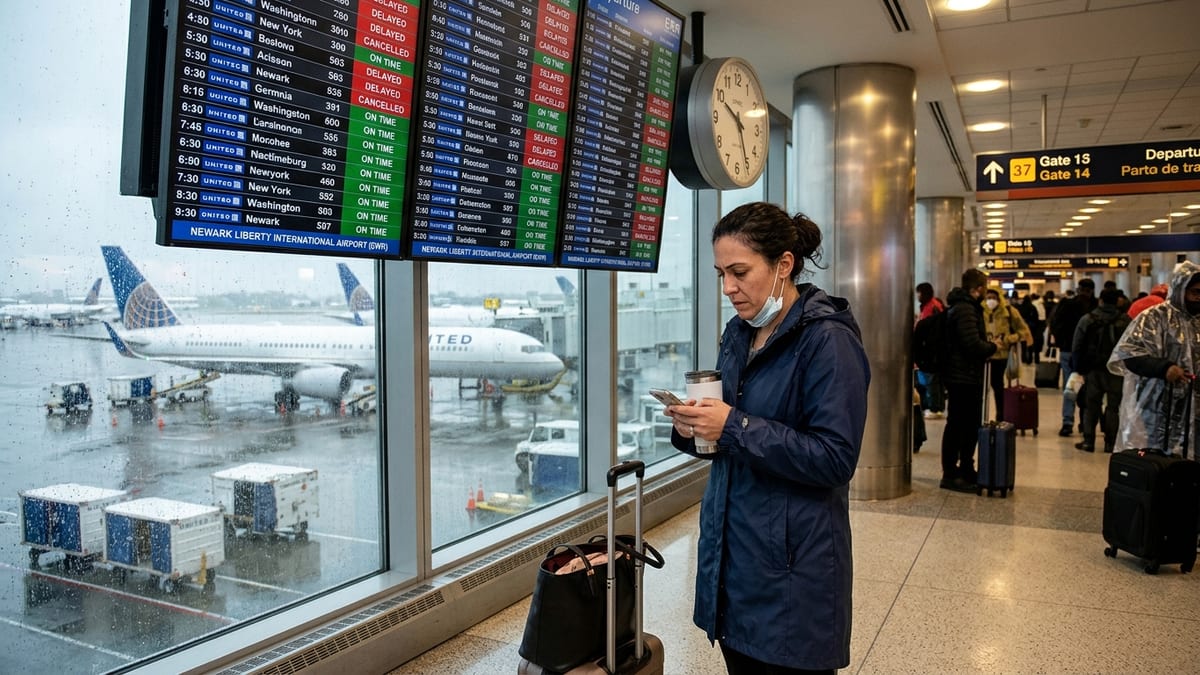
A strong Thanksgiving nor’easter is sweeping across the New York tri-state region, bringing heavy rain, high winds and coastal flooding on November 26 and 27, 2026, conditions that are already straining parts of the U.S. air network and could cause delays and cancellations for travelers using Newark Liberty, John F. Kennedy and LaGuardia airports through the holiday weekend.
Get the latest news straight to your inbox!
Storm forecast: what travelers can expect in the tri-state area
A deep coastal low tracking up the Eastern Seaboard is driving the nor’easter affecting the New York metro area over Thanksgiving. Forecasts from the National Weather Service call for periods of heavy rain, wind gusts that can exceed 40 to 50 miles per hour along the coast, and pockets of coastal flooding from New Jersey through Long Island through at least the early hours of Friday, November 27. The strongest conditions are expected along exposed shorelines, but inland areas, including the New York City boroughs, are also seeing hazardous crosswinds and reduced visibility at times.
Weather briefings for the region ahead of the holiday highlighted a window of intense conditions centered on Thanksgiving afternoon and evening, with rainfall rates locally approaching 1 to 2 inches per hour and wind gusts strong enough to down tree limbs and power lines. That combination has already produced scattered power outages in parts of the Mid-Atlantic and Northeast and prompted coastal flood advisories and warnings for vulnerable bays, inlets and low-lying neighborhoods near the ocean and tidal rivers. For travelers, the same wind and rain bands that complicate driving on major routes like I‑95 can also prompt air-traffic flow restrictions, particularly when they coincide with peak departure and arrival banks at the region’s airports.
Although the most intense phase of the storm is expected to shift north and weaken heading into Friday, residual impacts can linger for several hours after the heaviest rain ends. Wet runways, lingering crosswinds and airspace congestion from earlier ground delays can all keep flight operations constrained into the overnight and early Friday morning period, even as the weather slowly improves. Holiday travelers should therefore treat Thursday’s forecast as a potential multi-day disruption window rather than a brief, contained episode.
Current flight disruption picture at Newark, JFK and LaGuardia
By late Thanksgiving Day, national tracking data showed that U.S. airlines were already dealing with elevated levels of disruption tied to the wider storm system, with thousands of delays and hundreds of cancellations across the country as heavy rain and strong winds affected multiple regions. Much of that impact has been concentrated along the Eastern Seaboard and in a handful of major hubs, which increases the likelihood of knock-on effects for New York-area travelers even when local airport conditions are technically reported as open.
At the New York City airports themselves, the Federal Aviation Administration’s real-time status feed on Thursday evening did not show a formal ground stop or airport-wide ground delay program in effect for John F. Kennedy International or LaGuardia. That means the FAA was not, at that moment, holding all inbound traffic on the ground elsewhere or metering every arrival. However, the lack of a systemwide program does not guarantee a smooth experience on the terminal level. Individual flights can still be delayed or diverted as airlines and controllers work around bursts of heavy rain, crosswinds, low ceilings or congestion created earlier in the day.
Newark Liberty, a major hub for transatlantic and domestic connections, has already seen substantial delays during the Thanksgiving travel period this week, including departure queues that stretched well beyond an hour during earlier pre-holiday storms. Although conditions can fluctuate from hour to hour depending on the precise timing of wind shifts or thunderstorms overhead, the pattern across the week has been consistent: when the New York area’s airspace slows down because of weather, sparse slack in airline schedules and high load factors mean the ripple effects are felt quickly across entire networks.
How the nor’easter interacts with a stressed holiday air system
The timing of the nor’easter is particularly challenging because it strikes at the height of the Thanksgiving rush, when airlines are operating near peak capacity and recent technology outages have already reduced the margin for error. In the week before the storm, major U.S. carriers including United and Delta experienced separate system issues that led to hundreds of delays and forced short-term ground stops at key hubs. Even after those glitches were resolved, many schedules were left tightly wound, with little space to absorb a fresh wave of weather-related disruptions.
Strong winds and heavy rain from a coastal storm can affect flight operations in several ways. At lower altitudes near airports, crosswinds on final approach or departure may compel controllers to change active runways, which can temporarily cut arrival or departure rates. Prolonged tailwinds or low ceilings can also reduce the number of aircraft that can safely move through the busy New York airspace in a given hour. On the ground, wet ramps and lightning in the vicinity may slow down refueling, baggage loading and aircraft pushbacks, extending turnaround times even for flights that arrive roughly on schedule.
Those operational constraints interact with the slot-controlled and schedule-managed nature of the New York airports. For seasons through at least winter 2026/27, federal operating limits continue to cap scheduled movements at LaGuardia and, by order, at JFK, while Newark remains subject to schedule management to prevent chronic congestion. These measures are designed to keep average on-time performance from deteriorating further, but they also mean that there is little ability to “catch up” by pushing significantly more flights through the system in the hours immediately after a storm passes. Instead, airlines may be forced to consolidate lightly booked flights, delay some services into off-peak windows, or cancel individual rotations to re-position crews and aircraft.
Airline responses: waivers, rebooking and what travelers should verify
In advance of the Thanksgiving nor’easter, several large carriers issued weather waivers for East Coast travel, allowing customers booked through affected airports, including the New York metro, to rebook within a defined window without change fees and with fare differences waived under certain conditions. These waivers typically cover travel dates spanning the core of the storm, such as November 26 and 27, and require rebooked trips to take place by a specific cutoff, often by the end of the holiday weekend. The exact rules vary by airline and by ticket type, so passengers need to check the latest advisory on their carrier’s website or app before making changes.
For travelers who decide to keep their original plans, the most critical step is to monitor flight status directly with the airline, rather than relying only on generalized airport dashboards or news reports. Airline systems will show whether a particular flight has been delayed because of weather en route, congestion at another hub, a late-arriving aircraft or crew availability, each of which can imply a different risk of eventual cancellation. Especially during a fast-evolving storm, departure time estimates can be adjusted multiple times on the day of travel as new air-traffic directives are issued or conditions improve faster or slower than expected.
Passengers whose flights are significantly delayed or canceled for reasons within the airline’s control, such as mechanical issues or crew scheduling problems, may be entitled to meal vouchers, hotel accommodation or cash refunds under U.S. Department of Transportation rules and each carrier’s own customer service commitments. Weather disruptions are treated differently: airlines are typically required to refund passengers only if they cancel the flight entirely or make a significant schedule change, not for shorter, weather-driven delays. Given this distinction, it is important for travelers to clarify whether a disruption is being logged primarily as “weather” or “airline-controlled” if they plan to seek compensation or alternative arrangements.
Practical steps for travelers through the weekend
Holiday travelers moving through Newark, JFK or LaGuardia over Thanksgiving and the following weekend should plan with the expectation of periodic disruption, even if official FAA status pages show no broad ground stop at a given moment. Building extra time into connections, allowing for slower ground transportation in heavy rain and coastal flooding zones, and preparing contingencies for an overnight stay can mitigate stress if conditions deteriorate quickly. Those flying out early on Friday may still encounter residual delays from aircraft and crews that ended Thursday out of position because of the storm.
Before heading to the airport, passengers should refresh both weather forecasts and flight status, paying particular attention to any overnight forecast updates that tighten or extend wind or flood advisories for the New York region. If the storm’s heaviest band passes through earlier or later than expected, airlines and the FAA may adjust traffic management initiatives accordingly, which can suddenly ease or worsen congestion around key departure banks. Checking in online, confirming seats and adding contact details to a booking can help ensure that text or app alerts arrive promptly if an airline preemptively retimes or cancels a flight.
Looking ahead to the remainder of the weekend, early guidance from forecasters suggests that conditions across the tri-state area should gradually improve after Friday as the coastal low pulls away and high pressure builds in. That should allow airports to operate closer to their planned schedules, though some routes may continue to show scattered cancellations or swapped aircraft types as carriers rebalance their fleets. Travelers with flexibility may find that shifting to Saturday or Sunday departures reduces exposure to the storm’s most acute impacts, but only if their airline’s waiver terms and personal plans allow it. In all cases, the most reliable information will come from a combination of up-to-date official forecasts, real-time flight-status tools and direct communications from airlines and airports.