


For most visitors landing at Vancouver International Airport, the Canada Line SkyTrain is the fastest and cheapest way into downtown. The trip from YVR–Airport Station to Waterfront or Vancouver City Centre is usually under half an hour, but understanding tickets, zones, and the special airport add-fare can be confusing, especially if you are jet-lagged and juggling luggage. This guide walks you step by step through how the Canada Line works from Vancouver International Airport, what you should expect to pay, how long the journey takes, and the common mistakes to avoid so you can start your visit on the right track.
Get the latest updates straight to your inbox!
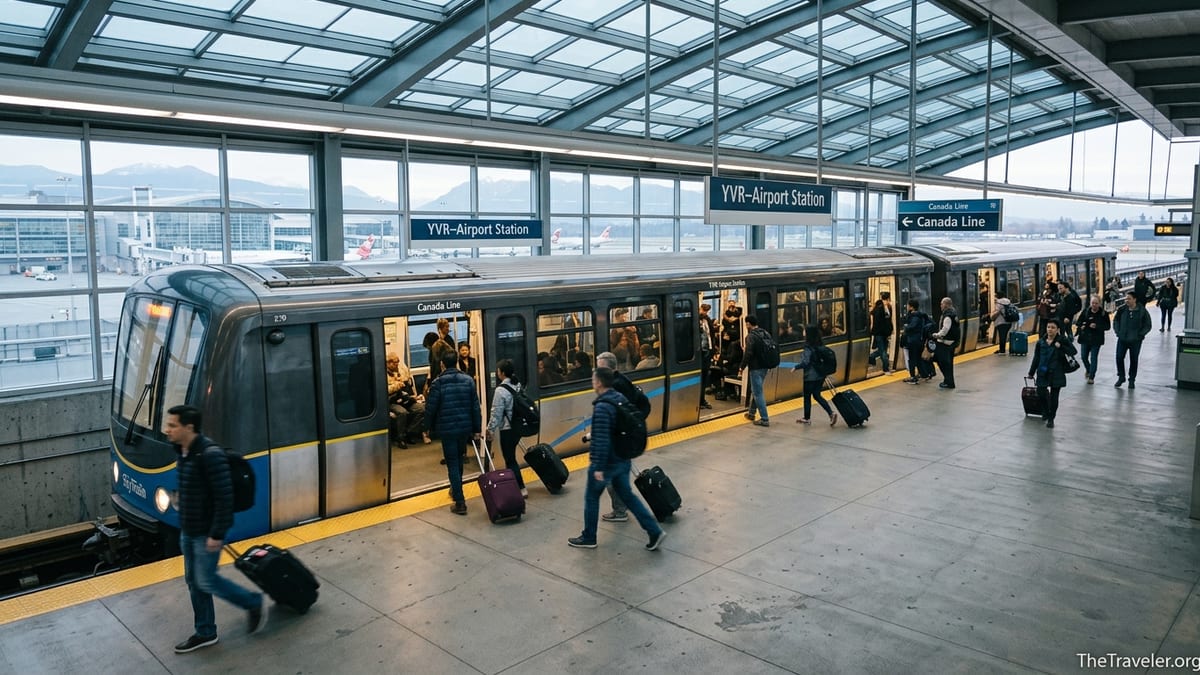
Understanding the Canada Line from Vancouver International Airport
The Canada Line is one of Metro Vancouver’s SkyTrain routes, running driverless trains between downtown Vancouver, central Richmond, and Vancouver International Airport. YVR–Airport Station sits on an elevated spur line on Sea Island, just a short covered walk from both the domestic and international terminals. Trains typically run every 6 to 10 minutes throughout most of the day, with more frequent service during rush hours, and reduced but still regular service early in the morning and late at night.
From YVR–Airport Station, every train heads east to downtown, stopping first at Sea Island Centre and Templeton before joining the main Canada Line at Bridgeport Station. From there, trains branch: some continue south to Richmond–Brighouse, while others head north through Vancouver City Centre and end at Waterfront Station. If your goal is downtown Vancouver, you do not have to worry about choosing the right branch at the airport. Every train from YVR is marked “Waterfront” and runs directly into downtown, passing through Vancouver City Centre on the way.
For context, Waterfront Station is at the north end of downtown, just steps from Canada Place cruise terminal and the office towers along Burrard Inlet. Vancouver City Centre Station is roughly in the middle of downtown, close to many hotels on Granville and Burrard Streets, and a short walk to Robson Square and the main shopping district. Many visitors headed to popular hotels like the Fairmont Hotel Vancouver, Hyatt Regency Vancouver, or the boutique properties around Robson Street choose to get off at Vancouver City Centre and walk or transfer to a short bus ride or taxi from there.
In normal conditions, the total travel time from YVR–Airport to Vancouver City Centre is about 24 minutes, and to Waterfront around 26 minutes. Even if you arrive during peak periods such as summer cruise season or the 2026 FIFA World Cup events, the SkyTrain journey time itself changes very little. The main variables are how quickly you can reach the station from your gate, purchase a ticket, and board with your luggage.
Ticket Types, Compass Cards, and How Zone Fares Work
TransLink, the regional transit authority, uses a zone-based fare system on SkyTrain and SeaBus. The region is divided into three zones. YVR–Airport, Sea Island Centre, and Templeton stations are in Zone 2. Downtown stations such as Vancouver City Centre and Waterfront sit in Zone 1. The price you pay normally depends on how many zones you travel through, with higher fares for two or three zones during weekday daytime hours and one-zone pricing for evenings and weekends.
Most visitors will encounter three main ways to pay: single-use Compass tickets from vending machines, stored value on a reusable Compass Card, or contactless payment with a tapped credit card or digital wallet. Compass ticket machines are easy to find at the entrance to YVR–Airport Station. They accept Canadian coins and bills as well as major credit and debit cards. Many travelers landing with only a credit card simply buy a one-way ticket or day pass directly from these machines before entering the fare gates.
Zone rules are slightly less important than they first appear because many journeys are automatically treated as one zone. On weekdays before approximately 6:30 p.m., a trip from YVR–Airport in Zone 2 to Vancouver City Centre or Waterfront in Zone 1 counts as a two-zone fare. In the evenings and on weekends, TransLink charges only a one-zone fare regardless of how many zones you cross, which often makes airport trips cheaper for late-night or Sunday arrivals. Still, the most important factor for airport travelers is not the number of zones but the extra airport add-fare, which sits on top of your regular ticket price.
One common example helps illustrate costs. A visitor arriving on a Tuesday at 2 p.m. buys a single-use adult ticket from YVR–Airport to Waterfront. They pay the standard two-zone cash fare plus the airport add-fare, bringing the total to roughly the high single digits in Canadian dollars, slightly more after the July 2026 fare increase. A second visitor arriving at 8:30 p.m. on a Saturday and tapping a contactless credit card pays a lower one-zone fare plus the same airport add-fare. In both cases, the base zone fare and the add-fare are combined into a single charge, so the passengers just see one total on the machine or on their card statement.
The YVR Airport Add-Fare Explained
The biggest point of confusion for new arrivals is the YVR Airport AddFare, a special charge on top of regular transit fares for trips that begin at YVR–Airport, Sea Island Centre, or Templeton stations and continue east to Bridgeport Station or beyond. As of mid-2026, this extra fee is set at approximately 6.50 Canadian dollars for eastbound journeys, after a planned increase approved in TransLink’s recent investment plans. In practice, that means your first ride into Vancouver from the airport will cost noticeably more than subsequent SkyTrain trips made from non-airport stations.
Several groups are exempt from paying the airport add-fare. Travelers using unlimited-use passes, such as monthly passes loaded on a Compass Card, do not pay the add-fare, nor do people using DayPasses that were purchased somewhere other than a Sea Island station. For example, a local resident who buys a DayPass in downtown Vancouver before riding to the airport can use that pass to return the same day without paying the additional airport fee. Conversely, a visitor who buys a DayPass directly from a ticket machine at YVR–Airport on arrival will have the add-fare applied on that first tap through the fare gates.
This distinction can lead to real-world surprises. Imagine a family of four planning heavy sightseeing on their first day in Vancouver. They intend to ride from the airport to their downtown hotel, then use transit all day. If they buy separate single-use tickets from the airport and then later buy DayPasses downtown, they pay the airport add-fare once plus the cost of a full day of separate travel. If they had purchased their DayPasses in advance from a retailer in the city or loaded a pass onto a Compass Card before arriving at YVR, the same airport trip would not trigger the add-fare, potentially saving the group the equivalent of a nice lunch.
The airport add-fare has generated controversy locally, partly because many travelers assume it is an airport tax, when in fact the revenue goes to TransLink to help pay for the Canada Line spur to YVR. Regardless of the local politics, for visitors the practical takeaway is straightforward: expect to pay an extra fixed amount when your first tap-in is at YVR–Airport Station and your destination is beyond Bridgeport, unless you are traveling on a pre-existing unlimited pass or eligible exemption. Plan for this in your budget and avoid building complex ticket strategies right after a long-haul flight.
Key Stations: YVR–Airport, Vancouver City Centre, and Waterfront
YVR–Airport Station sits between the domestic and international terminals, reached via level walkways and escalators. Inside the station concourse you will find Compass ticket machines, information boards, and clearly marked fare gates. Because the station is compact, you can usually walk from the international arrivals hall to the SkyTrain platform within about 5 to 10 minutes, even with bags. Elevators serve every level, which is helpful if you are traveling with large suitcases or mobility devices.
On the downtown end, Waterfront Station is a grand historic terminal facing the harbour. Its Canada Line platforms sit beneath Granville Street, linked by concourses and passageways to the main building. For cruise passengers heading to or from Canada Place, Waterfront is the nearest SkyTrain stop. The walk from the Canada Line exit to the cruise terminal is typically 5 to 10 minutes with wheeled luggage, and you remain mostly indoors or under cover, important during Vancouver’s frequent rain. Waterfront is also the interchange point for the SeaBus to North Vancouver and other SkyTrain lines, though changing routes requires leaving one fare-paid area and entering another.
Vancouver City Centre Station, a couple of minutes south of Waterfront by train, is tucked under Granville Street near the major intersection with Georgia Street. Many visitors find this station the most convenient for central hotels, shopping, and conferences. For example, the Vancouver Convention Centre West is about a 10 to 15 minute walk downhill from Vancouver City Centre. Hotels like the Fairmont Hotel Vancouver, Four Seasons (when operating), and numerous mid-range chains on Robson Street and Burrard Street sit within a short walk, making it easy to roll a cabin-sized suitcase along the sidewalks directly from the station.
Outside the downtown core, Bridgeport Station is another key point for airport travelers. It is the first station east of Sea Island where the airport branch joins the main line. If you are continuing beyond downtown or transferring to suburban buses, you may find yourself changing vehicles here. Bridgeport also serves the Richmond Night Market area during its operating season, so visitors staying near the airport sometimes ride from YVR–Airport to Bridgeport and back. Because the airport add-fare applies to trips starting on Sea Island and going at least as far as Bridgeport, you pay the add-fare even if your first evening in Vancouver is just a quick hop to enjoy the night market and return.
Luggage, Accessibility, and Onboard Etiquette
Many travelers are understandably anxious about taking a commuter train with full suitcases right after a long flight. The Canada Line trains are designed with generous standing areas and spaces near doors where travelers often stand with their luggage. There are no dedicated luggage racks like on some airport express trains, but most visitors simply keep their suitcases upright by their legs. In practice, cabin-sized roller bags and one larger suitcase per person are manageable, especially outside weekday rush hours.
If you are traveling with particularly heavy or numerous bags, consider using the elevators rather than escalators at YVR–Airport Station and downtown stops. Elevators at YVR–Airport are well signposted, and airport staff or volunteers in green or blue vests are generally happy to point you in the right direction. The airport also offers porter services in arrivals and departures areas if you prefer someone else to handle your bags inside the terminal. Porters can move luggage from baggage carousels to the curbside area or check-in counters, and while their remit does not extend onto the SkyTrain platforms, they can make the airport portion of the journey smoother, especially for seniors or travelers with limited mobility.
On board, standard local etiquette applies. Priority seats near the doors are reserved for seniors, people with disabilities, and pregnant passengers. Standing with your bag in front of you rather than blocking the aisle makes it easier for others to pass. If you board at YVR with a large airport trolley, be aware that carts are not meant to be taken onto trains or escalators. Some travelers have been seen pushing airport carts all the way to downtown stations and abandoning them there, but this is not recommended and can cause inconvenience to others. Instead, transfer your bags to personal luggage before entering the station and leave the trolley in the designated return areas at the entrances.
Accessibility from the Canada Line into the airport is a strong point. Level or near-level boarding, tactile strips, elevators, and step-free routes mean wheelchair users can travel directly between gate areas and the station with minimal assistance. For travelers who need more support, YVR offers curbside assistance that can be arranged in advance, connecting the Canada Line station to the check-in desks and security areas. If you are flying very early in the morning, check your airline’s suggested arrival time and factor in 25 to 30 minutes from downtown by SkyTrain, plus extra buffer for elevator waits and crowds at security.
Timing Your Journey: Travel Time and Operating Hours
Under normal conditions, the Canada Line journey from YVR–Airport to downtown Vancouver is consistent and predictable. The scheduled travel time from the airport to Vancouver City Centre is about 24 minutes, and from the airport to Waterfront about 26 minutes. Trains run roughly every 6 to 10 minutes during the day, with slightly longer intervals in the early morning and late evening. The service typically starts around 5 a.m. and runs until past midnight, although exact first and last train times can vary slightly by day and season.
When planning your trip to or from the airport, it is wise to work backward from your flight time or hotel check-in. For international departures, airlines commonly ask passengers to arrive at YVR about three hours before flight time. If your hotel is near Waterfront or Vancouver City Centre, leaving your room approximately three and a half to four hours before departure often feels comfortable: half an hour for the train, time to navigate the station and check-in, and a buffer for security queues. For domestic flights within Canada, a two-hour airport arrival is usually sufficient, so leaving downtown about two and a half hours before departure is often adequate for experienced travelers.
During special events like major concerts, sports finals, or peak cruise-ship days, trains can become crowded with locals and visitors alike, particularly between mid-morning and late afternoon. While travel time stays about the same, you may need to wait one or two extra trains to find space for larger suitcases. In those situations, standing closer to the ends of the platform where cars are often less busy can help. Alternatively, if you are traveling in a group with heavy luggage during a rush period, it may be worth comparing the Canada Line cost with a taxi or rideshare, especially for short distances from the airport to hotels in Richmond or South Vancouver where the time savings by car can be modest but the extra comfort significant.
Late-night arrivals present a different consideration. If you land after 11 p.m., the SkyTrain will likely still be running, but connecting bus services at the downtown end may be less frequent. A traveler arriving from Asia in the late evening and staying in a neighbourhood like Kitsilano or Commercial Drive might choose to ride the Canada Line into downtown and then finish the journey by taxi rather than wait for infrequent buses. Because the fare system charges you only for the transit portion, there is no penalty for combining SkyTrain with a short taxi hop to your final destination.
Common Tourist Mistakes and How to Avoid Them
One of the most frequent mistakes visitors make is forgetting to tap out at the end of their trip. The Canada Line uses a tap-in, tap-out system to calculate distance and zone charges. If you tap your Compass Card or credit card when entering YVR–Airport Station but forget to tap out at your destination, the system may charge you the maximum fare by default. For example, a traveler arriving jet-lagged at Waterfront might walk straight off the platform toward Canada Place, only to discover later that their card statement shows a higher-than-expected amount because the system recorded an incomplete journey.
Another common misstep involves misunderstanding when the airport add-fare applies. Many travelers assume the extra fee is charged both ways, but in practice it is only applied to trips that start at YVR–Airport, Sea Island Centre, or Templeton and continue at least as far as Bridgeport. That means riding from downtown to the airport does not trigger the add-fare at all. Some visitors, misinformed by outdated online comments, go to elaborate lengths to avoid what they think is a charge in both directions, adding unnecessary transfers or even taking slower bus routes, when a simple direct ride into YVR from Waterfront or Vancouver City Centre would have been cheaper and more convenient.
Miscalculating whether a journey counts as one, two, or three zones is also surprisingly common. The basic principle is that weekdays before early evening use zone-based pricing, while evenings and weekends treat the entire system as a single zone. Travelers who land on a Sunday but still worry about two-zone fares from the airport are often pleasantly surprised at the ticket machine when they see the total price. Others, especially those connecting from buses in outer suburbs, forget that a transfer from a one-zone bus ride onto SkyTrain toward the airport may bump them into a higher zone fare, or they become confused when they see separate small charges on their card statement where an add-fare has been applied on top of an initial payment.
A final mistake is leaving too little time for the overall journey. While the train segment is quick, bottlenecks at airport customs, baggage claim, and security on your departure can erode any time saved by choosing rail over road. A cruise passenger disembarking at Canada Place at 9 a.m. with a noon international flight from YVR might think taking the Canada Line gives them plenty of room. In reality, walking from the ship to Waterfront Station, buying tickets, riding to the airport, checking bags, and clearing security can make that schedule uncomfortably tight, especially during peak summer weekends. Building in at least an extra half-hour over textbook estimates can turn a stressful transit sprint into a relaxed part of your journey.
The Takeaway
The Canada Line is one of the best airport rail links in North America: clean, frequent, fully accessible, and integrated seamlessly into Vancouver’s wider transit network. From YVR–Airport Station you can be in the heart of downtown at Vancouver City Centre or Waterfront in under half an hour for a fraction of the cost of a typical taxi or rideshare. The key is understanding a few local rules, especially the YVR Airport AddFare and how zone-based pricing works at different times of day.
By planning your ticket purchase in advance where possible, giving yourself enough time to navigate the terminal, and watching for straightforward details like tapping in and out correctly, you can avoid the most common visitor pitfalls. Whether you are heading to a cruise ship at Canada Place, a conference near Robson Square, or a hotel along Granville Street, the Canada Line offers a reliable and budget-friendly first glimpse of Vancouver, with the added bonus of sweeping views over the Fraser River as you leave the airport island behind.
FAQ
Q1. How much does it cost to ride the Canada Line from YVR to downtown?
The total cost varies slightly by time of day and payment method, but you should expect to pay a standard adult SkyTrain fare plus the YVR Airport AddFare, which together usually come to under 15 Canadian dollars for a one-way trip into downtown in 2026.
Q2. Do I have to pay the airport add-fare when traveling from downtown to YVR?
No. The YVR Airport AddFare only applies to trips that start at YVR–Airport, Sea Island Centre, or Templeton and travel at least as far as Bridgeport Station. Journeys from downtown to the airport are charged regular zone fares without the extra airport fee.
Q3. How long does the train ride from YVR–Airport to Waterfront Station take?
The journey from YVR–Airport to Waterfront Station takes roughly 26 minutes under normal conditions, while YVR–Airport to Vancouver City Centre takes about 24 minutes. Trains are frequent enough that you rarely wait more than 10 minutes to board.
Q4. Can I use a credit card or phone tap to pay for the Canada Line at YVR?
Yes. Contactless payment with a major credit card or a digital wallet on your phone or smartwatch is accepted at the fare gates. You tap in at YVR–Airport Station and tap out at your destination, and the system automatically charges the correct fare including any applicable add-fare.
Q5. Is the Canada Line safe late at night for solo travelers with luggage?
Safety is generally good, with well-lit stations, onboard cameras, and regular riders even late in the evening. As in any large city, you should keep your belongings close, avoid leaving bags unattended, and sit or stand near other passengers or close to the operator’s intercom panels if you want extra reassurance.
Q6. Are there elevators and escalators at YVR–Airport and downtown stations?
Yes. YVR–Airport, Vancouver City Centre, Waterfront, and other key stations along the Canada Line are equipped with elevators and escalators, providing step-free access from street or terminal level to the platforms. This makes the route suitable for wheelchairs, strollers, and travelers with heavy luggage.
Q7. Will my hotel in downtown Vancouver be within walking distance of a Canada Line station?
Many downtown hotels are within a 5 to 15 minute walk of either Vancouver City Centre or Waterfront Station. Properties along Granville, Burrard, and Robson Streets are typically closest. If your hotel is farther away, you can combine a short walk with a brief taxi ride from one of these stations.
Q8. What happens if I forget to tap out when I get off the train?
If you forget to tap out, the system may treat your trip as incomplete and charge the maximum fare for your card type. This can be higher than the amount you expected for a simple airport-to-downtown ride. It is always worth pausing at the fare gates to make sure you see a green light and hear the beep as you tap out.
Q9. Can I avoid the YVR Airport AddFare by buying a DayPass or Compass Card?
You cannot avoid the add-fare if you buy a DayPass or ticket from machines at the Sea Island stations themselves, but if you already hold an unlimited pass purchased elsewhere, such as a monthly pass or a DayPass loaded in advance, then the add-fare is generally not applied to your airport trip. Locals sometimes plan ahead by purchasing passes before heading to YVR for exactly this reason.
Q10. Is the Canada Line the cheapest way from YVR to downtown compared with taxis or rideshares?
For most solo travelers and couples, the Canada Line is usually the cheapest option, often costing less than half of what a typical taxi or rideshare ride into central downtown would be. For groups of three or more with significant luggage, a taxi or rideshare can be competitive in price and may offer additional comfort door to door, but it will almost always be more expensive than the train on a per-person basis.