


Velana International Airport in Malé is the gateway to almost every Maldivian resort, and the opening of its new international Terminal 1 has changed how passengers move through the airport. With the former international building now rebranded as domestic Terminal 2 and a separate seaplane terminal handling the world’s largest seaplane fleet, it is easy to worry about turning up at the wrong place. This guide explains, in practical detail, which terminal you need, how to navigate between them, and what to do if things do not go to plan.
Get the latest updates straight to your inbox!
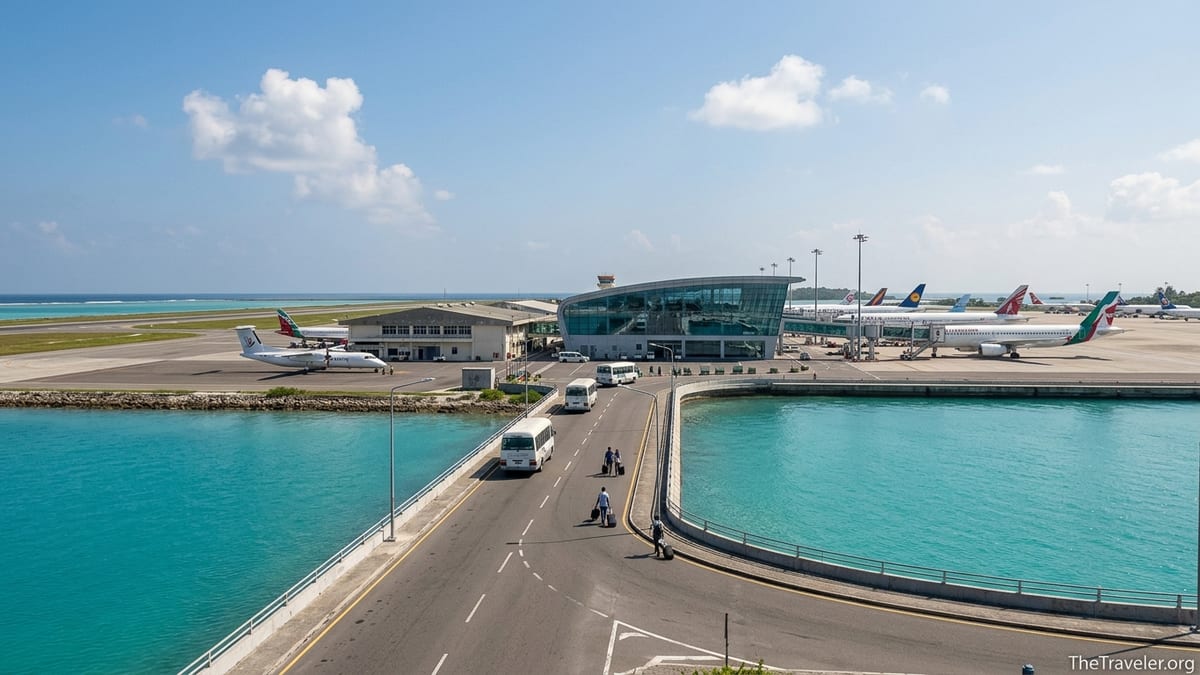
Terminal 1 vs Terminal 2 in 2026: The Big Picture
As of mid‑2026, all regular scheduled international passenger flights at Velana International Airport use the new Terminal 1. This modern facility, opened in phases after July 2025, was designed to handle millions of passengers per year with larger check‑in halls, more gates and expanded immigration facilities. If you are flying in from hubs like Dubai, Doha, Singapore, Istanbul or European cities on airlines such as Emirates, Qatar Airways, Singapore Airlines, Turkish Airlines, British Airways or Condor, you will arrive and depart via Terminal 1.
Terminal 2 is now the dedicated domestic terminal. It occupies the building that once served as the country’s only international terminal. In early 2026, Maldives Airports Company formally moved all domestic traffic into this structure, including flights operated by Maldivian, Manta Air and Villa Air to regional airports across the atolls. From a passenger’s perspective, that means any onward flight with a Maldivian “Q2” code, Manta Air “NR” code or Villa Air “VP” code that stays within the Maldives will use Terminal 2.
Seaplane flights are different again. They do not use either Terminal 1 or Terminal 2 for boarding. Instead, they depart from the separate Noovilu Seaplane Terminal on the other side of the runway, served by shuttle buses and short walks from the main terminals. If your resort transfer voucher mentions Trans Maldivian Airways, Manta Air Seaplane or Villa Air seaplanes, you will check in via counters linked to these operators, then be escorted or shuttled to the seaplane terminal.
The main source of confusion for many visitors is that some transfer documents and older online information still refer to the “international terminal” or “domestic terminal” without using the new Terminal 1 and Terminal 2 labels. In practice, you can remember one simple rule: long‑haul and regional flights from outside the Maldives use Terminal 1; regular land‑based domestic flights inside the Maldives use Terminal 2; and seaplanes use their own terminal reached via shuttle from Terminal 1.
How Terminal 1 Works: Arrivals, Departures and Facilities
When you land in Malé on an international flight, the aircraft will park at or near Terminal 1. You will walk through air‑conditioned jet bridges or short outdoor walks to reach immigration. Typical evening “bank” arrivals include multiple wide‑body flights landing within a short period, so queues at immigration can vary from 15 minutes to over an hour at peak times, depending on how many flights arrive together.
After immigration, you descend into the baggage claim hall. Resorts often have dedicated desks or staff waiting just outside customs. For example, guests heading to a high‑end resort in Baa Atoll might spot a staff member in a branded shirt holding a sign and standing beside a trolley ready to assist with luggage. Families arriving on overnight flights from Europe commonly hand over their baggage tags here so the resort representative can help coordinate check‑in for either a domestic or seaplane transfer.
On departures, Terminal 1 now handles all international check‑ins. Airlines such as Emirates, Qatar Airways and SriLankan have designated rows of counters, with economy, business and priority lanes clearly marked. Passengers flying economy to Europe often report arriving about three hours before departure to account for security and exit formalities. Inside, you will find duty‑free shopping, coffee shops and a selection of lounges, including airline‑branded and independent spaces, some still operating temporarily from parts of the old complex while facilities are fully migrated.
One small but important detail is that landside services such as taxi queues and airport buses now assume international passengers are using Terminal 1. For instance, if you are a domestic passenger needing a taxi after landing in Terminal 2, local guidance says to walk or shuttle across to the Terminal 1 side to join the main taxi queue. This is worth knowing if you are arriving late at night from another atoll and expect to head directly to a guesthouse in Malé.
Inside Terminal 2: Domestic Flights and Local Connections
Terminal 2 serves all scheduled domestic flights within the Maldives. This includes short hops from Malé to regional airports such as Gan in the far south, Hanimaadhoo in the north, Kooddoo, Kaadedhdhoo, Dharavandhoo and many others. These flights are typically the second leg of a resort transfer package, paired with onward speedboat rides or smaller domestic connections arranged by your hotel or tour operator.
In practice, arriving at Terminal 2 feels quite different from the gleaming international halls of Terminal 1. Many passengers are Maldivian residents and workers commuting between islands, so queues can look more like a busy domestic terminal anywhere else in the world. Check‑in is usually straightforward: you present your passport, reservation or resort voucher, and check your bags through to the regional airport. Luggage allowances on domestic flights tend to be lower than on long‑haul flights, so overweight baggage fees are common; resort guests connecting from Europe often find they need to pay a moderate fee per extra kilogram when moving onto these smaller aircraft.
For example, a guest flying from Frankfurt to Malé with a 23 kg checked bag might then connect to a Maldivian flight to Gan where the standard allowance is closer to 20 kg. At the domestic counter in Terminal 2, the agent may ask them to either pay a supplement or shift some items to hand luggage, which is itself limited in size. Being prepared for this, and keeping heavier items like electronics or cameras in your cabin bag, helps avoid last‑minute repacking at the scales.
Terminal 2 also hosts domestic lounges used by airlines or partner resorts. Travelers returning from a week at a southern atoll resort, for instance, may be escorted from their speedboat directly into a lounge area where light snacks and drinks are available while they wait for the short domestic flight back to Malé. From there, they transfer to Terminal 1 for their international departure.
Seaplane Transfers and the Noovilu Seaplane Terminal
For many visitors, the real magic of arriving in the Maldives begins not at Terminal 1 or 2 but at the Noovilu Seaplane Terminal. This dedicated facility, located a short distance from the main runway, handles the world’s largest commercial seaplane operation. Operators such as Trans Maldivian Airways and Manta Air shuttle guests to dozens of resort islands where no runway exists, using twin‑engine floatplanes that land directly on lagoon waters near the resorts.
The typical process starts immediately after you clear customs at Terminal 1. Resort representatives meet you in the arrivals area and guide you to seaplane check‑in counters inside or adjacent to the main terminal. Your checked bags are weighed again, and strict weight limits apply; many seaplane tickets include around 20 kg of checked luggage plus 5 kg of hand baggage, and overweight fees are usually charged at a fixed rate per kilogram. It is common for honeymooners arriving with large suitcases to be gently asked to repack or pay an extra fee here.
Once checked in, you are either escorted on foot or taken by shuttle bus to the Noovilu Seaplane Terminal. The journey usually takes around five to ten minutes. Some resorts describe it as a short walk from the main terminal, while others use dedicated vans to move guests, especially in the midday heat. At Noovilu, most high‑end resorts maintain private lounges with refreshments, air‑conditioning and Wi‑Fi. Guests bound for a Baa Atoll property, for example, might spend 45 minutes sipping juice and watching planes taxi past panoramic windows before boarding their afternoon seaplane.
On your return, seaplanes usually land in Malé three to four hours before your international departure time. This built‑in cushion accounts for possible weather delays and the need to transfer from the seaplane terminal back to Terminal 1. Resort staff or airline ground teams coordinate this movement; in practice, you follow a representative through the seaplane arrivals area to a shuttle that delivers you to the international departures level. From there you clear security, check in if needed, and proceed to your gate in Terminal 1.
Walking, Shuttles and Getting Around the Airport Island
Velana International Airport sits on a compact island, so distances between terminals are short in absolute terms, but the tropical heat and humidity can make even a five‑minute walk feel draining after a long overnight flight. Fortunately, a mix of covered walkways and shuttle vehicles connects Terminal 1, Terminal 2 and the seaplane terminal, though the exact routes and pickup points may vary depending on ongoing construction or traffic management at the time of your trip.
The walk between Terminal 1 and Terminal 2 is typically only a few minutes at a normal pace, often described as roughly 50 metres or so between certain exits and adjacent facilities. Many travelers with light luggage simply follow signage along the curbside area from the arrivals side of Terminal 1 toward the older terminal building. Those carrying large suitcases or traveling with young children may prefer to ask an airport staff member or resort representative to confirm the easiest path and whether any shuttle is running at that moment.
Movement between Terminal 1 and the Noovilu Seaplane Terminal is usually done by vehicle, though some reports mention short walks within the seaplane complex itself. If you arrive as part of a resort package, you rarely need to think about the route. For instance, guests traveling to a northern atoll resort often describe being met after customs, led to a branded minibus waiting outside, and driven straight to the seaplane lounge without ever consulting a map. Independent travelers, such as photographers documenting multiple islands, may occasionally navigate on foot, but it is still advisable to check with staff because some paths can be restricted or temporarily closed.
Landside connections to Malé and Hulhumalé, including public ferries, taxis and hotel speedboats, typically operate from piers and curb areas near Terminal 1. If you have booked a small guesthouse stay in Malé itself, your host will often send instructions that start with “Once you exit Terminal 1 arrivals, look for…” followed by directions to a meeting point or ferry counter. Domestic passengers landing at Terminal 2 who intend to go straight into Malé usually walk or shuttle back to Terminal 1 to pick up these services, since that is where most operators focus their passenger pickup.
Common Wrong‑Terminal Scenarios and How to Fix Them
With naming conventions still settling in and many older emails or websites referring to “international” and “domestic” terminals instead of Terminal 1 and Terminal 2, it is easy for travelers to end up at the wrong building. The good news is that on such a small island, a wrong‑terminal mistake is rarely catastrophic as long as you have some time in hand.
One common scenario involves passengers whose domestic flight confirmation simply reads “Malé Domestic Terminal” with no mention of Terminal 2. After landing from an international flight, they sometimes assume their next departure is still in Terminal 1 and wait near the international check‑in area, only to discover closer to departure time that their domestic airline uses the other building. In practice, correcting this is usually as simple as asking an airport official or resort representative and then walking a few minutes along the signed route to Terminal 2. To avoid stress, it is sensible to aim for at least two hours between arrival at Terminal 1 and a domestic departure from Terminal 2.
Another example involves local residents or expats heading out from Malé to the atolls who are dropped at Terminal 1 by a taxi driver out of habit, especially in the months immediately following the restructuring. Domestic operations, however, are now routed through Terminal 2, so these passengers need to cross over on foot or via internal transport to the correct check‑in area. At busy times such as school holidays or public festivals, this can lead to lines at the domestic counters, making early arrival a wise precaution.
Seaplane missteps are also possible, particularly for independent travelers who have arranged accommodation on an island that requires a domestic plus speedboat transfer rather than a seaplane. A typical mix‑up occurs when someone reads promotional material mentioning “spectacular seaplanes” and assumes their booking includes one, only to discover their actual ticket is for a domestic flight from Terminal 2. The key check is the type of aircraft or the operator name printed on your voucher; if it lists a regional airport such as Gan or Kooddoo with a flight number from Maldivian, Manta Air or Villa Air, you are using Terminal 2, not the seaplane terminal.
If you discover you are at the wrong place with very little time before departure, speak to the nearest uniformed staff member or information desk. Airport and airline personnel are used to these misunderstandings and can often escort you along the quickest route, sometimes using staff entrances or shuttle carts if available. While they cannot perform miracles in the face of strict cut‑off times, their familiarity with the layout gives you the best chance of reaching the correct terminal quickly.
Planning Transfers: How Much Time Do You Really Need?
The most important planning step for using Velana’s terminals effectively is to understand that almost all resort transfers are timed around your international flight schedule. Hotels and tour operators routinely collect your arrival and departure details weeks in advance, then book domestic or seaplane legs that fit within typical minimum connection times. As a result, the majority of visitors never need to book their own domestic ticket separately or worry about whether they have enough time to cross between Terminal 1 and Terminal 2.
For independent travelers booking separate tickets, conservative buffer times are essential. If you are arranging your own domestic leg from Terminal 2 after an international arrival into Terminal 1, a gap of around three hours between scheduled landing and domestic departure is usually considered comfortable. This allows for immigration, baggage claim, customs, a short walk over to Terminal 2, check‑in, and a snack before boarding. Weather, air traffic and delays at your origin airport can still compress this, but a three‑hour window gives you room for minor disruptions.
For same‑day international connections in the other direction, where you fly from a domestic airport into Terminal 2 and then move to Terminal 1 to catch a long‑haul flight home, a similar three‑hour minimum is prudent when tickets are not on the same booking. Passengers on through‑tickets issued by major airlines or tour operators often have their bags checked through and benefit from protected connections, but those on separate bookings carry more risk. In real‑world terms, that means a traveler flying from a southern atoll in the morning to catch an evening departure to Europe should avoid choosing a domestic flight that lands less than three hours before check‑in closes for their long‑haul flight.
For seaplane connections, your resort or operator typically dictates timing. Seaplane schedules are built around daylight hours and pooled passenger loads, so you might wait anywhere from 30 minutes to several hours at the seaplane terminal before or after your flight. Resorts generally ensure that you arrive back at Terminal 1 well in advance of international departures, often three to four hours before, even if this means spending extra time in the international terminal rather than squeezing in more beach time.
The Takeaway
Velana International Airport’s new layout can sound complicated at first glance, but the underlying pattern is straightforward. Terminal 1 is the modern international gateway where you start and end your journey to the Maldives. Terminal 2, housed in the former international building, now handles all domestic scheduled flights around the archipelago. The Noovilu Seaplane Terminal, reached via short walks and shuttles, manages the iconic resort seaplane transfers that feature in so many Maldives photos.
In practical terms, you rarely have to choose a terminal from scratch. Your airline ticket or resort voucher usually dictates which building you need, and local staff are adept at shepherding jet‑lagged passengers from one step to the next. Where confusion does arise, such as vague references to the “old international terminal” or “domestic terminal,” remembering that land‑based domestic flights use Terminal 2 and all regular international flights use Terminal 1 will resolve most questions. When in doubt, asking the nearest staff member and allowing generous connection times will keep your journey smooth and stress‑free.
FAQ
Q1. Which terminal do I use for international flights to and from Malé?
All regular international flights, such as those from Dubai, Doha, Singapore, Istanbul or European cities, arrive and depart from Terminal 1 at Velana International Airport.
Q2. Which airlines use Terminal 2 in Malé?
Terminal 2 is the domestic terminal, used by Maldivian, Manta Air and Villa Air for flights within the Maldives to regional airports like Gan, Hanimaadhoo and Kooddoo.
Q3. Where do seaplane flights depart from at Velana International Airport?
Seaplane flights depart from the separate Noovilu Seaplane Terminal, reached by a short walk or shuttle from Terminal 1 after you have checked in with your resort or seaplane operator.
Q4. How long does it take to walk between Terminal 1 and Terminal 2?
The walk between Terminal 1 and Terminal 2 is usually only a few minutes at a normal pace, but heat and luggage can make it feel longer, so allow extra time.
Q5. What happens if I go to the wrong terminal for my flight?
If you end up at the wrong terminal, speak to airport or airline staff immediately. Because the island is small, they can usually direct you quickly to the correct building on foot or via shuttle.
Q6. How much connection time do I need between an international arrival and a domestic flight?
If your tickets are separate, plan for at least about three hours between landing at Terminal 1 and departing from Terminal 2 to allow for immigration, baggage, walking and check‑in.
Q7. Do I have to collect my bags between terminals?
If your flights are booked on one through‑ticket, your luggage may be checked through automatically, but on separate tickets you should expect to collect your bags and recheck them at the next terminal.
Q8. Are seaplane luggage allowances different from international flights?
Yes. Seaplane operators usually allow less checked and cabin baggage than long‑haul airlines, so overweight fees are common if you arrive with very heavy suitcases.
Q9. Where do I meet my resort representative on arrival?
After clearing customs in Terminal 1, you will find resort representatives waiting in the arrivals area holding signs or standing at branded desks to help with your onward transfer.
Q10. Is it easy to get into Malé or Hulhumalé from the airport?
Yes. Taxis, ferries and hotel speedboats connect from areas near Terminal 1, and many guesthouses in Malé or Hulhumalé send simple step‑by‑step arrival instructions starting from the international terminal.