


Landing at Velana International Airport in Malé is when the Maldives suddenly becomes real: a ring of emerald atolls, bright white sand, and a surprisingly compact island airport in the middle of the ocean. For first-time visitors, the mix of seaplanes, speedboats, resort counters and local ferries can feel confusing. This guide walks you step by step through what to expect at Velana International Airport, how resort transfers actually work, where to buy SIM cards, and how to reach Malé or Hulhumalé before you head out to your island.
Get the latest updates straight to your inbox!
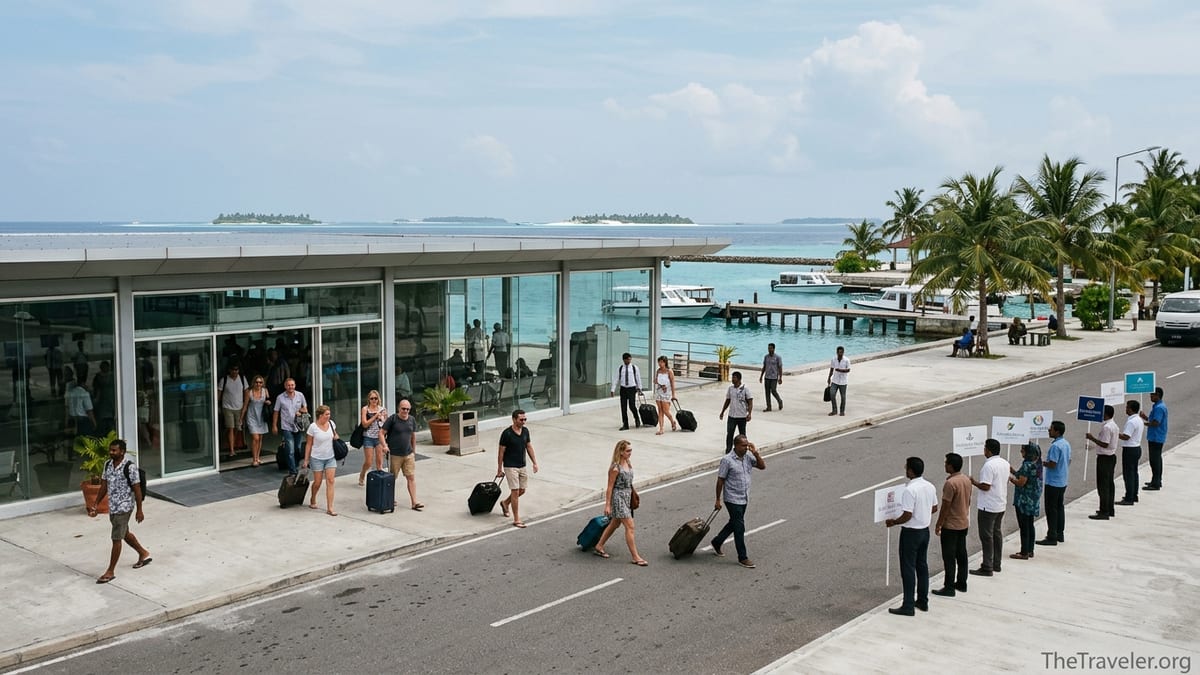
Understanding Velana International Airport and Its Terminals
Velana International Airport (IATA code MLE) sits on its own island, Hulhulé, next to the capital island of Malé. Every international traveler flies into the main international Terminal 1, while domestic flights and some services operate from smaller adjacent terminal buildings. Everything is on a walkable scale: you can cross from arrivals to the public jetty or to domestic and seaplane check-in areas in a matter of minutes.
On arrival at Terminal 1, you disembark via an airbridge or stairs, then follow clearly marked “Arrivals” signs to immigration. The building layout is straightforward: immigration booths, baggage claim, customs, and then the arrivals hall where you will see resort representatives, transfer desks, ATM machines, and telecom counters for SIM cards. If you have a resort package, a staff member will normally be waiting with a sign bearing your resort’s name just outside customs.
Departures from Terminal 1 are equally simple. Airlines such as Emirates, Qatar Airways, Singapore Airlines and British Airways use standard check-in desks in a single open hall. After check-in and security, there are duty-free shops, a few cafes and basic seating. Facilities are improving as the airport expands, but it is still not a gigantic hub like Dubai or Singapore, so do not expect dozens of lounges or endless dining options. For most visitors, this compact scale is a benefit: transfer times inside the airport are short and walking distances are reasonable even with luggage.
Separate from Terminal 1 is the seaplane terminal, located on the other side of the island. A short shuttle bus or van ride connects the buildings and is usually arranged by your resort or the seaplane operator. Domestic flights to other Maldivian islands operate from yet another small terminal, again only a few minutes by shuttle from international arrivals. You will be guided to the correct building if you have a prearranged booking, so do not worry about navigating this alone on your first visit.
Immigration, Customs and Arrival Formalities
Immigration at Velana is usually efficient but can see queues when several wide-body flights arrive together. Most nationalities traveling as tourists receive a 30-day visa on arrival without a fee, as long as they can show a valid passport, onward or return ticket, and proof of accommodation booking. In practice, officers typically ask a couple of questions about where you are staying and how long, then stamp your passport without much delay.
Before you reach the counter, you will pass through a queue where staff may check that you have filled in the Maldives Traveller Declaration, which as of 2026 is completed online, typically within 96 hours prior to arrival. Many airlines remind passengers to do this during check-in, but it is wise to complete it yourself before you fly to avoid scrambling on your phone while in line. If you forget, there is airport Wi-Fi and you can usually fill it out on your mobile device in a few minutes.
Baggage claim areas are directly behind immigration. Carousel space is limited, and bags from several flights may be on the belt at once, so double-check your luggage tags. Customs screening is generally light: you walk past a scanner, and officers may select passengers for random checks. Alcohol and pork products are strictly prohibited to bring into the country, and these items are routinely confiscated if found in luggage. In practical terms, that means avoid stocking up on duty-free alcohol before landing, because it will not be allowed into the Maldives even if it was legally purchased elsewhere.
Once you exit customs into the arrivals hall, you enter a compact but busy space packed with resort counters and representatives, small kiosks, and seating areas. This is where you will meet your hotel or resort contact, arrange any last-minute transfers if necessary, and buy a SIM card. It is normal for first-time visitors to feel slightly overwhelmed at this point, but everything you need for the next step of your trip is located within this one hall.
Navigating Resort Transfers: Seaplanes, Speedboats and Domestic Flights
Unlike many destinations where you simply hop into a taxi from the airport, in the Maldives the journey from Velana to your resort is usually prearranged and may involve a seaplane, a speedboat, a domestic flight, or a combination of these. In almost all cases, your resort or guesthouse is responsible for booking that transfer, not you. The cost is typically added to your accommodation bill, and round-trip transfer prices can be substantial, often sitting in the range of 100 to 500 US dollars per person for speedboats and 400 to 800 US dollars or more for seaplane transfers, depending on distance and resort category.
Seaplane transfers typically serve resorts located in atolls far from Malé. Operators like Trans Maldivian Airways and Manta Air run these flights from the dedicated seaplane terminal. After you meet your resort representative in the arrivals hall, you are usually escorted to a minibus that takes you to the seaplane terminal in about 5 to 10 minutes. Many upscale resorts maintain private lounges there, offering air-conditioning, drinks and snacks while you wait for your flight. Seaplanes operate only in daylight for safety reasons, so if your international flight lands late in the afternoon or at night, the resort will normally arrange an overnight stay near the airport and transfer you the following morning.
Speedboat transfers are common for resorts in atolls close to Malé, such as those in North and South Malé Atoll. These boats depart from jetties directly opposite the terminal building or from nearby piers in Malé. Travel times can range from 15 minutes to around 90 minutes depending on distance and sea conditions. For example, a shared speedboat to a mid-range resort in South Malé Atoll might take 35 minutes and cost around 150 to 250 US dollars per adult round-trip. Boats are usually enclosed and air-conditioned, though you can often stand at the back for open-air views once the crew deems it safe.
For remote southern and northern atolls not served by seaplanes, you may first take a domestic flight on a local carrier from the domestic terminal to an island airport like Gan or Hanimaadhoo, followed by a short speedboat ride. These domestic flights are also typically packaged and priced by your resort, and travel times can stretch the total journey to several hours after you land at Velana. A common pattern for first-time visitors is arriving on an early morning flight into Malé, transferring by domestic flight and boat to a resort in the south, then returning to Velana at least three hours before their departing international flight on the last day.
Getting between Velana, Malé and Hulhumalé
Because Velana Airport sits on Hulhulé island, you cannot simply walk into the capital. However, Malé and the neighboring island of Hulhumalé are both only a short drive away across the Sinamalé Bridge. The most straightforward public option for first-time visitors is the officially licensed airport bus, which runs between the airport and Hulhumalé with stops in between and costs the equivalent of just a few US dollars per person. Tickets are purchased at counters or on board, and buses run frequently enough for casual use, though schedules can thin out late at night.
Taxis at the airport are available outside the arrivals hall. These are standard four-door cars, not metered but operating on fixed fares for routes such as Airport to Malé or Airport to Hulhumalé. As an example, a taxi from the airport to central Malé might cost around 150 Maldivian rufiyaa, which is roughly 10 US dollars at recent exchange rates, with a small additional fee for large luggage. Payment is usually in local currency, though some drivers may accept US dollars for a slightly rounded amount. It is a good idea to withdraw some rufiyaa at the airport ATM if you plan to stay in Malé or Hulhumalé before heading to a resort.
Local ferries between the airport island and Malé used to be the default choice before the bridge opened and still operate at low cost, often under 2 US dollars per person. The public ferry pier is a short walk outside the terminal, and boats run every 10 to 30 minutes at peak times. This can be a very atmospheric way to arrive in the capital, especially in the late afternoon when the harbor is busiest. However, if you have large suitcases or arrive very late at night, a taxi via the bridge is usually more comfortable and reliable.
For travelers planning to stay in a guesthouse on a local island rather than a private resort, Malé and Hulhumalé are key transit points. Ferries and scheduled speedboats leave from specific jetties in the city to islands like Maafushi, Thoddoo or Rasdhoo. In practice, many first-timers land at Velana in the morning, take a taxi into Malé, have an early lunch and then connect with an afternoon speedboat organized by their guesthouse, with total additional transfer costs often around 30 to 60 US dollars per person.
Hulhumalé Hotels and Overnight Transit Stays
If your international flight lands late in the evening or if your seaplane transfer only operates during daylight hours, you may need an overnight stop before heading to your resort. In that case, Hulhumalé is usually more convenient than Malé for a short stay. The island is connected directly to the airport by bridge, and many small hotels and guesthouses run complimentary or low-cost transfers that pick you up from the arrivals area and drive you to their property in 10 to 15 minutes.
Hulhumalé has a long artificial beach, a growing cluster of cafes and restaurants, and a more relaxed layout than the densely packed streets of Malé. For example, a traveler arriving on a midnight flight might book a mid-range beachside hotel in Hulhumalé, pay around 80 to 140 US dollars for a double room including breakfast, sleep a few hours, then be driven back to the airport by hotel car in time for an 8:00 a.m. seaplane. This pattern is common enough that many hotels offer “transit packages” that combine early check-in, airport pickup, and breakfast.
Malé, by contrast, is a good choice if you want a glimpse of local life before heading to your resort. There are a handful of business-style hotels and guesthouses in the capital, with room rates that can range from 60 to over 200 US dollars per night depending on location and category. Staying here makes it easy to visit the fish market, local cafes, and mosques on foot. The trade-off is that streets are narrow and traffic can be busy, which can feel intense if you have just come off a long-haul flight.
For very short layovers of only a few hours during the day, some travelers choose to remain in or near the airport, using on-site cafes, small lounges, or day rooms offered by nearby transit hotels. In all cases, you should inform both your resort and any transit hotel of your international arrival and departure times in advance so that transport can be coordinated, especially if your flights are late at night or early in the morning.
SIM Cards, Connectivity and Money on Arrival
One of the most practical tasks after landing at Velana is setting up mobile data. The Maldives has two main telecom operators: Dhiraagu and Ooredoo. Both maintain clearly branded counters in the arrivals hall, often in bright red or blue, and in recent years they have also introduced digital kiosks and vending machines where you can purchase or collect tourist SIM kits. Tourist SIM packages typically include a local phone number and a bundle of data valid for 7 to 30 days, with prices that commonly start around the equivalent of 30 to 40 US dollars for a week’s worth of data suitable for basic navigation, messaging and occasional video calls.
For example, a Dhiraagu or Ooredoo “tourist SIM” might offer roughly 17 to 30 gigabytes of data plus bonus social media data for around 40 to 50 US dollars, while larger bundles with 50 or 100 gigabytes can cost more but are sometimes shared between two people via mobile hotspot. These tourist packages are straightforward to activate on the spot: staff will scan your passport, insert or help you scan an eSIM, and show you how to check your balance. If you are traveling as a couple and plan mostly resort stays with good Wi-Fi, a single large-data SIM that you share through hotspot can often be cheaper than two separate smaller packages.
Prices in the arrivals hall may be a bit higher than in city branches, and some budget-conscious visitors choose to buy a basic or “normal” prepaid SIM later in Malé or Hulhumalé and then add data packages themselves using a mobile app. This can bring down the per-gigabyte cost but requires a bit more time and setup, which is not ideal if you are rushing to catch a seaplane. For a first visit, most travelers find it worth paying a small premium to walk out of the airport with a working connection, especially if they need to contact a guesthouse, track a driver, or coordinate with fellow travelers.
In terms of money, there are several ATMs in the arrivals area where you can withdraw Maldivian rufiyaa using major international cards. US dollars are widely accepted at resorts and for many transport services, but small local expenses in Malé or Hulhumalé such as local cafes, public ferries and small shops are often easier to pay in rufiyaa. A typical withdrawal of 500 to 1000 rufiyaa, roughly 30 to 65 US dollars, is usually enough for a short stay in the capital before you head to a resort where most costs will be charged to your room.
Practical Tips for First-Time Maldives Travelers at Velana
Because so much of a Maldives holiday depends on smooth transfers, timing is crucial. When booking flights, allow generous connections: aim to land in Malé before early afternoon if you need a same-day seaplane, and schedule your departure flight for late afternoon or evening if possible, so that inbound transfers have some buffer for delays. For example, if your resort estimates a 40-minute speedboat back to the airport, plan to leave the resort at least four hours before your international flight to cover check-out, potential weather delays, and airport security.
Packing for arrival at Velana is also worth some thought. Keep swimsuits, a change of light clothing, and any medication in your carry-on. Seaplane luggage limits are often stricter than those of your international airline, commonly around 20 kilograms for checked bags plus 5 kilograms for hand luggage, and overweight fees can be steep. If you arrive from a long-haul flight in heavy shoes and jeans, you will likely want to change into shorts or light trousers while waiting at the seaplane terminal or speedboat jetty where the heat and humidity are immediate.
Food options at Velana are functional but limited compared with major hubs, so do not count on finding a wide range of cuisines or large supermarkets in the terminal. There are small cafes selling coffee, sandwiches and basic hot meals both landside and airside. If you know you or your children get hungry quickly, packing some snacks in your hand luggage can make long transfer days more comfortable, particularly if you are traveling with a late-night arrival followed by a morning seaplane.
Finally, remember that the Maldives is a Muslim country with modest dress norms outside resort islands. At the airport and in Malé or Hulhumalé, it is respectful to keep shoulders and knees covered, especially for women. You will see some tourists in shorts and T-shirts in the arrivals area, but if you plan to spend any time sightseeing in Malé or using public transport before your resort transfer, packing a light scarf or modest top makes it easier to blend in and feel comfortable.
Departure Day: Leaving Velana and the Maldives
On your last day, your resort or guesthouse will schedule your return transfer to Velana based on your international flight time. For seaplanes, this often means arriving back at the airport three or more hours before departure, as operators build in buffers for weather and operational constraints. Speedboats and domestic flights are usually timed to allow at least a two- to three-hour window before check-in, though the exact timing can vary with tides, daylight and passenger loads.
Once you are back at the airport, the process is straightforward: check in at your airline counter in Terminal 1, drop bags, clear exit immigration and security, then wait in the small departures area. Duty-free shops sell typical international items like perfume, cosmetics and chocolate, as well as some local souvenirs such as Maldivian tuna cans and packaged coconut products. Prices for branded goods are rarely bargains, so if you prefer to buy gifts in Malé markets or resort boutiques, do that earlier in your trip.
If you have long to wait, take advantage of any remaining mobile data or the airport Wi-Fi to confirm onward plans, download boarding passes and backup photos. Some travelers book access to a paid lounge through their airline or a card program, which can provide quieter seating and basic food and drinks. For those who prefer to spend time outside, remember there is no extensive public outdoor area airside, so most waiting will be indoors.
Because the airport is relatively small, queues can form at security or immigration when several departures cluster together. It is best not to linger too long in the check-in hall once your airline opens its counters. Aim to be at the airport at least two and a half to three hours before a long-haul flight so you can clear formalities without stress, even if your resort has delivered you to the island earlier.
FAQ
Q1. Do I need to arrange my resort transfer from Velana International Airport myself?
In almost all cases, no. Your resort or guesthouse arranges seaplane, speedboat or domestic flight transfers and adds the cost to your booking. You simply meet their representative in the arrivals hall after customs and follow their instructions.
Q2. How long does it take to get from Velana Airport to Malé city?
Travel time is usually 10 to 20 minutes by taxi across the bridge, depending on traffic. Public ferries, when operating, take a similar time but include waiting at the pier. Both options are short enough that many visitors make a quick visit to Malé on arrival or before departure.
Q3. What happens if my international flight arrives too late for a seaplane transfer?
Seaplanes only fly in daylight, so if you land late afternoon or evening, your resort will almost always arrange an overnight stay in Malé or Hulhumalé. You then transfer by seaplane the next morning, with hotel and transfer details confirmed when you book.
Q4. How much should I expect to pay for transfers from Velana to my resort?
Approximate round-trip prices commonly range from around 100 to 500 US dollars per person for shared speedboats and 400 to 800 US dollars or more for seaplanes, depending on distance and resort category. Domestic flight plus speedboat combinations often fall somewhere in between.
Q5. Is it worth buying a local SIM card at the airport instead of using roaming?
For most travelers, yes. Dhiraagu and Ooredoo counters in the arrivals hall sell tourist SIMs with data bundles that are usually cheaper than international roaming. The convenience of instant connectivity for calling your resort, checking transfer details or using maps often justifies the cost.
Q6. Can I stay overnight near the airport if I have an early morning seaplane?
Yes. Many travelers book a hotel or guesthouse in Hulhumalé for overnight transit. These properties typically offer airport pickup by car, a short 10- to 15-minute drive, and early-morning return transfers for seaplane check-in.
Q7. Are there strict luggage limits for seaplane flights from Velana?
Seaplane operators usually enforce stricter baggage allowances than international airlines, often around 20 kilograms for checked baggage plus 5 kilograms for hand luggage. Overweight luggage is generally accepted but charged at additional per-kilogram fees, so pack light where possible.
Q8. Is there Wi-Fi at Velana International Airport?
Yes. The airport provides basic Wi-Fi, and many resort lounges and seaplane terminals have their own networks. Wi-Fi quality can vary, so having a local SIM as backup is helpful if you need a reliable connection for work or navigation.
Q9. How much local currency do I need when I arrive?
If you are going directly to a resort that bills mostly in US dollars, you may only need a small amount of Maldivian rufiyaa for tips or small purchases. Travelers who plan to spend time in Malé or Hulhumalé often withdraw the equivalent of 30 to 65 US dollars to cover taxis, snacks and small shops before heading out to the islands.
Q10. Is it safe and realistic to leave the airport and explore Malé during a long layover?
Yes, if you have at least six hours between flights it is realistic to take a taxi into Malé, walk the waterfront, visit the fish market and have a meal, then return to the airport. Keep an eye on traffic and allow enough time to pass through security and immigration again before your onward flight.