


For many Maldives trips, the holiday truly begins the moment your seaplane lifts off from Velana International Airport and the atolls appear below. Yet that postcard-perfect flight can also be one of the most confusing parts of the journey, with separate terminals, strict luggage rules and daylight-only schedules that catch first-time visitors by surprise. This guide walks you through every step of the seaplane transfer process at Velana, from finding your resort counter in arrivals to understanding luggage limits, timing cut-offs, lounges and when a seaplane is actually worth the extra cost.
Get the latest updates straight to your inbox!
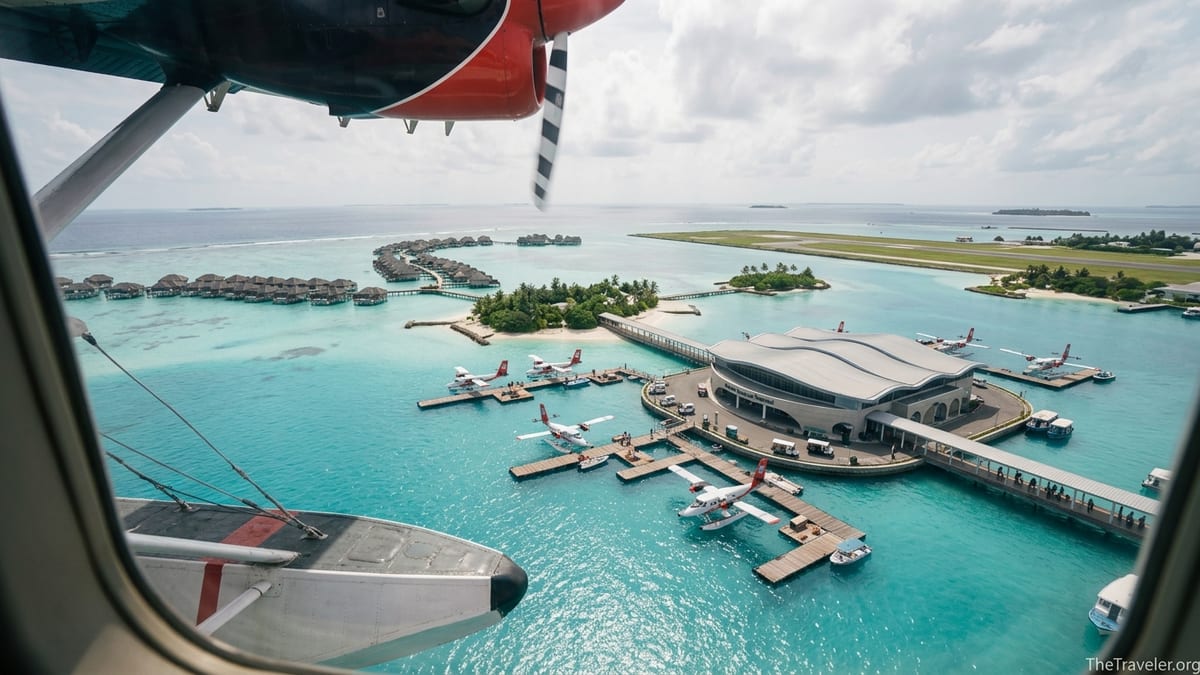
How seaplane transfers work from Velana International Airport
Velana International Airport (MLE) serves as the main gateway to the Maldives and also hosts one of the world’s largest seaplane operations. The waterdrome is separate from the main international terminal and is used by seaplane operators such as Trans Maldivian Airways (TMA), Manta Air and Maldivian. In almost all cases you do not book these flights yourself; your resort arranges them as part of your overall stay. The cost is usually added to your room bill or included in a package.
When you land in Malé, you clear immigration, collect your luggage and walk out into the public arrivals hall. There you will find a long row of resort and airline counters, each marked with a hotel logo. A representative from your resort or its seaplane partner will typically be waiting with a sign and will escort you to the correct counter. They handle check-in, weigh your bags and coordinate with the seaplane operator, so you rarely deal with the airline directly.
Once check-in is complete, you are transferred by shuttle bus or minivan to the Noovilu Seaplane Terminal, which is located across the airfield from the main international building. The drive takes around 5 to 10 minutes, depending on traffic on the service roads. From there you wait in either a shared airline lounge or your resort’s private lounge until boarding is called. Flights are scheduled dynamically based on arriving international passengers and resort locations, so you will not usually see a fixed departure time on a traditional ticket.
In practice, this means your seaplane departure can be adjusted on the day. For example, if your Emirates flight from Dubai lands 45 minutes late but several other guests for your resort are on the same plane, the seaplane operator may shuffle its schedule so that everyone can still make the same transfer. Conversely, you might have to wait longer than expected if one inbound international flight is delayed, since seaplanes aim to fly with as many seats filled as possible to outlying resorts.
Noovilu Seaplane Terminal and resort counters
Noovilu Seaplane Terminal is the dedicated seaplane facility at Velana, opened to consolidate operations that were previously spread across smaller jetties. It includes multiple boarding gates, piers leading straight to the pontoons, and a cluster of airline and resort lounges. Crucially, you do not go there on your own immediately after landing. Your first stop is always the resort counters in the main international arrivals hall, where staff check your details and coordinate ground transport over to Noovilu.
The arrivals hall counters can be busy during peak mid-morning periods when many long-haul flights from Europe arrive. You will see familiar names like Conrad, Soneva, Kuramathi, JA Manafaru, Velaa Private Island and many others, each with their own small booth. For instance, a guest staying at JA Manafaru in the far north, which uses a mix of domestic and seaplane transfers, will meet a representative at that counter before being taken either to the domestic terminal or to Noovilu depending on their booked option.
At Noovilu itself, the experience is far quieter and more resort-like. Seaplane operators maintain their own check-in areas, but after your initial processing at the main terminal the formalities here are light. Staff may recheck your boarding details and reconfirm luggage weights, but your main task is simply to wait for boarding in comfort. When your flight is called, ground staff will lead you along a shaded walkway to the floating pontoons where the seaplanes are moored.
On your return to Malé, the flow is reversed. The seaplane lands near Noovilu, you disembark onto a pontoon and walk into the terminal. After reclaiming checked bags, you are placed on a shuttle back to the international departures area. Resorts schedule these return seaplane legs so that most guests leave their island roughly 3 to 4 hours before their long-haul flight from Velana, though exact timing depends on distance and the operator’s daily schedule.
Luggage limits and excess baggage on Maldives seaplanes
Seaplanes in the Maldives use small turboprop aircraft, typically Twin Otter DHC‑6 floatplanes, which have strict weight limits for safe take-off and landing on water. As a result, standard baggage allowances are much lower than on long-haul jets. The most common allowance is 20 kilograms of checked luggage plus 5 kilograms of hand luggage per person. This is the policy used by Manta Air for seaplane services and is also specified by many resorts that contract seaplane transfers for their guests.
Trans Maldivian Airways, the largest operator, typically includes a total of 25 kilograms per passenger, made up of 20 kilograms checked and 5 kilograms hand luggage. Several resort fact sheets echo this, noting that any weight above the combined limit is charged per kilogram. For example, recent TMA guidance puts the excess fee at around 5 US dollars plus taxes per extra kilogram, while some contracts routed via third-party tour operators quote slightly higher ranges. A hard cap of around 32 kilograms for any single piece is also common for safety and handling reasons.
These limits are actively enforced. At Velana, your suitcases and hand luggage are weighed together at the seaplane counter. Couples or families often benefit from pooling, since allowances may be combined across the booking. For instance, a couple with 35 kilograms of checked bags between them would be within a shared 40‑kilogram allowance for two passengers, whereas a solo traveler with the same 35 kilograms would be 15 kilograms over and could easily face a surcharge of 75 US dollars or more.
In some situations, if the flight is especially weight-constrained due to hot weather, fuel needs or a short lagoon runway at a particular resort, the airline may decide to send part of your checked luggage on a later plane even if you have paid the excess charges. Resorts like JA Manafaru and others explicitly warn guests that delayed baggage is possible and that essential items such as medications, swimwear and one change of clothes should be kept in carry-on. Usually, delayed bags arrive on the island within a few hours, but for very remote resorts it can take until the next scheduled seaplane window.
Daylight-only operations and timing cut-offs
One of the most important features of Maldivian seaplane operations is that they run only during daylight. Flights use visual navigation to land in lagoons near resort islands, and there are no night operations. In practice, this means first departures from Velana typically begin around 6:00 in the morning, with last seaplanes leaving Malé in the mid to late afternoon. A commonly used guideline among resorts and transfer agencies is that international arrivals should land at Velana no later than around 14:00 to comfortably make a same-day seaplane connection.
Some resorts publish even tighter guidance. For example, several popular properties in atolls reachable only by seaplane note in their confirmations that guests arriving after roughly 15:00 will have to stay overnight near the airport and take the first available seaplane the following morning. Recent guest experiences echo this pattern, with visitors who landed at around 14:30 or later being advised that the remaining time was too tight given immigration lines and baggage claim, even if a theoretical later seaplane existed in the schedule.
On the outbound side, resorts and seaplane operators generally aim to get you back to Velana at least 2 to 3 hours before your international flight. Because seaplanes are small and can be affected by weather or shifting loads, there is limited flexibility if something runs late. It is common for guests heading to Europe on evening flights to leave their resort mid to late afternoon on one of the last seaplanes of the day, then spend some time in a lounge at the main airport before check-in opens.
Travelers planning tight connections should therefore build in margin. If you are booking your own long-haul flights to connect with a resort package, aim to arrive into Malé by late morning, not early afternoon. For example, a traveler arriving from Singapore at 11:30 usually has a comfortable window for immigration, baggage and the transfer to Noovilu. Someone landing at 14:05 on a busy day could be at real risk of missing the last seaplane to outer atolls like Gaafu Alifu or Noonu and might have to overnight in Hulhumalé instead.
Waiting lounges and what to expect at Noovilu
One pleasant surprise for many visitors is the quality of waiting lounges connected with seaplane transfers. Most upscale resorts maintain private lounges at Noovilu, offering air conditioning, drinks and light snacks. For example, well-known brands such as Four Seasons, Velaa Private Island and several luxury chains provide comfortable seating, showers and even small play areas for children. Access is typically included in your transfer cost, and check-in staff will escort you directly to your resort’s lounge after processing.
In addition to resort-specific spaces, TMA and other operators offer shared lounges for partner properties, and the airport company operates a common facility often referred to as the Neeri Lounge, which guests can use for a fee or when they are not tied to a particular hotel lounge. Services here can include refreshments for purchase, Wi‑Fi and basic seating. This setup is particularly useful if you are staying at a mid-range resort that does not have its own branded lounge but still wants to offer guests a comfortable place to wait.
Waiting times vary. On a smooth day, some guests are in the lounge for less than an hour before boarding. During peak periods, or when schedules are reshuffled due to weather or late inbound flights, it is not unusual to wait 2 to 3 hours. Families with young children often appreciate having snacks, baby supplies and entertainment in their hand luggage for this reason, even if the lounge itself offers some amenities. The wait is part of the cost of a dynamic, load-based seaplane operation that is coordinating dozens of island drops.
On the return leg, you may again spend time in a lounge at Noovilu while waiting for connecting seaplanes or shuttles back to the main terminal. Some resorts schedule departures conservatively, which can leave you with generous buffer time at the seaplane terminal. Rather than viewing this as lost holiday time, many guests treat it as a decompression zone between the slow rhythm of the islands and the intensity of long-haul air travel, especially if showers and refreshments are available.
When a seaplane transfer is worth it compared to speedboats or domestic flights
Not every Maldives resort requires a seaplane. Properties close to Malé in North and South Malé Atolls, such as many near the airport and around popular sandbanks, are usually reached by speedboat, often in 15 to 45 minutes. Resorts in far-flung atolls sometimes use domestic flights on larger aircraft followed by a final speedboat leg. Seaplanes tend to serve islands that are too far for a comfortable speedboat ride yet do not have a convenient domestic airport nearby.
Whether the seaplane is “worth it” depends on your budget, tolerance for small aircraft and desire for that classic Maldives aerial experience. Return seaplane transfers often cost several hundred US dollars per person, and luxury properties may charge more, especially for premium or private seaplane services. For example, some high-end resorts charter dedicated seaplanes for their guests during peak seasons or offer branded aircraft such as Four Seasons’ Flying Triggerfish, which combines standard baggage allowances with an upgraded cabin atmosphere at a higher price point.
For many travelers, the visual impact of the seaplane flight justifies the extra expense. Flying over reefs, sandbanks and tiny island chains at low altitude with large windows is a memorable introduction to the country, especially for first-time visitors celebrating honeymoons or milestone trips. It can also significantly cut journey times to distant atolls. A resort that is 45 minutes by seaplane might require a domestic flight of an hour plus a speedboat ride of 30 to 60 minutes if you avoid seaplanes, turning a quick hop into a multi-stage journey.
On the other hand, if you are nervous about small planes, prone to motion sickness, or traveling with a lot of oversized luggage like surfboards or bulky dive gear, a domestic flight and speedboat combination may be more comfortable. Seaplanes generally cannot carry large boards or very long items, and their cabins are noisier and more compact than those of regular jets. Families on a tighter budget sometimes choose resorts accessible by speedboat specifically to avoid seaplane surcharges; for example, staying on an island in South Malé Atoll rather than a more remote Baa or Noonu Atoll property.
Practical tips: timing your arrival and packing for the seaplane
To maximize your chances of a smooth same-day connection, aim to land in Malé by late morning. Travelers from Europe often choose overnight flights that arrive between 8:00 and 10:00, which gives ample time for immigration, baggage claim and the transfer to Noovilu even during busy periods. Those arriving from Asia or the Middle East should be wary of schedules that touch down after 13:00, especially during peak season when queues are longer and seaplane schedules are tight.
If your only affordable long-haul option arrives after the typical seaplane cut-off, budget for an overnight stay near the airport. Many visitors choose guesthouses or hotels on Hulhumalé, a short taxi ride away, to rest before their morning seaplane. In this scenario, keep a small overnight bag with essentials separate from your main cases so you do not have to unpack everything for one night. The next day, your resort or transfer agent will usually meet you again in the departures hall, even though you have already been in the country for a few hours.
When packing, treat the 20 kilograms checked plus 5 kilograms hand luggage allowance as a firm planning baseline unless your resort confirmation explicitly states otherwise. Weigh your main bags before leaving home, especially if you are bringing items like camera gear, snorkel equipment or children’s supplies that add up quickly. Consider a lightweight duffel instead of a heavy hard-shell suitcase; the latter can eat into your allowance and may be less practical for stacking in small seaplane holds.
Finally, remember that cabin space on seaplanes is limited. Overhead bins are minimal or non-existent, and much hand luggage may be stowed in the rear of the plane with checked bags. Keep only a compact daypack or handbag with your valuables, phone, headphones, medication and perhaps a light sweater. Anything larger will likely be tagged and placed in the luggage area regardless, so packing a small personal item makes boarding easier and keeps the cabin less cluttered.
The Takeaway
Seaplane transfers at Velana International Airport can feel intimidating on paper, but in reality the process is well-rehearsed and heavily supported by resort staff. Your main tasks are to arrive early enough in the day, stay within or close to the standard 20 kilograms checked plus 5 kilograms hand luggage limits, and allow time for the dynamic nature of seaplane scheduling. The opening of Noovilu Seaplane Terminal, with its network of lounges and organized boarding piers, has further streamlined the experience for most visitors.
For many travelers, the sight of turquoise lagoons and ring-shaped atolls from a low-flying seaplane is a highlight of a Maldives trip, and the extra planning and cost are worth it. Others may prefer the simplicity of a speedboat or the wider tolerances of a domestic flight. Whichever option your chosen resort uses, understanding how the transfer works when you land at Velana will help you start and end your island holiday with far less stress and far more time to simply enjoy the journey.
FAQ
Q1. How much luggage can I take on a Maldives seaplane from Velana?
Most travelers should plan for about 20 kilograms of checked luggage and 5 kilograms of hand luggage per person on seaplanes, regardless of the operator. Some contracts with Trans Maldivian Airways and certain resorts effectively allow a combined 25 kilograms per passenger as a standard inclusion, but any weight above this is usually charged per kilogram at check-in.
Q2. What happens if my bags are over the seaplane weight limit?
If your total luggage exceeds the allowance, you will almost always be charged an excess baggage fee per extra kilogram. In some cases, particularly on hot days or when flights are near capacity, the airline may also decide to send part of your checked luggage on a later seaplane even if you pay the surcharge. Resorts generally deliver delayed bags to your villa once they arrive.
Q3. Can I still take a seaplane if my international flight lands late in the afternoon?
It depends on the exact arrival time and the season, but as a rule of thumb you should land at Velana before roughly 14:00 to be confident of a same-day seaplane transfer. Guests arriving after mid-afternoon are often required to stay overnight near the airport and take the first seaplane the following morning, because seaplanes do not operate after dark.
Q4. How do I find my resort’s seaplane counter when I land?
After clearing immigration and customs, you will enter the public arrivals hall where there is a long row of resort and airline counters. Look for your resort’s logo on the signs, or for staff holding placards with hotel names. If you are unsure, you can show any staff member your hotel confirmation and they will usually direct you to the correct booth.
Q5. How long will I wait at the Noovilu Seaplane Terminal before my flight?
Waiting times vary with flight loads and international arrivals. In light traffic, you might board within 45 to 60 minutes. During busy periods or if other guests on your seaplane are arriving on a delayed long-haul flight, you could wait 2 to 3 hours. Lounges at Noovilu are designed to make that wait as comfortable as possible with air conditioning, drinks and Wi‑Fi.
Q6. Are seaplane transfers safe for nervous flyers?
Seaplanes in the Maldives are widely used and operate many flights daily during peak seasons, with experienced crews and established safety procedures. However, the experience is very different from large jets: the cabin is smaller, noisier and more affected by turbulence and crosswinds. Nervous flyers may prefer resorts reachable by speedboat or by domestic flight on larger aircraft, but many first-time seaplane passengers find the views so captivating that their anxiety eases in flight.
Q7. Can I bring surfboards, drones or other special equipment on the seaplane?
Large items such as surfboards are generally difficult or impossible to load on standard Maldives seaplanes due to door sizes and weight distribution limits, so many resorts advise against bringing boards if a seaplane transfer is required. Smaller items like camera gear or compact sports equipment are usually fine within your weight allowance. Drones fall under local aviation and security rules, and you should check both national regulations and your resort’s policy before packing one.
Q8. Do I need to check in for the seaplane myself or does the resort handle it?
The resort or its local handling agent typically takes care of seaplane check-in. After meeting you in the arrivals hall, staff bring you to the appropriate counter, present your booking to the airline, weigh your bags and provide boarding information. You do not need to manage a separate online check-in or visit a standard airline desk unless instructed otherwise in your confirmation.
Q9. What should I keep in my hand luggage for the seaplane transfer?
Because cabin space is limited and some hand luggage may be stowed separately, it is best to carry only a small bag with essentials. This should include travel documents, valuables, medications, a phone or camera, and perhaps a light layer if you get cold easily. Many travelers also pack swimwear and one change of clothes in carry-on in case checked bags are delayed on a later seaplane.
Q10. Is the extra cost of a seaplane worth it compared to a speedboat transfer?
For resorts that require it, a seaplane is simply part of the package and delivers a fast, scenic link to islands that would be impractical to reach by boat. Where you have a choice between resorts, the decision comes down to budget and preference. Speedboat transfers are usually cheaper and operate later into the evening, while seaplanes cost more but offer dramatic aerial views and reduced travel time to remote atolls. Many guests consider at least one seaplane flight during a Maldives trip to be a standout experience.