


Many trips to the Maldives include a long wait at Velana International Airport between your international flight and a seaplane, domestic flight or late-night speedboat to your resort. The good news is that, with a little planning, that wait does not have to feel like limbo. Whether you have three hours or an overnight layover, there are realistic ways to get comfortable, find a shower and a meal, or even explore nearby islands while staying aligned with your transfer.
Get the latest updates straight to your inbox!
Understanding How Resort Transfers Work at Velana
Velana International Airport sits on its own island, Hulhulé, just off Malé and across the bridge from Hulhumalé. It is the main arrival point for almost all Maldives resorts, but your journey is rarely finished when you clear immigration. Most visitors still have to connect to a seaplane, a domestic flight on a local carrier, or a speedboat run by the resort. These onward transfers are almost always arranged by the resort, not by you directly, and they are tightly tied to daylight hours, sea conditions and aircraft schedules.
Seaplanes in the Maldives operate in daylight only, typically from early morning until late afternoon, with many resorts advising that guests arriving after around 15:00 to 16:00 may need to overnight near the airport and fly the next morning. Domestic flights to further atolls, on the other hand, often run into the evening, and resorts can then pair those flights with shorter speedboat hops. Closer resorts in atolls near Malé use direct speedboat transfers from the airport jetty, which can run well into the night if sea conditions permit.
On arrival, you will find staff from your resort waiting as you exit customs, usually holding signs with the resort name. They will collect you, your checked luggage tags and your transfer documents, then either escort you to a counter in the arrivals hall, to the seaplane terminal check-in area, or to a holding lounge. In practice, this can mean a wait of anywhere from an hour to half a day while they group guests, confirm loads and clear weather windows. Knowing your options for how to spend that time can transform the experience.
Before you fly, it is worth asking your resort two questions: what is the latest arrival time that still allows same-day transfer, and what they recommend if your flight lands later than that. Many properties will proactively suggest a Hulhumalé hotel or arrange an airport-area stay if they already know your international arrival is too late for that day’s seaplane or domestic connection.
Lounges and Waiting Areas at Velana and the Seaplane Terminal
Velana has several types of lounges, and which ones you can use depends on your ticket, status and transfer type. In the international departures terminal, there is a main contract lounge that serves many airlines and card programs, generally accessible via business-class tickets, elite status or paid walk-in. This lounge offers air conditioning, soft seating, basic buffet food, non-alcoholic drinks, Wi-Fi and showers. Alcohol is not served in any airport lounge because Velana sits on an inhabited island where alcohol is restricted by law.
On the domestic side, the Moonimaa Lounge caters primarily to Maldivian domestic and some codeshare passengers. It typically sells walk-in access and is included for some business and flexible fares. For travelers connecting onward within the Maldives, this can be the most comfortable place to wait if your ticket or card benefits allow it. Expect simple hot dishes, snacks, coffee, charging points and Wi-Fi, which is a step up from sitting in the main hall on plastic chairs.
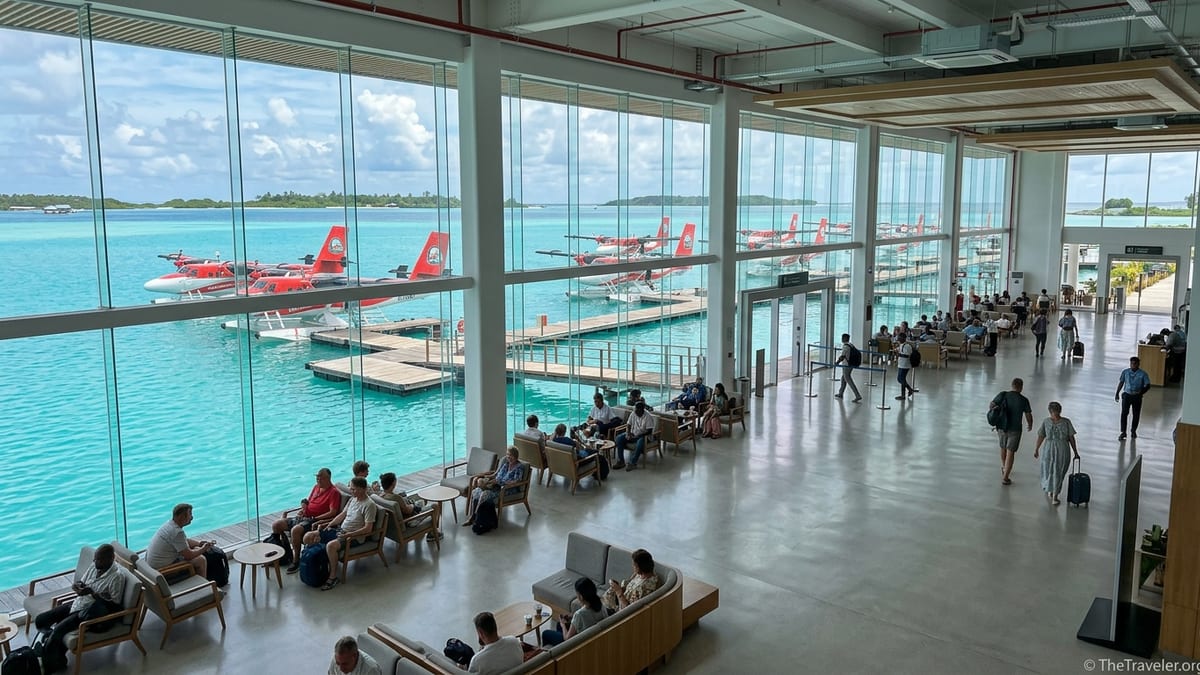
The most distinctive waiting experience is at the Noovilu Seaplane Terminal, which houses more than 40 lounges dedicated to individual resorts or operators. Almost all guests flying by seaplane are hosted in one of these spaces while they wait for their flight to the resort’s island. If you are heading to a big-name property like Soneva, LUX* or Sun Siyam, it is common to be taken directly from international arrivals to that resort’s branded lounge, where you can check in, grab refreshments and freshen up before your seaplane boarding is called.
Facilities between lounges vary. Some, such as the Huvandhumaa Lounge used by the Maldivian seaplane operation, feel similar to a compact regional business lounge, with indoor seating, snack buffets and views over the lagoon where the aircraft dock. Others, like lounges run by major resort chains, can be more upscale, offering small play areas for children, showers and even private cabanas. You generally cannot pay to enter a resort-branded lounge if you are not staying there, so your access is dictated by your booking. If your resort does not have its own facility, you will be hosted in a shared operator lounge, which still offers far more comfort than the main terminal.
Food, Showers and Practical Amenities During a Long Wait
Most long transfer waits start with the basics: a meal, a shower and somewhere to charge your phone. Inside the international arrivals area, your options are limited to a handful of cafes and fast-food counters, typically selling simple sandwiches, pastries, coffee and soft drinks at prices that are higher than in Malé or Hulhumalé but comparable to many international airports. For a quick refresh, this is often enough, especially if you have only a couple of hours before a seaplane.
If you pass through to departures or are already airside for an outbound international flight, the main lounge is usually your best bet for a shower. Walk-in fees tend to be in the range that many global contract lounges charge, and you will get access to private shower rooms, towels and amenities, which is valuable after a red-eye or before an overnight flight home. For travelers who prefer not to pay lounge fees, there are basic restroom facilities in both terminals, but they do not offer dedicated shower stalls.
At the Noovilu Seaplane Terminal, many resort lounges provide showers, which can be a welcome extra after a long-haul. These are normally free for guests of that resort, though availability depends on how busy the lounge is. Staff are used to families arriving in travel clothes and wanting to change into resort wear or swim gear, and they can often help with simple needs such as boiling water for baby bottles, warming up food pouches or storing medication in a fridge while you wait.
If your layover stretches to six hours or longer, it can be more comfortable to step out of the immediate airport zone. Some nearby hotels on Hulhulé and across the bridge in Hulhumalé sell short day-use packages or “refresh” deals that include a room for several hours, a shower and sometimes a buffet meal or pool access. These can be especially appealing for guests whose seaplane only flies the next morning, as you can sleep in a real bed instead of trying to nap upright in the terminal.
Short Layovers: Staying on the Airport Island
For layovers of roughly three to five hours in the middle of the day, leaving the airport island often does not make sense. In that window, your focus should be staying close to your resort’s meeting point so you can board quickly once your seaplane or speedboat is ready. After your resort host checks you in, ask clearly how much time you have and whether they expect to move you to the seaplane terminal or domestic side soon.
If you are outbound from the Maldives and have a similar-length wait before your international flight, investing in lounge access is usually the most comfortable solution. This is especially true in the evening, when the terminals can become crowded with multiple wide-body departures in a short period. A contract lounge gives you Wi-Fi, food and a quieter space to get organized, repack your hand luggage and charge devices after days on a resort where you may have been mostly offline.
Travelers on tight budgets sometimes try to nap in public seating near the check-in desks or by the windows facing the runway. While this is technically possible, Velana is not especially friendly to overnight “airport campers.” Seating is limited and armrests make lying down difficult, the air conditioning can feel cold in shorts and T-shirt, and cleaning or security patrols create regular noise. If you are connecting late at night to an early-morning domestic or international flight, it is wiser and more comfortable to arrange a nearby hotel than to rely on the terminal as a bedroom.
One practical detail worth remembering: luggage trolleys and porters are widely available, but formal left-luggage storage options are limited and policies can change. If you plan to leave the airport island briefly, ask your resort representative whether they will hold your bags or prefer that you keep them with you until you return for your transfer.
Overnight & Long Layovers: Hulhumalé Transit Hotels
When your arrival time makes a same-day seaplane impossible, an overnight on a nearby island becomes part of the journey. Hulhumalé is designed for this role. Connected to the airport by a short bridge, it is about 10 to 15 minutes from the terminal by taxi, and it has a long lagoon-side beach lined with small hotels, guesthouses and cafes. Many of these properties specifically market themselves as transit hotels with airport pick-up and drop-off services.
Examples include straightforward guesthouses such as Transit Beach View Hotel on the eastern shore, which focuses on one-night stays for people between flights, and slightly more polished options like Ocean Grand or Hotel Ocean Front that offer sea-view rooms and rooftop restaurants looking over the water. Moderately priced boutique stays such as Terminal 27 Hotel and Samann Host mix modern, compact rooms with convenient services like early breakfast, 24-hour front desks and pre-arranged taxis for early-morning seaplane check-in.
For a simpler, homestay-style experience, properties like Sunrise Stay or smaller guesthouses tucked a block or two back from the beach provide clean, air-conditioned rooms, Wi-Fi and basic breakfast at price points that are often significantly lower than international chain hotels. The trade-off is that common areas are limited and check-in desks may be compact, but for a layover of one night this is more than enough. Most are within a few minutes’ walk of the public beach, so you can still take a stroll along the sand before bed.
In practice, many resorts will make these arrangements for you if your flight arrives after seaplane cut-off. You might receive an email ahead of time offering a specific Hulhumalé hotel and outlining the plan: a driver will meet you at arrivals, take you to the hotel for the night, and then pick you up again at 5:00 or 6:00 the next morning to check in for your seaplane. If you prefer to choose your own place, confirm with the resort what time they need you back at the seaplane terminal and factor at least 30 to 40 minutes for hotel check-out and road transfer, even at quiet times.
Visiting Malé or Hulhumalé During a Layover
If you have a longer daytime layover, typically at least six hours between clearing immigration and your next check-in, a quick visit to Malé or Hulhumalé can add something memorable to your trip. Many travelers go to Hulhumalé first, because it is simple: take a taxi over the bridge from the airport and you will be dropped near the beach or your chosen cafe, then reverse the route later. The island has a growing selection of coffee shops, bakeries and casual restaurants, many open from morning until late evening, serving everything from Maldivian short eats to burgers and pasta.
Malé, the capital, is reachable in two main ways. The traditional option is the public ferry from the airport jetty across the channel, which runs frequently throughout much of the day and takes roughly 10 minutes. In addition, an express speedboat service connects the airport with different jetties in Malé on a schedule published by the local transport company. Once in Malé, you can walk to the fish market, the main mosque, small parks and narrow shopping streets where locals buy everything from boat parts to mobile phones.
Whichever island you choose, the key considerations are timing and luggage. Before leaving the airport, confirm with your resort or airline representative when you need to be back and at which terminal. Build in a buffer for traffic on the bridge and for paying your taxi or ferry fare. For luggage, some travelers bring only their hand baggage into town and leave checked bags in the care of their resort representative or on their already-issued luggage tags. Always ask explicitly before assuming someone will watch your belongings and avoid taking valuable items you do not need.
Culturally, both Malé and Hulhumalé are local, inhabited islands. Dress conservatively compared with resort wear: shoulders and knees covered is a safe guideline away from the designated tourist beaches. Alcohol is not served in cafes or restaurants in town. Instead, enjoy fresh coconut water, juices or strong Maldivian black tea while you people-watch and ease into the rhythm of daily life between flights.
Luggage, Transfers and Staying in Sync With Your Resort
Luggage handling at Velana is tightly linked to your resort transfer. On arrival, your bags will appear on the carousel like any other international flight. After customs, resort staff will usually match your luggage tags to their manifest and either collect the bags for you or supervise while porters move them to the seaplane or domestic check-in. It can feel like your bags vanish into the system for a few hours, which is why keeping your claim tags and hand baggage organized is essential.
If you are planning to leave the airport island during a layover before your seaplane or domestic flight, clarify exactly who is responsible for your bags. Some resorts insist on checking everything through to the seaplane terminal before you head off, then issuing you a time to meet back at a specific counter or lounge. Others may prefer that you keep luggage with you until you are fully checked in for the onward segment. In either case, storing key items such as medication, electronics and a change of clothes in your hand baggage reduces stress if plans shift.
For outbound journeys from a resort back to your international flight, transfers are usually arranged according to a template schedule built around your departure time. Seaplanes typically land at Velana at least three hours before your long-haul departure; domestic flights and speedboats are often paired to give similar buffers. Your resort will communicate pick-up times, but it is wise to verify these with them a day before you leave, especially in the wet season when weather can cause adjustments.
Ground transfers between terminals at Velana are mostly handled for you. If you are moving from seaplane to international, expect to be guided onto a shuttle bus that runs between the Noovilu terminal and the main building. If you are connecting from domestic to seaplane or vice versa, staff will direct you through a combination of short walks and internal corridors. Even though distances are not huge, queues and security checks can add time, so keep travel documents accessible and allow for short waits.
The Takeaway
Velana International Airport is less a final destination and more a hub that connects your long-haul flight to a remote island resort. Because so many transfers depend on daylight, tides and aircraft schedules, long waits are a built-in part of many itineraries. Approaching those waits with a plan makes a major difference. Decide early whether you will stay on the airport island, buy lounge access, or arrange a Hulhumalé hotel if an overnight is required.
For short layovers, staying close to your resort representative and using the seaplane or domestic lounges when available is usually the easiest option. For longer gaps, especially overnight ones, Hulhumalé’s cluster of transit-friendly hotels and beachfront cafes provides a much more comfortable place to reset your body clock than a hard chair under cold air conditioning. With realistic timing, respect for local customs, and clear communication with your resort about luggage and meeting points, your Velana layover can feel like the gentle beginning or soft landing of your Maldivian holiday rather than an unwelcome delay.
FAQ
Q1. How much connection time do I need between my international flight and a seaplane at Velana?
Most resorts like at least 2 to 3 hours between your international landing and seaplane check-in, and many will not schedule same-day seaplanes for arrivals after mid-afternoon. Always follow the timing your resort gives you, as they work with live seaplane schedules and daylight constraints.
Q2. Can I leave the airport and still catch my transfer safely?
Yes, but only if you have a generous layover and clear instructions from your resort or airline. For seaplanes and domestic flights, always check the latest meeting time before heading to Malé or Hulhumalé, and build in extra time for traffic, security and shuttle transfers back to the correct terminal.
Q3. Is there somewhere to shower during a long layover at Velana?
Showers are available in several lounges in the international terminal and in many of the resort and operator lounges at the Noovilu Seaplane Terminal. Some nearby hotels also sell short day-use rooms that include a private bathroom and shower if you prefer to rest in a proper bed.
Q4. Where is the best place to stay overnight near the airport?
For most travelers, a guesthouse or small hotel on Hulhumalé is the most practical option, combining short taxi rides with access to the beach and local cafes. Properties that regularly handle transit guests often offer airport pick-up and drop-off and early breakfast timed to seaplane or domestic departures.
Q5. Is it worth going into Malé during a layover?
It can be, if you have at least six hours free and enjoy exploring cities. Malé offers a glimpse of everyday Maldivian life, from its markets to mosques and busy harbor, but requires a ferry or speedboat ride and careful timing to ensure you are back in time for your onward flight or boat.
Q6. Are there left-luggage facilities at Velana International Airport?
Formal left-luggage options are limited and policies change, so you should not count on dropping bags independently for long periods. In most cases, your resort or airline representative will either arrange for your bags to move directly to the next segment or ask you to keep them with you until check-in opens.
Q7. Can I buy alcohol at the airport or in Hulhumalé during my layover?
Alcohol is not served in public areas, cafes or regular lounges at Velana or on inhabited islands like Malé and Hulhumalé, due to local laws. If you have purchased duty-free alcohol on departure from the Maldives, you will not be able to open it at the airport or in town.
Q8. What should I wear if I visit Malé or Hulhumalé between flights?
Outside resort islands, dress modestly in respect of local customs. Lightweight clothing that covers shoulders and knees is appropriate in town. Swimwear is best kept to designated bikini beaches or the privacy of your hotel room when you are staying on an inhabited island.
Q9. How early do I need to be back at the airport before my international flight home?
Plan to be at the international terminal at least three hours before departure, which is usually how resorts time their transfer schedules. In peak travel seasons or if you need to claim tax refunds or shop at duty free, consider arriving even earlier to allow for queues and security checks.
Q10. Is it safe and easy to take a taxi to Hulhumalé from the airport?
Yes, taxis are the standard way to reach Hulhumalé from Velana, using the bridge that connects the islands. The ride generally takes around 10 to 15 minutes in normal traffic, and drivers are used to picking up and dropping off transit passengers with luggage at hotels and guesthouses.