


Landing at Velana International Airport in the Maldives is only the first part of your journey. For most travelers heading to resort islands or budget-friendly local islands like Maafushi, the crucial next step is a speedboat transfer. Knowing how these boats work, where to meet them, how much they cost, and what happens if your flight is late can mean the difference between a smooth island arrival and an expensive, stressful delay.
Get the latest updates straight to your inbox!
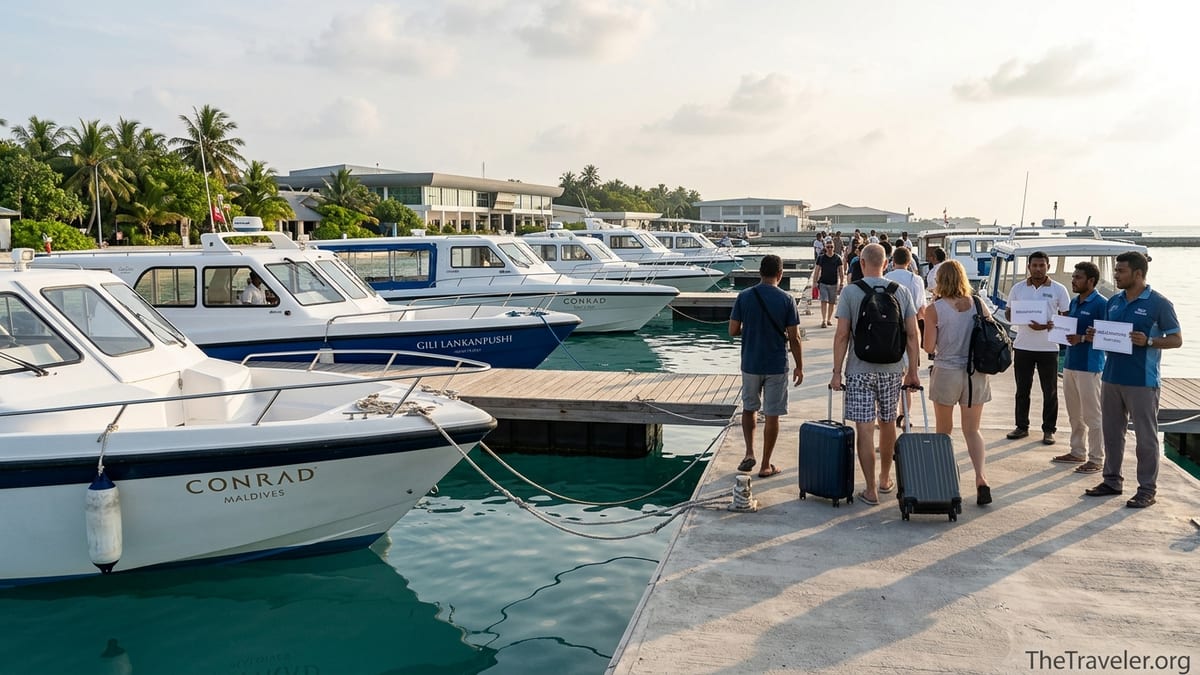
How Speedboat Transfers Work From Velana International Airport
Velana International Airport sits on Hulhulé Island, across a narrow channel from Malé. From here, speedboat transfers fan out mainly across North Malé Atoll, South Malé Atoll, parts of Vaavu Atoll, and closer areas of Ari Atoll. Resorts within roughly 60 to 80 kilometers of the airport typically use speedboats as their main transfer option, while more distant islands rely on seaplanes or domestic flights with a connecting boat.
After you clear immigration, collect your baggage, and pass customs, you step into the arrivals hall of the main international terminal. This is where most resort representatives and transfer agents wait with name boards. For example, guests of Meeru Island Resort are met by Crown & Champa Resorts airport staff just outside the arrivals exit, who then guide them directly to the correct speedboat jetty. Similar arrangements apply to properties like Adaaran Select Hudhuranfushi, which sits about 30 minutes by speedboat from the airport under normal sea conditions.
Speedboat transfers operate as a mix of scheduled shared boats and private charters. Resorts such as Meeru usually run shared boats timed to cluster around the day’s international arrivals, while independent operators run fixed-schedule boats to popular local islands like Maafushi, Ukulhas or Fulidhoo. In most cases, you do not buy a ticket at a public counter inside the terminal. Instead, you either prepay the resort for a bundled transfer or book a separate transfer service that sends you a confirmation with instructions on where to meet their representative in the arrivals hall.
Because aircraft and boats are not perfectly synchronized, a short waiting time at the airport jetty is normal. Visitor surveys in the Maldives report that most travelers using speedboats wait less than about 30 minutes before boarding. In peak times or bad weather this can stretch longer, so it is wise to keep some water, snacks, and a light jacket or shawl handy in your hand luggage in case you spend time on an open jetty.
Meeting Your Boat: Terminals, Jetties and Signboards
All international passengers currently arrive into the main Velana International Airport terminal, even as expansion continues. Once you exit customs into the arrivals hall, you will see a mix of resort counters and staff holding signs. Major resort groups often cluster together. For example, guests staying at resorts under the Crown & Champa umbrella or at LUX* properties are met by uniformed staff right outside the arrivals doors, holding branded boards and sometimes guest name lists. Smaller guesthouses and local-island hotels usually send one representative with a simple printed sign.
If your transfer is arranged through a resort, your confirmation email should clearly state who will meet you and what sign to look for. Paguro Maldives, which organizes speedboats to Ukulhas in Ari Atoll, specifically advises guests to share flight details as soon as tickets are booked. On arrival, a Paguro representative typically waits at the exit holding a “Paguro” sign and then escorts guests to the correct boat. Tour operators and destination management companies do something similar, often adding a WhatsApp contact in case you struggle to find them in the crowd.
The speedboat jetties are a short walk from the terminal. You may either walk with your representative along the waterfront or be taken by a small shuttle vehicle if the boat departs from a slightly more distant pier. The most important practical point is that you almost never need to negotiate directly with boat crews on the dock. Your name should already be on a manifest linked to your resort or local-island booking. If anyone at the jetty pressures you to board without your name on a list or offers a “cheaper” last-minute deal that does not match your booking paperwork, politely decline and call your hotel or pre-booked transfer contact first.
For self-arranged local-island trips where you are using a public or semi-public speedboat, you may be asked to meet at a specific counter in the arrivals hall, a café near the waterfront, or at a small office in Malé or Hulhumalé, depending on the company. It is crucial to read the meeting instructions carefully before you fly, as missing the group can mean waiting several hours for the next boat.
Resort Speedboat Transfers: What to Expect and Typical Costs
For resort stays, transfers are almost always organized directly by the property and added to your bill. Many travelers are surprised to learn that these transfers can be one of the biggest extra costs of a Maldives holiday. While exact figures change regularly, in 2026 a shared return speedboat transfer to a midrange resort in North Malé Atoll typically falls in the region of 100 to 250 US dollars per adult, with reduced rates for children, and higher prices for private or luxury boats.
As a concrete example, a resort about 45 minutes from the airport in South Malé Atoll might charge approximately 180 to 220 US dollars per adult for a round-trip shared speedboat, billed together with your room. Closer islands, such as those with a 20 to 30 minute transfer, often price return transfers in a lower band. On the luxury end, private speedboat charters for couples or families can reach several hundred dollars one-way, particularly during peak season or for larger, high-speed vessels with air-conditioned cabins.
The resort or tour operator will usually ask for your international flight details at least several days before arrival. This allows them to allocate you to the closest suitable transfer. Some resorts run fixed departures, for example a combined speedboat schedule every one to two hours during the afternoon to line up with inbound long-haul flights. Others will cluster guests whose flights arrive within a similar window to minimize waiting time. If your flight is significantly delayed, resort staff at the airport can often move you to a later shared boat or organize an additional trip, sometimes with a surcharge if it runs outside normal hours or carries only a few passengers.
On the return journey, resort front desks will confirm your transfer time the day before departure. Boats are generally scheduled to have you back at Velana at least three hours before an international flight, and often more for big long-haul departures. For instance, if you are staying 50 minutes from the airport with a 9:30 a.m. departure to Europe, you might be asked to board a resort speedboat around 5:30 or 6:00 a.m. to account for possible choppy seas, boarding, and check-in queues.
Maafushi and Other Local Islands: Shared Speedboats and Ferries
Maafushi in South Malé Atoll has become one of the best-known budget bases in the Maldives, and reaching it from Velana International Airport is straightforward if you plan ahead. The crossing by speedboat typically takes around 30 to 35 minutes under normal conditions. Several companies and guesthouses sell seats on scheduled shared boats that run multiple times per day between the airport, Malé and Maafushi. Recent traveler reports in 2025 and 2026 mention one-way fares in the region of 15 to 25 US dollars per person for these boats, though prices vary by operator, time of day, and demand.
Daily schedules change from time to time, but a common pattern is three or more departures during the day from the Malé area to Maafushi and similar frequencies in the opposite direction. Many visitors arrange their speedboat through their Maafushi guesthouse, which then provides an exact departure time and meeting point, often an office address in Malé or a staff member waiting at the airport arrivals hall if you request an airport pickup. For example, some hotel packages list shared boats at mid-morning, early afternoon and late afternoon, such as around 9:15 a.m., 1:15 p.m. and 5:15 p.m., subject to confirmation.
Budget travelers can also use the public ferry network. A public ferry between Malé and Maafushi typically departs once per day in the mid-afternoon on most days except Friday, taking around 90 minutes to 2 hours for the crossing. The fare is significantly cheaper than a speedboat, generally just a few US dollars equivalent in local rufiyaa. The trade-off is a fixed schedule and the need to transfer from the airport island to Malé by local ferry or taxi boat first, then find the correct public jetty. This option works best for travelers arriving before midday and comfortable navigating on their own.
Other local islands such as Fulidhoo in Vaavu Atoll, Ukulhas in Ari Atoll or Dharavandhoo in Baa Atoll are also connected by shared speedboats that may start or finish at the airport. For instance, Ukulhas currently has twice-daily speedboats that run between the island and Velana or Malé, with operators asking guests to share flight details in advance so they can coordinate departures. These services are especially popular with independent divers, backpackers, and travelers splitting their stay between two or three different islands.
Late Arrivals, Missed Boats and Overnight in Malé or Hulhumalé
One of the most common worries for first-time visitors is what happens if their international flight lands late in the afternoon or evening. Speedboat transfers have more flexibility than seaplanes, which are usually restricted to daylight hours, but they are still limited by weather, crew duty times, and local regulations. In practice, many resorts and local-island operators will run boats into the evening, especially for islands close to the airport. However, if your plane is very late or the sea is rough, your transfer may be postponed to the next morning.
If you know in advance that you will land in Malé after about 8:00 or 9:00 p.m., it is sensible to discuss options with your resort or guesthouse before you book flights. Some properties will confirm in writing that they can arrange a private or shared boat even for late-night arrivals, sometimes with an added surcharge. Others will recommend that you plan to stay one night in Malé or nearby Hulhumalé instead. Many travelers choose a simple overnight hotel near the airport ferry terminal or on the reclaimed island of Hulhumalé, then transfer by speedboat or public ferry the following morning in daylight.
Missed connections are usually handled individually. If your inbound flight is delayed by an hour or two, most resorts will simply move you to the next shared speedboat in their schedule, while local-island operators may wait a little longer at the airport if several guests are on the same flight. For serious delays, for example an unplanned arrival close to midnight, the most realistic scenario is an overnight stay in or near the capital, with your resort or guesthouse helping you arrange a room and confirming the next-day transfer. Travel insurance that covers missed connections can be useful for recovering some of these extra costs.
On departure, it is important not to cut your timings too fine. If you are staying on a local island that uses third-party shared speedboats, always tell them your international flight details rather than just asking for “the last boat.” Regular early-morning departures back to the airport exist from Maafushi and other popular islands, and recent itineraries in 2026 describe successful connections for 10:30 a.m. flights using a 7:00 a.m. speedboat. Still, seas can be unpredictable, so aim for a buffer of several hours between your planned boat arrival at Velana and your flight’s scheduled take-off.
Luggage, Safety and Sea Conditions
Speedboats in the Maldives are designed around typical tourist luggage loads, so standard checked suitcases, backpacks and hand luggage are usually accepted without issue. For resort-organized transfers, baggage is often tagged at the airport and brought directly to the boat by staff, then offloaded at the resort jetty where porters take it to your villa. Local-island boats are more hands-on: you may be asked to help place your bags in the bow or stern storage area, particularly on smaller vessels.
If you are carrying bulky items like dive gear, surfboards or camera cases, inform your resort or boat operator in advance. Many will accept them without extra charge if space allows, but some may apply a fee or require advance notice to ensure there is sufficient room and balance on board. Breakable items should go in your hand luggage and be kept off the floor, as sea spray and small puddles are common. It is also wise to pack a small dry bag for electronics and important documents.
In terms of safety, reputable operators use life jackets, radios, and experienced local captains who know their home atolls well. Still, you should expect a physical experience, especially in the wet season. Boats can bang over swells at speed, and spray may enter the cabin. If you are prone to seasickness, consider taking motion-sickness medication 30 to 60 minutes before departure and request a seat farther back in the boat where the motion is often slightly less intense. Families with small children often appreciate early-morning or late-afternoon crossings when the sea can be calmer and the sun less fierce.
Weather in the Maldives divides broadly into a drier northeast monsoon from roughly December to March and a wetter southwest monsoon from about May to October, with shoulder periods in between. During the wet season, more frequent rain showers and stronger winds can affect speedboat comfort and punctuality, even when air temperatures remain warm. Operators may delay or slow crossings in rough seas, so build some flexibility into your plans. Conversely, during settled dry-season spells, the water may be glassy calm, making crossings pleasant and sometimes spectacular, especially when you can see coral reefs flickering below the surface.
Booking, Payment and Practical Money Tips
For resort stays, you typically do not need to book a speedboat separately. The resort will quote the transfer price when you reserve your room, and the cost is added to your final bill. Always read your confirmation carefully: some packages advertise “return transfers included,” while others list transfers as a mandatory extra payable in cash or by card at checkout. To avoid surprises, ask for an approximate total cost including all taxes and service charges and confirm whether children receive reduced rates or free transfers.
Travelers heading to local islands often have more freedom and responsibility. Many guesthouses will ask if you want them to reserve a shared speedboat on your behalf. This can be convenient, as they know the current timetables and companies. Payment might be made in cash on boarding, via bank transfer, or through the guesthouse bill. Recent budget itineraries for 2026 suggest that couples planning a week across Maafushi and other islands typically set aside a few hundred US dollars in total for shared speedboat transfers, SIM cards and smaller incidentals.
US dollars and local Maldivian rufiyaa are both widely accepted for transfers. Some operators quote prices in dollars but accept payment in rufiyaa at a stated conversion rate. It is a good idea to change a modest amount of cash at the airport on arrival or to withdraw from an ATM in the arrivals hall. While card payments are common at resorts, smaller boat operators and local guesthouses may prefer cash, especially if you are paying on the day.
Keep your transfer confirmations, resort contact details and any WhatsApp numbers easily accessible on your phone. If your flight is delayed or if you cannot find your representative, sending a quick message or making a call from the arrivals hall can often resolve the issue on the spot. Screenshots of schedules and meeting instructions are valuable, as mobile data can be patchy immediately on landing before you purchase or activate a local SIM.
The Takeaway
Speedboat transfers are the essential bridge between Velana International Airport and the reef-fringed islands that draw travelers to the Maldives. With a little preparation, they can be straightforward and even memorable, offering your first real glimpse of the lagoons and atolls laid out in the sun. Understanding how resort-organized boats differ from public and semi-public services to islands like Maafushi, knowing where to find your representative in the arrivals hall, and planning around late flights or choppy seas will help you start and end your trip with far less stress.
Before you fly, confirm your transfer type, approximate cost, and operating hours directly with your resort or guesthouse. Share your flight details early, keep some flexibility for weather and delays, and budget realistically for boat transfers as part of your overall trip. Whether you are gliding across calm water toward a private villa or bouncing over waves to a laid-back local island, a smooth speedboat journey sets the tone for the days you will spend in the turquoise shallows beyond Velana Airport.
FAQ
Q1. Do I need to book my speedboat transfer from Velana Airport in advance?
It is strongly recommended to arrange your transfer before you fly. Resorts almost always book your speedboat automatically once you share your flight details, while local-island travelers should coordinate with their guesthouse or a reputable transfer company to secure a seat on a scheduled boat.
Q2. How much does a typical speedboat transfer cost in the Maldives?
Prices vary widely. Shared return speedboat transfers to nearby resorts often fall in the range of about 100 to 250 US dollars per adult, while shared boats to local islands like Maafushi may cost in the region of 15 to 25 US dollars one-way. Private or luxury boats are more expensive.
Q3. How long does it take to reach Maafushi from Velana International Airport?
Under normal conditions, the speedboat ride to Maafushi takes around 30 to 35 minutes. If you use the public ferry via Malé instead, the overall journey is longer, typically 90 minutes to 2 hours for the ferry leg plus transfer time between the airport island and Malé.
Q4. What happens if my international flight is delayed and I miss my boat?
If your flight is delayed by a short time, resorts and many local operators will usually move you to the next available shared boat. For serious delays late at night, you may need to stay in Malé or Hulhumalé and complete your transfer the next morning. Always contact your resort or boat operator as soon as you know about a delay.
Q5. Are speedboat transfers safe for children and non-swimmers?
Reputable operators provide life jackets and use experienced crews. Children and non-swimmers should wear life jackets and sit inside the cabin or toward the back where movement can be gentler. If anyone in your group is nervous, mention it to the crew when boarding so they can help you choose suitable seats.
Q6. Will bad weather cancel my speedboat transfer?
Strong winds, heavy rain or rough seas can delay or occasionally cancel speedboat journeys. Operators may wait for conditions to improve or reduce speed for safety, extending travel time. In rare cases, transfers are postponed until the next safe window. During the wet season, it is wise to build some flexibility into your arrival and departure plans.
Q7. Is there a luggage limit on Maldives speedboats?
Most resort boats are designed to handle standard airline baggage allowances without extra fees, though very heavy or oversized items should be mentioned in advance. Shared local-island boats can be more constrained. If you are carrying surfboards, dive gear or large camera cases, confirm with the operator before travel to avoid surprises.
Q8. Can I pay for my speedboat transfer by card or should I carry cash?
Resort-organized transfers are usually added to your room bill, payable by card or cash at checkout. Independent operators serving local islands may accept cash only or charge a fee for card payments. Carrying some US dollars or Maldivian rufiyaa is practical for on-the-spot payments or tips.
Q9. How early should I leave my island to catch my return flight from Velana?
Most resorts schedule your return boat so that you arrive at the airport at least three hours before your international departure. From local islands reached by shared speedboat, aim to be back at Velana four or more hours before your flight to allow for possible delays, check-in, and security.
Q10. Where exactly do I meet my speedboat representative at Velana Airport?
In almost all cases you meet your representative just outside the exit of the international arrivals hall, where resort and transfer staff stand with signboards. Your booking confirmation should state the company name and sometimes a counter number or WhatsApp contact. If you are unsure on arrival, stay in the arrivals hall area and call or message your hotel rather than leaving the building.