


Landing at Velana International Airport in Malé is an unforgettable moment: turquoise lagoons out the window, tiny islands scattered like beads, and the promise of an overwater villa just a transfer away. What often surprises first-time visitors, however, is that reaching the resort can take almost as long, logistically, as the international flight itself. The Maldives is a nation of far-flung atolls, and nearly every resort requires a carefully coordinated speedboat, seaplane or domestic flight plus boat connection from the main airport. Understanding what happens after landing will make the difference between a stressful arrival and a seamless slide into island time.
Get the latest updates straight to your inbox!
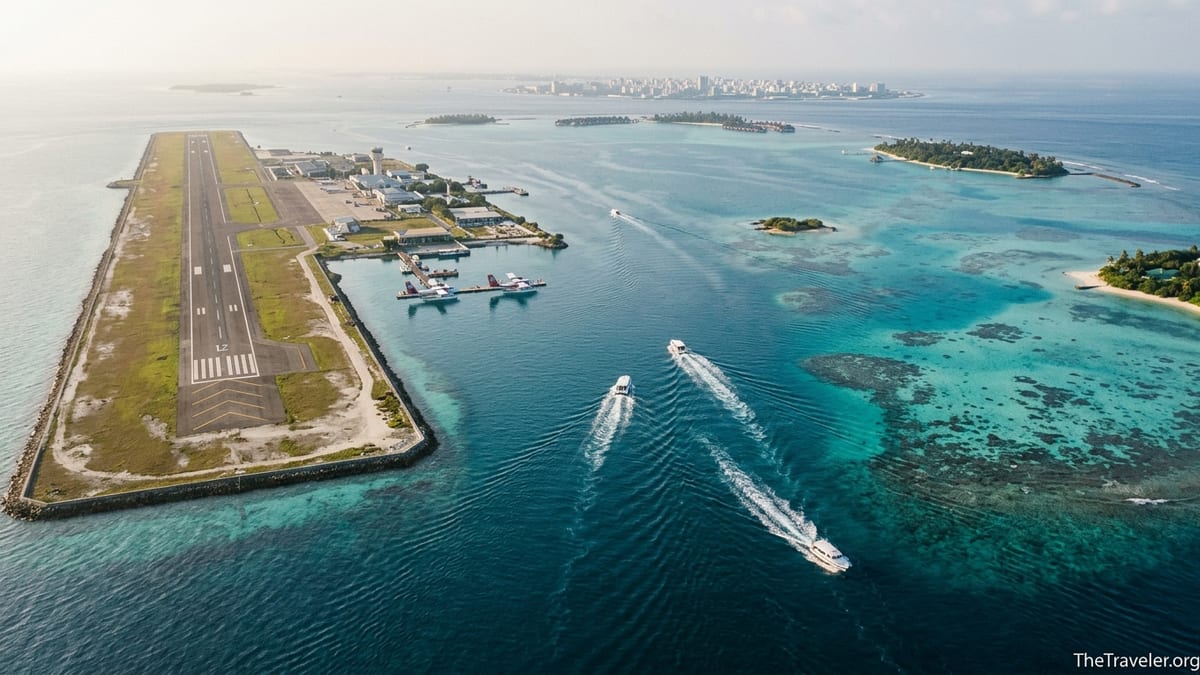
What Happens When You Land at Velana International Airport
Most international flights into Velana International Airport (MLE) arrive on the main airport island of Hulhulé, just off the capital Malé. After disembarking, you follow standard airport procedures: immigration, baggage claim and customs. Depending on how many flights arrive at the same time, this can be very quick or take up to an hour at peak periods, especially in high season from December to March.
For most travelers, the crucial detail is that resort transfers are almost always arranged by the resort itself rather than booked independently. As you exit customs into the public arrivals hall, you will see a long wall of resort and airline counters, typically organized alphabetically. Staff from properties such as Kurumba Maldives, Meeru Island Resort, Hard Rock Hotel Maldives and many others wait here holding resort signs and guest name lists, ready to escort arriving guests to the correct pier or terminal.
If your transfer is by speedboat, the resort team normally escorts you across the short outdoor walkway to the marina area on the same island. If you are continuing by seaplane, they will check you in with the seaplane operator, often Trans Maldivian Airways or Manta Air, and then transfer you by shuttle bus to the seaplane terminal on the other side of the runway. For domestic flights, staff help you check in with the appropriate local airline for your onward flight to an atoll airport.
The process is fairly hands-off once you connect with your resort representative. In many cases they will handle your bags from the arrivals hall onward, apply the required seaplane luggage tags, and provide you with a rough idea of waiting time before your onward transfer departs. This is also the moment to confirm your international departure details so the return transfer can be scheduled correctly.
Speedboat Transfers: Closest Resorts and Fastest Turnaround
Speedboats are the most common transfer for resorts located within roughly 80 kilometers of Velana International Airport, particularly in North Malé and South Malé Atolls and some nearby islands of Vaavu and Ari. Many well-known properties fall into this category, including Kurumba Maldives, Bandos Maldives, Hard Rock Hotel Maldives and Meeru Island Resort. Travel times typically range from about 10 minutes to just under 2 hours, depending on distance and sea conditions.
Once you meet your resort representative in the arrivals hall, you are usually guided directly to the pier. For example, guests heading to Kurumba Maldives often board a shared speedboat for the 10 to 15 minute ride across the channel, while those going to Meeru Island can expect approximately a 50 to 60 minute journey. Resorts like Holiday Inn Resort Kandooma in South Malé Atoll quote around 45 minutes by speedboat from Velana, illustrating the mid-range of typical transfer times.
Speedboat transfers are almost always charged per person, round trip, and can add a noticeable cost to the holiday. As a rough guide in 2026, resorts tend to charge in the region of around 100 to 490 US dollars per adult for a shared round-trip speedboat transfer, with children discounted and infants often complimentary. At some high-end properties, luxury shared or private boats can cost significantly more. For example, guests staying at ultra-luxury resorts in the Fari Islands have reported per-person shared-luxury-boat rates in the high hundreds of US dollars, while a fully private boat for a couple can easily exceed 2,000 US dollars for the round trip.
On the water, conditions depend on the season. During calm periods, the ride can be smooth and scenic, with views of Malé city, passing islands and sandbanks. During rougher monsoon seas, particularly in the southwest monsoon from May to October, the ride can be bumpy and may feel uncomfortable for those prone to motion sickness. Boat size matters here: larger resort vessels often handle rough conditions better than small charter speedboats. Resorts will generally delay departures or adjust schedules in case of unsafe conditions, which can extend waiting times at the airport.
Seaplane Transfers: Iconic Views and Daylight-only Flights
For resorts located further from Malé, especially in atolls like Baa, Lhaviyani, Noonu and outer Ari, seaplane transfers are the standard option. These flights are operated by carriers such as Trans Maldivian Airways and Manta Air from dedicated seaplane terminals at Velana. Resorts like Anantara Kihavah in Baa Atoll, Nala Maldives, and Alila Kothaifaru typically quote seaplane flight times between 25 and 45 minutes, depending on the route and intermediate stops.
After you clear immigration and meet your resort host, you are transferred by shuttle bus to the seaplane terminal. Here, check-in feels more relaxed than a conventional airport but still follows standard aviation rules: your checked luggage is weighed, and your hand luggage may be weighed as well. Most operators enforce strict baggage limits, commonly around 20 kilograms for checked bags plus 5 kilograms for hand luggage per person for shared flights, although exact allowances vary by resort and airline. Excess weight is either refused or charged at a per-kilogram fee that can add up quickly.
Seaplane schedules are not fixed in the way standard commercial flights are. Instead, the operator builds the next day’s flight plan the evening before based on all resort arrivals and departures. Resorts usually cannot confirm exact departure times until the day prior, and even then times remain subject to change. As a guest, this means you should expect a waiting period at the seaplane lounge. Some resorts provide access to branded lounges with refreshments, showers and Wi-Fi; others use the shared lounges of the seaplane operators.
A vital detail is that seaplanes operate only in daylight hours due to local regulations and the nature of water landings. In practice, this means roughly between about 6:30 in the morning and mid to late afternoon, often with last check-in for shared flights around 3:00 to 3:30 pm. Many resorts state that international arrivals should land at Velana by around 2:00 pm to guarantee same-day seaplane transfer. If your long-haul flight arrives later, or is significantly delayed, you may need to stay overnight in Malé or on the nearby island of Hulhumalé and continue to the resort the next morning.
Domestic Flight plus Boat: Reaching the Remote Atolls
For the most distant atolls, particularly in the far south such as Gaafu Dhaalu or Haa Alifu in the north, resorts often rely on a combination of domestic flight to a regional airport followed by a short speedboat hop to the final island. In this scenario you remain on conventional runways rather than using seaplanes, flying on turboprop aircraft operated by domestic airlines to airports like Kooddoo, Dharavandhoo or others, and then transferring to resort boats waiting at the local harbor.
The process after landing in Malé is similar to a seaplane transfer at first. Your resort representative meets you, helps you check in for the domestic flight at the main terminal and guides you through security. Once you land at the regional airport, another resort team or the same host traveling with you will escort you directly to the pier. The final speedboat leg is usually quite short, often between 10 and 30 minutes, crossing the inner reef channels to reach the resort island.
Travel times for this combination can be significant compared with closer atolls. A domestic flight might take around 45 to 60 minutes depending on routing, and can involve intermediate stops at other islands. When you add check-in time, potential waiting periods and the final boat leg, door-to-door travel from Velana to some of the most remote luxury resorts can approach 3 to 4 hours. On the other hand, this option is more reliable in poor weather than seaplanes, because domestic flights use conventional runways and can operate after dark.
Domestic flight plus boat transfers are typically priced per person, round trip, much like seaplanes. Current indicative ranges in 2026 often fall between about 350 and 520 US dollars per adult for the full combination to many remote-resort regions, with some variation depending on distance and class of resort. These costs are usually added to the room bill and paid at check-out, but guests should always verify the exact rates and inclusions with the resort at the booking stage, since this can be one of the largest additional expenses of a Maldives holiday.
How Resort-arranged Transfers Really Work
Almost every private-island resort in the Maldives handles transfers as an integrated part of the stay rather than leaving guests to arrange their own boats or flights. When you book a resort, whether directly or through an agent, you are typically asked to provide your international flight details no later than a few days before arrival. Some properties, particularly those dependent on shared seaplanes, ask for details at least 5 to 7 days in advance so they can coordinate with the transfer operators.
On arrival day, resort transfer desks at Velana track incoming flights and adjust timings when aircraft arrive early or late. If your plane is delayed, the resort will try to move you to a later speedboat or seaplane where possible. In practice, this can mean sharing a boat or plane with guests from one or more other flights to make the most efficient route. Private transfers, where you have a dedicated speedboat or chartered seaplane just for your party, are possible at extra cost, but are usually booked well in advance.
The main implication for travelers is that prices and terms for transfers are controlled by the resort and its chosen partners. At popular upscale properties near Malé, shared speedboat transfers are often mandatory, and third-party operators or public ferries are not allowed to drop at the private jetties. This is partly for security and partly because of how resort operations are licensed. In more budget-focused or guesthouse-oriented islands, especially those that are inhabited local islands rather than standalone private resorts, you may find public speedboat or ferry options at much lower prices, but they connect to village harbors, not private resort docks.
One practical example illustrates the difference. Guests staying at a private island resort a short speedboat ride from Malé might be quoted about 250 US dollars per person round trip for the resort’s shared boat, with no option to use the public ferry that serves a nearby local island. Meanwhile, travelers heading to the guesthouses on Maafushi, a popular local island, can take a scheduled public speedboat directly from the airport or Malé for a price often quoted around the tens of US dollars per person one way. The experiences and expectations are different, and so are the transfer ecosystems.
Luggage, Weight Limits and What Happens to Your Bags
For speedboat-only resorts, luggage is relatively straightforward. After you collect your bags at Velana, resort staff tag them and load them onto the boat. There is rarely a strict checked-baggage weight limit beyond what your international airline already imposed, although extremely large or heavy items, such as surfboards or professional camera cases, should always be declared in advance to ensure the boat and staff can handle them.
Seaplane and domestic-flight transfers are more tightly controlled. Operators typically impose per-person weight limits that are lower than many intercontinental airlines. A common pattern is around 20 kilograms for checked luggage plus 5 kilograms for hand luggage, with excess charged per kilogram. Some resorts include a modest allowance for sports equipment, while others charge separately. Because seaplanes are small and weight-sensitive, staff often weigh all bags together with the passengers, and may ask you to repack if you are significantly over the limit.
It is also common for luggage to arrive separately from you when seaplanes are running at capacity. For instance, if your bags are particularly heavy or the aircraft is close to its weight limit, they might be sent on the next available flight. Resorts are used to this scenario and will deliver bags to your villa once they arrive, but you should keep essentials and a change of clothes in your hand luggage just in case. On domestic flights, separation of bags and passengers is less common but can still happen during busy periods.
For all transfer types, make sure any valuables, medications, electronics and travel documents stay in your hand baggage. Boats and planes in the Maldives can be exposed to salt spray, high humidity and occasional splashes when loading at lagoon jetties. Hard-shell luggage tends to fare better than soft fabric cases in these conditions, especially for seaplane transfers where bags can be handled on floating pontoons and open docks.
Waiting Time, Jet Lag and Overnight in Malé or Hulhumalé
How long you wait at Velana before boarding your onward transfer depends on your arrival time, the transfer type and how tightly your resort and the operators are running their schedules that day. For nearby speedboat resorts in North and South Malé Atolls, waits can be very short: it is not unusual to be on a boat within 30 to 60 minutes of clearing customs. Resorts with frequent shared boats may consolidate guests from several arriving flights, but the turnaround is generally fast because the marina is just a few minutes’ walk from the terminal.
With seaplanes and domestic flights, longer waits are common. Seaplane operators group passengers by atoll and route, and aircraft shuttle back and forth between clusters of islands. This can mean waiting an hour or more in the seaplane lounge, particularly if you arrive early in the morning or just after a major bank of flights has departed. When flights are delayed by weather or operational issues, waits can stretch to several hours. The upside is that lounges are usually air-conditioned and offer drinks, snacks and Wi-Fi, and some resorts maintain comfortable private lounges with showers and nap areas.
If your international arrival is late in the afternoon or evening and you need a seaplane, most resorts will recommend or require an overnight stay near the airport, either in Malé or in the neighboring island-city of Hulhumalé. These islands are connected by a bridge, and taxis and airport shuttles move between them in under 15 minutes. Airport hotels and simple guesthouses provide a practical base to sleep, adjust to the time zone and then return to the airport for an early morning seaplane or domestic connection.
On the departure side, similar constraints apply in reverse. Resorts that rely on seaplanes typically require your international flight to depart after around 9:00 am to ensure you can safely connect from the island by daylight. For very early-morning long-haul flights, you may be transferred back to Malé or Hulhumalé the afternoon or evening before and need to spend the final night of your trip on the “mainland” rather than at the resort. Guests should factor this into trip planning, particularly if they want to maximize nights in overwater villas.
The Takeaway
Travel from Velana International Airport to your Maldives resort is an integral part of the overall experience, but it is not as straightforward as stepping into a taxi. Whether you speed across the inner atolls by boat, skim the turquoise lagoons in a seaplane, or hop a domestic flight to a far-flung atoll, you are working within a finely tuned but weather-sensitive system of boats and planes that link dozens of private islands to the outside world.
A smooth journey starts months before departure with clear communication of your international flight details to the resort and a realistic assessment of arrival and departure times. Build in margin for seaplane operating hours, expect waiting time at Velana and be prepared for luggage weight limits that are stricter than those on your long-haul flight. Keep essentials in your hand baggage, plan for possible overnight stops in Malé or Hulhumalé if your schedule does not align with daylight transfers, and budget carefully for transfer costs, which often rival or exceed the price of a regional flight.
Above all, treat the transfer as the first chapter of your Maldives story rather than a hurdle to clear. The moment the skyline of Malé falls behind the stern of a speedboat, or your seaplane lifts off from the lagoon and the atolls unfurl beneath you like a chain of turquoise rings, you will understand why the journey from Velana to your resort is as much a part of the Maldives as the white-sand beaches waiting at the other end.
FAQ
Q1. Do I need to book my Maldives resort transfer separately from my hotel?
In most cases no. Private-island resorts arrange transfers directly and will add the cost to your room bill, but you must send your international flight details in advance so they can schedule you on the correct speedboat, seaplane or domestic flight.
Q2. How long does it take to get from Velana International Airport to my resort?
It depends on distance and transfer type. Nearby speedboat resorts can be as little as 10 to 20 minutes from the airport, while seaplane or domestic-flight resorts in outer atolls may take 1.5 to 4 hours door to door, including waiting time.
Q3. How much should I budget for transfers in the Maldives?
As a broad guide for 2026, shared round-trip speedboat transfers commonly run from roughly 100 to 490 US dollars per adult, shared seaplane transfers around 400 to 820 US dollars, and domestic flight plus boat combinations about 350 to 520 US dollars, with luxury properties sometimes charging more.
Q4. What happens if my international flight is delayed?
If you are using a resort-arranged transfer, staff at Velana monitor flight times and will usually move you to the next available boat or plane. For seaplanes, if you arrive after daylight flying hours or too late for the last departure, you may need to stay overnight in Malé or Hulhumalé and continue to the resort the next morning.
Q5. Can I arrange my own cheaper transfer instead of using the resort?
For private-island resorts, usually not. Most do not accept third-party boats at their jetty and require you to use their contracted transfers for security and operational reasons. On local inhabited islands with guesthouses, you can often use public ferries or scheduled public speedboats that cost far less but do not serve private resort docks.
Q6. Are there strict luggage limits on Maldives transfers?
Speedboats are fairly flexible, but seaplane and domestic-airline transfers have defined weight allowances, often around 20 kilograms checked plus 5 kilograms hand luggage per person. Excess baggage is subject to availability and usually charged per kilogram, so keep essential items and one change of clothes in your carry-on in case bags are delayed.
Q7. Do seaplanes in the Maldives fly at night?
No. Shared seaplane services operate only during daylight hours, typically from early morning to mid or late afternoon. If your international flight arrives too late to connect, your resort will usually advise an overnight stay near the airport and transfer you by seaplane the next day.
Q8. Will I have to wait long at the airport before my transfer?
For nearby speedboat resorts, waits are often 30 to 60 minutes after clearing immigration and customs. For seaplanes and domestic flights, waits of 1 to 3 hours are common, especially in busy seasons or during weather disruptions, though you will normally wait in an air-conditioned lounge with refreshments.
Q9. Is the speedboat ride to my resort rough?
It depends on sea conditions and the season. During calm periods, rides are usually smooth and scenic, but during monsoon or windy days they can be bumpy. Larger resort boats generally handle swell better, and if the sea is too rough, departures may be delayed until conditions improve.
Q10. What should I keep in my hand luggage for the transfer?
Keep passports, money, medications, electronics, chargers, swimwear, sunscreen and at least one change of light clothing. This covers you in case your checked bag arrives on a later seaplane or boat, and protects valuables from the humidity and occasional splashes involved in lagoon and pier operations.