


Venice Carnival 2027 will officially run from 23 January to 9 February 2027, and you do not need an expensive private masquerade ball to experience it. With careful planning, free street performances, smart accommodation choices and an understanding of transport and access rules, you can enjoy the heart of the celebrations on a reasonable budget.
Get the latest updates straight to your inbox!
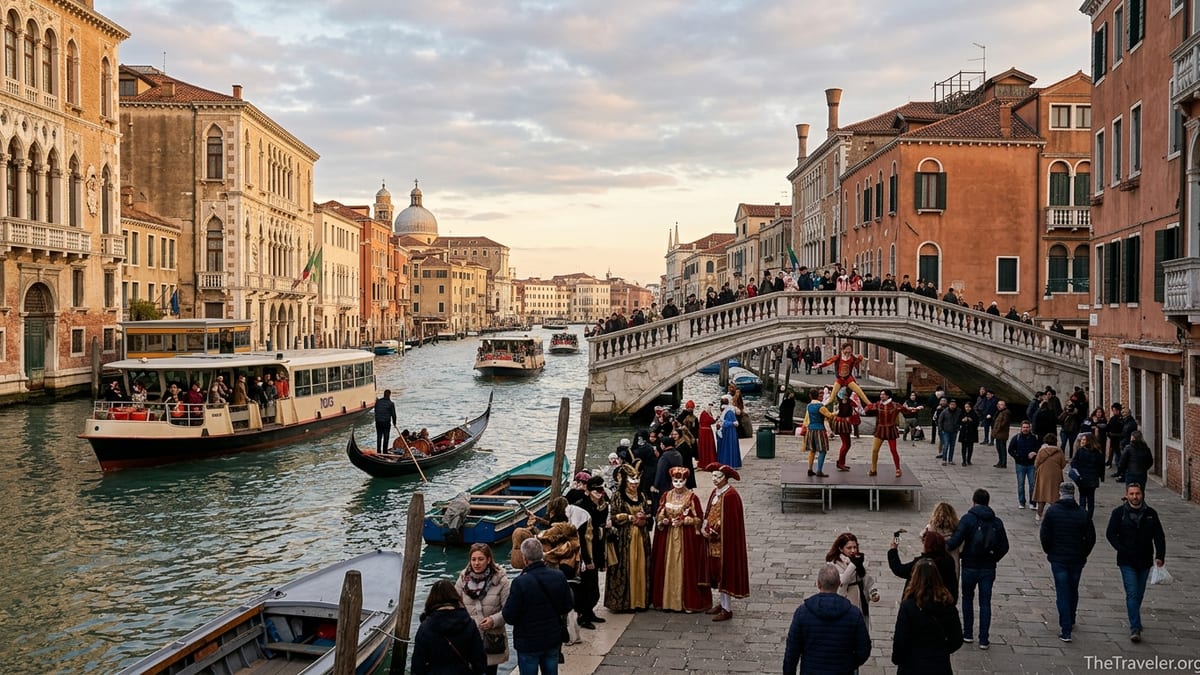
Key 2027 Carnival dates and how the program is structured
The City of Venice has confirmed that Carnevale di Venezia 2027 will take place from Saturday 23 January to Tuesday 9 February 2027, ending on Shrove Tuesday. The official calendar clusters events into preview weekends, a fuller middle period and an intense final stretch leading up to Martedì Grasso. While exact times and some details may still shift, these dates are now widely referenced across official and tourism sources.
Within those overall dates, the Venice Carnival Street Show is planned for three main blocks: the opening weekend of 23–24 January, the second weekend of 30–31 January, and a continuous run from 4–9 February 2027. These are the periods when you can expect a dense program of open-air performances in squares across Venice’s historic center, in Mestre on the mainland and on some lagoon islands. The core idea is art “diffused” throughout the city, so you encounter acrobats, musicians and theater troupes simply by walking.
In addition to the street shows, the official program is expected to include traditional ceremonies such as the Angel’s Flight from the Campanile in Piazza San Marco, costume and mask parades, rowing events on the Grand Canal and an official Carnival Dinner Show that is already announced for late January and 4–9 February 2027. Times and formats can change from year to year, so anyone visiting should cross-check dates close to departure against the municipal Carnival website and tourist office information on arrival.
For planning a budget trip, it helps to distinguish four broad phases. The opening weekend offers a lighter, mostly local atmosphere with the first Street Show previews. Weekdays in late January are quieter, with fewer programmed events but lower-price accommodation. The main performance period runs from 4–9 February with nightly street shows, parades and the official dinner shows. Finally, the last Saturday to Tuesday, 6–9 February 2027, are the most crowded and expensive dates, when hotel prices peak and Piazza San Marco becomes difficult to cross quickly.
Free street shows versus paid Carnival experiences
The Venice Carnival Street Show is designed as a free program. Performances scattered across squares such as Campo San Geremia, Campo Santa Margherita, Campo San Cassiano, Piazza San Marco and in Piazza Ferretto in Mestre do not require tickets. Audiences simply gather, watch and, when moved to do so, may offer small cash tips or digital contributions to artists. This makes the Street Show one of the best-value ways to enjoy Carnival atmosphere without paying for formal events.
Free outdoor highlights usually include informal mask gatherings in Piazza San Marco and around the Rialto Bridge, spontaneous parades through Cannaregio and Dorsoduro, music performances on temporary stages and costumed walks along the Riva degli Schiavoni. Visitors can take mask and costume photographs at no charge so long as they are respectful and ask for permission when focusing on a specific person rather than a crowd.
On top of the free events, the official program features ticketed experiences. The best known is the Carnival Official Dinner Show, already advertised for the nights of 30 and 31 January and every evening from 4 to 9 February 2027. Prices in recent editions have been in the region of a few hundred euros per person including show and multi-course dinner in a historic palace setting. There are also commercial masquerade balls run by private palaces and hotels where tickets can easily start around several hundred euros and rise sharply for VIP tables and costume rental.
Other paid activities during Carnival include museum admissions, such as the combined ticket for the Doge’s Palace and Correr Museum, and short-term costume rentals from specialist ateliers in San Polo or Castello that may charge well over one hundred euros per day for elaborate period outfits. For a budget-focused visit, you can skip these and instead concentrate on the free Street Show, window-shopping in mask workshops and visiting one or two smaller churches or scuole that charge modest entry fees compared with gala events.
Accommodation costs: Venice districts versus Mestre and mainland
Accommodation prices are the biggest variable in a Carnival budget. In the historic center, a simple double room that might cost somewhere between 120 and 180 euros on a regular January weekend can climb to 250 to 350 euros or more on the final Carnival weekend, especially in San Marco, San Polo and around the Rialto. Smaller guesthouses in Cannaregio or Castello sometimes remain closer to the lower end of that range, but even they tend to increase rates significantly for nights around 6–9 February 2027.
In Dorsoduro and Santa Croce, where there are more apartments and smaller hotels, prices for a basic double room or studio that might sit around 100 to 160 euros on an ordinary January weekend commonly rise into the 200 to 260 euro bracket during the last Carnival weekend. These areas balance relatively central locations with slightly fewer crowds at night, so they are popular with repeat visitors who know the city and accept the price bump for shorter walks.
On the mainland, Mestre and nearby boroughs such as Marghera generally remain cheaper. A chain hotel or modern guesthouse near Mestre station can often be booked for roughly 70 to 110 euros per night in late January, rising to perhaps 120 to 170 euros on the final Carnival weekend. Some simple two-star hotels and budget-oriented apartments stay under 100 euros even at peak if booked early. The trade-off is daily commuting time and the cost of return train or bus fares, especially late at night.
When comparing, it is important to factor in Venice’s tourist tax, which is charged per person per night and is higher in the historic center than in Mestre. While exact 2027 rates are not yet fixed, recent patterns show higher charges for four and five-star hotels and lower amounts for guesthouses and campsites. Over two or three nights, this can add up by tens of euros for a couple. Reading the tax breakdown in your booking confirmation helps avoid surprises and makes it easier to compare a central room with a slightly cheaper room on the mainland plus daily transport.
Is staying in Mestre really cheaper once you add transport and time?
On paper, saving 80 or 100 euros per night by staying in Mestre instead of Venice looks like an obvious win. A return regional train ticket between Venezia Mestre and Venezia Santa Lucia typically costs only a few euros, and buses on the Ponte della Libertà road bridge are comparably priced. Trains run frequently throughout the day and evening, often every 10 to 15 minutes in peak periods, and the ride itself takes around 10 minutes. For a two-night stay, a couple might spend roughly 20 to 30 euros in total on rail or bus fares.
The calculation shifts once you account for late-night travel during Carnival weekends. Regional trains and buses do run in the later evening, but frequencies fall, and crowds leaving Venice after the last shows can make carriages busy. Missing a train may mean waiting 30 minutes or more at Santa Lucia or Piazzale Roma when you are already tired and cold. If you end up taking a taxi from Piazzale Roma to a hotel in Mestre after midnight, a single ride can eat much of the savings you made on cheaper accommodation.
However, for longer stays of three or four nights or for visitors who prefer quieter evenings, Mestre can remain a worthwhile money saver. A solo traveler paying 60 to 80 euros per night in Mestre instead of 180 to 220 euros in Cannaregio across three nights could save several hundred euros even after accounting for transport and slightly higher access-fee risks as a day visitor. Couples who are happy to return to the mainland by 22:00 or 23:00 each night and who pre-plan train timetables often find the compromise acceptable.
The less tangible cost is time. Each day you will spend 30 to 60 minutes in total walking to and from stations and waiting for trains or buses on both sides of the bridge. During Carnival, especially on the closing weekend, bottlenecks near Santa Lucia, the Ponte degli Scalzi bridge and Piazzale Roma can slow movement further. Travelers with limited mobility or families with young children may find that paying more for a room in Cannaregio, Santa Croce or Dorsoduro, where you can simply walk back in 20 minutes, is the more comfortable choice even if it stretches the budget.
Moving around: vaporettos, walking routes and crowds
Arriving visitors either step off the train at Venezia Santa Lucia station in the historic center or at Venezia Mestre on the mainland. From Santa Lucia, you can walk directly into Cannaregio and across bridges toward the Rialto Bridge in around 20 to 30 minutes if paths are clear. Alternatively, you may board vaporetto waterbuses from the stops outside the station. The main Grand Canal lines, 1 and 2, run frequently along the canal to the Rialto area and San Marco, while additional lines serve outer districts and islands.
According to current ACTV information, the standard single vaporetto ticket for visitors is around 10 euros for 75 minutes of travel. Time-limited passes offer better value if you plan to ride several times: approximately 25 euros for 24 hours, 35 euros for 48 hours, 45 euros for 72 hours and 65 euros for 7 days. These passes cover vaporetto lines and most urban buses on the mainland. They can be bought at booths, ticket machines or via apps and must be tapped at electronic readers before boarding.
For budget-conscious Carnival visitors, walking is the most cost-effective transport within the historic center. Venice is compact, and many routes from Santa Lucia to San Marco take 35 to 45 minutes at a normal pace. During Carnival’s busiest evenings near Piazza San Marco and the Rialto Bridge, however, narrow calli can become so congested that walking times double. Police and stewards may implement one-way pedestrian flows on certain bridges, and crowds can come to a standstill in front of stages and performance spaces.
Navigating this means allowing extra time to cross the city, wearing comfortable shoes for irregular paving and consulting offline maps that show side routes through Santa Croce and San Polo to avoid the tightest corridors. In some cases, taking a vaporetto from Santa Lucia to San Marco or Salute may be worth the cost simply to bypass the slowest stretches. Late at night, vaporetto service continues at reduced frequency, including night lines, so planning the last departure toward your accommodation strengthens a budget plan by reducing the temptation for last-minute taxis.
Venice access fee in 2027 and what overnight guests must do
By 2026 Venice had introduced an access fee for day-trippers on selected peak days, charged in addition to the usual tourist tax that overnight visitors pay through their accommodation. For 2027, the city has approved a broader calendar of access-fee days spanning the main visitor season from late March through mid-August. At the time of writing, specific fee dates for January and early February 2027, including Carnival, have not been published, and city authorities have left the door open to adjust the calendar and tariffs.
Current rules indicate that overnight guests staying in registered accommodation within the Municipality of Venice, which includes the historic center and mainland boroughs such as Mestre, are generally exempt from paying the access fee itself. However, many still need to complete a simple online registration or obtain an exemption code that can be shown during spot checks. This is separate from the tourist tax and does not add cost but does require attention to official instructions sent by your hotel or apartment host.
Day-trippers who visit during chargeable periods must usually book their visit date in advance and either pay the access fee or register for an exemption if they qualify, for example because they study or work in Venice or are residents of the wider region. Penalties for entering without a valid title can include administrative fines plus payment of the maximum daily fee. Because political debate around the access fee is ongoing and the mayor has proposed dynamic pricing with a possible higher ceiling on the busiest days, Carnival 2027 visitors should verify the latest conditions a few weeks before travel.
The practical takeaway for budget planning is straightforward. If you book at least one night in a registered hotel, guesthouse or apartment within the Municipality of Venice, you will pay a tourist tax but are likely exempt from any separate day-tripper access fee, provided you register correctly. If you intend to stay in a town outside the municipality and only come in for the day, you should budget both for transport and for a possible per-person access fee if Carnival dates are designated as chargeable in 2027.
Sample budgets: day trip, two-night couple stay and premium ball
A realistic budget day trip during Carnival 2027 for one person who is watching costs closely might look like this. Return train from a nearby Veneto city such as Padua or Treviso could be around 10 to 20 euros. Add a single vaporetto ride on the Grand Canal at 10 euros, or save by walking instead. Allow 15 to 25 euros for snacks, coffee and a light lunch, perhaps a slice of pizza al taglio and cicchetti in Cannaregio, and 25 to 35 euros for an early evening sit-down meal with pasta or seafood in a mid-range osteria away from San Marco. If an access fee applies, budget its maximum published amount. Without paid balls or museums, you can experience Street Show performances, mask photography and general atmosphere within a total that many visitors keep near 70 to 120 euros for the day plus any access fee.
For a couple spending two nights in Venice on a moderate budget, one scenario would be a small guesthouse in Cannaregio at roughly 220 euros per night over the final Carnival weekend, including breakfast, for a total of about 440 euros. Tourist tax might add around 15 to 25 euros across two nights. Two 48-hour vaporetto passes at about 35 euros each add 70 euros, though fit couples could reduce this by walking and buying only occasional single rides. Food over two and a half days, mixing bakery breakfasts, counter-service lunches and one nicer dinner with wine, could realistically range between 200 and 260 euros. Allowing a small amount for coffee at bars, pastries and gelato, the couple’s total excluding flights or long-distance trains might land somewhere between 750 and 850 euros.
A traveler aiming to attend a premium masquerade ball or the official Carnival dinner show should expect a very different budget. Tickets to the official dinner show in recent years have often run into several hundred euros per person including entertainment and banquet. Private balls in historic palaces may charge on a similar scale or higher, particularly once you factor in compulsory costume rental. Renting a high-quality period costume and mask from an atelier can add another several hundred euros for a multi-day hire plus deposit. Add a centrally located four-star hotel near San Marco or on the Grand Canal, where Carnival weekend rates may reach several hundred euros per night, and it becomes easy for a single traveler’s two-night Carnival budget including a premium event to exceed 1500 euros without international travel.
For many visitors, a middle path works better. Instead of a formal ball, you might buy a ready-made mask in a workshop for 30 to 60 euros, pair it with elegant black clothing you already own and invest the savings into food, a vaporetto pass, one or two museum entries and perhaps a glass of wine at a Grand Canal bar. This approach keeps your two-night trip closer to the mid-hundreds of euros while still delivering memorable Carnival images and experiences.
Itineraries: one day focused on public celebrations and a quieter two-day stay
A one-day Carnival itinerary centered on free celebrations could begin with an early arrival at Santa Lucia station before 9:00 to avoid access-fee hours if applicable and to enjoy the city before crowds swell. Walk through Cannaregio toward Campo San Geremia and on to the Rialto Bridge, pausing for coffee and a pastry at a bar where locals stand at the counter. Late morning, follow signs toward San Marco, detouring via quieter calli through San Polo to escape bottlenecks. Around midday, Piazza San Marco normally starts to fill with elaborately costumed participants; this is a good window for photography and for watching any scheduled street performances on nearby stages.
After a simple lunch in Castello or Dorsoduro, where prices often drop compared with restaurants on the main sightlines, you can seek out Venice Carnival Street Show performances in secondary squares. Information boards and stewards usually indicate which fields are hosting acts in the afternoon. By late afternoon, consider a single vaporetto ride along the Grand Canal from San Zaccaria or San Marco back toward the railway station, using it as both transportation and a scenic mini-cruise. If staying into the evening, return toward San Marco or Campo Santa Margherita to catch more performances and glowing costumes against dark canals before making your way back to Santa Lucia in time for your train.
A two-day plan for a couple staying overnight can balance Carnival intensity with time in quieter neighborhoods. On day one, focus largely on Carnival events: morning explorations of San Polo and the Rialto markets, midday in San Marco for parades and mask competitions if scheduled, and late afternoon wandering through the calli near the Accademia Bridge and Zattere. Return to Cannaregio or Santa Croce for dinner in a less touristy osteria, then take an evening stroll along the Fondamenta della Misericordia or the Zattere for night views of the Giudecca Canal.
On day two, step back from the densest crowds. Start in the Jewish Ghetto in northern Cannaregio or on the island of Giudecca reached by vaporetto, exploring residential lanes, small churches and lagoon views. Visit one modestly priced museum or a historic scuola to deepen your understanding of Venetian art and history. Aim to re-enter the central Carnival area only in late afternoon or early evening, perhaps timed with a final Street Show performance you particularly want to see. This structure gives breathing space and variety without losing Carnival atmosphere.
For families or visitors with mobility concerns, both itineraries should be adjusted to include more seated breaks, careful selection of bridges and routes with fewer steps and, if budget allows, a vaporetto pass to avoid the most congested paths. Booking accommodation in Santa Croce or the western part of Cannaregio can shorten walking times while avoiding the highest room prices directly around San Marco.
Weather, acqua alta, accessibility and etiquette
Venice in late January and early February is cold and often damp. Daytime temperatures usually hover in the single digits Celsius, and evenings can feel colder in canal-side wind. Light rain is common, and the combination of water, algae and marble paving makes some surfaces slippery. Budget travelers should factor in the cost of adequate clothing, such as a waterproof jacket, hat and gloves, along with comfortable, non-slip shoes. Buying cheap umbrellas or plastic ponchos on the spot can be surprisingly expensive compared with bringing your own gear.
Acqua alta, the periodic high-tide flooding that can affect parts of San Marco and low-lying calli, is less frequent since the MOSE flood barrier system became fully operational but still occurs on some winter days. When it does, the city deploys raised walkways in key routes, and movement slows further. Alerts are shared locally via sirens and apps. For visitors with wheelchairs, strollers or limited mobility, acqua alta and bridges with steps present real challenges. Planning routes that follow main thoroughfares, relying on vaporetto piers with ramps and allowing plenty of time is essential.
Photography etiquette plays a significant role at Carnival. Many mask-wearers and costume enthusiasts come precisely to be photographed and will happily pose, but they still appreciate a polite request, especially for close-ups. A simple “May I take your photo?” followed by a thank you helps keep the atmosphere friendly. Avoid blocking narrow alleys for extended photo shoots, and do not touch costumes or masks without explicit permission, as many are fragile and represent substantial investment.
Finally, it is important to distinguish the official Carnival program from commercial advertisements. Posters and flyers around the city may promote private parties, buffet dinners “with Carnival atmosphere” and masked cruises. Some can be excellent experiences but are not part of the municipal program and may have no refund provisions if plans change. When in doubt, rely on information provided by the official Carnival organization, the tourist board desks at Santa Lucia and Piazza San Marco or your accommodation to verify whether an event is official, and review terms carefully before paying deposits or full ticket prices.
How to enjoy Venice Carnival 2027 affordably and when to book
Enjoying Carnival on a budget comes down to a few strategic choices. First, decide whether you value proximity over price. If you want to stay out late in the final weekend without worrying about trains, booking accommodation in Cannaregio, Santa Croce or Dorsoduro and accepting higher nightly rates may be worth it. If your priority is saving money and you do not mind commuting, Mestre or another mainland location connected by frequent trains can keep housing costs significantly lower, especially for visits earlier in the Carnival period.
Second, build your experience around free elements. The Venice Carnival Street Show, informal mask gatherings in Piazza San Marco and the general spectacle along the Grand Canal cost nothing beyond what you choose to spend on food and transport. Rather than paying for costume rental, consider buying a simple but well-made mask from a workshop and pairing it with clothing you already own. Choose one or two paid attractions that matter to you most, such as the Doge’s Palace or a small concert in a church, and let the rest of your schedule float around street performances.
Third, pay attention to administrative details that affect your budget. Monitor official announcements about access-fee dates for early 2027 and follow instructions from your hotel on registering as an overnight guest or claiming any exemptions. When buying vaporetto tickets, compare the price of single rides against time passes based on your likely movements, and validate or tap correctly to avoid fines. Keep track of tourist tax amounts in booking confirmations so you can compare true accommodation costs across districts and dates.
For booking, the busiest nights of Carnival 2027 will almost certainly be the final Saturday to Tuesday, 6–9 February. Travelers who want specific hotels in San Marco, San Polo or near the Rialto for those dates should consider reserving six to nine months in advance, ideally by mid-2026, with flexible cancellation where possible. For earlier weekends such as 23–24 and 30–31 January, four to six months’ lead time often remains sufficient for a good range of options. Day-trippers relying on regional trains should check holiday and weekend timetables closer to travel and, when possible, choose arrival before late morning to beat the largest crowds.
Approached thoughtfully, Venice Carnival 2027 can be both magical and manageable in cost. By focusing on free street shows, choosing accommodation that matches your tolerance for crowds and commuting, budgeting realistically for food and transport and staying informed on access rules, you can savor one of the world’s most evocative festivals without needing an invitation to a palace ball.