


Vienna International Airport is compact, efficient, and only around 20 minutes by train from the historic city center, which makes it one of Europe’s better hubs for a layover. But that convenience can also be misleading. Whether you should dash into town for a quick stroll around St. Stephen’s Cathedral or stay inside the terminal with a coffee and a power outlet depends heavily on how much time you really have between flights, what time of day you arrive, and how comfortable you are cutting it close.
Get the latest updates straight to your inbox!
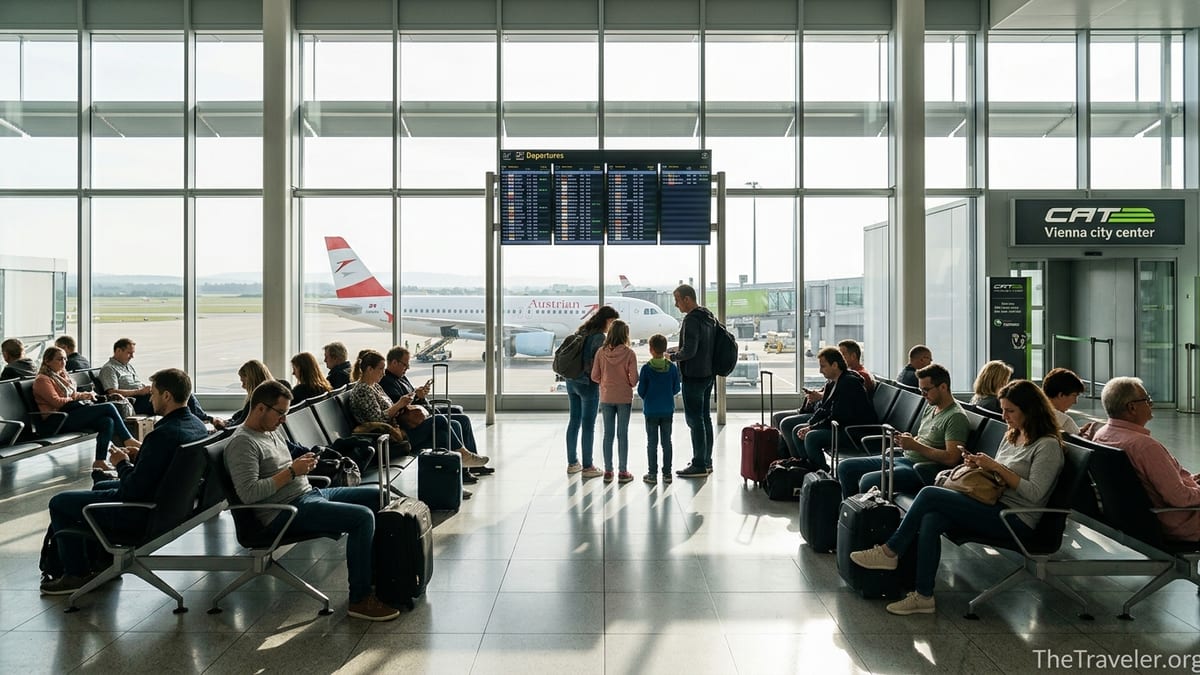
How Much Time You Really Need for a Vienna Layover
For most travelers, the key decision at Vienna is whether a layover is long enough to leave the airport. As a rule of thumb, if you have less than 5 hours between scheduled arrival and departure on a single ticket, it is usually safer to stay at the airport and treat the stop as a chance to eat, shower, or nap. Once you factor in taxiing, disembarkation, border control for non-Schengen flights, walking to the station, the ride into the city and back, plus security again, those hours disappear quickly.
With a 5 to 7 hour layover, a quick city visit becomes realistic if everything runs smoothly and you are a reasonably confident traveler. If your inbound flight is on time and you are traveling with hand luggage only, that window can be enough for a short walk around the old town, a coffee in a traditional café, and a glance at the Danube Canal before heading back. However, if you are arriving from outside Schengen and need to clear immigration, or your onward flight is on a low-cost carrier with stricter boarding cut-off times, your margin shrinks.
Longer layovers above 7 or 8 hours give far more flexibility. In that case, many travelers choose to treat Vienna as a bonus mini-city break: they head into town for lunch at Naschmarkt, an hour in the Belvedere Palace gardens, or a visit to the Museum Quartier before returning to the airport with time to spare. At that length, even if your inbound is delayed by an hour or you encounter a slow security queue on the way back, you are unlikely to jeopardize your onward flight.
It is also worth considering the time of day and day of week. A six-hour midday layover on a weekday usually offers very predictable trains and moderate security queues. A late-evening arrival with a pre-dawn departure might look long on paper, but many city sights will be closed, and you may prefer a lounge or airport hotel instead of wandering through a largely shut-down city.
Getting Between Vienna Airport and the City Center
Vienna International Airport sits about 18 kilometers from the city center, and you have three main public transport options: the City Airport Train, the S7 commuter rail, and airport buses. The City Airport Train, often called the CAT, runs non-stop between the airport and Wien Mitte station in about 16 minutes. It is the quickest and most comfortable option with spacious seating and luggage racks, and a one-way ticket for adults typically costs around 15 euros. Trains generally run every 30 minutes throughout the day, and because the CAT connects directly to the U3 and U4 metro lines at Wien Mitte, you can reach places such as Stephansplatz or Karlsplatz in just a couple more stops.
The S7 commuter rail, run by ÖBB as part of Vienna’s suburban network, is slower but much cheaper. Travel time between the airport and Wien Mitte is around 25 minutes, and the standard adult fare is roughly 5.40 euros one way as of 2026. This is the option many budget-conscious travelers and locals choose. Ticket machines at the airport station sell integrated tickets that cover both the airport leg and the Vienna city zone, and trains usually depart every 30 minutes. For a layover traveler watching the clock, the difference between 16 and 25 minutes is small, so the deciding factor is often comfort versus cost.
Airport buses provide a third alternative, especially convenient if you are heading to specific hubs like Vienna Main Station or Westbahnhof. The Vienna Airport Lines buses usually take between 22 and 40 minutes depending on the route and traffic, with one-way fares around 11 euros. They are a straightforward choice if you prefer a direct bus rather than navigating train connections, but at busy times they can be slower than the train due to congestion on the highway.
Whichever option you choose, build in a realistic buffer on both ends of your journey. For a city-center excursion during a layover, a sensible approach is to assume roughly one hour in total each way from gate to downtown and back, including walking time in the terminal, finding the right platform or stop, and a small delay margin. Many local travelers planning a brief visit into the city on a layover use this “one hour in, one hour out” rule when deciding what is feasible.
Should You Leave the Airport or Stay Inside?
Deciding whether to venture into Vienna or stay in the terminal comes down to combining your layover length with your risk tolerance and interests. Imagine you land at 10:00 in the morning from another Schengen country with a 15:00 departure. That is a five-hour layover, and you are likely to be walking out of the arrivals area by about 10:30. If you catch an S7 at 10:45 and arrive at Wien Mitte around 11:10, you could stroll up to Stephansplatz, admire St. Stephen’s Cathedral, grab a slice of Sachertorte at a café near Graben, and start heading back to the airport around 12:45 or 13:00. You would be back at the terminal by about 13:45, through security by around 14:15, and comfortably at your gate for boarding.
Contrast that with an itinerary where you arrive at 14:30 on a long-haul flight from North America with checked luggage, then depart at 19:00 on a non-Schengen flight. Immigration queues can add 20 to 40 minutes at busy times, and retrieving checked bags introduces another variable. After that, you would still need to find the train station and buy tickets. In such a scenario, a city dash would leave you with very little margin for error, and most seasoned travelers would stay at the airport, perhaps booking a lounge or day room at the airport hotel instead.
Families with young children, travelers with mobility challenges, and anyone with complex ticketing such as separate low-cost connections have even more reason to be cautious. For example, if you have two separate tickets and would not be protected by your airline in the event of a missed connection, you should treat the recommended minimum connection time as a hard floor and add at least two extra hours before considering a city visit. Those on a single through-ticket, checked all the way, with boarding passes already in hand can afford to be slightly more relaxed, as they will at least be rebooked if something goes wrong.
Weather and season also play a role in the decision. In winter, it gets dark early, pavements can be icy, and you may not feel like walking across the city in heavy snow during a short stop. In July or August, by contrast, many travelers find it appealing to use even a modest layover to sit in the shade at a city-center café with a cold drink rather than in a crowded gate area. If you arrive very late in the evening or in the middle of the night and depart early, services into the city will be less frequent, and closing times at attractions mean you might be better off resting in the terminal or at a nearby hotel.
Luggage Storage and What to Do With Your Bags
If you want to visit Vienna during a layover, you will almost certainly enjoy it more without dragging your suitcase through the U-Bahn. Vienna International Airport offers supervised baggage storage in Terminal 3. The baggage service center typically charges around 5 euros per calendar day for a piece of hand luggage and about 10 euros per day for a standard checked suitcase, with storage available for up to many months. Opening hours usually run from early morning to late evening, roughly 05:30 to 23:30, which covers most daytime layover scenarios.
In practice, this means that a traveler arriving on an early morning flight with a six-hour layover can check in their roller bag at the luggage storage desk, keep a small backpack for essentials, and head into town unencumbered. When they return to the airport, they simply pick up the bag from the same counter before going through security for their onward flight. Because fees are charged per calendar day, storing a bag for a few hours costs the same as a full day, which is still relatively inexpensive compared to the convenience gained.
There are also luggage lockers available at major city rail hubs such as Wien Hauptbahnhof and Wien Mitte, typically operated by ÖBB. Prices vary depending on locker size but are often in the range of a few euros per 24-hour period. Some travelers prefer to ride directly into the city with their bags, store them in a locker at Wien Mitte near the CAT and S7 platforms, and then explore on foot. This can be useful if your onward journey is by train from the city rather than by air, or if you plan to spend a longer break in Vienna between flights.
Another option, particularly if you are already staying in Vienna and only ending your trip at the airport, is to use private luggage storage services in the city center. Companies near Stephansplatz or the City Airport Train terminal rent secure lockers or staffed storage spaces by the hour or day, allowing you to sightsee freely before heading to your departing flight. For a pure layover, though, the dedicated baggage services at Vienna International Airport remain the most straightforward and time-efficient choice.
Lounges, Showers, and Places to Rest at Vienna Airport
Vienna International Airport has a better-than-average choice of lounges for an airport of its size, which is helpful if you decide to stay inside. The airport-operated Vienna Lounge in Terminal 1 and the Sky Lounge in Terminal 3 are accessible to any passenger regardless of airline or cabin class for a fixed entrance fee. As of 2026, prices are typically around 49 euros for the Sky Lounge and 59 euros for the Vienna Lounge for up to three hours, though many premium tickets, frequent flyer statuses, and lounge membership cards grant complimentary or discounted access.
Inside these lounges, you can expect buffet-style hot and cold food from a local catering partner, including soups, salads, hot dishes, pastries, and a Viennese coffeehouse section with espresso-based drinks and cakes. There are usually self-service bars with Austrian wines and spirits, quiet zones with recliner chairs, shower facilities, fast Wi-Fi, and plenty of charging points. For a traveler arriving from a red-eye flight with only a four-hour layover, paying for lounge access can make the difference between a groggy wait in a noisy departure hall and a restorative shower followed by a nap in a semi-dark relaxation area.
Austrian Airlines also operates several branded lounges in the Schengen and non-Schengen areas, primarily for its business class and Star Alliance passengers. These include Business, Senator, and HON Circle lounges near different gate areas. Access policies depend on your ticket class and frequent flyer status, but they all provide comfortable seating, workspaces, food buffets, beverages, and showers. For travelers connecting on a single Austrian itinerary, spending a full medium-length layover entirely inside the lounge is often the most convenient option.
For sleeping, Vienna Airport has quietly become known as relatively friendly to overnight stays. There are dedicated sleep pods in Terminal 3 on the landside, which can be rented by the hour for those who want private space to rest or work. Nearby, an on-site airport hotel connected to the terminal offers day-use rooms, which are particularly attractive if you have 8 to 12 hours to burn and want a proper bed and blackout curtains. Within the public terminal areas, many gates in Terminal 3 feature cushioned seating and armrest-free benches where travelers can stretch out for a nap. Nighttime security presence is visible, and Wi-Fi is fast and free, which makes an overnight layover reasonably comfortable for budget travelers who do not mind sleeping in public spaces.
Eating and Drinking: Making the Most of Airport Food
While Vienna is justly famous for its coffeehouses and schnitzel, the airport itself has a solid range of places to eat and drink if you decide to stay put. In both the public landside area and the airside departure halls, you will find a mix of international chains and Austrian brands. Typical options include bakeries selling fresh rolls and pastries, cafés pouring Melange and Einspänner coffee drinks, and casual restaurants serving schnitzel, goulash, and lighter salads. Prices are higher than in the city but still within the usual European airport range.
Near the main check-in area and in Terminal 3, there are branches of well-known coffee chains where you can grab a quick latte and sandwich before security, as well as Austrian-style cafés where you can sit down with a slice of apple strudel. Airside, duty-free shops stock not just alcohol and cosmetics but also local specialties like Mozartkugeln chocolates and Manner wafers, which make easy last-minute gifts during a layover. Smaller snack kiosks at the gates sell sandwiches, pretzels, and bottled drinks for travelers who prefer to stay near their boarding area.
For those with longer layovers, it can be worth seeking out a proper sit-down meal rather than grazing on snacks. A typical mid-range airport restaurant at Vienna might charge around 18 to 25 euros for a main course like Wiener Schnitzel with potato salad, with desserts in the 5 to 7 euro range and beer or wine by the glass costing 4 to 6 euros. In the lounges, all food and most drinks are included in the entry fee, making them good value if you would otherwise buy a meal and a few coffees separately.
Travelers with dietary restrictions will find vegetarian, vegan, and gluten-sensitive choices at several outlets, though the selection may be limited late at night or early in the morning. Many venues post clear allergen information and display menus in both German and English. If your layover coincides with breakfast hours, consider trying a simple Viennese-style breakfast of rolls, butter, jam, and soft-boiled eggs with coffee, which many airport cafés serve until late morning.
Sample Layover Scenarios: What to Actually Do
To make all this more concrete, imagine you have a 4.5-hour layover arriving from Frankfurt at 09:00 with a connection to Athens at 13:30 on a single ticket. Once you factor in disembarkation and a short walk, you are likely clear of the arrivals corridor by 09:30. If you left the airport at that point, a round trip into the city and a brief stroll would leave very little buffer for the return and for security, so the wiser choice would be to stay at the airport. You might buy lounge access in Terminal 3, take a shower, have a leisurely brunch, and then spend the final hour using the Wi-Fi to plan the rest of your trip.
Now consider an 8-hour layover arriving from Dubai at 07:00 with onward travel to London at 15:00. Even allowing 45 minutes for immigration and walking, you could realistically be on a train toward the city by around 08:00. Taking the S7 to Wien Mitte, you would be in the city center before 08:30 and could walk up to St. Stephen’s Cathedral. After a coffee and breakfast at a nearby café, you might spend an hour exploring the pedestrian streets of the Innere Stadt, perhaps visiting the Hofburg exterior and the Spanish Riding School courtyards, then return toward Wien Mitte by late morning. Catching a train back around midday would put you at the airport before 12:30, giving you more than two hours to clear security, stroll through duty free, and board your flight.
For a late-night scenario, suppose you land at 22:30 and depart at 06:00 the next morning. Public transport into the city still runs but at lower frequencies, and almost all museums and many restaurants will be closed. In this case, leaving the airport rarely makes sense unless you specifically want a late dinner in town. A more comfortable approach is to book a few hours at the airport hotel or a sleep pod, or simply find a quiet corner of Terminal 3 to rest. Many travelers spread out on benches, use noise-cancelling headphones, and rely on the strong airport Wi-Fi to stream movies until morning.
On the other end of the spectrum, if you have a very long daytime layover of 10 to 12 hours, you can treat Vienna almost like a proper day stop. For example, a traveler arriving at 08:00 and leaving at 20:00 could take the train into town, visit the Belvedere Palace grounds to see the gardens and the view over the city, have lunch at Naschmarkt among the food stalls, and then wander through the MuseumsQuartier before a late afternoon coffee. Returning to the airport around 17:30 would still offer a generous buffer for security and boarding, turning what might have been a tedious wait into a memorable mini-visit.
The Takeaway
Vienna International Airport is one of the more comfortable and convenient places in Europe for a layover, with quick rail links into the city, solid lounge options, and decent facilities for rest and food. Whether you should use your stop to explore Vienna’s historic streets or simply recharge inside the terminal depends primarily on your connection time, baggage situation, and appetite for risk.
As a broad guideline, layovers under 5 hours are best spent at the airport, between 5 and 7 hours can work for a short and focused city visit if everything runs smoothly, and anything longer than that can become a rewarding mini-break. With realistic time planning, an eye on train schedules, and smart use of luggage storage and lounges, your Vienna layover can be more than just a wait between flights. It can be the highlight of your journey.
FAQ
Q1. What is the minimum layover time needed to visit Vienna city center?
For most travelers, you should have at least 5 hours between scheduled arrival and departure to consider a quick city visit, and 7 hours or more if you want a relaxed margin for delays.
Q2. How long does it take to get from Vienna Airport to the city by train?
The City Airport Train takes about 16 minutes non-stop to Wien Mitte, while the S7 commuter train takes roughly 25 minutes, with additional time needed for walking within the terminal.
Q3. Is the City Airport Train worth the higher price compared with the S7?
The City Airport Train is faster and more comfortable but costs roughly three times as much as the S7. For a layover, the time difference is modest, so budget travelers often choose the S7 and spend the savings in the city.
Q4. Can I store my luggage at Vienna Airport during a layover?
Yes, there is a baggage service center in Terminal 3 that offers supervised luggage storage for a daily fee per piece, with typical opening hours from early morning to late evening.
Q5. Are there showers available at Vienna Airport?
Showers are available in several lounges, including the Vienna Lounge and Sky Lounge, and can be accessed either through airline status or by paying for lounge entry.
Q6. Is it safe and allowed to sleep overnight in Vienna Airport?
Vienna Airport is generally considered safe at night, and many travelers rest on benches or use sleep pods and the airport hotel for overnight layovers, subject to normal security patrols.
Q7. What food options are available during a layover?
The airport has bakeries, cafés, fast-food outlets, and sit-down restaurants serving both international and Austrian dishes, along with duty-free shops selling local sweets and snacks.
Q8. Do I need euros for trains and food during a short layover?
Most ticket machines and shops accept major credit and debit cards, but having a small amount of euros in cash can be helpful for backup or small purchases.
Q9. Is Vienna Airport easy to navigate for a tight connection?
The airport is relatively compact and well signposted, with clear separation of Schengen and non-Schengen areas, which helps keep walking times manageable even with a shorter connection.
Q10. What should I do if my inbound flight is delayed and I planned to visit the city?
If your arrival is delayed and your layover shrinks below about 5 hours, it is usually wiser to cancel your city plans and stay at the airport to avoid risking a missed onward flight.