


Vienna International Airport (VIE), also known as Wien-Schwechat, is the main gateway to Austria and a popular hub for Central and Eastern Europe. For first-time travelers, it feels compact and efficient, but the mix of terminals, train links, lounges and services can still be confusing on arrival. This guide walks you through the airport step by step so you know what to expect from the moment you land until you reach central Vienna or your departing gate.
Get the latest updates straight to your inbox!
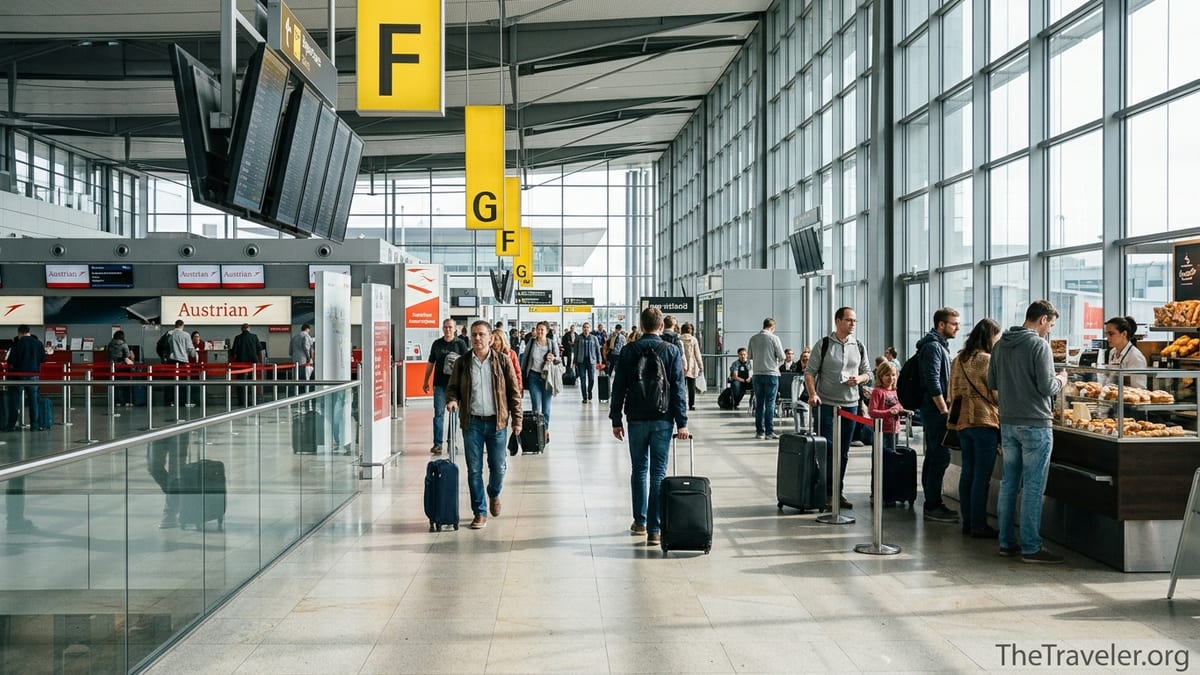
Orientation: Terminals, Layout and Airlines at VIE
Vienna International Airport sits about 18 kilometers southeast of the city center and is the primary hub for Austrian Airlines as well as a base for several low-cost and leisure carriers. The airport has multiple terminal areas that are physically connected in a single complex, so you rarely need a shuttle bus to change terminals. Instead, you walk through corridors and shopping areas that link check-in halls, security checkpoints and concourses.
The main passenger areas are usually referred to as Terminal 1, Terminal 1A and Terminal 3, along with their associated concourses B, C, D, F and G. Terminal 3 is the newest and largest section and handles most Austrian Airlines and Star Alliance flights, particularly on concourses F and G for Schengen and long-haul services. Many non-Star Alliance and low-cost airlines use Terminals 1 and 1A, with departures mainly from concourses B and C. Even if your ticket simply says “VIE,” your boarding pass and airport screens will clearly show the terminal and gate area, such as “Terminal 3, F gates.”
For a first-time traveler, the good news is that changing between these areas is straightforward. If you arrive on an Austrian Airlines flight at a G gate and depart later from an F gate, you follow the overhead signs for “Transfer” and “F-Gates,” pass through any necessary passport and security checks, and walk along the central shopping spine. Typical walks between concourses take 5 to 15 minutes. Large yellow signage, frequent gate displays, and bilingual German-English information panels keep the route understandable even if you are jet-lagged.
Most facilities are concentrated in and around Terminal 3, including the main arrivals hall, the long-distance train station below the terminal, and many of the airport’s shops and restaurants. If you are meeting someone, a common landmark is the arrivals hall in Terminal 3 near the large information desk and the exits leading to the City Airport Train and taxis. Because the complex is connected, you can easily walk from a budget carrier arrival in Terminal 1A to the central arrivals hall in under 10 minutes.
Arrivals: From Plane Door to City Center
On landing at Vienna, you disembark either via jet bridge or bus, depending on the parking position. Follow the “Arrivals” and “Baggage Claim” signs, which will route you either to passport control (for non-Schengen arrivals) or directly toward the baggage halls (for Schengen flights). Passport control lines are usually manageable, but during busy morning and late-afternoon banks of long-haul flights it is wise to expect 20 to 40 minutes. EU and EEA travelers with biometric passports can often use automated e-gates, which typically move faster than manual counters.
After immigration, you reach the baggage claim area where carousels are clearly numbered and linked to arriving flights on overhead monitors. Luggage carts are widely available and typically free to use. If your bag does not appear, the Lost & Found counters for the airport and major airlines sit close to the carousels, which is convenient for travelers in transit with tight connections. Once you have your bags, you walk through customs, which is usually a simple green or red channel system based on whether you have items to declare.
Stepping into the public arrivals hall, you will find currency exchange counters, ATMs from major Austrian banks, mobile phone SIM vendors and an information desk. For a first trip, it is usually better value to take cash from an ATM than to change money at the counter, though fees depend on your bank. Public transport tickets for trains and buses are sold at vending machines and staffed counters in the arrivals level and at the railway station one level below. Machines offer English instructions and accept cards.
If someone is meeting you, the standard meeting point is just outside customs in the main Terminal 3 arrivals hall, near the large central information desk and the doors that lead outside toward buses and the City Airport Train. For group tours, it is common to see representatives holding signs in this same area. The entire arrivals zone is under one roof, so even if you land at a different terminal your exit point into the public area will be nearby.
Ground Transport: City Airport Train, S-Bahn, Buses and Taxis
Vienna Airport is well connected to the city, and first-time visitors usually choose between the City Airport Train (CAT), the S7 suburban train, the Austrian Railjet, airport buses or taxis and ride-hailing services. All trains depart from the station directly beneath the terminal complex, reached by escalators and elevators from the arrivals hall. Buses and taxis leave from clearly signed curbside zones in front of the terminal.
The City Airport Train is the dedicated express link between the airport and Wien Mitte station, taking about 16 minutes with no intermediate stops. It is the most convenient option if you value comfort and speed, with modern green-and-white trains, spacious luggage racks and onboard information in German and English. Tickets cost noticeably more than local public transport, but many travelers appreciate the direct service into Wien Mitte, where you can connect to the U3 and U4 metro lines for places like Stephansplatz or the museum district. One distinctive feature is the City Check-in service at Wien Mitte for several airlines, where you can drop your luggage and receive a boarding pass hours before your flight, then travel to the airport later without bags.
For budget-conscious travelers, the S7 suburban train and regional trains such as the REX7 offer good value. The S7 takes around 25 minutes to reach Wien Mitte with several stops along the way and uses the same station under the terminal as the CAT. A standard adult ticket covering the airport zone and the Vienna city zone is roughly in the mid single digits in euros one way, significantly cheaper than the CAT, and tickets are valid on connecting city trams, buses and metro within the time limit. This makes the S7 a good choice if your hotel is not near Wien Mitte and you plan to switch to the U-Bahn or tram anyway.
Long-distance Austrian Railjet services also stop at the airport and run directly to Wien Hauptbahnhof, the city’s main railway station, in about 15 minutes, then onward to destinations such as Salzburg, Linz or Graz. If your hotel is near the main station, or if you are catching an onward intercity train, Railjet can be the most convenient link. Tickets can be purchased from ÖBB machines or online, and you can often combine the airport-to-city segment with a longer-distance ticket on the same reservation.
Vienna Airport Lines buses run to several hubs in the city, including routes via Wien Hauptbahnhof and Westbahnhof or toward the UNO City area. These coaches are useful if your accommodation lies near one of the bus stops or if you prefer a simple, luggage-friendly boarding process at ground level. Travel times range from around 20 minutes to more than 35 minutes depending on traffic and route. Taxis line up outside arrivals with regulated metered fares. Into the city center, you can expect a typical price in the several dozen euro range, depending on traffic and exact destination. Fixed-price airport transfer companies can be booked in advance and often undercut the metered rate, which is appealing if you are arriving late at night or with a family and heavy luggage.
Departures and Check-In: Security, Boarding and Connections
For departures, Vienna Airport advises arriving about two hours before European flights and at least three hours before long-haul flights, particularly during the busy morning wave between roughly 6:00 and 9:00 a.m. and the afternoon transatlantic window. On arrival at the terminal, check the large screens in the departures hall to confirm your airline’s check-in zone and the concourse for your flight, such as “Check-in 3, F/G gates.” Self-service kiosks and staffed counters are available for most major airlines, and Austrian Airlines offers numerous bag-drop stations for passengers who checked in online.
Security checkpoints are located after check-in and vary slightly by terminal and gate area. Standard rules apply for liquids, laptops and large electronics. At peak times, lines can extend but generally move at a steady pace. Fast track lanes are available for premium-class passengers and some elite-status holders. For Schengen flights, once you clear security you proceed directly to your gate areas B, C, D or F, moving through central retail areas. For non-Schengen destinations, you clear passport control after security and then walk to C, D or G gates depending on your flight.
If you are connecting in Vienna, your path depends on whether you arrive from within or outside Schengen and where you are heading next. Signage for “Transfer” routes you either to security, passport control, or directly to the relevant concourse. Short minimum connection times are a feature of Austrian Airlines’ hub operations, and many passengers successfully connect within 35 to 45 minutes, but as a first-time traveler it is safer to allow longer where possible, particularly if you need to change between Schengen and non-Schengen zones. Airport staff positioned at key junctions can point you to the fastest route if your inbound flight is late.
Boarding generally starts around 30 minutes before departure for European flights and earlier for long-haul services. Gates display status information in German and English, and audio announcements are frequent. Some remote stands still require a bus ride from the terminal; in those cases, make sure you are at the gate at the start of boarding, as buses often leave in waves and can take several minutes to reach the aircraft. Restaurants and shops near the gates remain open for early-morning and late-evening flights, but choice is best during daytime hours, so do not leave food and last-minute shopping to the final minutes before departure.
Lounges, Services and Airport Hotels
For those looking to relax before a flight or during a layover, Vienna offers several lounges run by both airlines and the airport. Austrian Airlines operates multiple branded lounges in the Terminal 3 area for business-class passengers and Star Alliance elites, including Schengen and non-Schengen options located near the F and G gates. These lounges typically provide hot and cold buffets with Austrian touches such as pastries, soups and cold cuts, along with showers, work areas and runway views. Access is based on your ticket class or frequent flyer status.
The airport also operates contract lounges such as the VIENNA Lounge and the SKY Lounge located airside after security, generally before passport control in the Schengen area. These can be accessed by passengers flying with various airlines, often through lounge memberships like Priority Pass or DragonPass, day passes purchased at the door, or as part of a business-class ticket on airlines that contract with the lounge. Hours broadly cover the main flight banks, often opening early in the morning and closing late in the evening. Facilities usually include light hot meals, snacks, soft drinks, coffee and alcoholic beverages, Wi-Fi, quiet workspaces and limited shower facilities. For example, travelers on a morning departure to Western Europe might spend an hour in the SKY Lounge after clearing security in Terminal 3, enjoying breakfast while keeping an eye on their nearby gate.
Beyond lounges, the airport offers a full set of passenger services. This includes Wi-Fi throughout the terminal, baby-changing rooms, children’s play areas, pharmacies, travel clinics, luggage wrapping and storage facilities, and a range of dining options from quick bakeries and coffee chains to sit-down restaurants with Austrian and international cuisine. A common real-world scenario is grabbing a coffee and a Viennese pastry at a bakery in the departures area of Terminal 3 while you wait for your Railjet-linked train schedule to line up with your flight.
If you have an early morning departure or a late arrival, staying at an airport hotel can be the most convenient option. Directly opposite the terminal complex is the NH Vienna Airport Conference Center, a full-service hotel that is a short walk across the road from arrivals. It caters to business travelers with meeting rooms and early breakfast options suited to 6:00 a.m. departures. In the nearby AirportCity area, within walking distance or a very short shuttle or taxi ride, you will also find newer properties such as a Moxy-branded lifestyle hotel and other mid-range options. These are ideal for travelers with overnight layovers, early flights or conferences held near the airport.
Parking, Car Rental and Driving from VIE
If you arrive by car, Vienna Airport provides a mix of covered garages and open-air lots at different price points and walking distances from the terminal. Short-term parking close to the terminal is convenient for pick-ups and drop-offs, while multi-day garage options offer better value for longer trips. Pre-booking a parking space online can secure lower rates and guarantee availability during peak holiday periods, which is useful for families driving in from elsewhere in Austria or neighboring countries.
Car rental desks for major international brands and local companies are grouped together in a dedicated area connected to the terminals, typically reached by following signs for “Car Rental” from the arrivals hall. Vehicles are parked in nearby garages, and pick-up is usually straightforward. Many travelers use rental cars not to reach Vienna itself, which has excellent public transport, but to explore destinations such as the Wachau Valley, Salzburg or the Alps. In practice, this means you might land in Vienna, stay one or two nights in the city using public transport, and then return to the airport to pick up a car for the next leg of your holiday.
Driving from the airport into Vienna is relatively simple via the A4 motorway and connecting city roads. However, traffic can be heavy at peak hours, and parking in the city center is limited and often metered. For most first-time visitors whose main goal is to explore Vienna’s historic core, museums and coffee houses, using public transport from the airport and relying on local transit, walking and taxis in the city will be easier than navigating central parking regulations. Renting a car mainly makes sense if your itinerary includes smaller towns or rural areas not well served by trains and buses.
For those picking up or dropping off passengers, there are signed short-stay zones near departures and arrivals with clear time limits. Enforcement is active, so it is worth following the signage carefully and avoiding stopping in bus or taxi lanes. If you expect delays, such as when greeting someone arriving from a long-haul flight, it is more economical to wait in a short-term parking area rather than circling the terminal road system repeatedly.
Practical Tips for First-Time Travelers
First-time travelers often worry about language barriers, but Vienna Airport is designed to be user-friendly for international visitors. Almost all signs are in German and English, and announcements for major flights are usually made in both languages. Many staff in information desks, lounges and larger shops speak additional languages. If you are unsure about something, such as which train ticket to buy or where to find the right concourse, asking at an information desk in the arrivals hall or near the main shopping areas is the fastest way to clarify.
When planning your timing, consider the daily rhythm of traffic at the airport. Early morning hours from around 5:00 to 9:00 are dominated by European departures, so security can be busier. Midday is typically calmer, while late afternoon and evening handle many arrivals from across Europe and some long-haul flights. For a 7:00 a.m. departure to another European city, for instance, many local travelers aim to be at the airport around 5:00 a.m., taking either the first S7, Railjet or airport bus of the day. If you are staying in central Vienna, checking the first departure time of your chosen train or bus the evening before can prevent a last-minute dash.
Payments at the airport are straightforward, with credit and debit cards accepted at nearly all shops, restaurants and ticket machines. Contactless payments are common. That said, having a small amount of cash in euros is useful for tipping or for small purchases at kiosks that may have minimum card amounts. For transport tickets, buying from machines with your bank card is usually smoother and cheaper than purchasing from a staffed counter at a currency exchange booth.
Finally, think about how you will spend short layovers. If you have two to three hours between flights, you can comfortably clear the necessary checks, visit a lounge or grab a meal, and still have time to walk the concourses. With longer layovers, remember that while Vienna city center is reachable in under 20 to 30 minutes by train, you must also factor in security, passport control and boarding times on your return. Many travelers with layovers under six hours prefer to remain at the airport, using lounges, restaurants and shopping, rather than risk a rushed return journey from town.
FAQ
Q1. How long does it take to get from Vienna Airport to the city center?
Travel time depends on your chosen transport. The City Airport Train reaches Wien Mitte in about 16 minutes, the S7 suburban train and regional trains take roughly 20 to 30 minutes, airport buses can take 20 to 40 minutes depending on route and traffic, and taxis usually take around 25 to 40 minutes to central districts.
Q2. Which is better for first-time visitors, the City Airport Train or the S7?
The City Airport Train is faster and more comfortable but more expensive, and it is ideal if you value a quick, non-stop ride to Wien Mitte. The S7 and regional trains are slower but significantly cheaper and integrate directly with Vienna’s public transport network, which suits budget-conscious travelers or those planning to change to metro or tram anyway.
Q3. How early should I arrive at Vienna Airport before my flight?
As a general rule, arrive around two hours before scheduled departure for European flights and at least three hours for long-haul flights. During busy periods such as early morning or holiday weekends, allowing a little extra time for security and passport control provides a more relaxed experience.
Q4. Is Vienna Airport easy to navigate for transfers?
Yes, the terminals are physically connected, and clear signage in German and English guides transfer passengers between concourses and passport or security checks. Many travelers successfully make tight connections, but if this is your first time and you are changing between Schengen and non-Schengen flights, aim for a connection of at least an hour where possible.
Q5. Are there lounges I can use even if I am not flying business class?
Yes, Vienna Airport has contract lounges such as the VIENNA Lounge and SKY Lounge that accept day passes, lounge membership programs and eligible premium credit cards. Access depends on your specific membership or ticket, but many economy-class travelers can buy entry at the door subject to space.
Q6. What are the best options if my flight leaves very early in the morning?
For very early departures, staying at an airport hotel such as the NH Vienna Airport or another nearby AirportCity property lets you walk or take a short shuttle to the terminal. Check the first departures of the S7, Railjet, City Airport Train or airport buses the night before to ensure they align with your check-in time if you prefer to stay in the city.
Q7. Can I store my luggage at Vienna Airport?
The airport offers luggage services that typically include short- and longer-term storage, as well as wrapping, which is useful if you want to secure bags before a long flight. This can be convenient for travelers taking a side trip from Vienna without all of their heavy luggage.
Q8. Is it worth renting a car at Vienna Airport?
Renting a car is usually not necessary if you plan to stay only in Vienna, thanks to the city’s efficient public transport. Car rental makes more sense if you are heading to rural areas, ski resorts or regions such as the Wachau Valley where train and bus connections may be less direct.
Q9. Are there good food options at Vienna Airport?
Yes, the airport offers a range of dining choices, from quick bakeries and coffee bars to sit-down restaurants serving Austrian and international cuisine. Options are most varied in and around Terminal 3, particularly in the main departures areas after security.
Q10. Is Vienna Airport child-friendly for families?
Vienna Airport is reasonably family-friendly, with baby-changing rooms, children’s play areas and plenty of elevators and ramps for strollers. Choosing the S7, Railjet or City Airport Train with dedicated luggage space can also make the journey into town more comfortable for families traveling with young children.