


Touching down at Vienna International Airport, most visitors share the same question: what is the smartest way to reach the city centre? The airport sits around 18 to 20 kilometres southeast of Vienna’s historic core, and a dense network of trains, buses and taxis means you can be in front of St Stephen’s Cathedral in as little as 20 to 40 minutes. This guide walks you through every major option in 2026, comparing cost, journey time and how easy each is with luggage, so you can pick the route that fits your budget and travel style.
Get the latest updates straight to your inbox!
Understanding Your Options from Vienna Airport
Vienna International Airport is unusually well connected to the city. You have three different rail options, an express airport bus network, classic metered taxis, ride hailing services and a large number of prebooked private transfer companies. Choosing between them typically comes down to a trade off between speed, price and how much hassle you are willing to accept with bags after a long flight.
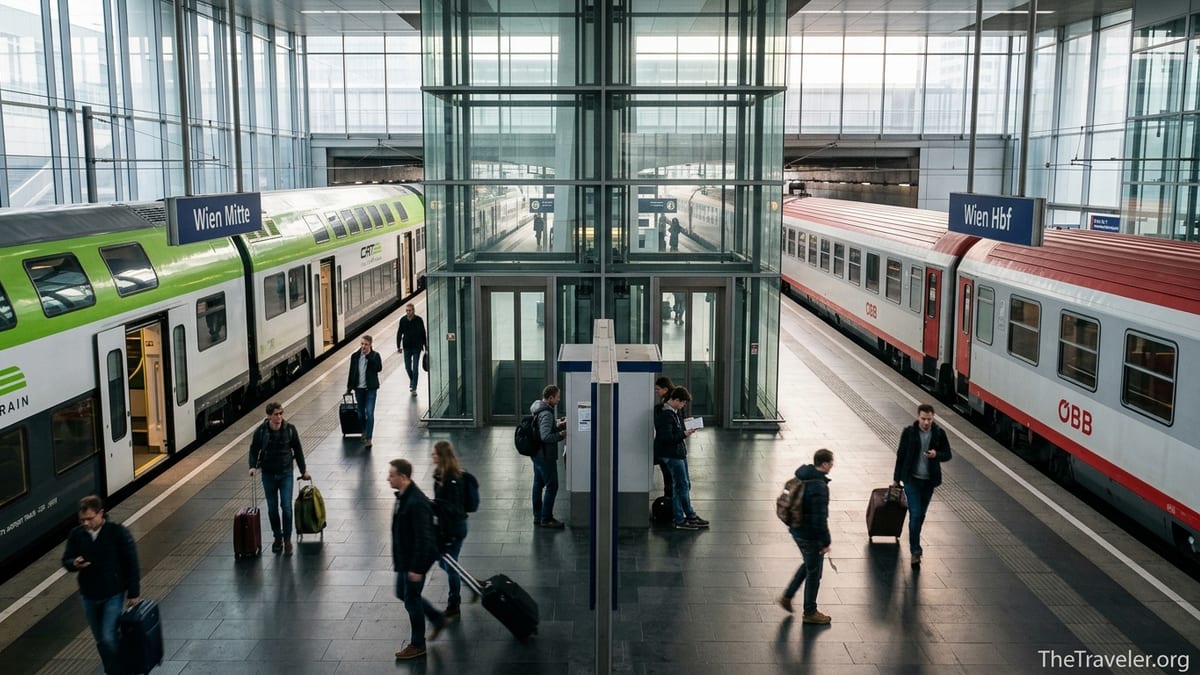
Most visitors heading to “Vienna city centre” mean the inner districts around Stephansplatz, Karlsplatz and the Ringstrasse. In practice, that usually means aiming first for Wien Mitte, Wien Hauptbahnhof (the main station) or Schwedenplatz, then connecting by metro or tram. The City Airport Train (CAT) and S7 suburban train both go to Wien Mitte, while the Railjet serves Vienna Hauptbahnhof. Airport buses fan out to several central stops including Schwedenplatz and Westbahnhof. Taxis and private transfers will take you door to door to your hotel, which is often the biggest advantage if you are tired, in a group, or carrying heavy luggage.
In 2026, you can generally expect to pay roughly in the high single digits in euros for public transport into the centre, around the low to mid tens for express buses, and between about 30 and 50 euros for a taxi or ride hailing service depending on traffic, time of day and exact destination. Prebooked private transfers often advertise fixed prices starting somewhere in the mid 20s for central districts, scaling up for larger vehicles. Exact fares change periodically, so treat prices here as typical ranges rather than guaranteed figures.
Before you leave the arrivals hall, it is worth checking two things: where your accommodation is on a map relative to Wien Mitte or Hauptbahnhof, and whether you are arriving at a peak commuter time. At rush hour on a weekday morning, a direct train can be significantly faster than a taxi to the inner city. Late at night, the balance can flip, and a prebooked taxi or transfer may be more convenient than waiting for less frequent public transport.
City Airport Train (CAT): Fastest Train and Easiest With Luggage
The City Airport Train, known locally as CAT, is the dedicated non stop airport express linking Vienna International Airport with Wien Mitte, just east of the historic centre. The journey takes about 16 minutes and runs roughly every 30 minutes for most of the day. Trains use modern rolling stock with wide doors, luggage racks and generous space in the aisles, so it feels designed around travellers with suitcases rather than local commuters.
CAT tickets are priced as a premium option. As of early 2026, a standard one way adult ticket typically costs into the low teens of euros, with discounts for returns and online purchase. Families sometimes find good value in bundled tickets or city card combinations that include both the CAT ride and 24 or 48 hours of local transport. A common real world example is a couple landing from a long haul flight to Vienna: they buy a CAT plus city transit combination at the machines in the arrivals hall, ride straight to Wien Mitte, then connect one stop on the U3 metro to Stephansplatz without having to think about extra tickets.
For luggage convenience, the CAT scores highly. Platforms at the airport are reached by elevators and escalators directly from arrivals, and the route is fully step free. On board, there are large luggage racks near the doors and ample overhead space. Because the train only makes this one city connection, it is rarely as packed as a suburban S Bahn at rush hour, which many travellers appreciate if they are balancing a backpack, roller case and a child’s stroller.
The main limitation of the CAT is that it delivers you only to Wien Mitte. If your hotel is near Stephansplatz, Stadtpark or on the Ringstrasse, this is ideal. If you are staying closer to Westbahnhof, Praterstern or far out in districts like Döbling, you will still need to transfer to the metro or tram network. In those cases, a Railjet to Hauptbahnhof or even a direct taxi can be more logical. Still, for many visitors, the CAT offers the most predictable combination of speed, comfort and luggage handling from the airport itself.
S7 Suburban Train: Cheapest Rail Option Into the Centre
The S7 suburban train is the budget friendly workhorse of the airport to city route. It is part of the regular Vienna suburban rail network rather than a special airport service. Trains normally run about every 30 minutes and reach Wien Mitte in around 25 minutes, with additional stops on the way that serve residential and business areas. For travellers, the big attraction is price: a combined ticket from the airport into the Vienna core zone usually costs in the mid single digits in euros, often under half the price of the CAT.
In practice, a popular pattern for cost conscious travellers is to buy a 24 hour or 72 hour Vienna public transport ticket or a Vienna City Card for zones within the city, then add a separate supplement ticket covering the short stretch from the airport to the city boundary. Some visitors simply buy a single combined ticket in the ÖBB or VOR apps or from ticket machines in the arrivals hall, which cover both the airport segment and ongoing metro travel in the core zone. For a solo backpacker or a couple staying several days, this can be excellent value, especially when compared with a forty euro taxi ride.
On the S7, rolling stock is more functional and geared to commuters than to air passengers. There are overhead shelves but fewer dedicated suitcase racks, and at busy times there may be standing passengers, especially near city stations. That can make boarding with several large bags more awkward than on the CAT or Railjet. At off peak times though, such as a midday arrival on a weekday, the S7 usually has plenty of space and feels perfectly manageable even with a medium suitcase and daypack.
The route of the S7 is also worth understanding. From the airport it runs through stations like Wien Geiselbergstrasse and Wien St Marx before arriving at Wien Mitte, where you can connect directly to the U3 and U4 metro lines. Travellers heading to areas like Landstrasse, the area around Rochusmarkt, or hotels near the Stadtpark often find that staying on the S7 right into Wien Mitte is more efficient than switching to a bus or taxi earlier. If you are arriving late in the evening, check schedules in a journey planning app or at station displays, as frequencies may decrease; at very late hours a taxi or ride hailing car can be simpler.
Railjet to Wien Hauptbahnhof: Best for Connections and Some Hotels
The Railjet is Austria’s high speed intercity train, but it also performs an important role as an airport link. From Vienna Airport, Railjet and similar ÖBB long distance trains run directly to Wien Hauptbahnhof, with an advertised journey time of around 15 to 18 minutes and typical intervals of about 30 minutes during the day. For many travellers whose hotels are clustered around the main station or in the Belvedere area, this is the most logical option.
Typical one way fares from the airport to Wien Hauptbahnhof with Railjet are in the high single digits in euros if you buy a standard second class ticket. For example, in 2026 it is common to see tickets around 4 to 6 euros for the airport to Hauptbahnhof segment when purchased via the ÖBB app or ticket machines. Because these trains are part of the national network, they are also ideal if you are connecting onwards to cities like Salzburg, Graz or Linz: you arrive from your flight, walk to the airport platforms, and board a Railjet that continues after the Hauptbahnhof stop without needing to change.
From a luggage and comfort perspective, Railjet trains are well suited to travellers. Carriages have generous luggage racks at the end of the coaches, overhead shelves and wide aisles. Many visitors arriving with large checked bags find this easier than navigating the more compact spaces of the S7. For a real world example, a family flying into Vienna for a ski trip might take the Railjet to Hauptbahnhof with two large suitcases and ski bags, then stay overnight at a hotel directly opposite the station before catching a morning Railjet to Innsbruck the next day.
The trade off is that the Railjet does not run to Wien Mitte, so if your final destination is close to the city’s historic core rather than the main station, you will need a short onward metro or tram ride. From Hauptbahnhof, the U1 metro line runs straight to Karlsplatz and Stephansplatz in about 5 to 8 minutes, and several tram lines fan out along the Ring. This extra transfer is usually straightforward, but if your priority is walking out of the station straight into the Innere Stadt, you may prefer the S7 or CAT to Wien Mitte instead.
Vienna Airport Buses: Direct to Key Central Stops
Vienna Airport Lines buses, operated by a national bus company, provide another alternative between the airport and the city. These express buses run to several key urban hubs, including routes that serve Westbahnhof, Schwedenplatz near the historic centre and locations around the business districts. Journey times vary by route and traffic, but you can typically expect 30 to 45 minutes to central stops, longer at peak times when the city streets are busy.
Bus tickets are generally priced in the low tens of euros for a one way adult fare, often sitting in between the suburban train and CAT in cost. For example, a typical single ticket from the airport to Schwedenplatz is around the low teens in euros, with options for discounted return tickets. Unlike the S7 or Railjet, these buses are not covered by standard Vienna city transport tickets, so you will usually need a separate ticket even if you already hold a 24 or 72 hour pass for the metro and trams.
In terms of luggage handling, the airport buses shine for travellers carrying larger or heavier bags. There is underfloor storage where you can place checked suitcases, leaving just a small carry on in the cabin. This can be more comfortable than trying to manoeuvre big luggage into the racks on an S Bahn train. For example, two friends arriving from North America with large rolling bags might choose the direct bus to Westbahnhof because their hotel is a short walk from the station bus stop, avoiding any need to carry suitcases up and down metro stairs.
The key drawback is exposure to traffic delays. While the bus route from the airport uses motorways for part of the journey, it still has to navigate surface streets in central Vienna. During the evening rush hour around 17.00 to 18.30, journey times can lengthen and become less predictable than the fixed timetable of a Railjet or CAT. If you arrive during a busy time and are on a tight schedule, for example a same day train connection to another country, the train options usually offer more time certainty.
Taxis and Ride Hailing: Door to Door Convenience
Traditional taxis are available directly outside the arrivals halls, and in normal daytime traffic a ride to central Vienna typically takes around 25 to 35 minutes, depending on your exact destination and the state of the roads. Recent information suggests an average fare in the high 30s to mid 40s of euros from the airport to inner districts, with surcharges for night time, Sundays, public holidays or particularly heavy traffic. It is not unusual for visitors to report paying around 40 to 50 euros to a hotel near Stephansplatz or the Ring when using the official taxi rank.
Ride hailing services also operate in Vienna and often price slightly below traditional taxis at off peak times, though they may use surge pricing during busy periods or late at night. A typical quoted range for central Vienna in 2026 is roughly 30 to 50 euros, with fares at the higher end during peak demand or poor weather. A couple landing at 11 pm on a rainy Friday night, for example, may find that a ride hailing app shows an estimated fare around 45 to 50 euros, whereas at 10 am on a Tuesday the same journey could be closer to 30 to 35 euros.
The major advantage of both taxis and ride hailing is door to door convenience. If your hotel is in a pedestrianised area of the old town, drivers will usually drop you at the closest point accessible by car, which can save you pulling a heavy suitcase across cobblestones from the nearest metro station. For families with small children, travellers with mobility issues or anyone arriving after a long flight who wants to minimise transfers, this can be worth the higher cost. Splitting a 40 euro fare between three or four people can also make it competitive with four separate CAT tickets.
However, visitors should be cautious about unofficial drivers who may approach in the arrivals hall offering transfers. These informal services sometimes quote higher prices, and there is less recourse if something goes wrong. The safer approach is to use the official taxi rank signposted after customs, ask your hotel to arrange a reputable car, or book through a well reviewed ride hailing or transfer app. Before you set off, you can also ask the driver for an approximate fare to your destination so that you have a ballpark figure in mind when you reach the city.
Private Transfers and Prebooked Airport Taxis
Private transfers sit between regular taxis and shared public transport. A number of Vienna based companies and international providers offer fixed price airport transfers where a driver waits for you in the arrivals area with a sign, assists with your luggage and then drives you directly to your accommodation. In 2026, advertised rates for a standard sedan from Vienna Airport to the central districts often start in the mid to high 20s of euros when booked online in advance, rising into the 30s or 40s for larger estate cars or minibuses.
This model can make particular sense for families and small groups. For instance, four friends travelling together for a weekend in Vienna might prebook a minivan transfer for around the mid 40s in euros, which works out close to 11 or 12 euros per person. That is in the same ballpark as a CAT ticket, but with the added benefit of being dropped directly at their apartment’s front door in the 7th district rather than needing to change at Wien Mitte and again to a tram.
Private transfers also remove the uncertainty of taxi meters and ride hailing surge pricing. You typically receive a booking confirmation with a fixed price, meet the driver in a clearly described meeting point in arrivals and pay by card or cash according to the company’s policy. Many services monitor flight numbers and adjust pick up times automatically if your flight is delayed, which can be reassuring on long haul journeys when arrival times are unpredictable.
The downsides are less flexibility and sometimes stricter conditions. If you miss your allocated time slot by a large margin, there may be waiting fees or a risk that the driver leaves. At very short notice, for example if you land early and clear passport control faster than expected, you might need to wait for your scheduled driver rather than stepping straight into a taxi. Nevertheless, for travellers who like to have logistics locked down before they board their flight, private transfers are an appealing option.
Choosing the Right Option: Cost, Time and Luggage Compared
When deciding how to get from Vienna Airport into the city centre, it can help to think in terms of a few common traveller profiles. A budget conscious solo traveller with a small backpack will usually find the S7 suburban train best value. With a ticket costing around the mid single digits in euros for the airport to city journey including onward metro use, they can ride to Wien Mitte and change once onto the U3 or U4 to reach most central hostels within 35 to 40 minutes of leaving the terminal.
A business traveller arriving on a tight schedule, especially during rush hour, may value reliability and comfort more than the lowest price. For them, the CAT or Railjet are logical choices. The CAT delivers a non stop 16 minute ride to Wien Mitte, while Railjet reaches Hauptbahnhof in roughly 15 to 18 minutes. With trains departing every 30 minutes, they can plan around a fixed arrival time in the city, then finish the last leg with a short metro ride or a pre arranged hotel pick up from the station taxi rank. The slightly higher ticket price is often justified by the time certainty and space to work or make calls on board.
Families and groups juggling several suitcases and perhaps a stroller frequently gravitate toward direct, low stress options. Airport buses with underfloor luggage storage or prebooked private transfers with larger vehicles are particularly attractive here. For example, a family of five with three large checked bags might pay the mid 40s in euros for a private minivan that meets them in arrivals and drops them at their apartment in the 2nd district. Compared with the combined cost and complexity of five separate CAT tickets plus a metro transfer, this can be both cheaper and considerably easier.
Ultimately, Vienna is a city where every major option works reasonably well. There is no single “right” answer, but rather a set of sensible choices depending on your priorities. If you prefer predictability and minimal changes, pick the CAT or Railjet. If you want the absolute lowest price and do not mind a slightly longer ride, choose the S7. If you want door to door simplicity, opt for a taxi, ride hailing service or private transfer. And if your hotel is near a bus stop served by Vienna Airport Lines, the express bus can still be a comfortable, luggage friendly compromise.
FAQ
Q1. What is the fastest way to get from Vienna Airport to the city centre?
The fastest options in normal conditions are the City Airport Train to Wien Mitte in about 16 minutes and the Railjet to Wien Hauptbahnhof in roughly 15 to 18 minutes. Both run about every 30 minutes and are rarely affected by road traffic, which makes them faster and more predictable than taxis or buses at peak times.
Q2. What is the cheapest way to reach central Vienna from the airport?
The S7 suburban train is usually the cheapest practical option. A combined ticket from the airport into the Vienna core zone typically costs in the mid single digits in euros and covers onward metro or tram travel within the city. For travellers staying several days, pairing the S7 with a 24 or 72 hour Vienna transport pass can be especially economical.
Q3. Is the City Airport Train worth the extra cost?
For many travellers, the City Airport Train is worth the higher fare because it is fast, comfortable and designed for passengers with luggage. It runs non stop to Wien Mitte, with spacious carriages, reliable frequency and clear signage in English and German. If you are staying near Wien Mitte, Stephansplatz or the Ring and value a stress free arrival, the CAT can justify its premium price. If your priority is saving money, the S7 offers a similar route at a lower cost, just with more stops and fewer luggage facilities.
Q4. Should I go to Wien Mitte or Wien Hauptbahnhof from the airport?
Choose Wien Mitte if your hotel is near the historic centre, Stadtpark, Landstrasse or along the U3 or U4 metro lines. Choose Wien Hauptbahnhof if you are staying near the main station, in the Belvedere area, or if you are connecting to long distance trains to places like Salzburg, Graz or Budapest. From Hauptbahnhof, the U1 metro line makes it easy to reach central stops like Karlsplatz and Stephansplatz in a few minutes.
Q5. How much does a taxi from Vienna Airport to the city centre cost?
In 2026, a typical metered taxi fare from Vienna Airport to inner city districts is usually in the high 30s to mid 40s of euros in normal daytime traffic. At night, on Sundays or during heavy congestion, fares can climb into the 50 euro range. Splitting the cost between three or four passengers often makes a taxi competitive with buying several separate airport train tickets.
Q6. Are private transfers from the airport better than regular taxis?
Private transfers offer fixed prices agreed in advance, a driver waiting for you in arrivals and often more space for luggage, which many travellers find reassuring after a long flight. For example, a prebooked sedan to central Vienna may cost in the mid to high 20s or low 30s of euros, while a larger minivan for a group might be priced in the 40s. Regular taxis are more flexible if your plans change but rely on meters and can be more affected by traffic and surcharges.
Q7. Is it easy to use public transport with large suitcases?
The CAT and Railjet are generally the easiest public transport options with big luggage, thanks to wide doors and dedicated racks. The S7 suburban train is manageable but can be crowded at peak commuting times and has more limited luggage space. Airport buses have underfloor storage, which is convenient for big bags but involve lifting suitcases in and out. If you have mobility issues or very heavy baggage, a door to door taxi or private transfer may still be the most comfortable choice.
Q8. What is the best option for a late night arrival?
For flights arriving late in the evening or around midnight, it is important to check the last departures of trains and buses on your travel date. In many cases, at least some S Bahn or Railjet services continue into late evening, but frequencies are reduced. If your flight lands very late or is heavily delayed, a prebooked taxi or private transfer is usually the safest and most straightforward option, as these services can adjust pick up times to match your actual arrival.
Q9. Can I use a Vienna travel pass from the airport into the city?
Standard Vienna city transport passes and most tourist cards cover travel within the city core zone but do not automatically include the airport segment, which lies just outside the boundary. You usually need either a combined ticket that specifically includes the airport section or an additional supplement ticket for the short stretch between the city limits and the airport. Some products bundle airport transfers with unlimited city travel, so it is worth checking the exact conditions when you buy.
Q10. How long should I allow to get from the airport to a central hotel?
For planning purposes, allow at least 45 to 60 minutes from landing to reaching a central hotel. This includes time to taxi to the gate, clear passport control, collect luggage and reach your chosen transport. Once you leave arrivals, journeys by CAT or Railjet take about 15 to 20 minutes, the S7 around 25 minutes, airport buses roughly 30 to 45 minutes depending on traffic, and taxis around 25 to 35 minutes in normal conditions. Adding a buffer is wise if you have onward reservations, such as dinner bookings or theatre tickets.