


Vienna International Airport looks complicated on paper, with multiple terminals, piers and gate letters. On the ground, though, it functions more like one connected building with several entrances. The real question most travelers have is not how many terminals there are, but whether they should head for Terminal 1 or Terminal 3, and what that means for check-in, security, Schengen versus non-Schengen gates, and transfers. This guide walks you through exactly how the airport is laid out today, which airlines use which terminal, and how long things actually take in real life.
Get the latest updates straight to your inbox!
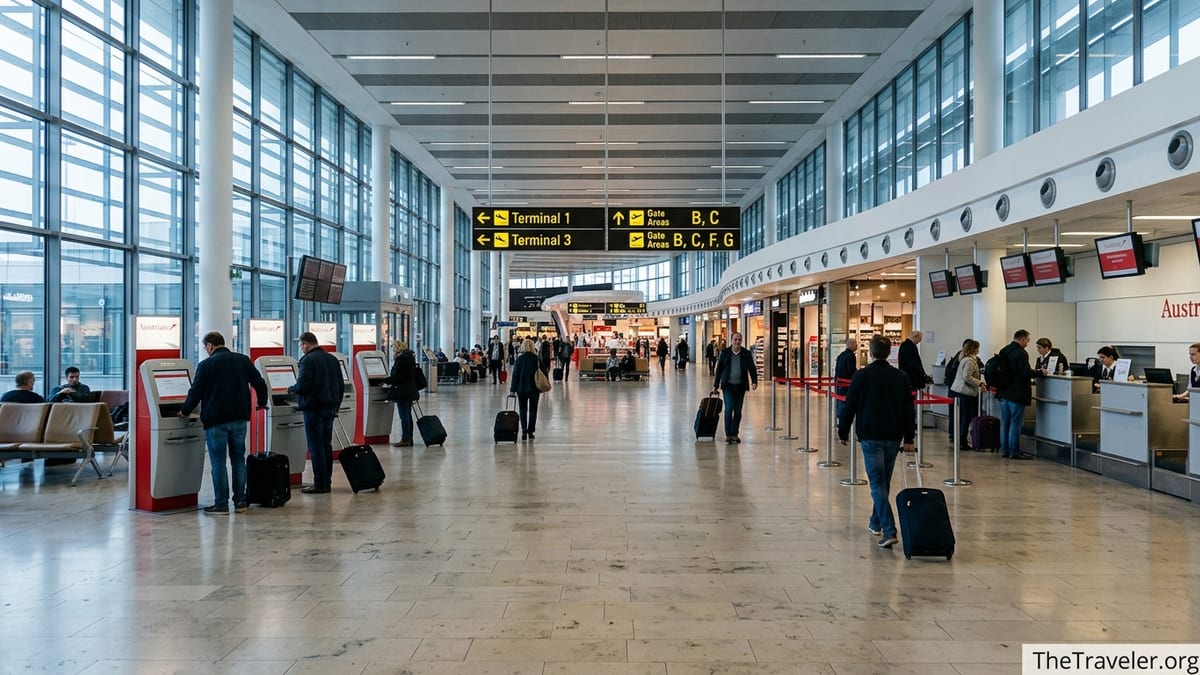
How Vienna Airport Is Really Laid Out
Vienna International Airport has three main landside check-in areas used by most passengers: Terminal 1 (T1), Terminal 1A (a small low-cost annex right beside T1), and Terminal 3 (T3). All of them sit next to each other in one continuous complex above the railway station, so you are never dealing with remote buildings or shuttle trains the way you might at Frankfurt or Paris Charles de Gaulle. You can walk from T1 to T3 indoors in a matter of minutes, passing shops and cafés on the way.
Behind security, the airport is organized by gate letters rather than terminal numbers. Piers B and C connect broadly to T1, while F and G connect to T3, and D sits in between, connected through Terminal 2’s security area. In practice, you will mostly follow signs for your gate letter rather than for a specific terminal once you have your boarding pass. For example, the screen might say “Gate F24” or “Gate D61” rather than “Terminal 3.”
The key operational split is not domestic versus international, but Schengen versus non-Schengen. Schengen flights generally use B, C and F gates, while non-Schengen flights use D and G gates, with passport control positioned at the transition points. A flight to Paris on Austrian will likely depart from an F gate, while an Austrian flight to London or New York will usually depart from G or D.
For most travelers, the “terminal choice” is decided by the airline and appears on the booking confirmation and boarding pass. Still, understanding how T1 and T3 relate to the gates and passport controls will make it easier to plan your arrival time, choose where to clear security, and avoid unnecessary backtracking inside the building.
Terminal 1 vs Terminal 3: Who Uses What
Terminal 3 is the home base of Austrian Airlines and most Star Alliance carriers operating at Vienna. If you are flying Austrian on almost any route, including typical long-haul destinations like New York, Washington, Bangkok or Tokyo, you will check in at the large Terminal 3 hall and then follow signs to F (Schengen) or G (non-Schengen) gates. Many connecting passengers transferring between two Austrian flights never see any other part of the airport, moving simply between different F and G gates.
Terminal 1 is shared mainly by oneworld and SkyTeam partners and several European airlines. In recent schedules, airlines like Lufthansa, Swiss, Brussels Airlines and Eurowings are handled at Terminal 1 even though they are Star Alliance partners, while carriers such as Air France, KLM and British Airways also use T1. Low-cost and leisure airlines like easyJet and some holiday charters are similarly concentrated around T1 and its small neighbor T1A. If your booking mentions Ryanair or Wizz Air, you are very likely to see “Terminal 1” or “Terminal 1A” on your ticket.
At first glance, it might seem odd that some Star Alliance carriers check in at T1 while Austrian and others use T3, but it rarely affects your transfer because all gate areas are connected airside. For example, you might arrive from Frankfurt on Lufthansa, checked in at T1, at a C gate, then walk airside to an F gate for an Austrian connection, all without leaving the secure zone. The terminal listed on your boarding pass matters most for where you enter the building and where you drop your bags.
For travelers who simply need to meet someone or get dropped off at the correct door, the rule of thumb is straightforward: Austrian and most long-haul Star Alliance flights use Terminal 3; many other European and low-cost airlines use Terminal 1 or 1A. Because the doors are so close together, a taxi driver who stops at the wrong sign can usually roll forward a short distance and let you out at the next terminal without any drama.
Check-in Areas, Security, and Where to Go First
When you arrive at the airport from central Vienna, either by train into the underground station or by taxi at the departures level, your first step is to identify your check-in area. Overhead boards show flights grouped by terminal and airline. If your Austrian flight to Brussels is at 10:00, for example, you will see it listed under Terminal 3 with a row number such as “Check-in 301–399.” You then follow the yellow or white signage for T3 and these row numbers to find the correct counters.
Terminal 1 works the same way on a slightly smaller scale. A KLM flight to Amsterdam or Ryanair flight to Rome will appear under Terminal 1 with its assigned row range. The check-in halls in both T1 and T3 are open-plan, bright and modern, with self-service kiosks increasingly used by full-service airlines. Austrian, Lufthansa and Swiss, among others, support print-your-own bag tags at kiosks, which can save time at peak hours when staffed counters develop queues.
Security is generally efficient at Vienna compared with many other European hubs. You do not choose security purely by terminal; you choose it by where you want to emerge airside. If you are flying from T3-based F or G gates, the main security checkpoints feeding those gates are in the Terminal 3 departures level. If you are departing from B or C gates, the security lane system that leads to those piers is accessed closer to Terminal 1 and 2. In most cases, walking time from the end of check-in to the nearest security checkpoint is well under 10 minutes, even at a moderate pace.
Real-world experience suggests that at off-peak times, passengers can move from the train platform to their gate in 25 to 35 minutes when traveling with only hand luggage and familiar with the layout. Early morning and late afternoon banks are busier, especially at non-Schengen passport control, so building in 60 to 90 minutes from station or curb to gate is a safer margin. If you have priority security through your airline status or a paid fast-track product, it can meaningfully reduce queuing at the main Terminal 3 checkpoint during those peaks.
Schengen vs Non-Schengen: Understanding F, G, B, C and D Gates
The most important distinction for navigation is whether you are departing to a Schengen or non-Schengen destination. Schengen flights are those within most of continental Europe, where passport checks are not required at the border. Non-Schengen flights include destinations like the United Kingdom, Ireland, the United States, Canada, Turkey and most of Asia and Africa, where border control checks take place on departure and arrival.
At Vienna, Schengen flights typically leave from B and C gates near Terminal 1 and from F gates near Terminal 3. For instance, an Austrian flight to Frankfurt might depart from F12, while an easyJet flight to Geneva could use a B or C gate. These areas are connected airside, so a passenger arriving at a Schengen C gate can walk through the commercial gallery and follow signs to an F gate without passing passport control.
Non-Schengen flights generally depart from G and D gates. A long-haul Austrian service to Chicago will often leave from a G gate, while a Turkish Airlines flight to Istanbul might use a D gate. To reach these areas, all passengers must clear outbound passport control. Vienna has traditional manned booths as well as automated e-gates for eligible passports. During busy departure waves, small queues can build at these checkpoints, though they tend to move quicker than at some larger hubs because the airport is comparatively compact.
In practical terms, Schengen passengers who started at Terminal 1 might still find themselves at F gates near Terminal 3, and non-Schengen passengers starting at Terminal 3 might walk toward D gates closer to Terminal 1. The building is designed so that you can move between these zones inside the secure area without confusion, as long as you follow the color-coded signage for gate letters and keep an eye on the information screens in case your gate assignment changes.
Transfers and Minimum Connection Times
Vienna markets itself as a fast connecting hub, and the official minimum connection times between two regular flights on a single ticket can be as low as around 35 minutes for certain Austrian-to-Austrian transfers. In practice, many travelers report making 45 to 60 minute connections comfortably when both flights use F and G gates in Terminal 3 and their checked bags are through-tagged. The key is that you rarely need to change buildings; you usually change only levels and piers.
For example, imagine you arrive from New York on Austrian at a G gate and connect to a Vienna to Athens flight on Austrian at an F gate. After disembarking from the long-haul, you follow the transfer signs through non-Schengen arrival passport control, which returns you to the Schengen departures level. From there it is typically a 10 to 15 minute walk via escalators and a central shopping area to most F gates. As long as your first flight is not severely delayed, a 1 hour scheduled connection is usually workable, although airlines themselves build in buffers based on historical performance.
Transfers between T1-linked B/C gates and T3-linked F/G gates may involve longer walks or a short shuttle bus if you are moving between the B/C pier and F/G pier clusters. The airport provides a free airside shuttle between the C/D and F/G areas for eligible transfer passengers. A typical scenario would be arriving on a leisure charter at a C gate and connecting to a long-haul Austrian flight from a G gate. Depending on your walking speed and whether you use the shuttle, 60 to 90 minutes is a sensible connection window to reduce stress.
If you are on separate tickets or switching from one airline group to another, you may need to exit to landside arrivals to collect and re-check baggage, then pass security again. For instance, landing on Ryanair at a bus gate associated with Terminal 1A and later flying on Emirates from a G gate requires you to clear passport control, retrieve your bag, walk or take an escalator up to departures, check in again at T3 and go through security. In such mixed-ticket cases, treating Vienna like any other major hub and allowing at least 2.5 to 3 hours is wise.
How Easy Is Vienna Airport to Navigate?
Compared with multi-terminal giants like London Heathrow or Frankfurt, Vienna is relatively easy to understand and walk. There are no inter-terminal trains, and the distances are moderate enough that a healthy adult can usually walk from one end of the main departures area to the other in 15 to 20 minutes. All main halls are indoors, and the design after recent refurbishments is bright, with large digital displays showing flights by time and destination.
The main challenge for first-timers is that the naming convention mixes terminals and gate letters. A boarding pass might say “Terminal 3, Gate F31,” but once you are inside security you no longer see large “Terminal 3” signs. Instead, you will see arrows and walking times to F and G gates. Many travelers liken the layout to a shopping mall with multiple wings: once you know which wing corresponds to your gate letter, you simply follow the path, occasionally passing a fork where F splits from G or C splits from D.
A practical example: you arrive by suburban S-Bahn at the airport station on level -2. You ride an escalator up to the arrivals hall on level 0, then another up to departures on level 1. Overhead, your Lufthansa flight to Munich shows “Terminal 1, B gates.” You turn right toward Terminal 1, pass a few cafés, then enter the T1 security check. Ten minutes later you emerge airside by the B and C gates, stop at a bakery for a coffee, and walk another five minutes to your boarding gate. At no point do you need to leave the building or puzzle over shuttle buses.
For passengers with reduced mobility or families with small children, the compact footprint and mostly level floors are a plus. Elevators are available between all levels, and most walking routes are on smooth, wide corridors that accommodate strollers and wheelchairs. There are occasional bottlenecks around popular cafés and duty free entrances, but the general feel is less hectic than many larger hubs, particularly outside the early morning departure wave.
Practical Tips for Choosing and Using Terminals
Because airlines assign terminals, you do not usually get to choose between Terminal 1 and Terminal 3. Still, you can make small decisions that simplify your journey. If you are arriving very early and your airline checks in at T3, it may be more comfortable to wait in T3’s larger public area, which has more seating and food options, rather than lingering around T1. Similarly, if you are meeting someone arriving on Austrian, waiting near the T3 arrivals door is more logical, as most Austrian flights feed into the baggage claim areas served by that zone.
For departures, plan your path based on your most likely gate type. If you are flying non-Schengen long-haul from G gates, arrive a little earlier to allow for the extra passport control step and potential queues at security. A traveler heading to Chicago on Austrian at midday might aim to reach the Terminal 3 check-in area 2.5 to 3 hours before departure, particularly during summer peak. For a short-haul Schengen flight to Prague or Milan, arriving 90 minutes before departure is often sufficient if you are familiar with the airport and traveling off-peak.
Vienna offers a range of lounges in both Schengen and non-Schengen zones, primarily concentrated around the F and G gates linked with Terminal 3. Austrian Airlines operates multiple branded lounges, and there is a Sky lounge that accepts some priority pass-style memberships in the Schengen area. If you are flying from a B or C gate with an independent airline but hold a membership that grants lounge access near F or G, it might be possible to relax in an F-area lounge and then walk back to your departure gate, though you should allow enough time to cover the walking distance.
Finally, remember that the airport’s signage and staff are generally well prepared to guide confused passengers. Information desks in the departures hall can quickly tell you whether your airline is currently using T1 or T3, and gate screens are updated regularly. If a last-minute gate change shifts your Austrian flight from F to D, for example, there will be clear arrows and repeated announcements directing you toward the new pier.
The Takeaway
In everyday use, Vienna International Airport feels more like one compact terminal with several wings than a sprawling multi-terminal hub. Terminal 3 is the main base for Austrian Airlines and most Star Alliance operations, while Terminal 1 and its low-cost neighbor 1A host a mix of European and leisure carriers. Behind security, the real navigation task revolves around gate letters and Schengen versus non-Schengen flows rather than the terminal printed on your boarding pass.
If you understand that Schengen flights tend to use B, C and F gates and non-Schengen flights D and G, and that walking times between these areas are limited, you can connect confidently even on relatively short layovers. Transfers between T1 and T3 are essentially just walks along the same building, with an optional airside shuttle between certain piers. For most travelers, allowing 60 to 90 minutes for standard connections and a bit more when changing airlines or tickets is a comfortable rule of thumb.
Ultimately, the choice between Terminal 1 and Terminal 3 is made for you by your airline, but that choice has surprisingly little impact on how easy Vienna is to use. As long as you check the terminal on your booking, follow the clear gate signage, and build in sensible time for security and passport control, Vienna Airport ranks among Europe’s more straightforward hubs both for origin-destination trips and for transfers.
FAQ
Q1. How do I know whether I need Terminal 1 or Terminal 3 at Vienna?
The terminal you need is listed on your booking confirmation and boarding pass and is determined by your airline. Austrian Airlines and many Star Alliance flights normally use Terminal 3, while many other European and low-cost carriers use Terminal 1 or 1A.
Q2. Are Terminal 1 and Terminal 3 in different buildings?
No. They are separate check-in zones within one continuous terminal complex. You can walk between T1 and T3 indoors in a few minutes without using any shuttle train.
Q3. Which gates are Schengen and which are non-Schengen at Vienna?
Schengen flights generally use B, C and F gates, while non-Schengen flights depart from D and G gates. Border control is located on the way into D and G for departures and on the way out of those areas for arrivals.
Q4. Is 45 minutes enough to transfer between flights at Vienna?
It can be, especially on a single ticket with both flights on Austrian using F and G gates. However, delays or long passport queues can eat into that margin, so 60 to 90 minutes is more comfortable when possible.
Q5. Do I need to exit and recheck my bag when changing from Terminal 1 to Terminal 3?
If both flights are on a single ticket and your bags are checked through, you normally stay airside and simply walk between gate areas. If you are on separate tickets or switching airline groups, you will likely need to collect your bag in arrivals and re-check it at the new terminal.
Q6. How long does it take to walk from the train station to the gates?
From the underground airport train station, most travelers reach the departures hall in about 5 to 10 minutes, then need another 15 to 25 minutes for check-in, security and walking to the gate, depending on queues and destination type.
Q7. Where should I go if I arrive too early and my check-in is not open yet?
You can wait landside in the departures hall for your terminal. Terminal 3 generally has more cafés, shops and seating, so some travelers prefer to wait there if their airline uses that area.
Q8. Are there good lounge options in both Schengen and non-Schengen areas?
Yes. Austrian Airlines runs several lounges in the Terminal 3-linked areas, and there are additional lounges accessible to eligible passengers and membership holders in both F (Schengen) and G (non-Schengen) zones.
Q9. What should I do if my gate letter changes close to departure?
Keep an eye on the information screens. If your flight is reassigned from, say, an F gate to a D gate, follow the new arrows and allow extra time for any required passport control step when moving into a non-Schengen area.
Q10. Is Vienna Airport suitable for travelers with limited mobility?
Yes. The airport is relatively compact and mostly on one main level, with elevators, ramps and wide corridors connecting terminals and gates. Walking distances exist but are shorter than in many larger European hubs.