


Flying into Central Europe, you often face a surprisingly tricky choice: land at major-hub Vienna International Airport in Austria, or pick smaller, low-cost focused Bratislava Airport just across the border in Slovakia. The two airports sit barely 60 kilometers apart, but they offer very different experiences in price, connectivity, and convenience. Which one works better for you depends on where you are coming from, where you are going, and how you like to travel.
Get the latest updates straight to your inbox!
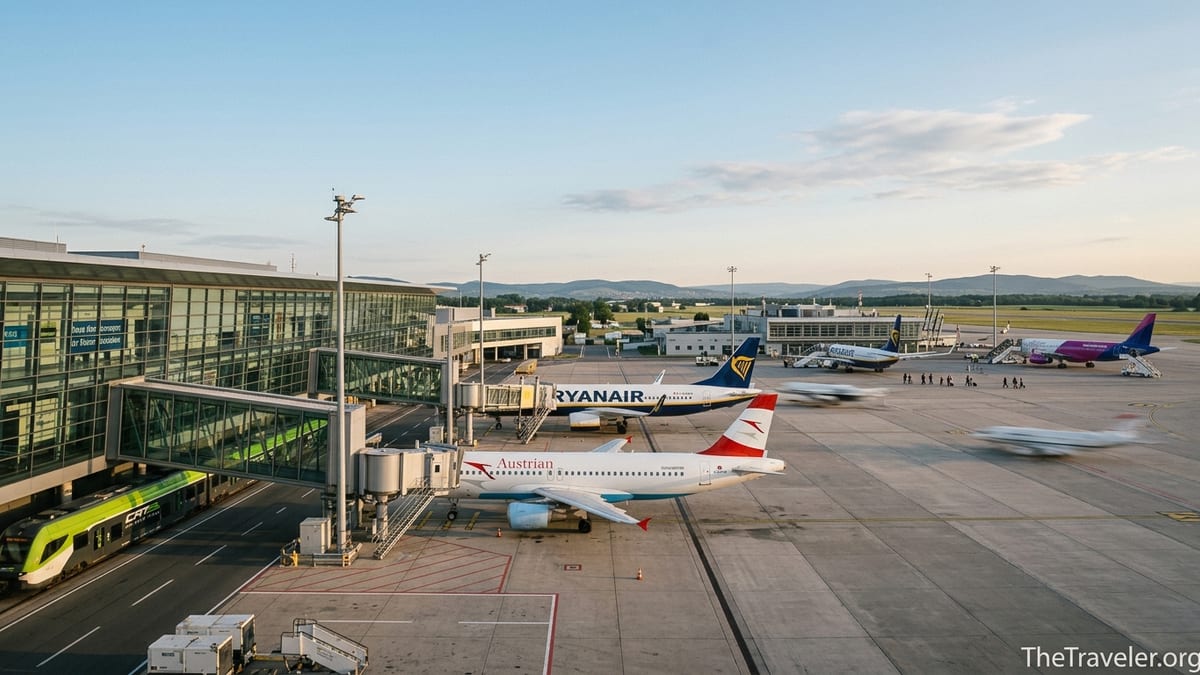
Big Hub vs Small Player: What Sets VIE and BTS Apart
Vienna International Airport (VIE) is Austria’s main gateway and one of Central Europe’s most important hubs. It serves hundreds of routes and is the primary base for Austrian Airlines, with additional operations from carriers like Ryanair and other leisure and charter airlines. That means dense connectivity across Europe plus long-haul links to North America, the Middle East, and parts of Asia. If you are flying from New York, Toronto, Dubai, or Tokyo, chances are you will be routed through Vienna rather than Bratislava.
Bratislava Airport (BTS), officially M. R. Štefánik Airport, is much smaller and has a very different focus. It has around a few dozen regular destinations, heavily dominated by low-cost carriers such as Ryanair, Smartwings and Wizz Air, which has been rapidly expanding its base here with additional Airbus A321neo aircraft and new routes. In practice, this means an emphasis on point-to-point leisure traffic rather than global connections, with direct flights from cities like London, Dublin, Brussels, Milan, and Spanish or Greek holiday destinations.
In raw numbers, Vienna handles many times the traffic of Bratislava, with over 200 destinations listed in recent timetables compared with roughly 30 countries served from BTS. For travelers, the key takeaway is that Vienna usually wins on sheer route choice and frequencies, while Bratislava competes on price and simplicity. When you search flights from a typical European city such as London or Barcelona, you may find multiple daily departures to Vienna on both full-service and low-cost airlines, but perhaps only a handful of low-cost options to Bratislava on specific days of the week.
The final structural difference is that Vienna is a full-service hub with proper transfer infrastructure, lounges, and intercontinental links, while Bratislava is closer to a regional low-cost facility. If you are planning a complex multi-leg itinerary with a checked bag, Vienna is almost always the more practical choice, whereas Bratislava makes sense when you spot a great low-cost fare on a simple point-to-point trip.
Flight Options and Destinations: Where Can You Actually Fly?
From Vienna International Airport, travelers can reach almost every major European capital nonstop, plus many mid-sized cities. Austrian Airlines alone serves over a hundred international destinations via its Vienna hub, from London, Paris and Rome to regional cities such as Lviv (subject to current conditions), Tirana, Chisinau or Yerevan. Low-cost carriers and holiday airlines add further options to beach destinations around the Mediterranean, the Canary Islands, and Red Sea resorts. Long-haul flights connect Vienna to cities like New York, Chicago, Washington, Montreal, Dubai, Doha, Bangkok, and sometimes seasonal routes to the Far East.
Bratislava’s route map is more limited but sharply focused. Ryanair typically connects BTS to major low-cost markets such as London Stansted, Dublin, Brussels Charleroi, Milan Bergamo and several Spanish airports including Malaga or Alicante in season. Smartwings and other holiday operators add flights to Greek islands, Turkish resorts and Egypt. Wizz Air’s new base at Bratislava is adding a wave of extra routes, including popular city-break and sun destinations in Italy, Spain, and North Africa. However, you may only see two or three flights a week on some of these routes, not a daily year-round service.
What this means in practice is that if you need flexibility in dates or times, Vienna is far superior. For instance, you might find five or more daily flights between Vienna and London when combining full-service and low-cost carriers, so leaving Friday after work or early Monday morning is easy. From Bratislava to London, you are likely tied to Ryanair’s pattern, perhaps four to seven flights a week at set times. For a three-day weekend trip, that can make Vienna more practical even if the base fare is slightly higher.
On the other hand, Bratislava sometimes offers routes that directly match leisure demand from price-sensitive travelers. As an example, summer flights from Bratislava to Greek islands or smaller Mediterranean airports can be significantly cheaper than routing through Vienna with a change. A family from Slovakia booking a package holiday to Crete or Rhodes may find that the charter and low-cost flights from BTS not only undercut Vienna’s fares but also include friendlier departure times and simple point-to-point operations with fewer complications.
Ticket Prices and Fees: Is Bratislava Really Cheaper?
Many travelers assume Bratislava is always cheaper because it is dominated by low-cost airlines. The reality is more nuanced. On certain routes, especially within Europe, you will absolutely find attractive headline fares from BTS. It is not unusual to see promotional one-way tickets advertised at under 30 euros from Bratislava to cities such as Milan, London or Barcelona during off-peak periods. Wizz Air’s promotional fares to sunny destinations can dip even lower for members of their discount clubs, sometimes in the 20 to 25 euro range before add-ons.
Vienna, as a larger hub, often has higher base fares, particularly on full-service carriers like Austrian Airlines or Lufthansa Group partners. A typical one-way ticket from Vienna to a major Western European city might run between 80 and 150 euros if booked close to departure, although advance purchase and competition from low-cost carriers based at VIE can bring that down. There are also occasional flash sales and new-route promotions that make Vienna surprisingly competitive, particularly on city-pairs where several airlines face off.
However, travelers must look beyond the sticker price. Low-cost tickets from Bratislava usually do not include checked baggage, seat selection or priority boarding. Adding a checked suitcase on a Ryanair or Wizz Air ticket can easily add 30 to 50 euros each way, sometimes more in peak season. A traveler flying Bratislava to London for a winter shopping trip with a big suitcase could see their total cost climb close to a standard economy fare from Vienna that already includes one checked bag, a proper cabin allowance and free airport check-in.
Airport access costs also matter. The cheapest train from Vienna Airport into the city center, the S7 suburban service or an ÖBB Railjet with a local add-on, can cost around 4 to 5 euros one way, while the dedicated City Airport Train is closer to the mid-teens for a one-way ticket. In Bratislava, a local city bus ticket from the airport to the center costs around 1.50 euros and even a ride-hail or Bolt trip to the Old Town often falls in the 8 to 20 euro range depending on time and demand. When you compare total door-to-door cost for a budget city break, these differences can tip the scale toward one airport or the other.
Access to Vienna and Bratislava: Transfers, Time and Hassle
Vienna International Airport lies roughly 18 to 19 kilometers from central Vienna. Several options link the airport to the city. The City Airport Train covers the distance non-stop to Wien Mitte in about 16 minutes, with modern rolling stock, luggage racks and in-town check-in for some airlines. This is the fastest and most comfortable choice but also one of the pricier ones, generally in the low teens in euros per journey. Regular ÖBB Railjet and S-Bahn S7 trains take a few minutes longer, usually 18 to 25 minutes to major stations such as Wien Mitte or Wien Hauptbahnhof, and cost around 4 to 5 euros if you purchase the correct combination of zone and city tickets.
Airport buses operated by Vienna Airport Lines serve key points like Wien Hauptbahnhof, Schwedenplatz and the Vienna International Centre, typically in 20 to 45 minutes depending on traffic, with fares in the high single digits. Taxis and ride-hailing services from VIE to central hotels often fall in the 40 to 50 euro range for a standard car, sometimes more late at night. These options make Vienna Airport quite accessible, especially for visitors comfortable with trains. Even a first-timer can follow clear signs to “City Center / Wien Mitte” and be on a train within minutes.
Bratislava Airport sits very close to the city, about 9 kilometers from the historic center. Local city bus number 61 usually connects the terminal with the main train station and central transfer points in roughly 20 to 25 minutes, and a basic public transport ticket valid for an hour costs around 1.50 euros. Travelers on a tight budget often appreciate that they can step off their plane, buy a cheap ticket from a machine at arrivals, and be in the Old Town using a single city bus. Even late at night, there are early-morning and night connections or relatively affordable taxis compared with Western European capitals.
An extra dimension is that Vienna and Bratislava themselves are closely linked. Many travelers choose flights based on price and then travel by coach or rail between the two cities. Buses between Vienna Airport and Bratislava typically take about 45 to 60 minutes and can cost as little as 8 to 15 euros one way. So a Slovak traveler might fly out of Vienna for a long-haul trip to the United States, then return to Bratislava by bus, while an Austrian resident might cross the border to take advantage of a very cheap low-cost fare from BTS. When deciding between the airports, you can consider not just city access, but cross-border transfer time if you actually plan to stay in the other capital.
Low-Cost Carriers and Service Experience
Bratislava Airport’s profile is shaped by low-cost airlines. Ryanair has long maintained a substantial operation at BTS, flying to popular airports such as London Stansted and holiday destinations across Europe. More recently, Wizz Air has committed extra capacity and new routes, turning Bratislava into an even more important low-cost base. Smartwings and other carriers add seasonal flights to beach hotspots and charter destinations. The overall feel of BTS reflects this: a compact terminal, straightforward boarding gates, and fewer premium services, but efficient processing for point-to-point travelers.
At Vienna International Airport, low-cost airlines do operate, but they share the field with a wide range of full-service carriers. You may board a Ryanair or easyJet aircraft at one gate and see long-haul Austrian Airlines or Emirates flights at the next pier. This mix creates more variety in lounges, dining and shopping, but also a more complex terminal layout and, at peak times, longer walks or bus transfers to remote stands. For a backpacker on a Ryanair flight, Vienna can feel like a busy international hub, whereas Bratislava’s more relaxed pace may suit those who prefer smaller airports.
The on-board experience mostly depends on the airline rather than the airport, but the airport environment still matters. At Bratislava, security lines are often shorter outside of peak summer Saturdays, and gates are close together. This appeals to travelers who value speed over amenities. However, the downside is limited choice in restaurants, shops and lounges. Vienna, by contrast, offers multiple lounges, including options for business-class passengers and various paid-entry facilities, as well as a wide range of boutiques, duty-free shops and dining from fast food to sit-down Austrian cuisine. For a long layover or a delayed flight, Vienna is a more comfortable place to kill a few hours.
Low-cost carriers also have strict rules about check-in deadlines, boarding and hand luggage, and the smaller Bratislava terminal can make these procedures feel very efficient. You may go from curbside to your gate in under 30 minutes at quieter times if you are traveling with hand luggage only. At Vienna, especially during busy holiday peaks, it is wise to build in more buffer time. Security and passport control can back up, and walking distances can be longer, which makes that last-minute dash to the gate more stressful.
Convenience, Comfort and On-the-Ground Experience
Convenience is not only about distance and price. It also includes how intuitive navigation is, how busy the terminal feels, and whether the airport’s facilities match your travel style. Vienna International Airport is well signposted in English and German, with clear color-coded zones for arrivals, departures and transfers. Information desks are plentiful, and public transport options are integrated directly with the terminal. Families with children appreciate dedicated play areas, and many gates have power outlets and seating areas designed for business travelers working on laptops.
Bratislava Airport is smaller and simpler. Signage is clear but there are fewer facilities. There may be only a handful of cafes and shops, and lounge options are more limited, although some airlines or card providers may offer access to a basic lounge. For travelers who get overwhelmed in giant hubs, this simplicity is a plus: fewer corridors, fewer terminal trains, and a general feeling that you cannot really get lost. Arriving passengers often comment that they are at the taxi rank or bus stop within minutes of stepping off the plane.
One aspect where Vienna tends to score higher is operational resilience. A large hub with multiple airlines and aircraft stands can usually re-accommodate passengers more easily in case of cancellations or severe delays. If your flight from London to Bratislava is canceled, there may be only a couple of alternatives over the next days. If your London to Vienna flight is disrupted, you might be able to switch to a different airline, reroute via another hub, or choose from several later departures the same day. For business travelers or those connecting onward on long-haul flights, that additional safety net is valuable.
On the flip side, Bratislava’s small size can mean shorter queues at security and passport control outside peak periods, and luggage sometimes arrives more swiftly because there are fewer simultaneous wide-body arrivals. A traveler arriving on a midweek evening Ryanair flight from Brussels, for example, may clear the airport and be in a city center bar within 45 minutes of landing. In Vienna at a busy time, that same process might take longer just because of the number of passengers being funneled through the terminal.
Real-World Scenarios: When to Choose Vienna or Bratislava
Consider a couple planning a week-long trip from London to Vienna for museums, cafes and classical music. They compare options from London airports. From Heathrow or Gatwick to Vienna they find multiple daily flights on full-service carriers and low-cost airlines, with prices varying by time of day but generally reasonable. From London Stansted to Bratislava, they see a cheaper base fare on Ryanair, but the timings are awkward: a late-night arrival on the outbound and an early-morning departure home. Once they factor in an extra hotel night and transfers from Bratislava to Vienna by bus, Vienna Airport itself becomes the more convenient and only slightly more expensive choice.
Now imagine a group of friends from Bratislava planning a long weekend in Barcelona. From Vienna, there are several flights on different airlines, but fares during a spring holiday period run high, especially when each person needs checked baggage. From Bratislava, Wizz Air or Ryanair may offer a direct low-cost flight to Barcelona or Girona for a fraction of that price, even after adding one shared checked bag. The group decides to depart from BTS, accepts the slightly longer bus ride from the center to the airport, and enjoys a straightforward budget trip with no need to change planes.
Another example is a North American traveler flying to Central Europe for a multi-city itinerary. Someone starting in Chicago might find a competitive non-stop flight to Vienna on a legacy carrier, with onward Austrian Airlines connections to cities such as Krakow, Bucharest or Sarajevo. Using Vienna as a hub allows them to check a bag through to their final destination and enjoy lounge access on a single ticket. Bratislava does not have this kind of long-haul connectivity, so using BTS would require a separate European low-cost ticket and an overland transfer from Vienna anyway, which complicates the journey and exposes them to missed-connection risks.
Finally, think about a budget-conscious solo traveler based in Central Europe, deciding between a beach holiday in Greece or a city break in Rome. They check flights from both Vienna and Bratislava within a two-hour radius of their home. They might discover that a Bratislava to Thessaloniki or Crete flight on a low-cost carrier is significantly cheaper than any Vienna options, while a Vienna to Rome ticket with a full-service airline at a sale price is only slightly more than a no-frills Bratislava option. Depending on dates, they could choose BTS for the beach trip and VIE for the city break, illustrating that there is no single “better” airport, only a smarter choice for each itinerary.
The Takeaway
Choosing between Vienna International Airport and Bratislava Airport is less about declaring a universal winner and more about matching each airport’s strengths to your specific trip. Vienna is the clear favorite for long-haul travel, tight connections, and itineraries where schedule flexibility and network depth matter. Its excellent rail links to the city, robust hub infrastructure, and wide range of airline partners make it the logical choice for intercontinental flights and complex multi-leg journeys.
Bratislava shines as a compact, user-friendly base for low-cost point-to-point trips, especially leisure travel within Europe. When you find a very cheap fare to or from BTS that fits your dates and you are comfortable with the typical low-cost model of add-on fees and stricter rules, the smaller airport can deliver impressive value. Quick, inexpensive transfers into Bratislava’s center and improving route diversity thanks to expanding Wizz Air and Ryanair operations further strengthen its appeal.
For many travelers in this corner of Europe, the smartest strategy is to treat Vienna and Bratislava as complementary, not competing. Check fares and schedules from both, factor in the cost and time of getting to and from each airport, and consider any cross-border bus or train you might need if you are staying in the opposite city. With that broader perspective, you can consistently choose the airport that delivers the best balance of price, convenience and comfort for each journey, rather than defaulting to one or the other out of habit.
FAQ
Q1. Is Vienna International Airport or Bratislava Airport closer to Vienna city center?
Vienna International Airport is physically closer and directly connected to Vienna by fast trains and buses. Bratislava Airport requires an additional cross-border bus or train ride of about one hour to reach Vienna, so VIE is usually more convenient if you are staying in Vienna itself.
Q2. Which airport is better for low-cost flights within Europe?
Bratislava Airport has a stronger focus on low-cost carriers such as Ryanair and Wizz Air, often offering very cheap point-to-point fares to popular leisure destinations. Vienna also has low-cost options, but its role as a full-service hub means average prices can be higher on many routes.
Q3. Can I easily travel between Vienna and Bratislava if I land at the “wrong” airport?
Yes. Regular buses connect Vienna, Vienna Airport and Bratislava in about 45 to 60 minutes, and there are also train options between the two cities. This makes it feasible to land in one country and continue by road or rail to the other without much hassle.
Q4. Which airport should I choose for long-haul flights from North America or Asia?
Vienna International Airport is the better choice for long-haul journeys. It has non-stop and one-stop connections to major cities in North America, the Middle East and Asia, and works as a proper transfer hub with through-checked baggage and coordinated connections.
Q5. Is Bratislava Airport too small for comfortable travel?
Bratislava Airport is small but that can be an advantage. It is easy to navigate, security lines are often shorter, and you can get from the entrance to your gate relatively quickly. The trade-off is fewer lounges, shops and dining options compared with a large hub like Vienna.
Q6. How much does it cost to get from each airport to the respective city center?
From Vienna Airport, a budget train ticket into the city can cost around the low single digits in euros, while a premium airport train is closer to the mid-teens. From Bratislava Airport, public buses to the center are typically around 1.50 euros, and taxi or ride-hail fares often fall in the 8 to 20 euro range depending on distance and time.
Q7. Are there big differences in baggage rules between flights from VIE and BTS?
Baggage rules depend on the airline, not the airport, but many flights from Bratislava are operated by low-cost carriers with strict limits on cabin bags and extra fees for checked luggage. Vienna offers more full-service airlines that usually include at least one checked bag in standard economy fares, which may be better value if you travel with more luggage.
Q8. Which airport is more reliable in case of delays or cancellations?
Vienna International Airport generally provides more options for rebooking because of its large number of airlines and flights. If a flight is canceled, you may be able to switch to another departure the same day or reroute via a partner hub more easily than from Bratislava, where frequencies and airline choice are more limited.
Q9. Is security and passport control faster at Vienna or Bratislava?
At quieter times, Bratislava’s smaller size often leads to quicker processing, but during peak summer periods both airports can experience queues. Vienna has more lanes and staff but also far more passengers. Allow extra time at either airport during holiday seasons, early mornings and late afternoons.
Q10. For a short city break, how should I decide between flying to VIE or BTS?
Compare total cost and schedule, not just the base airfare. Look at flight times, baggage fees, transfer costs between airport and city, and the time you lose in early-morning or late-night departures. For a Vienna city break, VIE is usually best; for a budget-focused holiday that matches a cheap non-stop BTS flight, Bratislava can be the smarter choice.