


Some of Southeast Asia’s most memorable rail journeys are not the glossy luxury trains that fill magazine spreads, but the everyday services that locals quietly use to move along the coast and between small cities. One of those unsung routes runs along Vietnam’s central shoreline between Da Nang and Quy Nhon, a slow, affordable trip that trades high-end frills for big windows, sea views and an easy glimpse of real life in the countryside.
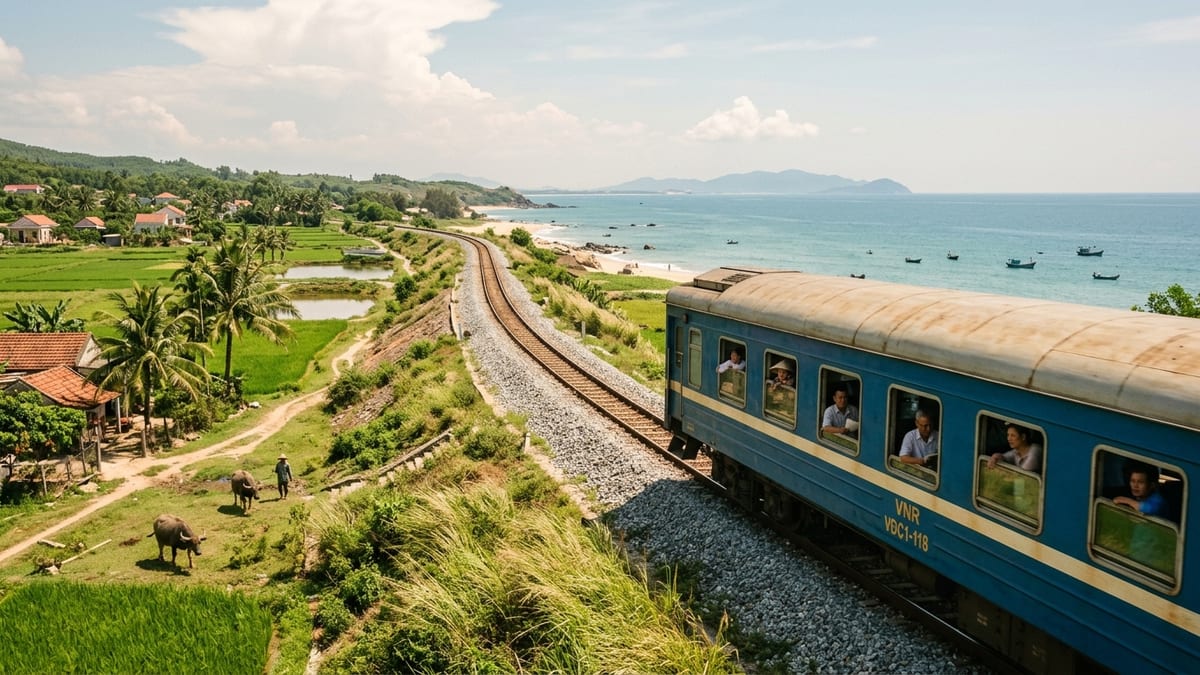
Why This Coastal Train Deserves More Attention
The railway between Da Nang and Quy Nhon follows a particularly beautiful stretch of Vietnam’s north–south line, yet it rarely appears on classic rail bucket lists. Travelers fly between big cities or book headline routes, while this service quietly carries families, students and traders between coastal provinces. For visitors who take the time, it offers one of the most grounded and scenic train experiences in Southeast Asia at a price that often feels closer to a bus ticket than to a curated tour.
Da Nang itself is a busy hub in Central Vietnam, with a modern airport and a central station that sits just a short taxi ride from My Khe Beach and the city’s riverside hotels. Quy Nhon, further south, is a smaller and more laid-back city in Binh Dinh Province, known for long curves of golden sand, local seafood restaurants and a refreshingly low-key tourism profile. Trains do not run directly into the beachfront here; instead they pull into Dieu Tri Station, around 10 kilometers inland, where passengers fan out toward Quy Nhon and the surrounding fishing villages.
Multiple Vietnam Railways services each day link Da Nang and Dieu Tri, typically as part of longer north–south runs. Depending on which train you board, the journey usually takes around five to six hours and covers roughly 320 kilometers along the spine of the country. Fares for soft seats in air conditioned carriages are often in the range of what you might pay for a midrange intercity bus, which makes this route attractive for budget minded travelers who still value reasonable comfort.
Well known luxury services like The Vietage use sections of the same line and have helped draw some attention to Central Vietnam’s rails. Yet the regular Vietnam Railways trains remain resolutely everyday in feel, used far more by Vietnamese passengers than by international tourists. That balance is exactly what makes the Da Nang to Quy Nhon route such a compelling alternative for travelers who want to see the landscape without leaving the rhythms of local life behind.
What The Journey Actually Looks Like
Leaving Da Nang, the train rattles gently through the outskirts of the city before the buildings thin and the landscape opens into a mix of low, green hills and flat agricultural land. In the first hour or so, the view from your window is a constant alternation between patches of rice paddies, clusters of small houses and glimpses of the sea. Farmers in conical hats bend over bright fields, and motorbikes follow rough paths alongside the tracks, occasionally racing the train for a few moments before veering away toward a village.
Further south, long lagoons and river mouths come into view. On some sections, you pass small fishing harbors where blue wooden boats with colorful bows bob in sheltered water. The tracks often run just inland from the coast here, close enough that, on clear days, you can see a pale strip of sand and long low waves rolling in from the South China Sea. On humid afternoons the horizon can blur, giving the impression that the train is threading a narrow band of land between water and low cloud.
Roughly halfway into the journey, the scenery tips toward more rugged countryside. Low mountains rise a little higher, and the train weaves between them in a series of shallow curves. There are short tunnels, shady gullies filled with banana plants and dense vegetation, and then sudden openings where the view stretches across wide, river-fed plains speckled with cattle. Small stations slide past with names that may not appear in many guidebooks, each with a simple concrete platform, a few snack sellers and clusters of waiting passengers sheltering from the sun.
As you approach Binh Dinh Province and the stop at Dieu Tri, the scenery softens again into wide rice fields and sugarcane plantations edged by slender palm trees. In the late afternoon, the light here can be particularly beautiful, with the sun low over the fields and long shadows of water buffalo cast across the grass. It is the kind of landscape that makes you instinctively put your camera down for a moment and simply watch. By the time the train slows for Dieu Tri, you have traced a quiet cross section of Central Vietnam that few flights or express buses manage to show in such detail.
What It Feels Like Onboard
The regular Da Nang to Quy Nhon trains are operated by Vietnam Railways, so the onboard experience is straightforward and unfussy. Most travelers opt for soft seat cars, which are air conditioned and laid out in pairs of seats on either side of a central aisle. The upholstery varies in condition from train to train, but seats typically recline slightly and provide enough legroom for an average height traveler to sit comfortably for several hours.
Carriages tend to show their age in small ways: scuffed plastic panels, metal luggage racks with the paint worn thin, slightly rattling windows. At the same time, they are generally clean, with staff walking through to collect trash and check tickets. Bathroom standards can fluctuate, so carrying your own tissues and hand sanitizer is sensible, especially on longer runs. There is usually a basic trolley service selling bottled water, instant coffee and simple snacks, while some passengers bring their own food from Da Nang markets or small station kiosks along the line.
The atmosphere onboard is relaxed and distinctly local. You are likely to find families traveling with children, students heading home for a weekend, and traders moving between markets with bags of goods. Conversations hum in Vietnamese, with the occasional burst of laughter over a shared video on someone’s phone. Foreign travelers are still a minority on this route, which can make it easy to strike up genuine, low pressure interactions, even if you share only a few words of a common language.
Compared to Vietnam’s overnight sleepers on longer stretches of the north–south line, this daytime run feels less about settling in and more about watching the world pass. Most people keep their curtains open, and the best seats fill with quiet observers, headphones on or books in hand, looking up whenever the landscape shifts. On busy days close to public holidays, carriages can be fuller and noisier, but even then the prevailing mood is more patient than rushed, with people willing to shuffle bags or swap seats to help families sit together.
How To Book And Plan The Trip
Planning the Da Nang to Quy Nhon train journey is relatively simple once you understand that you are booking to and from Dieu Tri rather than directly into Quy Nhon itself. Most booking platforms and Vietnam Railways’ own channels list the station as Dieu Tri, so you will want to look for routes from Da Nang to Dieu Tri on your chosen date. From there, it is usually a short taxi or ride hailing car to central Quy Nhon, which takes around 20 to 25 minutes depending on traffic.
Tickets can be bought in a few different ways. Many travelers use online booking sites that aggregate Vietnam Railways schedules and allow payment by international cards, making it easy to organize seats a few days in advance. Others prefer to visit the ticket counters at Da Nang Station, where staff can advise on departure times and help you choose between soft seats and sleeper berths. Buying in person also lets you see a printed schedule, which is useful if you are comparing different times of day for the best views.
Trains that run this section of the line are often part of longer journeys between Hanoi and Ho Chi Minh City, with several services passing through Da Nang in both morning and afternoon. Daytime departures are the most rewarding, especially if you want to enjoy the views around Binh Dinh’s fields as the light softens. Many travelers aim for a late morning or early afternoon train from Da Nang, which generally brings them into Dieu Tri in time to reach Quy Nhon before dark and check into their guesthouse or hotel without rushing.
Fares vary according to class and demand, but soft seat tickets on standard services are typically priced at a level comparable to or slightly higher than intercity buses running the same route. Sleeper berths, sometimes available on trains that continue overnight, cost more but can be attractive if you prefer to lie down and rest. Regardless of class, it is smart to keep your valuables close, choose a seat near your luggage if possible, and keep a printed or digital copy of your ticket handy, as staff will often check them more than once during the journey.
Why This Route Stays Under The Radar
One reason the Da Nang to Quy Nhon train remains relatively quiet in international travel circles is that it sits in the shadow of more famous sections of Vietnam’s railway. The Hai Van Pass route between Da Nang and Hue attracts much of the attention for its dramatic cliffside views, while luxury services along Central Vietnam’s coast draw travelers looking for a packaged experience. By contrast, the ordinary trains between Da Nang and Dieu Tri rarely make headlines, even though they traverse a mix of coastline, countryside and small towns that many visitors hope to see.
Quy Nhon itself also plays a role in the route’s lower profile. While cities like Hoi An, Nha Trang or Da Nang have long been prominent on the tourist trail, Quy Nhon has developed more gradually and tends to attract visitors who are already comfortable straying a little away from the obvious stops. Those who do come often choose flights from Hanoi or Ho Chi Minh City to nearby Phu Cat Airport for convenience, which reduces the number of people who might discover the railway line from the south or north.
The perception of the route as primarily functional may also contribute. For many Vietnamese passengers, these trains are still about getting from one place to another at a reasonable price, not about a curated scenic journey. Timetables are practical rather than romantic, and the experience on board is closer to a moving waiting room than to a lounge. To the traveler who is used to glossy marketing, this can initially appear unremarkable, yet it is precisely this lack of spectacle that helps protect the authentic feel of the ride.
Finally, information about the route tends to be scattered. You might find a short mention in a guidebook chapter on Central Vietnam or a brief note on a travel blog, but rarely a deep dive into what the specific journey feels like. That relative lack of coverage keeps the Da Nang to Quy Nhon train in a kind of pleasant half-light: easy enough to find once you start researching, but still far from crowded. For travelers who appreciate experiences that feel discovered rather than delivered, that is a significant part of its charm.
When To Ride And How To Make The Most Of It
Central Vietnam has a distinct climate compared with the north and south, so timing your trip can make a difference to how much you enjoy the journey. In general, the months from about February to August tend to be sunnier and drier along this coastal strip, with hot temperatures and plenty of clear days. These conditions are ideal for watching the changing colors of the rice fields and the reflections on the lagoons as the train moves south.
The later months of the year can bring heavier rain and occasional storms, especially around October and November. Trains usually continue running, but low clouds and showers may obscure some of the longer views. On the other hand, traveling in shoulder periods can mean quieter carriages and a more subdued atmosphere, useful if your main aim is to read, write or simply drift while the countryside passes outside the window. If your schedule is flexible, checking short term weather forecasts for Da Nang and Quy Nhon before picking a date is a sensible step.
Your choice of time of day on the train matters as much as the time of year. A morning departure from Da Nang often means cooler temperatures in the first part of the trip and softer light falling sideways across the fields. Afternoon trains can deliver warm, saturated colors and the possibility of a sunset arrival in Quy Nhon, particularly in the drier seasons when evenings stay clear. Sitting by a window on the seaward side, with a light jacket in case the air conditioning runs cool, is usually all you need to feel comfortable.
Simple habits can also turn a straightforward trip into a richer experience. Bringing a small supply of snacks and water gives you freedom to stay in your seat rather than queuing at the onboard trolley. Downloading an offline map of Central Vietnam helps you follow your progress from one province to the next, while a phrasebook or translation app can open the door to brief chats with fellow passengers. Above all, staying unhurried in your plans for arrival in Quy Nhon allows you to treat the hours on the train as part of your journey rather than a gap between destinations.
The Takeaway
The Da Nang to Quy Nhon train is not a luxury icon or a glossy tourist product, and that is exactly why it deserves a closer look from travelers exploring Southeast Asia. It is an affordable, practical service that happens to trace a quietly beautiful line along Vietnam’s central coast, linking a dynamic city with a more understated beach town through hours of unfolding countryside.
On this route, there are no choreographed photo stops or formal dress codes, just the low clatter of wheels on tracks, steady conversation in the carriage and a window that keeps offering new details every few minutes. You see how small stations serve as social hubs, how fields, rivers and villages fit together, and how the sea is a constant but often subtle presence on the horizon. For anyone who values slow travel and local texture over spectacle, this is a journey that can quietly become a highlight of a trip.
As tourism in Vietnam continues to expand, it is likely that more visitors will gradually discover this central coastal line. For now, though, it remains an under-the-radar option that rewards curiosity with long views, real everyday scenes and a sense of connection that is hard to replicate from a plane seat. If you find yourself in Da Nang with time to spare and a desire to see more than the next resort, booking a train seat to Dieu Tri and continuing into Quy Nhon might be one of the most satisfying choices you make.
FAQ
Q1. How long does the train from Da Nang to Quy Nhon take?
The journey between Da Nang and Dieu Tri, the inland station for Quy Nhon, usually takes around five to six hours depending on the specific train and any delays on the line.
Q2. How much does a ticket typically cost for this route?
Prices fluctuate with demand and class, but soft seat tickets on regular Vietnam Railways services along this stretch are generally in the affordable range for budget travelers, often comparable to or slightly higher than intercity bus fares for the same distance.
Q3. Which side of the train has the best views?
The view shifts throughout the journey, with both sides offering interesting scenery, though the side closer to the coast may give you more glimpses of lagoons, beaches and the open sea as the line follows the shoreline at different points.
Q4. Do I need to book tickets in advance?
It is often possible to buy tickets a day or two before departure, especially outside public holidays, but booking in advance through online platforms or at Da Nang’s station is wise if you have fixed dates or prefer specific seats or classes.
Q5. What is the difference between soft seats and sleepers on this route?
Soft seats provide padded, reclining seating in air conditioned carriages and are usually sufficient for a daytime journey, while sleeper berths offer shared compartments with bunks that may be preferable if you are connecting to or from a longer overnight stretch of the north–south line.
Q6. Is the train comfortable enough for families with children?
Many Vietnamese families use these trains, and children are a common sight in the carriages, so as long as you bring snacks, some entertainment and keep an eye on younger travelers in the aisle, the journey can be pleasant and manageable for families.
Q7. How do I get from Dieu Tri Station to central Quy Nhon?
On arrival at Dieu Tri, you will find taxis and ride hailing drivers outside the station who can take you to central Quy Nhon or directly to your hotel, with the drive typically taking around 20 to 25 minutes.
Q8. Is this route safe for solo travelers?
Solo travelers regularly ride Vietnam’s trains, and this route is no exception, though it remains sensible to keep valuables close, be cautious when moving between carriages and trust your instincts about personal space and late night arrivals.
Q9. Can I bring luggage easily onto the train?
Standard luggage such as backpacks and suitcases is generally easy to manage, with overhead racks for smaller bags and space near the ends of carriages or beside seats for larger items, as long as you do not block aisles or doors.
Q10. What makes this route different from more famous scenic trains in Vietnam?
Unlike heavily marketed scenic routes, the Da Nang to Quy Nhon section is still primarily a local transport link, which means fewer crowds of tourists, more everyday encounters with Vietnamese passengers and scenery that feels discovered gradually rather than presented as a series of set pieces.