


Many travelers arrive at Liberty State Park expecting postcard views of the Statue of Liberty and Lower Manhattan. They often leave talking instead about something else entirely. The Empty Sky Memorial, New Jersey’s official tribute to the victims of the September 11 attacks, looks at first like a simple pair of steel walls. In person, though, this understated structure delivers a far stronger emotional impact than many visitors anticipate, turning a casual sightseeing stop into a moment of reckoning and remembrance.
Get the latest updates straight to your inbox!
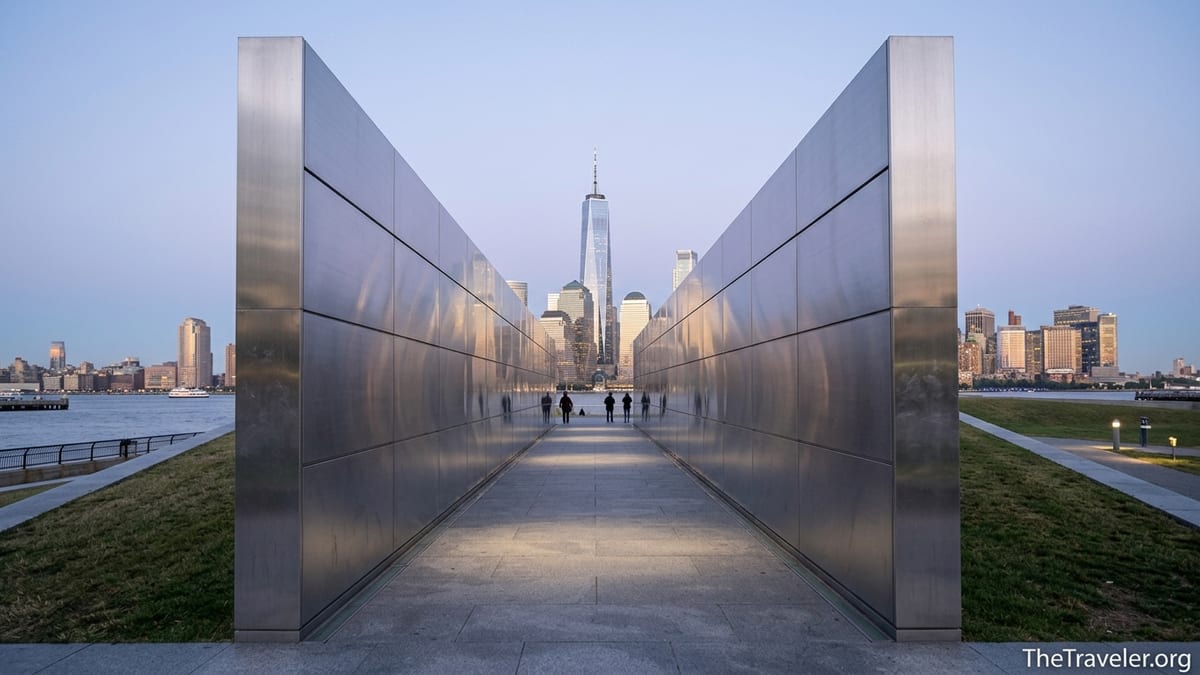
A Memorial That Uses the Skyline as Part of the Story
The Empty Sky Memorial sits along the waterfront of Liberty State Park in Jersey City, directly across the Hudson River from Lower Manhattan. Its twin brushed stainless steel walls, each about 210 feet long, form a corridor that lines up with the exact site where the Twin Towers once stood. Stand at the entrance and your gaze is pulled straight between the walls toward the gap in the skyline where the original World Trade Center rose and fell.
On paper, this sounds like clever architectural symbolism. In person, the alignment is startlingly literal. Travelers who come for a classic skyline photograph often walk through the park, frame a shot of One World Trade Center, then step into the memorial and realize that the walls are not just pointing at New York. They are pointing at an absence, at the space that was once occupied by two skyscrapers that defined the view from New Jersey. The Manhattan skyline, usually a backdrop for selfies, suddenly becomes part of a story about loss.
That framing effect is especially powerful at quiet times, such as early on a weekday morning in spring or just after sunset in autumn when ferry horns echo across the river. Visitors have described entering the memorial excited by the view, then feeling their mood drop as they understand that the open slot of sky beyond the walls is not simply beautiful but symbolic. It is a sightline that cannot be recreated anywhere else in the region, and it anchors the emotional punch of the site.
Because Liberty State Park is free to enter and has wide lawns, playgrounds, and picnic areas, many locals bring out-of-town guests here as an easy alternative to paying for a harbor cruise. What those guests often remember afterward, though, is the moment they turned from the sunny park toward the steel corridor and felt the skyline shift from tourist attraction to memorial.
The Design Feels Simple Until You Step Inside It
From a distance, Empty Sky can look almost stark: two low earthen berms leading to a pair of silvery walls facing the water. There are no dramatic fountains or multimedia exhibits, no towering statues or figurative sculptures. The materials are minimal: concrete, grass, granite underfoot, and plates of reflective stainless steel. Many travelers approach expecting a quick glance and a photograph before moving on.
That expectation changes at ground level. As you walk up the gently sloped path and enter the corridor, the walls rise to 30 feet on either side. The space narrows your field of vision until the only things you see are the glowing sky above, the strip of Manhattan ahead, and the polished panels to your left and right. The acoustics shift too. The sounds of kids playing soccer on the nearby lawn and cyclists on the waterfront path fade, replaced by the hollow echo of footsteps on granite and the wind moving between the walls.
Travelers who visit both Ground Zero in Manhattan and Empty Sky in the same day often comment that the New Jersey memorial feels more personal and less mediated. There is no security screening line, no ticket booth, and no formal route. You might arrive after a ferry ride from Liberty Landing Marina or a walk from the Hudson-Bergen Light Rail station, wander over for the view, and suddenly find yourself inside a carefully composed architectural space that is quietly doing something to your emotions.
Because the park itself is open and airy, the contrast when you step into the corridor can be jarring. One moment you are part of a crowd enjoying a sunny afternoon, the next you are between tall, cool walls, hemmed in and focused on a single line toward the horizon. That sudden change of scale and mood is a big part of why the memorial lingers in travelers’ memories far more than its low-profile exterior might suggest.
Names at Eye Level Turn Statistics into People
The towers of steel are inscribed with the names of New Jersey’s victims of the September 11 attacks. Instead of being placed on a distant plaque, the names are engraved along the inner surfaces of the walls at about eye and hand level. As you walk through, your shoulder often comes within inches of the metal. It is difficult not to reach out and trace a fingertip along a name as you pass.
Many visitors arrive knowing roughly how many people died in 2001, familiar with the number from documentaries and school lessons. What they rarely anticipate is the effect of seeing hundreds of names repeated panel after panel, many accompanied by middle initials and suffixes that hint at age and family connections. Travelers describe recognizing familiar last names, spotting someone who shared their own first name, or pausing at a birth year close to their own. In those moments, the tragedy moves from the abstract scale of “thousands” to the intimate scale of individual human lives.
Because there is no formal guided path, different people interact with the names in personal ways. A couple visiting from the Midwest might walk the entire corridor in silence, reading every name aloud under their breath. A New Jersey resident in running clothes might slow to touch one particular name at the midpoint before continuing on their workout along the waterfront. A family traveling with teenagers might stop halfway through while a parent quietly explains that some of these people took the same commuter trains and ferries that run behind the memorial today.
Small design decisions reinforce this intimacy. The letters are cut deep enough that mourners can make rubbings on paper, a common sight in the weeks around September 11 when families gather. The reflective surface of the steel means that, as you lean in to read, your own face appears faintly beside the engraved names. Many visitors recall this moment of seeing their reflection aligned with the list of the dead as unexpectedly emotional, a subtle reminder that the boundary between past and present is thinner than it appears.
Silence and Everyday Life Collide in One Place
Empty Sky is not enclosed behind gates or separated from the rest of Liberty State Park. Joggers, cyclists, dog walkers, and families on picnic blankets pass within a few yards of the memorial all day long. The Statue of Liberty ferries come and go from nearby, and on summer weekends food trucks set up along the park roads. For some travelers, this bustling context creates a surprising emotional contrast when they step into the memorial.
One common scene plays out in late afternoon. A group of friends, cameras in hand, strolls along the waterfront taking cheerful photos with the Manhattan skyline behind them. They laugh, swap places, and wave at the camera. Then one of them suggests checking out “that cool stainless steel thing” up the hill. As they walk into the corridor, the mood shifts. Voices drop. A few people fall back to read the introductory inscription at the entrance, which references the “empty sky” of that day. By the time they emerge on the far end, they are quieter, sometimes openly wiping away tears.
At the same time, the memorial is part of daily life for local residents. It is not unusual to see office workers from Jersey City financial firms walking there during lunch breaks, or parents pushing strollers through the corridor on the way back from the playground. For them, the memorial functions as both a neighborhood landmark and a space to revisit private grief. Travelers who witness this mix of ordinary routines and solemn remembrance often say it deepens their own emotional response, reminding them that for many people in the region, September 11 is still a lived and local experience, not just a page in a history book.
Because the memorial is open at all hours the park is open, visitors encounter it under very different conditions. Before sunrise, the corridor can be nearly empty except for a lone photographer setting up a tripod to catch the first light on the skyline. On September 11 itself, the space fills with families at the annual ceremony, standing shoulder to shoulder as names are read. Experiencing Empty Sky in any of these contexts can reshape a traveler’s sense of how public memory and everyday life coexist.
Comparison with Other 9/11 Memorials Highlights Its Uniqueness
Travelers who have walked the National September 11 Memorial at Ground Zero in Manhattan or visited the Flight 93 National Memorial in Pennsylvania often assume that Empty Sky will feel like a smaller version of those spaces. In practice, it offers a different kind of emotional experience, one that many visitors find unexpectedly intense because of its direct connection to the skyline.
At Ground Zero, the twin waterfall pools mark the exact footprints of the original towers, surrounded by trees and dense city streets. The focus is inward, down into the void where water disappears. Empty Sky, by contrast, opens outward. The corridor acts as a long visual tunnel pointed across the river; the memorial’s emotional weight is tied to a view that is still full of office buildings, cranes, and commuters. Standing in Jersey City and looking toward Lower Manhattan, visitors feel the distance and the nearness at once. They are separate from the place of the attacks, yet the gap in the skyline feels close enough to touch.
Compared with smaller local memorials around New Jersey and New York, which often feature statues, plaques, or pieces of recovered steel, Empty Sky can seem less literal. There are no sculpted firefighters or angelic figures, no narrative panels recounting the timeline of events. This restraint invites visitors to bring their own memories and emotions into the space. A traveler who remembers watching the news in a college dorm room in 2001 will experience the corridor differently from a teenager born years later who learned about the attacks in school, but both are given room to process what the absence in the skyline means to them personally.
Some visitors only discover Empty Sky after reading about it in a guidebook or seeing photos in a travel article that describe it as one of the region’s most underrated 9/11 sites. They arrive expecting something modest. Afterward, they often report that the New Jersey memorial stayed with them as strongly as their time at Ground Zero itself, in part because it connected the iconic view of Manhattan with the quieter stories of commuters and residents on the west side of the river.
Criticism, Controversy, and the Question of How to Remember
Like many public memorials, Empty Sky has not been free from controversy. Long before it opened in 2011, some local groups argued that the twin walls would block beloved views of the Manhattan skyline from Liberty State Park’s lawns. Others questioned the cost of building such a large structure in a state park that already faced maintenance needs. Lawsuits and public meetings delayed construction and drew sharp opinions on both sides.
Even after its completion, debates continue around how people use the space. On busy spring weekends it is common to see couples posing for engagement photos at the edge of the corridor or high school students in formal attire passing through on their way to prom pictures along the waterfront. Some residents feel that staging celebratory photo shoots inside the memorial, in front of the engraved names, disrespects the site’s purpose. Others argue that integrating the memorial into ordinary life, rather than isolating it as an off-limits shrine, reflects a living relationship with the past.
For travelers, witnessing these tensions first-hand can amplify the memorial’s emotional impact. You might visit on a quiet weekday and find a small group of family members placing flowers against one name while, just outside the walls, joggers pass with headphones on. You might return on a different trip and see a professional photographer coaching a wedding party into position near the entrance. These scenes raise difficult questions about how public grief should be expressed and who gets to decide what is appropriate.
Instead of providing easy answers, Empty Sky makes those questions visible. By existing within a busy urban park, it forces a conversation between remembrance and recreation. Many visitors leave thinking less about architecture and more about how societies choose to remember tragedies over time, and how those choices feel to people whose loved ones are listed on the walls.
Practical Tips for Travelers: How to Visit Thoughtfully
Because Empty Sky is located inside Liberty State Park, it is relatively easy to include in a New York City or New Jersey itinerary without extra cost. Many travelers arrive by car and use the large pay parking lots near the historic Central Railroad of New Jersey Terminal, which typically cost only a modest day rate compared with Manhattan garages. Others rely on public transit, taking the Hudson-Bergen Light Rail to the Liberty State Park station and walking about 15 to 20 minutes through open grounds and along the waterfront.
Photographers often aim for golden hour, just after sunrise or before sunset, when the stainless steel walls catch warm light and the Manhattan towers glow in pastel tones. On clear evenings, reflections on the panels can show both the engraved names and the mirrored skyline at once. If you are hoping for a quieter experience, early weekday mornings in winter and late evenings outside of holiday weekends tend to be the least crowded times, when you may share the corridor with only a handful of other visitors.
Etiquette at the memorial is mostly unwritten but deeply felt. Travelers are not required to dress formally or remain silent, but it is wise to lower your voice, keep music off, and avoid staging playful photos directly in front of the names. If you are visiting with children or teenagers, take a few minutes before entering to explain where you are going and why. Many families choose to walk the corridor slowly together, pausing to read the introductory text at the entrance and perhaps discussing how the skyline has changed.
Pairing a visit to Empty Sky with other nearby experiences can help balance the emotional weight of the memorial. Some travelers spend an hour at the site, then board a Statue of Liberty and Ellis Island ferry from the same park to explore broader immigration and freedom themes. Others bring a picnic, planning time afterward to sit on the grass with a view of the harbor and process what they have just seen. However you structure your day, giving the memorial more than a quick five-minute stop will usually deepen its impact.
The Takeaway
At first glance, the Empty Sky Memorial can seem almost understated compared with the grand gestures of other 9/11 sites. Yet that restraint is exactly what gives it such surprising emotional force. By turning the familiar Manhattan skyline into part of the memorial itself, by placing names within arm’s reach, and by situating everything in the middle of a lively urban park, it transforms a scenic viewpoint into a place of quiet reckoning.
For travelers, visiting Empty Sky is less about ticking off another attraction and more about allowing a well-loved view to tell a different story. Many people come expecting a photo opportunity and leave carrying an image they cannot easily forget: a corridor of steel, an open slice of sky where two towers once stood, and their own reflection faintly visible among the names. That lingering impression is why this memorial so often touches visitors more deeply than they ever expected.
FAQ
Q1. Where exactly is the Empty Sky Memorial located?
Empty Sky stands inside Liberty State Park in Jersey City, New Jersey, along the Hudson River waterfront directly facing Lower Manhattan and the World Trade Center site.
Q2. How much time should I plan to spend at the memorial?
Most travelers spend between 20 and 45 minutes walking the corridor, reading names, and taking in the skyline, though some stay longer to sit nearby and reflect.
Q3. Is there an entrance fee to visit Empty Sky?
There is no separate fee for the memorial itself. Liberty State Park is free to enter, though you may pay for parking or public transit to reach the site.
Q4. What is the best time of day to experience the memorial?
Early mornings and late afternoons offer softer light and fewer crowds. Sunset often provides dramatic reflections on the steel walls and a glowing Manhattan skyline.
Q5. Can I take photos inside the memorial corridor?
Yes, photography is allowed, but visitors are encouraged to be respectful, avoid loud behavior, and refrain from using the engraved names merely as a backdrop for playful or posed images.
Q6. Is the memorial accessible for visitors with limited mobility?
The approach to Empty Sky follows a gently sloped paved path with no stairs, and the corridor itself is level granite, making it generally accessible for wheelchairs and strollers.
Q7. Are there restrooms or facilities nearby?
Liberty State Park provides public restrooms near the Central Railroad of New Jersey Terminal and other key areas, all within a short walk of the memorial.
Q8. Can I combine a visit to Empty Sky with the Statue of Liberty?
Yes. Ferries to the Statue of Liberty and Ellis Island depart from Liberty State Park, making it easy to visit the memorial before or after a trip to the islands on the same day.
Q9. Is there public transportation to reach the memorial without a car?
Many visitors use the Hudson-Bergen Light Rail to Liberty State Park station, then walk through the park, or arrive by rideshare or taxi from nearby Jersey City or Manhattan.
Q10. Are there special events at Empty Sky on September 11?
Each year around September 11, New Jersey holds a remembrance ceremony at the memorial, with families, officials, and the public gathering for readings, music, and quiet reflection.