


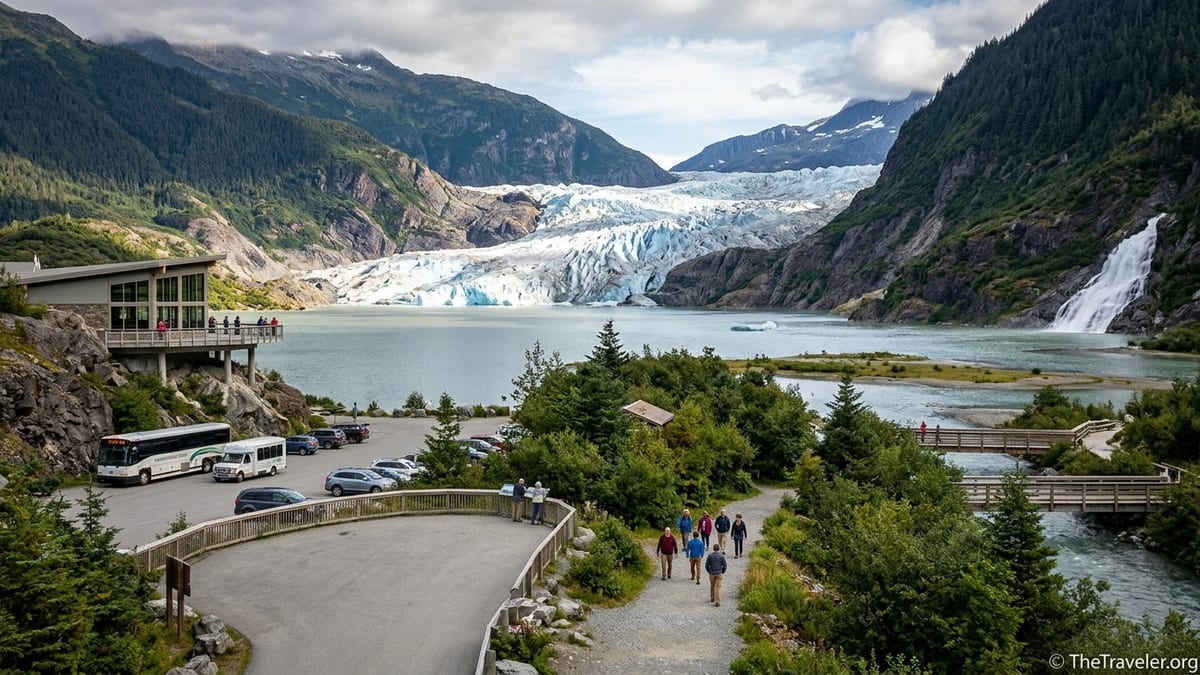
Mendenhall Glacier is one of Alaska’s most accessible ice giants, spilling from the vast Juneau Icefield into a lake just 13 miles from downtown Juneau and the cruise ship docks. Because it sits within the Mendenhall Glacier Recreation Area of Tongass National Forest and is connected to town by road, it is an unusually straightforward glacier to visit, even on a short cruise call. This guide focuses on the practical details you need to plan a visit from Juneau, whether you are traveling independently or arriving by ship with only a few hours in port.
Get the latest updates straight to your inbox!
Understanding Mendenhall Glacier and How You Reach It
Mendenhall Glacier is one of dozens of glaciers flowing from the Juneau Icefield, a roughly 1,500–square–mile expanse of snow and ice in Southeast Alaska. The glacier itself stretches about 13 miles from its source to its terminus at Mendenhall Lake. The surrounding recreation area is managed by the USDA Forest Service as part of Tongass National Forest, with a mandate to balance visitor access, safety and protection of sensitive wildlife and landscapes.
The glacier’s key advantage for travelers is road access. The Mendenhall Glacier Visitor Center sits in the Mendenhall Valley about 12 to 13 miles from downtown Juneau and the main cruise berths, reached along Egan Drive and Glacier Highway. From downtown, the drive typically takes around 20 to 30 minutes in light traffic. There is no need for a boat, helicopter or extended hike just to see the ice, which is why the site is one of the most popular shore excursions in Alaska.
The recreation area includes the elevated visitor center, a network of paved and gravel paths to overlooks, Nugget Falls and lakeshore viewpoints, along with seasonal ranger programs and a Steep Creek wildlife viewing area. Some facilities and trails are staffed and managed as a developed fee site, while others remain accessible at no charge. Because both glacier length and lake conditions change over time, viewing distances and perspectives can shift from year to year, but the overall layout of the road, visitor center and main trails has remained consistent.
For planning purposes, keep in mind that regulations, fees and even specific routes can change with management plans and safety concerns. The Forest Service has recently considered significant changes to day-use fees and pass structures at Mendenhall. Any article or guide that mentions costs or access rules should present them as current as of the verification month and year and recommend that visitors confirm details again before they travel.
Visitor Center Status, Hours and Fees
The Mendenhall Glacier Visitor Center is operated by the USDA Forest Service as a developed site with exhibits, a film, bookstore and staffed information desk. Current official information indicates that the visitor center is open on a daily summer schedule, typically from May through September, with core hours around 9 a.m. to 6 p.m. Travel Juneau and the facility’s cooperating association report that for the 2026 summer season the visitor center is scheduled to open for full operations in late April and continue daily through early fall. Limited winter operations, such as outdoor viewing and some staffed services, may be available, but indoor hours and programming are significantly reduced outside the main season.
As of November 2026, the standard fee model at Mendenhall Glacier Recreation Area distinguishes between basic outdoor access and entry to the developed visitor center and some associated facilities. Recent Forest Service descriptions and local explainer articles note that walking the main trails to viewpoints such as Nugget Falls generally remains free of charge, while there is a per-person fee to access the visitor center building, restrooms in that complex and certain other developed amenities. Typical published figures in 2025 and early 2026 list a day-use fee of about 5 dollars per person, with federal recreation passes accepted.
However, in mid-2026 the Forest Service proposed raising the day-use fee substantially and shifting to a primarily per-person structure across the recreation area, with a public comment period continuing into summer 2026. Because of this ongoing process, you should instruct readers that any quoted fees are current as of late 2026 and may change before their visit. Emphasize that visitors should verify the latest fee amounts, pass applicability and which facilities the fee covers through the Forest Service or local visitor information sources shortly before travel, especially for trips planned for 2027 and beyond.
Parking at the recreation area has also been under review, particularly for busy cruise days when congestion is common. While independent travelers with rental cars can usually find space earlier or later in the day, they should be prepared for controlled access or short waits at peak times in high summer. Any guidance on parking policies should be presented cautiously, with a reminder to check current conditions and potential restrictions during the intended travel month.
Getting to Mendenhall from Downtown and the Cruise Docks
Travelers have four main ways to reach Mendenhall Glacier from downtown Juneau and the cruise berths: city bus, commercial shuttle or tour bus, taxi or rideshare, and rental car. Each option involves clear trade-offs in cost, flexibility and walking distance, and all of them can be affected by cruise-ship traffic and seasonal crowds.
Capital Transit operates Juneau’s public bus system. According to the city’s 2025 and 2026 schedules and a dedicated information card for visitors, routes serving the Mendenhall Valley stop at Dredge Lake Road, which is the closest bus stop to the glacier. The bus does not enter the recreation area or reach the visitor center parking lot. The walk from the Dredge Lake Road stop to the visitor center is approximately 1.25 to 1.5 miles each way, taking most visitors 25 to 35 minutes at a steady pace. Recent fare tables indicate a standard adult cash fare of about 2 dollars each way, with youth fares lower and mobile ticketing available. Service typically operates daily, but frequency and late-evening options vary by season and route, so travelers must confirm the current timetable and last return bus on the specific date they plan to visit.
Dedicated shuttle buses and tour buses are the most common choice for cruise passengers with limited time. Several local operators run frequent shuttles between the downtown cruise area and the Mendenhall Glacier Visitor Center parking lot during the main cruise season, usually on a loop that allows travelers to choose their return time. Recent examples advertised for 2026 show round-trip glacier shuttles priced in the rough range of a few tens of dollars per adult, often with higher rates when combined with whale watching or guided hiking, and lower child fares. Some cruise lines also sell branded shore excursions that use similar transportation but include a guide and fixed schedule. Because both pricing and shuttle frequency change with demand, you should advise readers to verify one-way and round-trip fares, as well as the latest first and last departure times, directly with shuttle providers close to their sail date.
Taxis and rideshares offer flexibility but can be more expensive, especially for solo travelers. A typical metered taxi or rideshare fare for the 13-mile each-way trip might fall in the several tens of dollars range one way, depending on traffic, demand and waiting time, but actual prices can fluctuate significantly. This option works best for small groups who can split the fare or visitors who want to set their own schedule without relying on shuttle timetables. Travelers should factor in the possibility of limited vehicle availability at the glacier when multiple ships are in port and plan for a buffer so they are not waiting for a ride close to their all-aboard time.
Rental cars remain a practical option for those spending a full day in Juneau or starting and ending their trip in the city rather than arriving on a cruise. Agencies near the airport and downtown offer daily rentals that allow visitors to drive themselves to the glacier and continue to other attractions, such as Auke Bay or the Shrine of St. Thérèse. A rental car provides maximum flexibility to visit early in the morning or later in the evening when buses and tours are less frequent. The downside is the need to navigate on unfamiliar roads, find parking on busy days and budget for the overall rental cost, fuel and insurance. Because inventory can sell out in high summer, independent travelers should reserve well in advance and recheck pickup and return procedures.
Main Viewing Areas and Established Trails
Most visitors experience Mendenhall Glacier from a combination of the visitor center, designated overlooks and a few well-maintained trails near the lake. Even without setting foot on the ice, the views of the glacier face, surrounding mountains and Nugget Falls are substantial, and the area is designed so that people with different mobility levels can enjoy them.
The elevated visitor center building offers panoramic views across Mendenhall Lake to the glacier through large windows, along with spotting scopes and exhibits that explain the glacier’s movement, climate influences and wildlife. Outside, short paved walks lead to the Photo Point overlook, which is one of the most popular spots for unobstructed photos of the glacier over the lake. This path is relatively short, commonly described as roughly a quarter mile or less each way, and is suitable for most visitors who can manage a gentle, paved walk with minimal elevation change.
The Nugget Falls Trail is the signature hike at Mendenhall for many travelers. Forest Service maps and visitor descriptions place it at about 2 miles round trip, with a well-graded gravel surface and very modest elevation gain. Most people complete the walk in 45 to 75 minutes, depending on how long they linger for photos. The trail typically ends at a broad, often sandy or pebbly beach area near the base of Nugget Falls, where you can look back across the lake toward the glacier. Access to the exact shoreline can vary with lake level, sediment and safety conditions, so the writer should frame this as a lakeshore approach rather than guarantee a particular beach configuration.
Additional routes, such as the Trail of Time and Steep Creek boardwalks, provide short walks through forest and along salmon streams with educational panels. More demanding trails, including longer routes up the surrounding slopes, may be available for fit and prepared hikers when conditions and management plans allow. Because these paths can be subject to closures due to landslides, flooding, bear activity or infrastructure projects, any guide to specific longer hikes should urge readers to check current trail status with the visitor center staff or official notices on the day of their visit rather than rely on outdated descriptions.
Guided Glacier Access, Ice Caves and Adventure Tours
While it can be tempting to walk as close as possible to the ice, travelers should understand that routes onto the glacier surface or into ice caves are inherently hazardous and are heavily regulated. The Forest Service manages commercial guiding permits in the Mendenhall Glacier Recreation Area, and only authorized operators may lead guests onto the ice or into high-risk zones. Over the past decade, access to well-known ice caves near the glacier face has fluctuated as entrances collapse or become unsafe. As a result, ice caves are usually treated as opportunistic features that may or may not be reachable in a given season rather than guaranteed tour highlights.
For visitors who want more than a viewpoint, several permitted commercial outfitters typically offer guided experiences that may include glacier trekking, mountaineering-style hikes accessed by helicopter, or paddle-and-hike combinations that involve kayaking or canoeing across Mendenhall Lake before approaching the ice on foot. These trips are usually sold either through independent local companies or through cruise line shore excursion programs that work with those companies. Activities can range from moderate walks with traction devices on relatively low-angle ice to more strenuous climbs requiring specialized equipment.
Because permits, route choices and safety assessments change with glacier conditions, you should clearly state that any description of guided tours is representative, not exhaustive. Travelers who are serious about walking on the ice or attempting more technical experiences must confirm which operators hold current commercial use authorizations in the Mendenhall Glacier area and what specific activities they are legally permitted to offer in the season of travel. They should also review minimum fitness requirements, age limits, equipment lists and cancellation policies carefully.
Independent attempts to reach the glacier surface or explore ice caves without a guide are strongly discouraged. Hazards include unstable ice, hidden crevasses, rock and icefall, rapidly changing meltwater channels and sudden weather shifts. Even experienced backcountry travelers can underestimate how dynamic a maritime glacier environment is. Any planning guide aimed at general visitors should emphasize that walking standard front-country trails to signed viewpoints is appropriate for independent exploration, while travel on the ice or into caves generally belongs in the realm of professionally guided, permitted tours.
Wildlife Viewing, Steep Creek and Safety Regulations
The Mendenhall Glacier Recreation Area is as notable for its wildlife as for its ice. Steep Creek, which flows near the visitor center, supports seasonal salmon runs that in turn attract black bears, bald eagles and other scavengers. During mid to late summer, it is often possible to see salmon in the shallow water from elevated boardwalks and, with some luck and patience, to observe bears fishing along the banks. Interpretive signs and rangers typically explain the life cycle of the salmon and how the surrounding forest benefits from the nutrients the fish bring inland.
Because human–bear interactions can quickly become dangerous, the Forest Service implements detailed regulations on bear viewing, trail access and food storage in the Steep Creek area. At times of intense bear activity or poor visibility, staff may close sections of the boardwalks or nearby trails to reduce conflict risk. Visitors are usually required to keep food secure, avoid leaving packs unattended, never feed wildlife and maintain safe observation distances. Cameras and phones should be used from stable positions without blocking pathways or surrounding a bear. An up-to-date guide must instruct travelers to check for any posted advisories, closures or special rules for Steep Creek and adjacent trails on the day of their visit.
Outside the immediate creek area, wildlife sightings remain common. Bald eagles often perch in trees or soar above the lake, while porcupines, squirrels and a variety of birds can be seen along forest trails. On quiet days, some visitors hear or spot beavers in nearby ponds. However, these experiences are not guaranteed, and ethical viewing practices should always take priority over getting a photograph. Remind readers that all animals in the recreation area are wild and protected, and that fines or removal from the site are possible consequences for harassing wildlife or ignoring ranger instructions.
For those particularly interested in bears, timing matters. Salmon runs generally peak during the mid to late summer months, but exact dates vary each year with water temperature and river conditions. Instead of promising specific weeks, a responsible guide should note that late July and August often offer good chances while advising travelers to consult current-season updates from local authorities or visitor information centers before assuming that bears will be present in large numbers.
Practical Tips: Crowds, Timing, Accessibility and Packing
Mendenhall Glacier’s popularity means that crowd management is a key part of trip planning. On days when multiple large cruise ships are in port, late morning through mid-afternoon can see heavy visitor flows at the visitor center, bus stops and the Nugget Falls Trail. Travelers who want a quieter experience are often better off visiting early in the morning, shortly after the visitor center opens, or in the early evening when many cruise passengers have returned to their ships. Longer daylight hours in mid-summer allow for later visits, though independent travelers should ensure they can return to town before their last bus or rental car drop-off time.
For timing, a standard independent visit that includes transport from downtown, a stop at the visitor center, time at the main overlooks and a walk to Nugget Falls typically requires at least three to four hours door to door. Cruise passengers using shuttles should factor in possible waiting time at both ends, while those riding the city bus need to build in the 1.25-mile walk each way from the stop plus schedule buffers. Guided glacier or kayak tours often run four to six hours or more, depending on transport logistics and activity length, so they may not fit into shorter port calls.
The Mendenhall Glacier Visitor Center and several key viewpoints are designed to be accessible to many visitors with mobility limitations. The visitor center itself is reachable by paved paths and has indoor exhibits and large windows facing the glacier. The main paved overlook trails near the building are generally suitable for wheelchairs and strollers, though grades vary. The Nugget Falls Trail, while wide and relatively flat, is gravel and may present challenges for some mobility devices, particularly in wet weather or where small ruts develop. Any detailed accessibility guidance should encourage travelers using wheelchairs or with specific needs to contact the visitor center in advance for the latest information on surfaces, grades and seasonal conditions.
Weather in Juneau’s temperate rainforest is highly variable. Even in summer, visitors should plan for cool, damp conditions with temperatures often in the 50s or low 60s Fahrenheit near the glacier. Layered clothing, including a waterproof outer shell, warm mid-layer, hat and gloves, helps manage shifting temperatures and wind near the lake. Sturdy, closed-toe footwear with good traction is advisable for all trails, as surfaces can be wet and slick. Guests should also bring insect repellent, especially earlier in the season, and basic essentials such as water and snacks, bearing in mind that food rules near Steep Creek may restrict where they can eat.
Choosing a Plan: Short Cruise Stop vs Full-Day Visit
Many visitors first encounter Mendenhall Glacier during an Alaska cruise that stops in Juneau for only a few hours. In this context, setting a realistic plan is crucial. For a short port call of, say, four to six hours in town, a practical approach is to book a dedicated shuttle timed to ship schedules, ride directly from the dock to the recreation area, spend about 90 minutes to two hours at the glacier and then return on a chosen shuttle departure. That on-site time typically allows for a visit to the visitor center, photos from the primary overlooks and a brisk walk to Nugget Falls, provided the guest moves efficiently and does not linger long at every exhibit.
For cruise travelers with slightly longer in port, such as eight hours or more, there is more flexibility. They might still prefer the convenience of a glacier shuttle but have time to slow their pace at the visitor center, walk both the Photo Point and Nugget Falls trails, spend time on the Steep Creek boardwalks if they are open and still return to town with a comfortable buffer before all-aboard. Those particularly interested in bears or salmon may aim to time their Steep Creek visit for early morning or late afternoon when wildlife can be more active and crowds thinner, always subject to current regulations and closures.
Independent travelers staying in Juneau for several days can build an entire day around Mendenhall Glacier, especially if they plan to book a guided adventure. A representative full-day plan might include an early-morning bus ride or drive to the recreation area, unhurried time at the visitor center and main overlooks, the Nugget Falls hike, a break for lunch, and an afternoon guided kayak or glacier trek if conditions and budgets permit. Because adventure tours have fixed departure times and can be cancelled or modified for weather, visitors should schedule other flexible activities, such as additional short walks or photography time, around their tour’s confirmed schedule.
In all cases, the key message for readers is to match their plan to their time, fitness and interest level, and to build in generous buffers for transportation, weather and potential crowding. With thoughtful planning and up-to-date information on visitor center operations, transport options, fees, trails and wildlife regulations, Mendenhall Glacier can be a highlight of any trip to Juneau, whether as a brief shore excursion or a full-day immersion in one of Alaska’s most accessible glacial landscapes.