


From the street, Casa Batlló already looks like a fragment of a dream, all shimmering tiles and bone-white balconies. But it is only when you step through the front door and start walking its blue-tiled staircases, touching curved banisters and leaning into windows that breathe, that Gaudí’s creativity stops being an image on a postcard and becomes something you can feel under your fingertips. A visit here is not just sightseeing; it is a slow, physical conversation with one of the most original architectural minds of the 20th century.
Get the latest updates straight to your inbox!
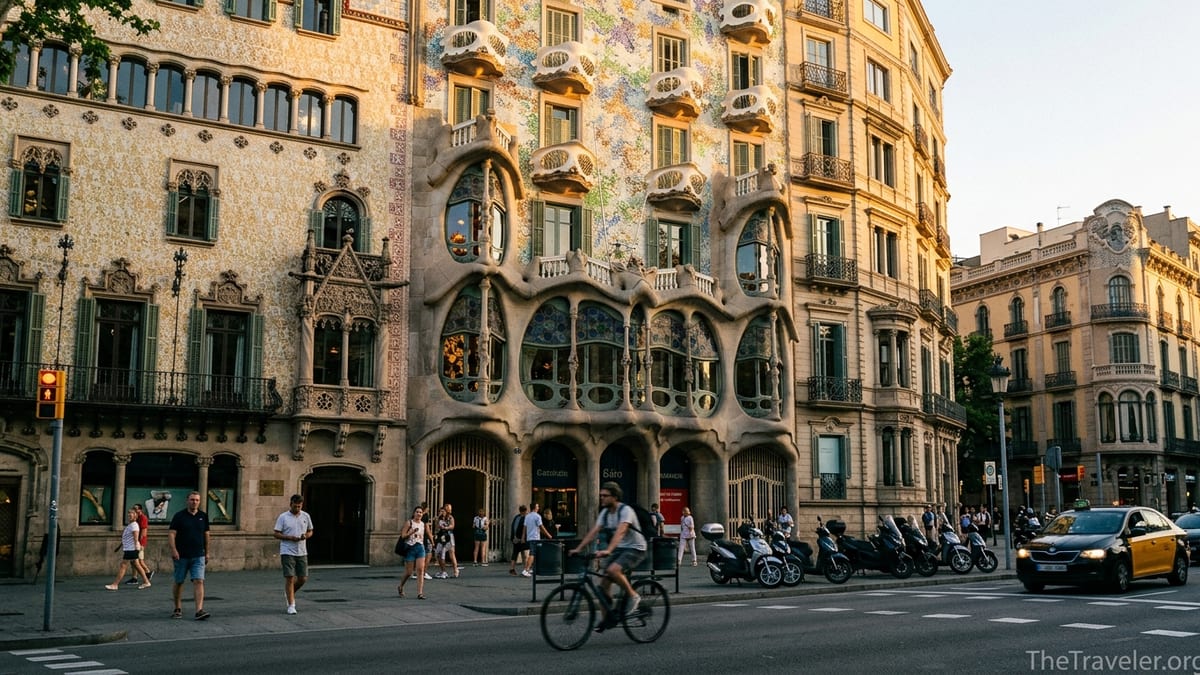
Arriving on Passeig de Gràcia: First Glimpse of a Dragon
Most travelers meet Casa Batlló from the broad sidewalks of Passeig de Gràcia, Barcelona’s showcase boulevard in the Eixample district. Even before you join the cluster of visitors adjusting audio guides and snapping photos, the façade stops you in your tracks. Its rippling surface, set between more conventional neighbors in the so-called “Block of Discord,” looks more like a coral reef than a traditional apartment block. Standing here, you see why Gaudí’s work is often compared to living organisms rather than buildings.
Up close, the details begin to sharpen. The lower floors are carved from Montjuïc sandstone, their windows opening in fluid, almost skeletal shapes that locals long ago nicknamed “the house of bones.” Above, a skin of colored glass and ceramic discs catches the Catalan light in different ways as clouds pass, so the façade seems to shift tone from greenish to blue to soft violet through the day. It is the kind of surface you keep photographing, only to realize the camera never quite catches the way the color actually moves.
Look up again, this time to the roofline. The tiles bulge in a pronounced curve, like the arched spine of a dragon, their glaze deepening from cool blues to rusty reds along the crest. A turret topped with a cross punctures this back, an allusion many guides link to the legend of Saint George, Catalonia’s patron saint, driving a spear into the beast. Knowing that story does not feel theoretical when you are standing there; you can trace the dragon’s body with your eyes, from the “scales” of the roof tiles to the “skulls” and “bones” of the balconies below.
On busy summer mornings, you may hear several languages around you as visitors compare impressions. A couple from Chicago might be debating whether it looks more like a sea monster than a dragon; a local guide might be pointing out how the balconies resemble carnival masks. The key is not to rush inside immediately. Give yourself a few minutes on the pavement simply to look, because that first contact with the façade becomes a reference point for everything you experience later inside.
Crossing the Threshold: From City Noise to Submerged Silence
Once you pass through the entrance doors, a different atmosphere closes around you. The city’s traffic noise softens behind thick walls, and the light changes from broad daylight to a filtered, underwater glow. The entrance hall, with its fluid blue and sand-colored surfaces, feels closer to the belly of a whale or the inside of a seashell than a conventional lobby. It was at this moment, walking in from a busy morning on Passeig de Gràcia, that Gaudí’s creativity started to register as a complete environment rather than isolated wild shapes.
The main staircase, leading up to the noble floor, is a perfect example. Its carved wooden banister has the sheen and warmth of polished bone, but it is unexpectedly smooth and ergonomic under your hand. The new-generation audio guide encourages you to slide your palm along it, and you realize every curve is placed where a wrist or thumb naturally falls. This is where Gaudí’s imagination becomes practical: he did not only create a fantastical form; he shaped it so a tired 21st-century traveler, camera hanging from one shoulder, can climb comfortably without thinking.
At the top of the first flight, a light well opens above you, tiled in a gradient that deepens from pale near the bottom to rich cobalt at the top. When you stand here around midday, you can see how the narrowing shape and intensifying tile color balance the distribution of natural light, so the lower floors do not sit in gloom while the upper ones burn with sun. You may have read about Gaudí’s obsession with natural light, but here the logic is literally visible. Look up, and you see the bright core; look down, and you see the same blue glow reaching to levels you have not visited yet.
Practical details quietly reinforce the sense of care. Ticket checks are quick and mostly digital, often via QR codes on your phone, and staff keep visitor flow moving gently so staircases never feel dangerously crowded. In peak seasons, when timed-entry tickets are common and basic “Blue” admission can start in the low 30 euro range depending on the day and demand, this choreography of people is essential. You become part of a continuous, slow river of bodies, and the building seems ready for that rhythm.
The Noble Floor: Where Daily Life Became Sculpture
The noble floor, once the Batlló family residence, is usually the point where visitors stop talking and simply stare. Here, Gaudí’s creativity intersects with domestic life, and the result is a sequence of rooms that feel both theatrical and unexpectedly livable. When you first step into the grand salon overlooking Passeig de Gràcia, the entire urban scene outside is framed by a huge, undulating window that looks like a series of bubbles pressed together.
Standing by this window, you realize how precisely Gaudí choreographed views. The wood frames curve around discs of clear and stained glass that distort the street below. Cars and buses on the avenue warp into streaks of color; pedestrians appear framed in soft circles, as if seen through droplets of water. You begin to understand that Gaudí was not just decorating a façade. He was editing the city itself for the people who lived here, filtering the outside world into something softer and more dreamlike.
Move deeper into the noble floor and the details continue. Ventilation grilles are carved as swirling organic patterns in the doors, allowing air to circulate without ugly metal vents. Partition walls curve, opening into bays where built-in benches invite you to sit and watch the play of light. One small alcove, once used as a kind of private corner or courting nook, wraps around a mushroom-shaped fireplace. It is easy to imagine late 19th-century conversations taking place here, but it is just as easy to picture a modern visitor taking a quiet moment away from the flow of the tour.
For many travelers who have only seen photographs, this level is where Gaudí’s work shifts from being a style to being a way of inhabiting space. You find yourself ducking slightly through lower arches, adjusting your stride to the curve of the floor, turning automatically to follow lines that guide your eye toward windows and doors. In doing so, you participate in his design. It is not an abstract appreciation; it is something your body does almost without instruction.
Light Wells, Attic Arches, and the Quiet Genius of Function
As you climb higher, Casa Batlló reveals a side of Gaudí that photographs rarely capture: the engineer concerned with comfort and practicality. One of the most striking moments comes in the central courtyard, where the ceramic tiles shift from almost white at the bottom to deep sea blue at the top. If you pause between floors and look at the windows facing this space, you will see that they decrease in size as they rise, compensating for the increasing brightness of the sky. Together with the tile gradient, this ensures that each level receives a similar quality of light.
On a warm afternoon, the temperature difference becomes noticeable. The thick walls, adjustable wooden shutters, and carefully placed vents maintain a surprisingly mild interior climate. You might step in from a 30-degree Celsius August street and find yourself in a cool, softly lit stairwell where the heat seems to dissolve. Without modern air conditioning, Gaudí used form, materials, and airflow to create comfort, and walking these spaces reminds you that his creativity was rooted in deeply practical solutions.
Then there is the attic, once used as service spaces for laundry and storage. Here, the house’s organic metaphors reach a peak of abstraction. A series of catenary arches, white and rhythmic, line the long hallway like the ribs of some giant animal. As you walk through, the arches compress and expand the corridor subtly, guiding your pace. One moment the ceiling is close enough to make you tuck your shoulders slightly; the next it opens just enough to encourage you to breathe more deeply. Even in this utilitarian zone, Gaudí turned structure into a sensory experience.
Modern interpretive additions, such as projections and gentle soundscapes in some rooms, highlight how the building functioned without overwhelming it. For instance, in areas that once housed water tanks or washing facilities, digital overlays may evoke the movement of water across the tiles. When these elements are at their best, they serve as annotations rather than distractions, nudging you to notice how carefully each curve, window, and vent once supported everyday tasks like drying sheets or circulating fresh air.
Rooftop and Gaudí Dome: Inside the Dragon and Beyond
Reaching the rooftop is often the emotional high point of a visit. The space opens suddenly after the controlled compression of staircases and attic arches. The dragon-back roof, which earlier you only admired from the street, is now at arm’s length. You can see how each ceramic tile in the spine has its own subtle variations of color and texture, and how the line of the back is not perfectly straight but slightly irregular, like real anatomy rather than stylized ornament.
Clusters of chimneys rise around you, their surfaces broken into shimmering trencadís mosaics of broken tile that catch the afternoon sun. Walking between them feels less like strolling over a roof and more like navigating a sculptural garden. On clear days, the city spreads out in all directions: the grid of the Eixample, the distant line of the sea, and the outline of Tibidabo on the horizon. Many visitors linger here, taking the classic photos, but if you step to one side and simply run your hand along the cool ceramic, the dragon metaphor becomes tactile instead of purely visual.
In recent years, Casa Batlló has added immersive experiences such as the so-called Gaudí Dome and Gaudí Cube, often included in higher-tier tickets or certain visit formats. In the dome, a curved space surrounds you with projections evoking the natural forms that inspired Gaudí: tree branches, seashell spirals, patterns of light on water. The effect can be intense, but for many travelers it serves as a bridge between their own mental images and the physical building they are about to walk through or have just explored.
The Gaudí Cube, a 360-degree projection room created with contemporary digital art techniques, wraps visitors in shifting images based on Gaudí’s sketches and textures. It is a clear example of how the house has become not just a preserved monument but a platform for new forms of storytelling. Purists sometimes debate whether these additions are necessary, but for many visitors unfamiliar with architectural theory, they provide accessible entry points. Stepping out of these immersive spaces back into a real stairwell, you may find yourself looking more carefully at the very ordinary things around you: the way a doorknob fits the palm, or how a skylight breaks up sun into soft ellipses on the wall.
New Experiences and the Living House in 2026
Casa Batlló has continued to evolve as a visitor experience. In 2026, for example, the third-floor apartment, the last largely intact domestic space designed by Gaudí in the building, began opening as a complementary, more private visit option. This level, once occupied by descendants of the Batlló family, preserves the feeling of an early 20th-century home more directly than the heavily interpreted noble floor. Small details like original doors, fireplaces, and room layouts survive with a high degree of authenticity, and touring these rooms in a smaller group changes the rhythm of your walk through the house.
These more exclusive visits are typically priced above the standard ticket tiers and can include extras such as small-scale gastronomic events or private gatherings. While not necessary for a meaningful first encounter with Casa Batlló, they underline an important point: this is still, in many ways, a living building. Spaces are adapted, curated, and reused, much as they were when Gaudí first remodeled the house between 1904 and 1906. For travelers who have already done a general visit, returning for one of these special formats can deepen the impression of walking inside a real, layered history rather than a frozen museum set.
Ticketing itself has also become a subtle lesson in how contemporary tourism reshapes historic sites. Dynamic pricing means that the basic “Blue” ticket might start somewhere in the low 30 euro range and climb at busier times, while higher “Silver” or premium experiences sit correspondingly higher, often with additions like fast-track entry, rooftop concert evenings in summer, or more expansive immersive content. From a budget traveler’s perspective, this can feel complicated, but understanding that you are paying for timed access that preserves a sense of intimacy inside a world-famous UNESCO-listed building can make the expense easier to accept.
Walking through Casa Batlló with this in mind, you realize you are part of the latest chapter in a long story. The same staircases that once saw servants carrying laundry now host visitors from Seoul, São Paulo, and Seattle in quick succession. The rooftop that once held functional water tanks now stages live music under the stars. Gaudí’s creativity, anchored in structure and function a century ago, keeps absorbing new layers of use without losing its original force.
Practical Ways to Feel Gaudí’s Creativity When You Visit
For travelers planning their own walk through Casa Batlló, a few practical choices can make Gaudí’s creativity feel especially immediate. Time of day matters. Early morning or late evening slots often mean softer light slanting through stained glass and fewer people crowding windows and staircases. An evening visit, as long as it still includes rooftop access under the current ticket structure, can add the drama of the façade and city views lit after dark, though some exterior details may be harder to see compared with full daylight.
Your choice of ticket tier shapes the experience too. A basic ticket will usually include the core self-guided visit through the main levels, often with a smart audio guide and access to at least some immersive spaces. Upgrading to a mid-range or higher tier can add benefits such as rooftop access if not already included, more extensive multimedia content, or special events like rooftop concerts. For a first-time visitor who cares deeply about architecture, ensuring that your chosen option includes both the attic and full rooftop is worth the extra cost. Those few additional euros are repaid several times over the moment you stand eye-level with the dragon’s back.
Inside, a simple strategy is to alternate between looking and touching where allowed. Run your fingers lightly along the wooden railings, the cool plaster curves of walls, and the mosaic-tiled banquettes. Pause at the light wells to watch how reflections move as clouds pass. Then step back to absorb full rooms in silence, without the audio guide for a minute or two. This physical engagement turns the visit from a series of photos into a felt experience; you start to understand how Gaudí wanted bodies to move, not just eyes to look.
Finally, consider pairing Casa Batlló with another Gaudí building during your stay, such as Casa Milà a few blocks away or the Sagrada Família further north. Experiencing multiple works in quick succession helps you see recurring ideas: organic façades that still hide rational structural grids, courtyards used as breathing lungs for light and air, roofscapes that double as sculptures and ventilation systems. After walking through Casa Batlló, you may find you notice more at these other sites. Gaudí’s creativity becomes a lens you carry with you through the rest of Barcelona.
The Takeaway
When you step back onto Passeig de Gràcia after a visit to Casa Batlló, the building’s façade looks different. What was once only a photograph or an icon now contains memories of stair treads under your feet, cool blue light on your skin, the faint echo of footsteps in the attic, and the weight of a wooden handrail in your palm. Gaudí’s creativity, so often described in grand terms, reveals itself as an accumulation of very small, tangible decisions: how a window opens, how air moves, how a tile catches light.
For travelers, this is what makes Casa Batlló more than a box to tick on a sightseeing list. It is a rare chance to walk inside someone’s imagination and discover that it has been carefully designed to host real life. Whether you splurge on a premium experience or choose the simplest timed entry, give yourself space to slow down, to look twice, and to feel the building as much as you see it. That is where Gaudí’s genius stops being distant and starts to feel undeniably real.
FAQ
Q1. How much time should I plan for a visit to Casa Batlló?
Most visitors spend between 60 and 90 minutes inside, though architecture enthusiasts often stay closer to two hours, especially if they linger on the rooftop and in the attic.
Q2. Which ticket type is best if I want to experience the rooftop and immersive areas?
Check the current ticket descriptions carefully and choose a tier that specifically includes both rooftop access and the immersive spaces like the Gaudí Dome or Gaudí Cube, since inclusions can change over time.
Q3. Is Casa Batlló suitable for children?
Yes, many children respond strongly to the colorful shapes and dragon imagery, and the interactive audio guides can help keep them engaged, though strollers may be restricted in some narrow stair areas.
Q4. What is the best time of day to visit Casa Batlló?
Early morning and late afternoon generally offer softer light and slightly thinner crowds, while selected evening visits can add the atmosphere of illuminated interiors and a lit façade.
Q5. Do I need to book tickets in advance?
Advance booking is strongly recommended, especially in high season, as same-day slots can sell out and walk-up prices are often higher than online dynamic fares.
Q6. Is Casa Batlló accessible for visitors with reduced mobility?
There are lifts and adapted routes for many areas of the house, and discounted tickets for visitors with disabilities are typically available, though some rooftop and attic sections may remain challenging.
Q7. Can I visit Casa Batlló and Casa Milà on the same day?
Yes, they are within easy walking distance on Passeig de Gràcia, and pairing them on the same day can help you compare different phases of Gaudí’s residential work without excessive travel time.
Q8. Are guided tours better than the audio guide?
Well-designed audio guides offer considerable flexibility, but travelers who enjoy asking questions or exploring specific themes may find small-group guided tours more rewarding.
Q9. Is photography allowed inside Casa Batlló?
Non-flash photography for personal use is generally allowed in most areas; however, tripods, flashes, and professional equipment may be restricted, so check current rules before you arrive.
Q10. Is Casa Batlló worth the ticket price compared with other Barcelona sights?
For visitors interested in architecture, design, or Gaudí’s work, Casa Batlló is widely considered one of Barcelona’s unmissable experiences and offers a uniquely immersive look into his creative world.