


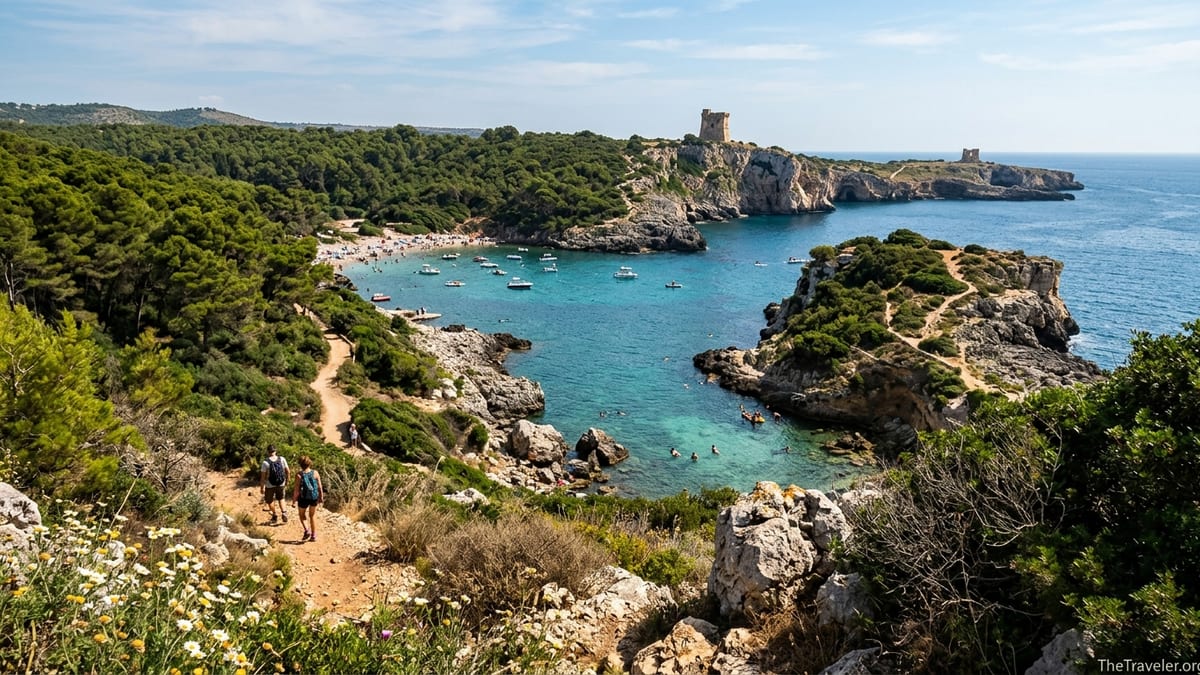
Porto Selvaggio Regional Nature Park, on the Ionian coast of Puglia near Nardò, is one of southern Italy’s most beautiful swimming spots, but it is not an easy, drive-up beach. Reaching its famous turquoise bay means walking through a pine forest or along rocky coastal paths, then swimming from pebbles and low cliffs rather than soft sand. This guide explains in practical detail how to get in, how far you will walk, what the shoreline is really like and which travelers will enjoy Porto Selvaggio most.
Get the latest updates straight to your inbox!
Understanding the Three Main Accesses: Inland, Santa Caterina and Torre Uluzzo
Porto Selvaggio belongs to the regional nature park "Porto Selvaggio e Palude del Capitano" in the municipality of Nardò. The protected coastline sits between Santa Caterina and Sant’Isidoro along the SP286 litoranea. There is no road that drops you directly on the pebbles of Baia di Porto Selvaggio; in every case you must walk the final stretch. The most used access for swimmers is from the inland-style parking at Villa Tafuri on the SP286, while more scenic but longer coastal options link from Santa Caterina or Torre Uluzzo.
The main inland approach starts from the official park parking areas on the SP286. Sources agree on three reference parking zones: Villa Tafuri for Baia di Porto Selvaggio, Torre Uluzzo for the Uluzzo area and Pennu Pendu further along the road. From these clearings in the pine woods you follow marked dirt paths downhill through the forest to the sea, with Baia di Porto Selvaggio around 900 to 1,000 metres from Villa Tafuri and roughly 15 to 20 minutes’ walk at a normal pace.
From Santa Caterina, a small seaside resort west of Nardò, access is possible on foot via paths that climb towards Torre dell’Alto and then descend into the park. This route is often described in Italian guides as the "sentiero dal Chiapparo" and uses a combination of residential streets and rocky trail. Walking times from Santa Caterina seafront to the bay are often around 35 to 45 minutes one way depending on exact starting point and fitness, with significant uphill sections at the beginning.
Torre Uluzzo lies east of the bay toward Sant’Isidoro. A roadside parking area on the SP286 gives access to a viewpoint, archaeological sites and a network of trails. You can either follow a spectacular balcony path towards Porto Selvaggio, which involves ups and downs along the cliffs, or drop directly to the rugged Uluzzo cove. Reaching Baia di Porto Selvaggio from Torre Uluzzo on foot is often estimated at about one hour, making this an option for hikers rather than casual beachgoers.
Can You Drive to the Bay? Parking, Shuttles and Trailheads
Drivers heading specifically for Baia di Porto Selvaggio should set their navigation to one of the named park entrances on the SP286, such as "Villa Tafuri" or generic "Parcheggio Porto Selvaggio" near the big curve between Santa Caterina and Sant’Isidoro. Tourist information from Gallipoli and regional projects describe these as informal but regulated clearings in the forest, operating as paid car parks in summer and often free in the low season. Several sources give a typical summer price in recent years of around 5 euros for the day for a car, with staff collecting payment at the entrance. Exact charges can vary slightly from one year to another.
From the Villa Tafuri car park a dirt road and then a stone and earth path descend through Aleppo pine forest roughly a kilometre to the bay. Waymarking is reasonably clear and, because this is the main family access, the gradient is steady but not extreme. Most walkers take around 15 to 20 minutes to go down and 20 to 30 minutes to climb back out, especially in afternoon heat. This is the route used by many organized excursions described by Italian hiking clubs.
The municipality of Nardò has, in recent summers including 2026, run an electric shuttle system as part of its "mobilità turistica" program. Municipal notices describe a minibus service between a designated park-and-ride area and the Porto Selvaggio entrance areas, plus an internal shuttle from the Torre Uluzzo access along the forest track to the upper end of the main path. One official note mentions operating hours from 8:00 to 20:00 and a fare of about 2 euros per ride for the internal segment. Because routes and prices are set season by season, visitors should verify the current year’s arrangements with Nardò tourist information or at local ticket machines on arrival.
Local bus links exist but remain limited. Regional bus schedules show lines touching Nardò, Gallipoli and the litoranea, with some stops labeled along the road to Porto Selvaggio, yet frequencies are not high and timetables are largely aimed at commuters and summer seaside traffic. In practice most visitors arrive by private car, scooter or taxi, then use the park paths or summer shuttle for the final section.
Trail Distances, Elevation and Why Porto Selvaggio Feels Demanding
The classic wooded descent from Villa Tafuri to Baia di Porto Selvaggio is short on paper but can feel demanding in July and August. You descend around 60 to 80 metres of elevation on a sun-exposed dirt track and stony path, then climb the same height back up, usually after swimming under a strong afternoon sun. For a fit adult in trainers carrying a small backpack, the uphill return is a moderate effort of 20 minutes. For families with small children, people unaccustomed to walking or anyone carrying heavy beach equipment, it can feel significantly harder.
In contrast, the longer walks from Santa Caterina or Torre Uluzzo add horizontal distance and more uneven terrain. From Santa Caterina waterfront, you first follow streets and steps up toward Torre dell’Alto, gaining perhaps 70 to 90 metres of elevation, then descend on a rocky mule track of about 900 metres toward the sea. Combine both sections and the return involves several hundred metres of total ascent and descent. Many travelers take 40 to 50 minutes each way, especially if pausing at viewpoints.
From Torre Uluzzo, guides describe a "sentiero a mezza costa" running along the side of the limestone cliffs toward Porto Selvaggio. This balcony path is spectacular but narrow and irregular underfoot, with short steep sections, loose stones and occasional exposure near drops. The direct time between Torre Uluzzo and Porto Selvaggio bay is often given as about one hour each way for experienced walkers, more if stopping for photos or detours down to small inlets. The elevation gain is broken into several smaller climbs rather than one big hill, but the technical footing and sun exposure increase fatigue.
What makes Porto Selvaggio more demanding than a regular sandy beach is this combination of heat, hard surfaces and the need to stay mobile. You walk in and out on rough ground rather than a paved promenade, then spend your swimming time on rocks or pebbles instead of a level sandbank. Anyone with knee issues, balance problems or who is used to parking 50 metres from a lido sunbed should factor in these physical demands before committing.
The Bay Itself: Rocks, Cold Springs and Water Conditions
Baia di Porto Selvaggio is a compact indentation in the rocky coast at the base of the pine forest. Regional and tourist descriptions stress that the "beach" is made of rounded pebbles and low rock shelves rather than sand. There is effectively no broad sandy area. Most people spread towels on the pebbles at the back of the cove or find flat rock slabs along the sides. Space is limited and in August the most comfortable spots fill quickly, leading some visitors to perch on awkward boulders.
One of the most distinctive features of the bay is the presence of cold freshwater springs entering the sea close to shore. These karst springs lower the water temperature noticeably compared with nearby sandy beaches such as Baia Verde near Gallipoli. Swimmers often remark that the first immersion is bracing even in high summer. The mixing of fresh and salt water also contributes to exceptional water clarity in patches, making the cove popular for snorkeling despite the small size.
Underwater, the seabed alternates between pebbles, bare limestone rock and patches of seagrass. There are submerged rocks and a healthy population of sea urchins clinging to crevices, especially around the rocky edges of the cove and along the outer coastline towards Torre dell’Alto and Torre Uluzzo. Because entry points are uneven, can be slippery with algae and may drop suddenly from knee-deep to chest-deep, robust water shoes or neoprene reef shoes are strongly recommended. Many local swimmers treat them as essential gear, along with a mask and snorkel.
The rocky environment also means that waves can surge and reflect off the cliffs during onshore winds, making exits a little tricky for inexperienced swimmers. On calmer mornings the cove feels like a natural pool, but conditions can change during the day. There are no lifeguards stationed on the rocks, and this is an unserviced natural bay; each swimmer is responsible for judging their own ability and the sea state before venturing far out.
Facilities, Crowding, Rules and Environmental Protections
Porto Selvaggio is officially a regional nature park and is managed as a protected area. Official and semi-official descriptions consistently underline that there are no permanent lido structures, beach clubs or large food kiosks directly on Baia di Porto Selvaggio. In some recent summers small temporary refreshment stands or mobile vendors have appeared near the back of the bay or along the path, but their presence is not guaranteed and they may not operate all season. There are no built changing cabins and reports of toilets at the bay itself are inconsistent; visitors should not rely on them.
Summer crowding is a real issue. Italian beach guides describe the bay as one of the most famous natural spots on the Ionian coast and note that parking on the SP286 can fill by mid-morning on August weekends. Late arrivals around 11:00 often have to leave cars along the road at greater distances and walk further under the sun. On the shore, this translates into a dense occupation of the small pebble strip and rocks. Travelers who prefer quieter conditions should target June, early July or September, and aim to arrive before 9:30 in high season.
As a regulated protected area, the park enforces rules on fires, litter and habitat disturbance. Open flames are normally prohibited during the summer fire-risk period, including barbecues, and there are seasonal bans on smoking within the pine forest in very high risk phases. Removing plants, rocks or animals, including sea urchins and marine life, is forbidden. Litter rules follow standard Italian protected-area regulations: visitors must dispose of waste at designated points outside sensitive zones and can be fined for abandoning trash in the park.
Camps and overnight stays are not part of the normal use of Porto Selvaggio. There is no authorized campsite inside the bay area and wild camping is not allowed. Local ordinances in similar regional parks often restrict drone flights for privacy and wildlife reasons. While specific drone rules for Porto Selvaggio may be included in municipal regulations rather than widely publicized tourist material, visitors should assume that flying drones over crowded bathing areas or nesting cliffs is either prohibited or tightly controlled and seek explicit permission before launching any device.
Half-Day Swim, Full-Day Hike and an Easier Santa Caterina Alternative
A practical half-day swimming excursion might start with parking at Villa Tafuri on the SP286 around 8:30. After paying for the day, you walk 20 minutes down through the pine trees, choosing one of the shady benches or low walls for a brief rest if needed. Reaching the bay by 9:00, you can claim a flat rock at the eastern side, pull on water shoes and spend the morning alternating between swims in the cold spring-fed water and relaxed time under the scattered pines. Around 12:00 you begin the ascent, allowing 25 minutes for a slow, shaded climb and a water break before driving back to Nardò or Gallipoli for a late lunch.
A full-day hiking and snorkeling itinerary suits fitter travelers keen to explore more of the park. You might begin in Santa Caterina at 8:00, climbing up past Torre dell’Alto then following the clifftop path east towards the Porto Selvaggio woods, stopping at viewpoints above the bay to look down on the cove from above. Mid-morning you descend to Baia di Porto Selvaggio for a long swim and picnic lunch from food you carried in. In the afternoon you either return to Santa Caterina by the same route or continue on foot toward Torre Uluzzo along the mezza costa trail, exploring side paths to small rocky inlets and archaeological sites before arranging a taxi pickup on the SP286 near Torre Uluzzo in the late afternoon.
For travelers who want the scenery but need easier access, Santa Caterina itself offers a more accessible alternative. The village has a paved waterfront with low cliffs and concrete bathing platforms, metal ladders into the sea and short stretches of rocks that are much closer to street parking, cafes and toilets. You can stay in Santa Caterina, swim from the accessible waterfront in the morning and then, if energy allows, take only a short stroll into the lower edge of the Porto Selvaggio pine woods in the late afternoon without committing to the full descent to Baia di Porto Selvaggio. This plan suits multi-generational families or anyone unsure about the steep forest path.
Although boat trips to the area exist from nearby harbors, they are usually marketed as coastal cruises with swim stops rather than as direct transport into the bay itself, because of the protected status and the rocky shoreline. If you prefer to avoid the walk entirely, enquire in Gallipoli or Santa Maria al Bagno about small-boat excursions that cruise under the cliffs of Porto Selvaggio, swim in offshore coves and then return to more conventional sandy beaches for the rest of the day.
Getting There from Nardò, Gallipoli and Lecce, Plus a 2026 Budget Example
By road, Porto Selvaggio sits closest to Nardò. The inland town is roughly 8 to 10 kilometres from the SP286 entrances depending on your route, with driving times around 15 minutes in light traffic. Gallipoli is about 16 kilometres to the south-west along the coast, with common estimates of 20 to 25 minutes’ drive outside peak holiday congestion. Lecce, the provincial capital, lies inland to the north-east; the run from Lecce to the SP286 near Porto Selvaggio covers around 35 to 40 kilometres and takes about 40 to 50 minutes by car depending on traffic and approach roads.
Taxis and private transfers are available from these towns, though ridesharing services have patchy coverage. In 2026, a realistic ballpark for a one-way daytime taxi from Nardò to Porto Selvaggio might fall in the range of 20 to 35 euros depending on the exact pickup point and company policies, while Gallipoli to Porto Selvaggio might cost somewhere around 35 to 50 euros one way. Fares should always be confirmed in advance with a local operator. Public transport is possible by combining regional buses between Lecce, Nardò and the coast, or summertime coastal shuttle routes around Gallipoli, but frequencies and connections mean that door-to-park travel can easily take more than an hour.
For two travelers visiting in summer 2026 with their own car, a simple half-day budget might include 5 to 7 euros for parking at an SP286 car park, 10 to 20 euros for sandwiches, fruit and water bought in Nardò or Santa Caterina, and, if used, around 8 euros total for four shuttle rides at approximately 2 euros per trip between the forest entrance and the upper path. Renting or buying water shoes in a seaside shop in Gallipoli or Santa Maria al Bagno could add about 15 to 25 euros per pair depending on brand and quality. Including a coffee and gelato stop in Santa Caterina before driving back, a realistic total could land around 60 to 90 euros for two for the day, excluding accommodation and fuel.
Travelers without a car need to budget much more for transport. A taxi round trip from Gallipoli could alone cost in the region of 70 to 100 euros in 2026. Splitting such a fare between four friends makes it more palatable, but solo travelers on tight budgets may do better to stay in Nardò, Santa Caterina or Santa Maria al Bagno and focus on the more accessible waterfronts reachable on foot or by short local bus hops.
Water, Heat, Navigation Tips and Accessibility Limits
Porto Selvaggio’s beauty comes with strong summer heat. The approach paths have some shade from the pines but include exposed stretches, and there is limited shelter on the rocks by the water once the central trees are taken. High-season afternoon temperatures regularly climb well above 30 degrees Celsius. Visitors are strongly advised to carry enough drinking water for the entire outing, for example at least 1.5 litres per person for a typical half-day visit, more if attempting a full coastal hike.
The safest strategy is to plan the downhill walk either before 10:00 in the morning or after around 16:30 in the afternoon, avoiding the intense midday hours. In July and August, arranging your main uphill return before 11:30 or after 17:30 reduces heat stress. Families with infants, older travelers and anyone with cardiovascular issues should be especially cautious about attempting the climb in the hottest period of the day and should listen to their bodies, taking rests in the shade whenever possible.
Navigation is fairly intuitive once you understand the layout. From Villa Tafuri and the SP286 parks, signposts lead along broad forest tracks that inevitably converge on the bay. From Santa Caterina and Torre Uluzzo, the network is more confusing: worn but unmarked side paths criss-cross the cliffs and woods, and it is easy to drift away from the main line. Carrying a downloaded offline map on a smartphone with GPS, or using a reputable hiking app, can help confirm your position. Mobile coverage in the area is generally present but can weaken in some gullies, so do not rely entirely on live mapping.
Accessibility is limited. The dirt and stone paths are not suitable for wheelchairs or standard baby strollers, and even all-terrain buggies will struggle on the rocky sections. At the bay itself there are no ramps or handrails leading into the water, and entries from the rocks require good balance. People with serious mobility impairments, recent injuries or who depend on walking aids are unlikely to find Baia di Porto Selvaggio usable for swimming. For them, the stepped concrete platforms and short ramps of Santa Caterina or larger sandy beaches around Gallipoli are safer and more comfortable options.
Trail Comparison and Who Will Enjoy Porto Selvaggio
Comparing the three main access routes helps set expectations. The Villa Tafuri descent is the shortest at about 1 kilometre each way with a clear forest track and moderate gradient, suited to reasonably fit walkers and children used to short hikes. The Santa Caterina route is longer, combining village streets, uphill sections and a rocky descent, best for active travelers who enjoy varied terrain and photograph viewpoints. The Torre Uluzzo link is more of a mini-trek with narrow balcony sections and exposure, appealing to hikers comfortable on uneven paths who want a combination of archaeology, cliff views and a swim at the end.
For navigation, the simplest approach is to treat Baia di Porto Selvaggio as a hiking destination rather than a casual beach stop. Wear closed, grippy footwear for the walk, switch to water shoes for swimming, bring a small backpack rather than supermarket bags, and check the return route and your timing before settling in at the water’s edge. Keeping an eye on milestones such as the forest edge, junctions with wooden signposts and prominent landmarks like Torre dell’Alto helps you stay oriented.
Porto Selvaggio will delight travelers who like wild-feeling coasts, cool water and a sense of achievement in reaching their swim. Hikers, trail runners, snorkelers and photographers, as well as couples seeking a half-day escape from crowded lidos, tend to rate it highly. It is also a strong choice for visitors already staying in Nardò or Santa Caterina who can time their visit for quieter early mornings or shoulder season days.
On the other hand, those who need flat, sandy entries, guaranteed facilities and very short walks should probably choose an easier beach. Families with toddlers, people with limited mobility or travelers carrying heavy chairs, umbrellas and cool boxes will likely find Baia di Porto Selvaggio uncomfortable or stressful. For them, the wide sands and equipped lidos around Gallipoli, or the accessible waterfront of Santa Caterina, offer a safer and more relaxing way to enjoy the same stretch of Ionian coast without the demanding walk and rocky shoreline.