


Stand on the acropolis of Cuma, looking over the Tyrrhenian Sea and the smoking fields of the Campi Flegrei, and you are standing at one of Europe’s great cultural fault lines. Here, on a rocky spur west of modern Naples, Greek settlers carved a city into volcanic stone nearly three millennia ago, brought their alphabet and gods, and began a cultural experiment that would change Italy forever. To understand how Greek ideas became Roman, and how both still shape the modern Mediterranean, you could do far worse than start among the tufa walls and echoing tunnels of ancient Cuma.
Get the latest updates straight to your inbox!
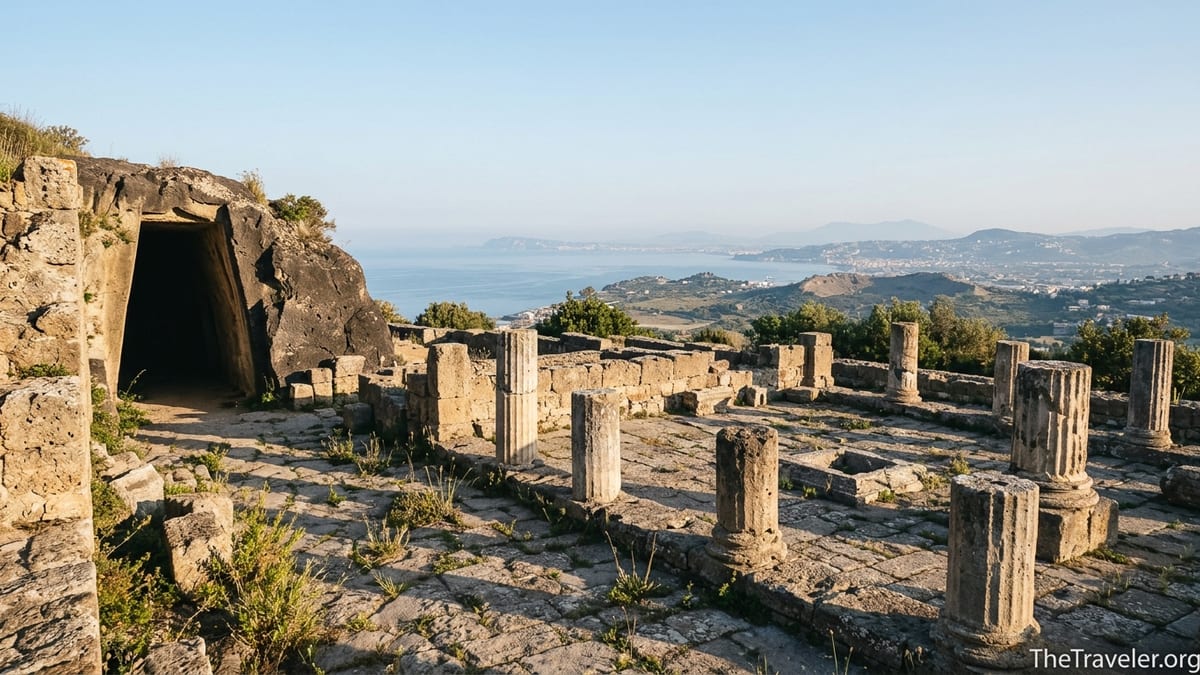
Cuma: The First Greek City on the Italian Mainland
Cuma, or Cumae, was founded by Euboean Greeks in the 8th century BC, probably from the island city of Chalcis, soon after they had created a trading settlement on nearby Ischia. Ancient writers and modern archaeologists agree that this was the first fully fledged Greek city on the Italian mainland, making Cuma the spearhead of what Romans later called Magna Graecia, the Greek south. For visitors today, that status is not just a line in a guidebook. You see it in the urban layout, the masonry of the fortification walls, and the way the city grips its acropolis ridge in the same way Greek cities did back in the Aegean.
Walking up from the ticket office of the Parco Archeologico di Cuma, you climb a paved path that once led from the lower town to the acropolis. On your way you pass stretches of heavy ashlar walls, some dating to the late 6th and 5th centuries BC, built in a Hellenic style that predates Roman control. These fortifications, raised in an era when Cuma was wealthy, embattled, and fending off Etruscan and Italic rivals, visually anchor the idea that this was a Greek polis transplanted to Italy, complete with its own harbor, agricultural hinterland, and diplomatic network.
Cuma’s position on a headland above rich coastal plains allowed it to dominate traffic through the Bay of Naples. That geography is still obvious on a clear day. From the acropolis terraces you can pick out the line of the coast toward Pozzuoli, the islands of Procida and Ischia on the horizon, and the cratered fields of the Campi Flegrei around you. This is the setting that made Cuma both a gateway and a filter through which Greek goods, scripts, and stories entered Italy long before Rome was anything more than a cluster of hilltop villages.
The Birthplace of an Alphabet and a Cultural Bridge
One of the quiet reasons Cuma matters so much is invisible on site, yet all around you in modern Italy: the alphabet. The version of the Greek alphabet used in Cuma, adapted from the script of Euboea, was adopted by the nearby Etruscans, who in turn passed a modified form of it to early Romans. Over centuries of tweaks and standardization, that sequence ultimately leads to the Latin alphabet used across the western world today. When travelers photograph the weathered inscriptions in Naples’ archaeological museum or on the walls of Pompeii, they are seeing the long shadow of choices made in places like Cuma.
Archaeological studies of pottery and inscriptions from Cuma and neighboring sites show a tight network of contacts with Etruscan communities inland and coastal Italic groups. Objects unearthed here include Greek fine-ware cups with dedications scratched in early alphabets, as well as locally made imitations. For a visitor, the most accessible way to grasp this is to pair a day at Cuma with time at the National Archaeological Museum of Naples, where many finds from the site are displayed. Seeing a sherd of inscribed pottery in a glass case, then walking the windswept acropolis where it was dug up, connects abstract talk of cultural transmission to the real texture of clay and stone.
This cross-cultural role is written into the later history of the region too. Cuma’s colonists and their descendants helped found Parthenope and Neapolis, the ancestors of Naples, using their language and urban planning as templates. When you stroll along the seafront in modern Naples or explore its grid of old streets, you are moving through a city whose bones were laid out under the influence of Cuma and its Greek civic model.
The Sibyl’s Cave: Where Myth, Literature, and Rock Meet
Very few archaeological sites in Italy let you walk straight into the setting of a major classical myth. Cuma is one of them. Just below the acropolis summit, cut deep into the volcanic tuff, lies the so-called Antro della Sibilla, the Cave of the Sibyl. It is a long, trapezoidal corridor, about 130 meters in length, sloping gently and lined with side chambers, lit today by carefully placed electric lights that catch the rough chisel marks on the walls. Ancient authors believed that here, or nearby at Lake Avernus, lived the Cumaean Sibyl, a prophetess of Apollo who guided heroes to the underworld and issued oracles to early Roman rulers.
For readers of Virgil’s Aeneid, descending into the tunnel can be an uncanny experience. This is where Aeneas is said to have met the Sibyl before his journey to Hades, a scene that shaped Roman ideas about the afterlife and imperial destiny. Roman historians also told how one Sibyl sold prophetic books to the last kings of Rome, texts that later magistrates consulted in times of crisis. Whether the exact details are historical or not, the physical cave you visit at Cuma explains why such stories gathered here. The combination of volcanic landscape, fumaroles, and a real man-made tunnel that dives into the hillside made this a natural stage for oracles and underworld journeys.
Modern research suggests that the cave complex visible today took shape over several phases, including significant work during the late Republican or early Imperial period. Yet the tradition of a sibylline oracle at Cuma is older, and there are other grottoes and cuttings in the area that may have served oracular functions before this grand passage was carved. From a traveler’s perspective, the important thing is that Cuma gives you a concrete, sensory way to think about how Greeks and Romans mapped religious ideas onto striking natural features. The cool air, the echo of footsteps, and the sudden glimpses of daylight at side openings all help you understand why ancient visitors felt they were crossing a border between worlds.
Greek Temples, Roman Churches, and the Layered City
On top of the acropolis, the ground plan of Cuma’s religious life lies open to the sky. Here, remains of a major temple complex, probably dedicated to Apollo in the Greek period, were later modified by Roman builders and eventually converted into a Christian basilica. Today you can walk through a forest of reused columns and masonry bases, reading information boards that point out where a pagan altar once stood and where a baptismal font was later installed. The shifting functions of this plateau capture, in a few square meters, the transition from Greek to Roman to Christian Italy.
Archaeologists have identified multiple construction phases on the acropolis. The earliest structures, in local tuff blocks, follow Greek architectural norms, including an axial alignment and a surrounding colonnade. Later Roman interventions introduced new building materials such as brick and concrete, thickening walls and reshaping interior spaces. By the 4th and 5th centuries AD, when Cuma had become an important Christian center, the old temple cella was reoriented and partitioned to form a church, and a baptistery was added nearby. When you stand in front of the apse, looking back toward the entrance, you are literally facing in a different direction than an Archaic Greek worshipper would have done.
This palimpsest is a powerful reminder that Greek influence in Italy did not end when Roman rule began. Instead, Roman religion and urban culture digested and reinterpreted Greek forms. At Cuma you can see how an originally Greek sanctuary became a Romanized cult site, then a Christian basilica, and finally an archaeological monument inside a modern Italian national park. For travelers interested in late antique and medieval history as much as the classical world, the site offers rare continuity from Archaic Greece through to the early Middle Ages in one walkable circuit.
Cuma in the Wider Story of Magna Graecia
Cuma did not exist in isolation. Its founders were part of a broader wave of Greek settlement that reached across southern Italy and Sicily from the 8th to the 6th centuries BC. Cities such as Syracuse, Tarentum, and Croton grew into major powers, but Cuma retained a special position as one of the earliest bridgeheads in the far west and a crucial ally or rival in regional politics. For modern visitors, this means that Cuma is an ideal starting point for exploring Magna Graecia sites that show different stages of Greek interaction with Italy.
From Naples, Cuma can be paired in a day or two with Paestum to the south, where three Doric temples stand almost complete above the coastal plain. In recent decades, research has drawn connections between the sanctuaries of Cuma and those of Paestum, highlighting shared cult practices and architectural ideas. If you walk through the fragmentary temple bases on Cuma’s acropolis in the morning, then catch a regional train to Paestum the next day, the contrast is striking: one site layered and reworked, the other remarkably intact yet more distant from the everyday urban fabric of a modern city.
Cuma also played a role in the political struggles between Greeks, Etruscans, and later Rome. In the early 5th century BC, the Battle of Cuma saw a coalition led by the city repel an Etruscan fleet, helping to halt Etruscan expansion in the Tyrrhenian. Centuries later, during the Second Punic War, Cuma sided with Rome against Hannibal. Although little of this military history is visible to the casual tourist, knowing it adds depth to a visit. The same ridge where you now watch the sun set over the Tyrrhenian Sea once bristled with defenders whose choices shaped the map of Italy.
Experiencing Cuma Today: Practical Impressions for Travelers
Despite its historical importance, Cuma sees only a fraction of the visitors that crowd Pompeii or Herculaneum. On a weekday in spring or autumn you may share the acropolis with a few school groups and the occasional independent traveler. This relative quiet is part of its appeal. It allows you to walk slowly along the Sibyl’s corridor or sit on a stone block in the former temple precinct and listen to the wind in the grasses without the hum of tour buses in the background.
The archaeological park is managed together with other sites in the Campi Flegrei area, including the Suburban Baths and underwater ruins at Baiae and the Roman amphitheater in Pozzuoli. At the time of writing, a combined ticket to multiple sites in the park typically costs in the range of 8 to 12 euros per adult, often valid for several days. Details change periodically, so travelers should check current prices and opening hours locally in Naples or Pozzuoli before setting out, but as a rule Cuma is significantly less expensive and less crowded than the better-known Vesuvian sites.
Reaching Cuma from Naples usually involves a regional train toward Torregaveta or Pozzuoli, followed by a local bus or taxi across the Campi Flegrei. For many visitors, it is convenient to combine Cuma with a stop at the nearby Flavian Amphitheater in Pozzuoli or the archaeological zone of Baiae, breaking up the day with a seaside lunch in a modern town like Lucrino. This kind of itinerary not only makes transport more efficient but also lets you see how ancient Greek and Roman landscapes intersect with the lived-in suburbs and working harbors of contemporary Campania.
Why Cuma Still Matters for Understanding Greek Influence
For anyone interested in the big question of how Greek thought and culture spread westward, Cuma is a rare place where the story remains legible in the ground. Here you can trace the arc from early Greek apoikia, or overseas foundation, to Roman municipium and Christian bishopric. The city shows how a small group of migrants, carrying their language and gods across the sea, could reshape a coastline and leave marks that still affect alphabets, city plans, and literature.
In practical terms, Cuma helps decode other places you might visit in Italy. Standing in the Sibyl’s cave makes the underworld scenes in Virgil more concrete, which in turn illuminates frescoes in Roman houses in Pompeii or sculptures in the Capitoline Museums in Rome. Observing the conversion of a Greek temple into a basilica here prepares you to understand similar transformations in sites like Paestum or Syracuse. Noticing the interplay of Greek walls, Roman brickwork, and medieval additions on the acropolis gives you a toolkit for reading the layered facades of southern Italian towns you pass through on trains and buses.
Cuma also underscores that cultural influence is rarely one-way. The Greeks who settled here brought their own customs, but they also adapted to local conditions and interacted with Italic neighbors. Their descendants, in turn, were folded into the Roman world and later into Christian Europe. For travelers, recognizing that complexity helps resist simplified stories of a monolithic Greece civilizing a passive Italy. Instead, Cuma becomes a case study in how cultures meet on real coastlines and hillsides, negotiate power and belief, and leave behind a mixture of architecture, myths, and everyday objects that we can still explore.
The Takeaway
Cuma may not have the grand theaters of Syracuse or the photogenic temples of Paestum, but it offers something just as valuable: a concentrated, walkable lesson in how the Greek world took root in Italy and how that encounter reverberated through Roman and Christian history. From the cool darkness of the Sibyl’s tunnel to the sun-baked paving stones of the acropolis, the site forces you to think about movement and adaptation rather than static monuments.
For modern travelers based in Naples or the Amalfi Coast, a day at Cuma is both manageable and transformative. It connects the bustling streets and cafes of the present city with the older story of Greeks crossing the sea in small ships, carving sanctuaries into tuff cliffs, and trading wine and pottery for Italian grain and metals. If you want to understand why so much of Italy feels, in subtle ways, both Greek and Roman at once, there is no better place to start than on this quiet headland overlooking the Tyrrhenian Sea.
FAQ
Q1. Where exactly is Cuma and how far is it from Naples?
Cuma lies in the Campi Flegrei area, west of Naples, roughly an hour away by a combination of regional train and local bus or taxi, depending on connections and traffic.
Q2. Is Cuma worth visiting if I have already seen Pompeii and Herculaneum?
Yes. Cuma offers a different perspective, focusing on earlier Greek settlement and the famous Sibyl’s cave, with far fewer crowds and a more contemplative atmosphere than the Vesuvian cities.
Q3. How much time should I plan for a visit to Cuma?
Most visitors can explore the main highlights, including the Sibyl’s cave and the acropolis temples, in two to three hours, though history enthusiasts may want longer to read site panels and enjoy the views.
Q4. Are there guided tours available on site?
Availability varies. In high season, organized tours from Naples or Pozzuoli sometimes include Cuma, and occasional on-site guides may be present, but many travelers explore independently using guidebooks or audio resources.
Q5. What should I wear and bring when visiting Cuma?
Wear comfortable walking shoes, as paths can be uneven, and bring water, a hat, and sun protection, since much of the acropolis is exposed with limited shade in summer months.
Q6. Is the Sibyl’s cave always open to visitors?
Access to the Sibyl’s cave can be temporarily restricted for conservation or safety reasons, so it is wise to check current conditions locally before your visit and be prepared that some areas may occasionally be closed.
Q7. Can I visit Cuma using public transportation?
Yes. You can usually take a regional train toward the western suburbs of Naples and then a local bus or taxi into the Campi Flegrei, though schedules may be infrequent, especially on weekends or holidays.
Q8. Are there facilities like cafes or restrooms at the site?
Basic facilities, typically including restrooms, are usually available near the entrance, but food options are limited, so many visitors bring snacks or plan to eat in nearby modern towns before or after their visit.
Q9. Is Cuma suitable for children or casual travelers, not just history experts?
Yes. The atmospheric cave, dramatic views, and relatively compact site make Cuma engaging even for those without a deep background in archaeology, especially if you share a few stories about the Sibyl and ancient myths in advance.
Q10. How does Cuma compare to other Greek sites in southern Italy?
Cuma is smaller and more fragmentary than places like Paestum or Syracuse, but its early date, role in spreading the alphabet, and connection to Roman literature give it an outsized importance for understanding Greek influence in Italy.