


Long before Pompeii became a byword for Roman tragedy, another city on the Bay of Naples was quietly shaping the history of southern Italy. Cuma, founded by Greek settlers on a volcanic headland west of modern Naples, was the first Greek colony on the Italian mainland and a gateway through which writing, myth, and Mediterranean trade entered Campania. Today, its windswept acropolis, mysterious tunnels, and views over the Phlegraean Fields offer one of the most atmospheric encounters with antiquity in the region, yet many visitors to Campania never make it this far west.
Get the latest updates straight to your inbox!
From Euboea to Campania: How Cuma Was Born
Cuma’s story begins with a group of adventurous Greeks from the island of Euboea, particularly from the cities of Chalcis and Eretria. Around the mid 8th century BC, these settlers pushed west across the Tyrrhenian Sea, first establishing a trading outpost on the island of Ischia (known in antiquity as Pithekoussai), then venturing to the mainland where they founded Cuma on a rocky promontory above the sea. Archaeology suggests continuous occupation here from at least the 8th century BC, making it the earliest known Greek settlement in mainland Italy and a cornerstone of what would later be called Magna Graecia.
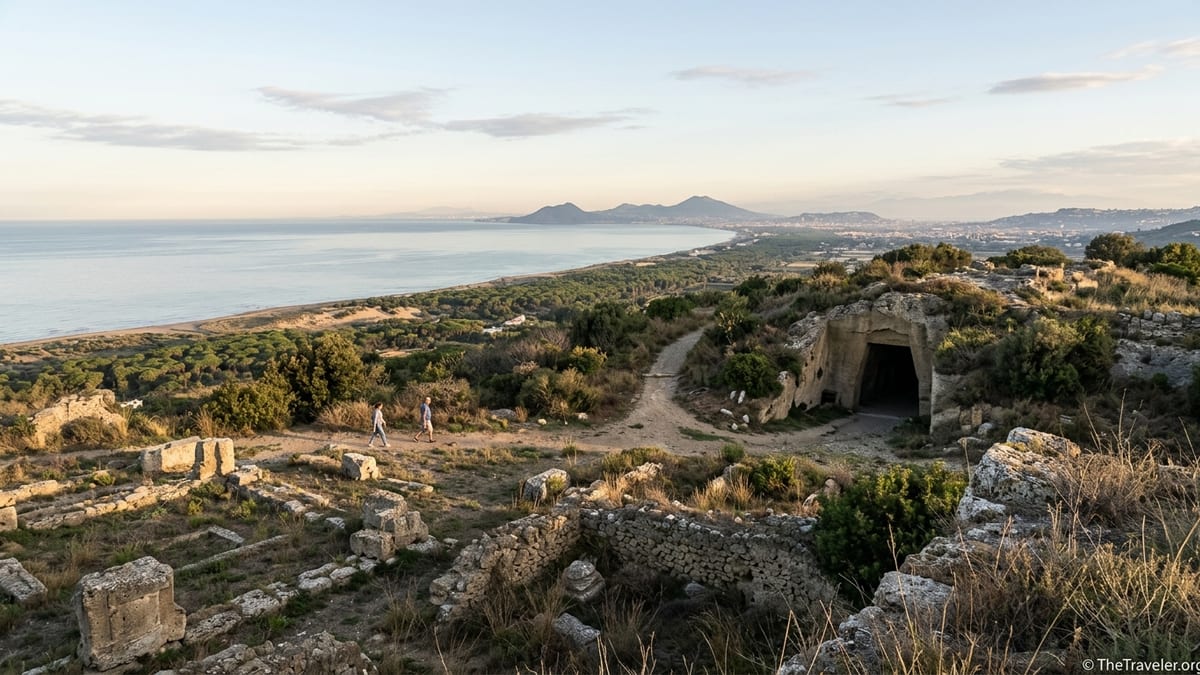
The choice of site was strategic rather than scenic. Cuma sat on a defensible hill with natural cliffs and a broad coastal plain behind it, controlling access to the fertile lands of Campania and the maritime routes that connected central Italy to the wider Mediterranean. From this stronghold, the Greeks could trade with local Italic peoples such as the Ausones and Opici and tap into the metal, agricultural, and timber resources of the hinterland. For modern travelers, this same promontory is what gives the archaeological park its drama: when you climb to the upper acropolis, the sweeping views over dunes, pine forests, and the volcanic cones of the Phlegraean Fields make its ancient strategic value immediately obvious.
Cuma quickly became more than a mere trading post. By the 7th and 6th centuries BC it had grown into a wealthy city-state with its own coinage, temples, and influence stretching along the coast. It was strong enough to help defeat the Etruscans at the naval Battle of Cuma in 474 BC, a turning point that checked Etruscan expansion in the Tyrrhenian. This single victory helped secure Greek and, later, Roman dominance over the region, illustrating how decisions made in this compact settlement rippled across Campania and beyond.
For visitors today, that early Greek phase is not always as visually obvious as the later Roman remains, but you see its traces in the plan of the acropolis, the foundations of the temples, and the imported Greek ceramics displayed at the Archaeological Museum of the Phlegraean Fields in nearby Baia. Touring both Cuma and the museum on the same day gives a tangible sense of how a modest group of colonists from Euboea reshaped the cultural map of southern Italy.
The Cumaean Sibyl and the Myths That Echo Across Campania
If Cuma left its mark on politics and trade, it left an even deeper imprint on myth. The city became famous throughout the ancient Mediterranean as the home of the Cumaean Sibyl, a prophetic priestess of Apollo whose sayings were believed to guide the fate of cities and emperors. Literary sources from Virgil’s Aeneid to later Roman historians insist that Cuma’s oracle was central to Rome’s own story. According to tradition, the Sibyl sold the Sibylline Books, a collection of prophecies, to the last king of Rome after dramatically burning most of the volumes to prove their value.
At the archaeological park, this legendary world is tied to a very real tunnel. The so-called Antro della Sibilla is a long, trapezoidal corridor carved into the tuff rock of the acropolis. It runs for roughly 130 meters with small side chambers and openings that let in slivers of light. For centuries, locals and visiting scholars identified it as the Sibyl’s actual cave, imagining robed priestesses pacing its length while supplicants waited for cryptic verses. More recent research suggests the structure was probably a military or defensive gallery dug between the 4th and 3rd centuries BC, but the association with the oracle remains part of its power.
Walking through the Antro today is one of the most vivid experiences in Campania. In practical terms, you will step from bright Mediterranean sun into cool, damp darkness, then follow the gently sloping passage as your eyes adjust and the distant light at the far opening slowly grows larger. Even travelers who know the archaeological debates tend to fall quiet here, pulled into the long continuity of myth that binds Cuma to other legendary nearby sites like Lake Avernus, once believed to be an entrance to the underworld, and Baiae, the luxurious resort later associated with imperial intrigue.
Because of this mythic aura, Cuma is an ideal stop if you are interested in combining literary history and travel. Students who have read the Aeneid, for example, often time their visit so they can stand at the tunnel entrance, copies of the text in hand, before continuing to other locations in the Phlegraean Fields. Tour guides based in Pozzuoli and Naples increasingly build “myth and volcano” itineraries that link the Sibyl’s cave, Lake Avernus, and the fumaroles of Solfatara, underlining how Cuma’s stories have shaped the identity of the entire region.
A City Between Greeks, Italic Peoples, and Rome
Cuma’s long history is also a story of cultural exchange and conflict. For several centuries it was a dominant Greek power in Campania, founding or influencing nearby communities and spreading elements of Greek language, art, and urban planning. Inscriptions and archaeological finds suggest that the Greek alphabet used at Cuma helped shape the scripts adopted by neighboring Italic peoples and, eventually, by the early Romans. In that sense, the alphabet that underpins modern Italian and English owes something to this windswept headland.
Yet Cuma did not exist in a vacuum. From the beginning it interacted with local Italic cultures. Burial customs and pottery styles found in the surrounding plains show a blend of Greek and indigenous traditions, while ancient authors mention tensions with neighboring peoples who resented Cuma’s growing power. In the 5th century BC, the city suffered heavy defeats at the hands of the Samnites, an Italic group expanding from the Apennines. Cuma survived, but its autonomy weakened, and by the late 4th century BC it had come under the influence, then control, of Rome.
For travelers walking through the site, these shifts appear in the layers of stones underfoot. The lower town and necropolis areas, partly visible beyond the main visitor paths, reveal how street layouts and house types evolved, while the fortifications bear traces of adaptation to changing military threats. Signage in the park and at the Baia museum often highlights how the same spaces were used differently over time: a Greek sanctuary might be remodeled into a Roman temple, and a defensive structure might be repurposed as a public passageway.
By the time of the late Republic and early Empire, Cuma’s political power had faded, but its surroundings became attractive for wealthy Romans seeking villas by the sea. The Cumaean coastline merged into a broader playground that included Baiae, Bacoli, and Misenum. The naval base at Misenum, the thermal complexes at Baiae, and the commercial port at Puteoli (modern Pozzuoli) all owe something to the earlier Greek presence that had mapped out the strategic potential of the area. In practice, many visitors today will sleep in modern towns like Pozzuoli or Bacoli and day-trip to Cuma, unintentionally retracing the steps of senators and emperors who once shuttled between city politics and seaside retreats along this same shore.
Inside the Archaeological Park: What Travelers Actually See
The modern Parco Archeologico di Cuma is part of the wider Archaeological Park of the Phlegraean Fields, administered by Italy’s Ministry of Culture. The site covers around 50 hectares, though only part is accessible on a standard visit. In recent years, a cumulative ticket has often been available that covers Cuma, the thermal ruins at Baia, the Flavian Amphitheater in Pozzuoli, and the Archaeological Museum housed in the Aragonese Castle of Baia, valid for several days. Prices vary slightly with policy changes, but travelers can generally expect to pay a modest fee that is lower than entry to major sites like Pompeii, making it good value if you plan to see multiple locations.
Most visits begin near the lower entrance, from which a path climbs steadily to the acropolis. Early on, you pass sections of city wall and scattered remains that hint at the ancient urban layout. The main attraction, however, is the upper plateau with its temples and the famous tunnel. Here you will find the remains traditionally identified as the Temple of Apollo, overlooking the sea, and the later Temple of Jupiter, which dominates the inland side. These structures were extensively reworked in the Roman period, so the columns and brickwork you see today are mainly Roman restorations on Greek foundations.
Concrete experiences make the site come alive. For example, many visitors pause on the edge of the Temple of Apollo platform to photograph the dune-backed coastline that stretches toward the modern beach of Licola. On clear days you can pick out the curvature of the Gulf of Gaeta and, inland, the circular depression of ancient craters. Guides often point to these features to explain how the same volcanic forces that created the landscape also provided the hot springs that later fueled spa culture at Baiae. In the opposite direction, looking inland from the Temple of Jupiter, you see the flat agricultural plain that connected Cuma with Capua and the interior, underscoring why this city mattered to traders moving grain and wine.
In practical terms, exploring Cuma requires a bit of preparation. Paths are mostly unshaded, and the climb from entrance to acropolis can feel longer under the summer sun than it looks on a map. Sensible shoes are important because surfaces are uneven and sometimes dusty. There are usually basic information panels in Italian and English, but for a deeper understanding many travelers either hire a licensed local guide in Pozzuoli or Bacoli or join small-group tours that combine Cuma with Baia and Pozzuoli in a full-day itinerary. Tours typically include transport by minivan from Naples, commentary, and time for a seaside lunch in Bacoli or on the lakefront near Lake Avernus.
Cuma’s Role in Shaping Campania’s Culture and Landscape
Beyond its walls, Cuma influenced how Campania looks and feels even today. The Greeks who founded the city brought with them new crops, building techniques, and religious practices. Vine cultivation, already present among Italic peoples, was expanded through Mediterranean expertise, helping set the stage for Campania’s long-standing reputation for wine. Modern labels from the Campi Flegrei DOC, produced in vineyards around Pozzuoli and Bacoli, often draw on grape varieties and viticultural practices with roots in antiquity, and tastings at wineries near Lake Avernus explicitly reference this continuity.
Religiously, Cuma introduced Greek deities and cults to a region that previously honored local gods and nature spirits. Sanctuaries devoted to Apollo, Demeter, and other Olympian figures appeared not only in Cuma but also in satellite communities. Over time, these cults mixed with Roman religious practices, creating a layered spiritual landscape. When you visit the Archaeological Museum at Baia, for instance, you might see statues of Greek gods that once stood in villas around the Phlegraean Fields, reminding you that the entire coastline served as a kind of extended cultural district originally seeded by Cuma.
The city also shaped perceptions of the landscape itself. To the Greeks, the Phlegraean Fields were not just a geological curiosity but a place where myth and nature fused: an arena of giants, the forge of Hephaestus, and a threshold to the underworld. These stories framed how later Romans saw the same fumaroles, craters, and lakes, encouraging the construction of temples and luxury retreats in locations that felt both beautiful and charged with meaning. Modern travel writing continues this tradition: contemporary articles in European and Italian media often describe the region as a blend of geology and legend, highlighting Cuma and its Sibyl as central characters in a long narrative.
For today’s visitors, understanding this cultural layering changes how you move through the wider area. A morning walk through the forested dunes of the Foce Volturno and Lago di Patria nature reserve, for example, becomes more than a beach outing when you realize you are crossing the same coastal corridor that connected Cuma with later Roman military and commercial hubs. Similarly, a soak in a modern spa that taps geothermal waters near Pozzuoli or Lucrino can be seen as the latest chapter in a bathing culture that began when Cuma’s Greeks first recognized the value of the hot springs bubbling up from the volcanic substrata.
Planning a Visit: Getting There, Tickets, and Nearby Highlights
Reaching Cuma from Naples is straightforward but requires a bit of planning. Independent travelers often take the Cumana or Circumflegrea railway lines from Naples (commonly departing from stations such as Montesanto or Torregaveta side) toward the Phlegraean coast, then connect by local bus or taxi to the Cuma archaeological park. Because schedules and station stops can change, especially during maintenance periods, it is wise to check timetables and ask locally whether trains are stopping near Cuma on the day of your visit. Some years, the closest small station offers limited service, making a taxi from Pozzuoli or Bacoli a more reliable option.
Another popular choice is to join an organized excursion. Several regional operators based in Naples and Pozzuoli run half-day or full-day tours that include transport, entry tickets, and a guide, often combining Cuma with Baia’s submerged ruins or the Flavian Amphitheater in Pozzuoli. These packages can be especially convenient if you are staying in central Naples without a car, or if you prefer not to navigate local buses. Prices vary by company and season, but travelers can expect a per-person cost that is comparable to guided visits at better-known sites like Pompeii, with the added benefit of smaller crowds.
Once you reach the park, you will typically purchase tickets at the entrance kiosk unless you already hold a cumulative “Circuito Flegreo” pass that covers multiple sites in the Phlegraean Fields. Opening hours can vary by season and may be adjusted due to conservation work or local volcanic monitoring, so it is usually best to confirm current times the week of your visit via official tourism channels or local accommodation hosts. In high summer, consider arriving earlier in the morning or later in the afternoon both to avoid heat and to enjoy softer light on the ruins and landscape.
To make the most of your day, it helps to cluster nearby attractions. Many travelers pair Cuma with a stop at the Baia archaeological park and its cliffside thermal ruins, or with a visit to the Aragonese Castle of Baia, where the Archaeological Museum of the Phlegraean Fields brings together sculptures, inscriptions, and everyday objects recovered from the entire area. Others continue on to Pozzuoli to walk through the Flavian Amphitheater, Italy’s third-largest Roman arena, and the Macellum (often called the Temple of Serapis), where the pitted marble columns still show the marks of marine organisms that once lived around them, silent evidence of the region’s slow ground movements.
The Takeaway
Cuma is not as instantly recognizable as Pompeii or Herculaneum, yet its impact on Campania and on the wider ancient world is profound. As the first Greek colony on the Italian mainland, it helped carry the alphabet, urban planning, new religious ideas, and Mediterranean trade networks into the heart of southern Italy. Its oracle shaped myths that Roman writers used to define their own identity, and its strategic position drew in Etruscans, Samnites, and Romans in successive waves.
For modern travelers, a visit here offers something that more famous sites sometimes lack: a blend of relative quiet, sweeping natural scenery, and a palpable sense of deep time. Walking through the tunnel long associated with the Cumaean Sibyl, standing among the temple remains on the acropolis, and looking out over the volcanic plain of the Phlegraean Fields connects you to a chain of stories that stretches from Greek colonists to Roman emperors, medieval pilgrims, and today’s hikers and history enthusiasts.
Seen in this light, Cuma is more than a side trip from Naples. It is a key to understanding why Campania became such a densely layered cultural landscape, where volcanic craters double as historic backdrops, and beach towns sit atop buried ports and villas. If you are willing to venture a little beyond the standard circuits, the ancient settlement of Cuma will reward you with one of the most evocative experiences in the region.
FAQ
Q1. Where exactly is Cuma located in Campania?
Cuma lies on the Phlegraean coastline west of Naples, between Pozzuoli and Bacoli, on a low volcanic headland overlooking the Tyrrhenian Sea.
Q2. Why is Cuma considered so important historically?
It is regarded as the first Greek colony on the Italian mainland and a major gateway through which Greek language, religion, and trade entered Campania.
Q3. What is the connection between Cuma and the Cumaean Sibyl?
Ancient writers placed the oracle of the Cumaean Sibyl at Cuma, and the long rock-cut tunnel on the acropolis has traditionally been identified as her cave.
Q4. How much time should I plan for a visit to the Cuma archaeological park?
Most visitors spend between two and three hours walking from the entrance up to the acropolis, exploring the tunnel and temples, and enjoying the views.
Q5. Can I combine Cuma with other nearby sites in one day?
Yes, many travelers visit Cuma together with the ruins and museum at Baia and the Flavian Amphitheater in Pozzuoli on a single full-day itinerary.
Q6. Is Cuma suitable for children and less experienced travelers?
Yes, though there are slopes and uneven paths, children and casual visitors generally manage well with good footwear, water, and occasional rest stops.
Q7. Do I need a guide to appreciate Cuma, or can I visit on my own?
You can tour independently using on-site panels, but hiring a local guide or joining a small-group tour adds valuable context about history and mythology.
Q8. Are there facilities like cafes or restrooms inside the park?
Facilities are limited and may change with management, so it is best to carry water and snacks and not rely on extensive services inside the site.
Q9. Is Cuma affected by volcanic activity in the Phlegraean Fields?
The entire region sits within an active volcanic area monitored by authorities, and access to sites can be adjusted if needed for safety and conservation.
Q10. When is the best time of year to visit Cuma?
Spring and autumn are ideal, with milder temperatures, clearer views, and generally lighter crowds compared with the hottest weeks of summer.