


The first time you cross the small iron bridge over Wesley Lake from buzzy Asbury Park into Ocean Grove, it feels less like walking into the next town and more like slipping through a crack in time. Neon bars and thumping music fall away. In their place: narrow streets lined with gingerbread-trimmed cottages, a quiet wooden boardwalk, and the soft shuffle of people strolling to the beach with canvas chairs instead of coolers on wheels. For travelers who crave atmosphere over amusement rides, walking through Ocean Grove can feel like stepping straight into another century.
Get the latest updates straight to your inbox!
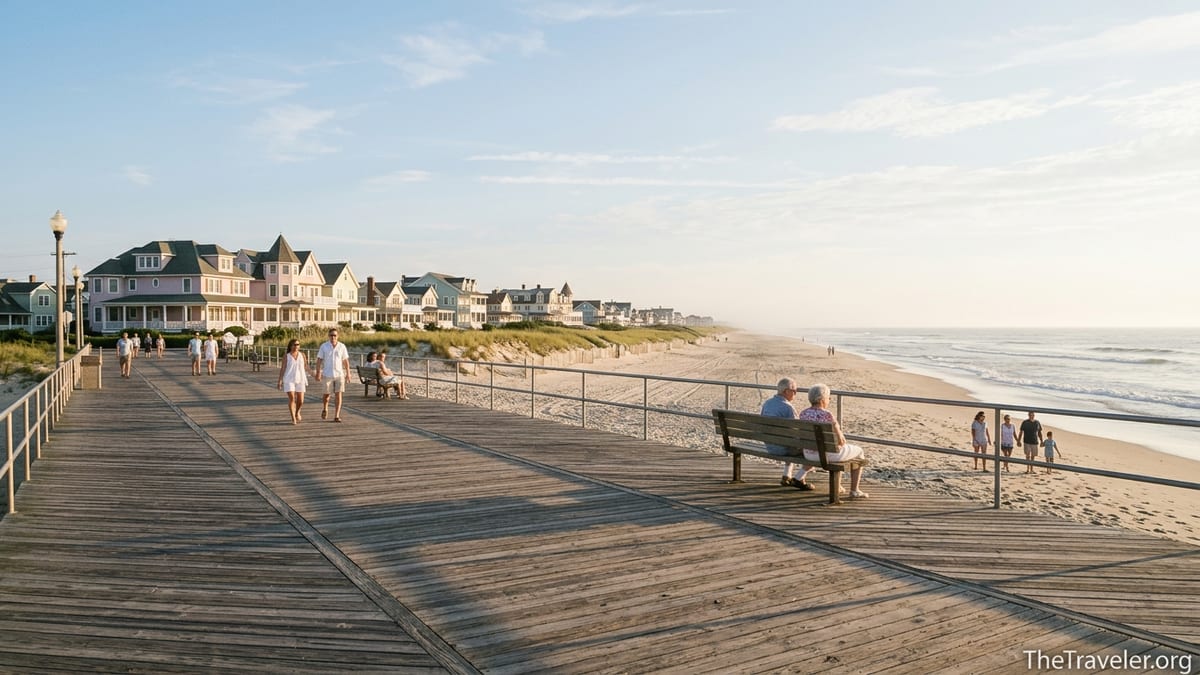
A Victorian Seaside Village That Stayed Small
Ocean Grove sits on a compact square mile of the Jersey Shore, but its character is dramatically different from the neighboring resort towns. Founded in 1869 by Methodist ministers as a seaside camp meeting ground, the community was carefully laid out with narrow streets, small lots, and a central focus on gathering spaces rather than commercial strips. Today, it remains a remarkably intact example of a late 19th century planned resort, with much of its housing stock still in the form of wood-framed cottages and small inns instead of high-rise condos.
Walking inland from the ocean, you quickly notice the absence of the usual boardwalk carnival noise. There are no amusement rides here, and only a modest scattering of snack stands and cafes at the north and south ends. The central stretch of boardwalk remains mostly open planking, benches, and beach access points. It is not unusual, even in high summer, to find long stretches where the loudest sound is the surf and the clink of bicycle bells along the promenade.
Ocean Grove’s scale is part of its time-warp charm. Most houses are two or three stories at most, with deep front porches instead of back decks. Many are painted in soft sherbet tones or classic white, with intricate wooden trim bordering railings and gables. On an evening walk along Ocean Pathway or Heck Avenue, the effect can feel theatrical: rows of Victorian facades facing each other across narrow streets, porch lights glowing, residents chatting from wicker chairs as if smartphones were never invented.
Practical details reinforce this human scale. There are no beach parking lots; visitors rely on free street parking threaded through the grid of residential blocks. It can take a few patient loops to find a space on busy Saturdays in July, but once parked, most people forget about their cars for the rest of the day. Ocean Grove is a place you navigate at three miles an hour, on foot.
Canvas Tents and a Living Camp Meeting Tradition
The most vivid reminder of Ocean Grove’s origins appears a few blocks inland, where a cluster of white canvas tents springs up each summer on small wooden platforms around the Great Auditorium. Locals simply call it Tent City. About 100 of these seasonal tent dwellings are still assembled every May, rented by families who often return to the same spot for generations. Each tent is paired with a small wooden shed in back that holds a kitchenette and bathroom, while the front remains a canvas-sided living and sleeping space cooled by ocean breezes and box fans.
Strolling these pedestrian-only walkways on a summer afternoon, you might see someone watering potted geraniums outside a tent flap while another resident sits on a rocking chair, reading in the filtered shade. Plastic patio chairs mingle with vintage metal gliders, and the hum of window air conditioners from the wooden sheds blends with the low murmur of conversation. It looks almost like a faded postcard from 1900 brought to life, yet it is entirely contemporary: residents stream music over Wi-Fi, teenagers scroll on phones, and delivery services still manage to find their way to the maze of canvas lanes.
The tents are leased through the Ocean Grove Camp Meeting Association, not sold, and there is a long waiting list. This unusual setup keeps the community from turning into a row of luxury cottages. On a practical level, it also means travelers walking through Ocean Grove encounter a rare sight on the modern Jersey Shore: a modest, almost communal style of summer living. You may spot someone stringing laundry between tent poles or carrying a crockpot along the walkway to a neighbor’s porch supper. It is a resolutely low-tech lifestyle in a region increasingly dominated by rooftop bars and condo towers.
Visitors cannot rent the tents for an occasional weekend, but simply observing this enclave can be a highlight of an afternoon walk. Respectful photographers often pause at the edge of the lanes to capture the rows of white roofs and striped awnings, especially in the soft light before sunset. It is worth remembering that these are private summer homes, so it is best to stay on the main walkways and avoid peering directly into open tent doors, even if you are tempted by the nostalgia.
The Great Auditorium and Old-Fashioned Gatherings
At the heart of town looms the Great Auditorium, a vast wooden structure built in the late 19th century and still used for concerts, worship services, and community events. From the boardwalk, you can see its peaked roof rising above the trees, like a giant seaside tabernacle. Up close, the weathered wood siding and stained glass windows convey the age of the building, yet it continues to host a full summer calendar that draws both devout visitors and secular music lovers.
For travelers, the building offers two kinds of time travel. By day, stepping inside during open hours reveals a cavernous interior supported by wooden trusses and lined with rows of simple wooden seats. The faint scent of old pine and the filtered light through colored glass recall a period when summer recreation meant hymn sings and Chautauqua lectures. By night, the same space can host a pops orchestra or a well-known contemporary Christian artist, with ticket prices often lower than comparable venues in nearby cities.
Just outside the Auditorium, the wide lawn and gazebo serve as informal gathering spots. On warm evenings, you might find an ice cream social organized by local churches or a free community concert stretching into the twilight. Folding chairs appear from every direction, and multi-generational groups settle in with coolers. Instead of craft cocktail bars, Ocean Grove’s nightlife is more likely to mean a late concert, a stroll for soft-serve at a small corner stand, and then a quiet walk back along sun-faded sidewalks.
Compared with larger Jersey Shore towns that market beach clubs and nightlife packages, Ocean Grove’s event lineup feels restrained and often faith-inflected. Yet travelers of all backgrounds regularly attend summer programs here, treating the town more as a historic cultural venue than a religious retreat. That mix of secular curiosity and enduring devotion is part of what gives an evening walk around the Auditorium the sense of being in two eras at once.
Slow Strolls, Porches, and the Art of Doing Less
One of the simplest ways to appreciate Ocean Grove’s old-fashioned pace is to walk a lazy loop from the boardwalk inland to the residential streets and back. Start near the northern end, where the wooden planks run almost seamlessly into Asbury Park’s broader, busier promenade, then turn south. Very quickly, the soundtrack shifts from restaurant patios and live music to the rhythm of waves and low conversation. Cyclists coast past in beach clothes instead of racing jerseys, and joggers thread through family groups without the usual urgency of training runs.
Turn west at one of the broad, tree-lined avenues such as Main Avenue or Webb Avenue, and you enter a world of porches. Many homes place rocking chairs and swings front and center, some with signs that read "Porch Life" or simple seasonal wreaths on the door. It is not unusual to see entire families or groups of friends spending the evening outside, greeting neighbors who pass by on the sidewalk. As a visitor, you may pick up practical tips just by listening: where to grab the best morning coffee on Main Avenue, which cross street has the least crowded beach access, or what time the evening breeze usually picks up.
The town’s modest commercial area along Main Avenue reinforces this slower tempo. Instead of national chains, you find small cafes, a few casual restaurants, ice cream counters, and independent shops that close on the early side compared with nearby Asbury Park. Travelers who expect late-night dining may need to plan ahead, perhaps picking up groceries at a small market in neighboring Neptune for simple porch suppers. In return, they gain quiet streets after dark, with little more than distant surf and the occasional murmur from a group lingering on a veranda.
It is worth noting that Ocean Grove has become relatively popular with remote workers and second-home owners who commute to New York or Philadelphia. Yet even with that modern connection, the daily rhythm is still oriented around walking: to the beach in the morning, to town for coffee or a paperback in the afternoon, and to the boardwalk again at sunset. Cars remain mostly parked along the curb, dusty with sea salt, like props that have outlived their starring role.
Beach Traditions and Quiet Rules
Ocean Grove’s beach is wide, clean, and notably quieter than many others along the Jersey Shore. There are no booming DJ stands or beach bars on the sand itself, and amplified music is generally rare. Families spread out with umbrellas and simple coolers, and you will often see older couples reading on low chairs near the high-tide line. Lifeguards staff several stands during the main season, and beach badge checkers greet visitors at the top of each access point.
Badges are required in summer, with prices roughly in line with other Monmouth County beaches: expect to pay in the range of a typical shore day pass for adults, while seasonal badges offer a discount for frequent visitors. Children below a certain age can usually enter free, which makes the beach appealing for multi-generational families. There are no large parking lots, so it pays to arrive early on sunny weekends or to come by NJ Transit train to Asbury Park and walk across the lake.
Historically, one of Ocean Grove’s most distinctive rules was the closure of its beach on Sunday mornings, tied to the community’s religious roots. In recent years, those policies have been challenged and modified under state oversight, and access patterns have shifted. Travelers planning a weekend visit should check the latest local guidance closer to their trip, but they can still expect a generally more restrained and contemplative atmosphere on Sundays than in neighboring towns. Even when the sand is open, the culture of quiet Sabbath time lingers in how locals use the morning.
Practical details matter here: no alcohol is sold on the beach, and Ocean Grove itself does not permit liquor stores or bars within its borders. Visitors often walk over to Asbury Park for dinner and drinks, then amble back across the lake afterward. That short stroll between two dramatically different nighttime scenes is one of the most vivid ways to feel the time shift: bright murals, live music, and rooftop lounges on one side; soft porch lights and muted conversation on the other.
Crossing the Bridge: A Study in Contrasts
If Ocean Grove sometimes feels unreal, it is in part because of how close it sits to a very different shore experience. Asbury Park lies directly to the north, connected by two small bridges across Wesley Lake. On a summer evening, you might walk north along the boardwalk past the last Ocean Grove jetty, where the atmosphere is mostly families and older couples, and suddenly emerge into a world of arcade lights, outdoor bars, and food stands. The contrast is striking enough that some visitors deliberately time their stroll to watch the change.
For travelers, this geography offers a practical advantage. You can book a small inn or Victorian guesthouse in Ocean Grove, waking up to quiet streets and the sound of gulls, then spend part of the day enjoying Asbury Park’s restaurants, galleries, and live music. After a late show at a venue near the boardwalk, it is an easy, well-lit walk back across the lake to the pastel facades and dimmer nights of Ocean Grove. It can feel as if you are commuting between 2026 and 1926 on foot.
The two towns even differ in simple rituals like coffee runs. In Ocean Grove, your morning might start at a modest bakery on Main Avenue, where customers linger to chat about the weather and the latest summer programming at the Great Auditorium. A ten-minute walk away in Asbury Park, you can order an oat-milk latte at a sleek café with laptop-lined counters. That back-and-forth can be part of the appeal: you choose your decade by choosing your direction.
Yet for many travelers, it is the return walk to Ocean Grove that leaves the deepest impression. Crossing the narrow bridge at night, the reflections of streetlights ripple on the lake, and the noise from Asbury’s bars fades quickly. By the time you reach the first row of Victorian homes, the air feels cooler, quieter, and somehow slower. It is at that moment, more than any other, that visitors report feeling they have stepped not just into another town, but another time.
Planning a Stay in a Town That Prefers to Whisper
Because Ocean Grove is small and largely residential, accommodation options tend toward bed-and-breakfasts, small inns, and a few simple hotels housed in historic buildings. Many properties date from the late 19th or early 20th century, though interiors have generally been updated to modern standards with air conditioning and Wi-Fi. Room rates in peak summer can be comparable to other Jersey Shore destinations, but travelers who visit in shoulder seasons such as May, early June, or September often find better value and fewer crowds.
When choosing where to stay, consider whether you prefer to be close to the boardwalk or nearer to the commercial strip on Main Avenue. A room one or two blocks from the beach means you can step out barefoot with a towel over your shoulder in the morning and be at the surf in minutes. A place closer to Main Avenue offers easier access to cafes and shops, as well as a shorter walk to the bridges into Asbury Park. Because everything is compact, no location is truly far from anything else, but travelers with mobility concerns may want to pay attention to the number of stairs in older properties and the distance to the nearest beach access ramp.
Dining in Ocean Grove itself tends to be low-key, with pizza, casual seafood, and simple American fare dominating the options. Many places are family-friendly and close by 9 or 10 p.m., even in mid-summer. Visitors who crave more variety often plan a midpoint stop in Asbury Park for dinner before retreating to the quiet streets of Ocean Grove for the night. It can be wise to make reservations on peak weekends, especially in July and August, when both towns see a surge of day-trippers and weekenders from New York and North Jersey.
Packing for Ocean Grove is straightforward, but a few items can enhance the experience: a light sweater for evening porch sitting, a small flashlight or phone light for late walks on dim side streets, and comfortable sandals or sneakers for long strolls along the boardwalk and lake paths. Leave expectations of flashy nightlife at home, but bring a good book and a willingness to let your days be guided by the weather and the tide chart.
The Takeaway
Ocean Grove is not a museum piece, yet it preserves the feeling of an earlier shore era more completely than almost any other New Jersey beach town. Its Victorian cottages, summer tent colony, great wooden Auditorium, and quiet boardwalk work together to slow the pace of anyone who visits. You may arrive for the day expecting a quick walk-through on your way to Asbury Park and find yourself lingering instead, drawn to the rhythms of porch conversations and unhurried beach days.
For modern travelers accustomed to resort towns that market themselves through nightlife and attractions, Ocean Grove’s appeal lies in all the things it does not have: no roller coasters, no neon beach bars, no towering hotels. In their place, you get the creak of old wooden stairs, the soft thump of screen doors, and neighbors who still wave from porches. Practicalities such as beach badges, modest dining choices, and on-street parking require a bit of planning, but they are a small price to pay for the chance to experience a living fragment of 19th century seaside culture.
In the end, walking through Ocean Grove feels like stepping into another time not because the town has frozen itself in amber, but because it has chosen its pace. The world beyond Wesley Lake moves at highway speed; inside this square mile, people still organize their days around sunrise swims, evening concerts, and the simple pleasure of a stroll before bed. If you are willing to match that tempo, even for a weekend, you may find that the distance between centuries is no longer than a walk from the boardwalk to a lighted porch.
FAQ
Q1. Where exactly is Ocean Grove, and how do I get there without a car?
Ocean Grove is on the central New Jersey coast in Monmouth County, between Asbury Park and Bradley Beach. Without a car, most travelers take NJ Transit’s North Jersey Coast Line train to Asbury Park station and walk about 15 to 20 minutes through town and over Wesley Lake into Ocean Grove.
Q2. When is the best time of year to visit if I want fewer crowds but good weather?
Late May, early June, and September are ideal. The ocean may be a bit cooler than in peak summer, but daytime temperatures are usually pleasant, businesses are open, and crowds are smaller than in July and August.
Q3. Do I need a beach badge, and roughly how much should I expect to pay?
Yes, like most New Jersey shore towns, Ocean Grove requires badges in the main summer season. Expect day badges to cost in the same general range as other Monmouth County beaches, with discounted season badges available; specific rates change year to year, so it is wise to check current prices before you go.
Q4. Is Ocean Grove suitable for travelers who are not religious?
Yes. While the town’s history and some events are strongly tied to its Methodist roots, many visitors come primarily for the architecture, quiet beach, and proximity to Asbury Park. You can enjoy concerts, the boardwalk, and cafes without participating in religious activities.
Q5. Can I find nightlife in Ocean Grove, or should I plan to go elsewhere in the evening?
Ocean Grove itself is quiet at night, with most restaurants and shops closing relatively early. For more active nightlife, travelers typically walk or drive to nearby Asbury Park, which has bars, live music venues, and late-opening restaurants just across the lake.
Q6. Are the historic Victorian houses and tent colony open to the public for tours?
Most Victorian houses and the canvas tents are private residences, so they are not open for walk-in tours. However, at certain times local organizations may offer guided walks or house tours, and you can always admire the architecture and tent lanes respectfully from the sidewalks and designated paths.
Q7. Is Ocean Grove a good destination for families with children?
Yes. The calm atmosphere, lifeguard-staffed beach, and absence of loud amusement rides on the boardwalk make it appealing for families seeking a quieter shore experience. Parents should keep in mind that organized children’s attractions are limited, so entertainment often centers on the beach, walks, and simple outdoor play.
Q8. How accessible is the town and boardwalk for people with mobility challenges?
The boardwalk has ramps at several access points, and the terrain through most of town is flat. However, many older inns and houses have stairs and limited elevator access. Travelers with mobility concerns may want to contact accommodations in advance to confirm room and entry details.
Q9. What should I know about parking in Ocean Grove in the summer?
Parking is primarily free street parking, and spaces can fill quickly on sunny weekends. It is wise to arrive earlier in the day or consider parking slightly farther from the beach and walking. Once you have a spot, you can usually leave your car for the duration of your stay and explore on foot.
Q10. Can I easily combine a stay in Ocean Grove with visits to other Jersey Shore towns?
Yes. Ocean Grove’s central location makes it simple to walk into Asbury Park, and short drives or train rides connect you to nearby towns like Bradley Beach, Belmar, and Long Branch. Many travelers base themselves in Ocean Grove for the quiet atmosphere and then make day trips up and down the coast.