

More news on this day
Air travelers across Australia and New Zealand are facing another day of severe disruption as winter weather and knock-on operational issues force the cancellation of 47 flights and delays to a further 349 services at key airports including Melbourne, Sydney, Brisbane, Wellington, Blenheim and Picton, affecting major carriers such as Qantas, Jetstar, Sounds Air and Air New Zealand.
Get the latest news straight to your inbox!
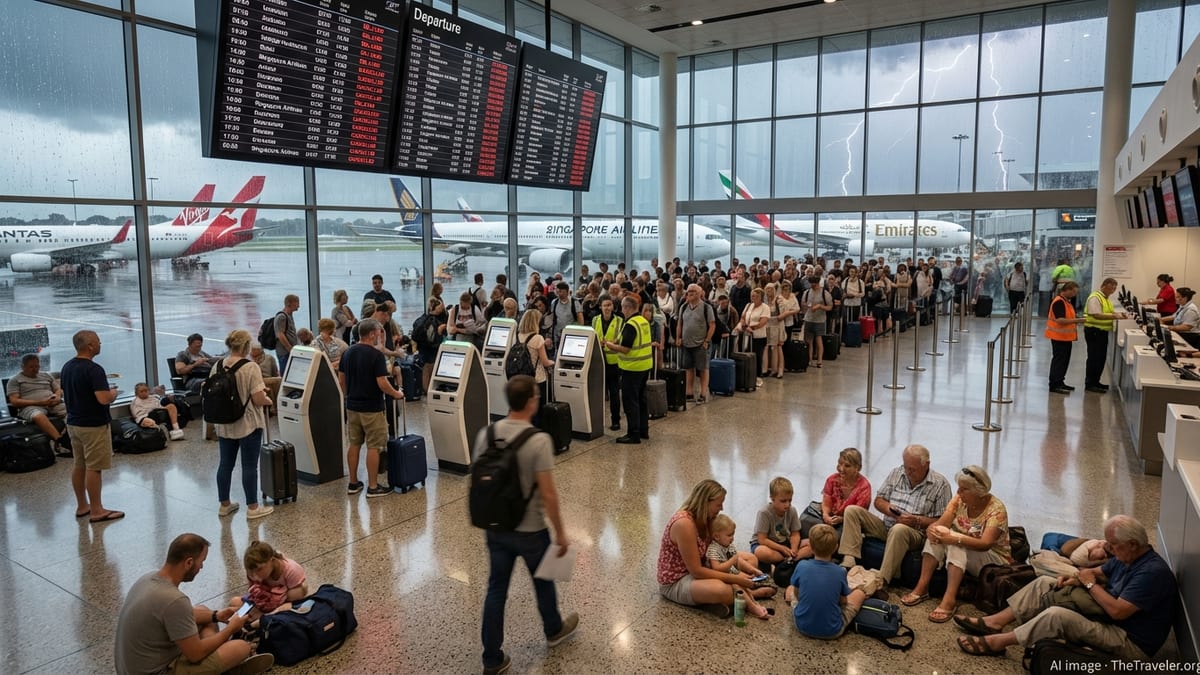
Major Hubs Struggle as Weather Front Sweeps the Region
Published coverage indicates that a vigorous winter front sweeping across southeastern Australia and much of New Zealand has pushed airport operations to their limits, with low cloud, strong crosswinds and heavy rain combining to reduce runway capacity and trigger widespread schedule changes. The latest aggregate data from airport and airline dashboards points to 47 outright cancellations and 349 delays across the two countries, concentrated in the busiest morning and evening peaks.
Melbourne, Sydney and Brisbane have borne the brunt of the disruption on the Australian side, where a mix of domestic trunk routes and trans-Tasman services have been curtailed or heavily delayed. Publicly available flight-status feeds show clusters of late departures from Melbourne to Sydney and Brisbane, alongside cancellations on some regional links where aircraft availability has become constrained after earlier weather holds.
In New Zealand, Wellington once again features prominently, with its short, wind-prone runway reducing operations as gusts rise and cloud ceilings drop. Blenheim and Picton, key links for regional connections at the top of the South Island, have also seen services scrubbed or pushed back, primarily on turboprop routes where crosswind limits are more restrictive. The combined effect has been a rolling pattern of delays that builds through the day as aircraft and crew fall increasingly out of position.
By midafternoon, the pattern across the region resembled a patchwork of airlines trying to recover their schedules, with some routes operating broadly on time while adjacent services remained substantially late or absent from departure boards altogether.
Qantas, Jetstar, Air New Zealand and Sounds Air Among Those Hit
The disruption has cut across the major airline groups that dominate the trans-Tasman and domestic networks. Qantas and its low-cost affiliate Jetstar have seen a series of short-haul flights between the Australian east coast capitals trimmed or consolidated, with some trans-Tasman departures from Melbourne, Sydney and Brisbane either cancelled or re-timed to fit within weather-imposed constraints.
On the New Zealand side, Air New Zealand’s dense web of domestic services has been particularly exposed at Wellington and regional airports, where a single cancelled turboprop rotation can ripple through onward connections for the remainder of the day. Regional carrier Sounds Air, which operates smaller aircraft on routes linking Wellington with Blenheim, Picton and other centres, has also faced a series of weather-related adjustments, with publicly visible schedules showing several sectors removed or significantly delayed.
Travel industry trackers highlight that, while the absolute number of cancellations remains modest relative to total daily movements, the imbalance between scrapped services and delayed flights creates an uneven experience for passengers. Popular morning business services tend to be preserved where possible, while off-peak and regional sectors are more likely to be cut altogether, leaving some communities with sparse options until conditions stabilize.
Observers note that sustained bouts of winter weather have become a recurring feature of the June travel period in both countries, but the increasing tightness of airline schedules and high load factors mean there is less slack in the system to absorb prolonged periods of disruption.
Knock-On Delays Expose Fragile Recovery in Airline Operations
Beyond the immediate weather conditions, the scale of delays revealed by operational dashboards underscores how fragile airline recovery remains in the Australasian market. Reports from passenger forums and recent performance data point to tight aircraft rotations and limited spare capacity, which can magnify even relatively brief ground stops into multi-hour delays later in the day.
In Melbourne and Sydney, a combination of runway flow restrictions, crew duty limits and aircraft maintenance requirements has contributed to a cascade effect in which one delayed arrival quickly jeopardizes several subsequent departures. Similar patterns are visible in Wellington and other constrained New Zealand airports, where short turnarounds are routine and there are few backup aircraft available to step in when weather temporarily closes the field.
Publicly available on-time performance statistics from transport agencies in both countries already show elevated cancellation and delay rates on some trans-Tasman and regional routes during the Southern Hemisphere winter. Today’s figures, with hundreds of delayed departures across multiple airports, highlight how quickly those trends can intensify when an active weather system stalls over the region.
Industry analysts suggest that, while airlines have rebuilt capacity on many core routes since the pandemic-era downturn, staffing levels in ground operations, maintenance and air traffic services remain tight. On days when weather sharply reduces runway throughput, there is little scope to add recovery flights or rapidly reassign crews, prolonging disruption into subsequent days.
Passengers Face Long Queues, Tight Connections and Limited Alternatives
For travelers, the operational pressures have translated into long queues at check-in and rebooking desks, crowded departure lounges and anxious waits for updated departure times. Reports from passengers at Melbourne, Sydney and Wellington describe morning services departing significantly behind schedule, with some travelers missing onward connections in Brisbane and Auckland as a result.
Those affected by outright cancellations at smaller airports such as Blenheim and Picton appear to have been particularly constrained, with limited same-day alternatives available once the day’s services are cut back. In some cases, published information indicates passengers are being rebooked onto flights the following day or rerouted through larger hubs, lengthening travel times substantially.
Consumer advocates have repeatedly highlighted that, while airlines often provide meal vouchers or hotel accommodation in the case of extended disruption, compensation rules differ between Australia and New Zealand and are less prescriptive than regimes in regions such as the European Union. Travelers caught up in today’s disruption are being urged by online advice channels to retain receipts and carefully document delays in case they are eligible for reimbursement or travel insurance claims.
Travel planners note that the latest turbulence across trans-Tasman and domestic routes offers another reminder for passengers to allow generous connection times, particularly when linking separate tickets or international and domestic itineraries during the winter months.
Outlook for the Coming Days and Advice for Travelers
Forecasts from national meteorological agencies indicate that the current weather system is expected to move slowly eastward, suggesting that conditions at some airports may remain challenging into the early part of the week. Aviation forecasters expect intermittent low cloud and strong winds to persist around Wellington and exposed parts of New Zealand’s South Island, while coastal showers and crosswinds continue to affect approaches into Melbourne and Sydney.
Airlines across the region are using their public travel alerts and status tools to flag potential changes, and travel agents report that many carriers are offering limited-fee or fee-free changes for passengers booked on affected routes. Published advisories consistently recommend that travelers reconfirm their flight status before leaving for the airport, build in extra time for security and check-in, and consider carrying essential items in hand luggage in case bags are separated during disrupted connections.
For those yet to depart, experts in the travel sector suggest that flexible bookings and comprehensive travel insurance remain prudent, particularly for itineraries that rely on tight domestic connections to reach long-haul international flights. With winter still in its early stages in the Southern Hemisphere, today’s wave of cancellations and delays is unlikely to be the last significant test of airline resilience across Australia and New Zealand this season.