


Kuala Lumpur International Airport (KLIA) is one of Southeast Asia’s busiest hubs, and for many travelers the easiest way into the city is with Grab, Malaysia’s dominant rideshare app. Yet between two terminals, multiple pickup levels and a mix of tolls, surcharges and surge pricing, it can be confusing to know exactly where to meet your driver and what a fair fare looks like. This guide walks you through KLIA Terminal 1 and Terminal 2 step by step, with current examples of prices, pickup zones and smart alternatives if Grab is surging or unavailable.
Get the latest updates straight to your inbox!
KLIA in 2026: Terminals, Layout and Where Grab Fits In
Kuala Lumpur International Airport sits about 55 to 60 kilometers south of central Kuala Lumpur, roughly a 45 to 70 minute drive depending on traffic and time of day. The airport has two main passenger terminals: Terminal 1, the original “KLIA” building handling most full-service carriers, and Terminal 2, commonly referred to as klia2, which serves AirAsia and other low-cost airlines. Understanding which terminal you land in is the first step to finding the correct Grab pickup zone and estimating realistic travel times into the city.
Terminal 1 is used by airlines such as Malaysia Airlines, Singapore Airlines, Emirates and many major international carriers. Terminal 2 is heavily dominated by AirAsia flights along with a mix of regional low-cost operators. The two terminals are a few kilometers apart, linked by road and by the KLIA Ekspres / KLIA Transit rail line, with an inter-terminal train ride of only a few minutes. If you accidentally book a Grab to the wrong terminal, it can still be resolved, but you may pay extra and wait longer, so double-check the “KLIA T1” versus “KLIA T2/klia2” label in the app before confirming your ride.
Grab integrates tightly with the airport’s official layout. Both terminals have designated e-hailing pickup areas where Grab, as well as other apps, are allowed to meet passengers. Airport management has progressively moved these zones away from the immediate curb of the arrival halls and into clearly signposted areas to reduce congestion. In practice, this means you will almost always be going down to Level 1 at both terminals to meet your Grab driver, rather than stepping straight out from baggage claim to the nearest curb.
For most visitors, Grab sits in the middle ground between the premium, high-speed KLIA Ekspres train and traditional airport taxis. A typical Grab car to central Kuala Lumpur is usually cheaper than a dedicated airport taxi for one or two people, more flexible than the train, and door-to-door. For families, small groups or anyone with several suitcases, Grab often becomes the most cost-effective option, provided you know how to reach the right pickup zone and avoid the worst of surge pricing.
Grab Pickup Zones at Terminal 1 (KLIA T1)
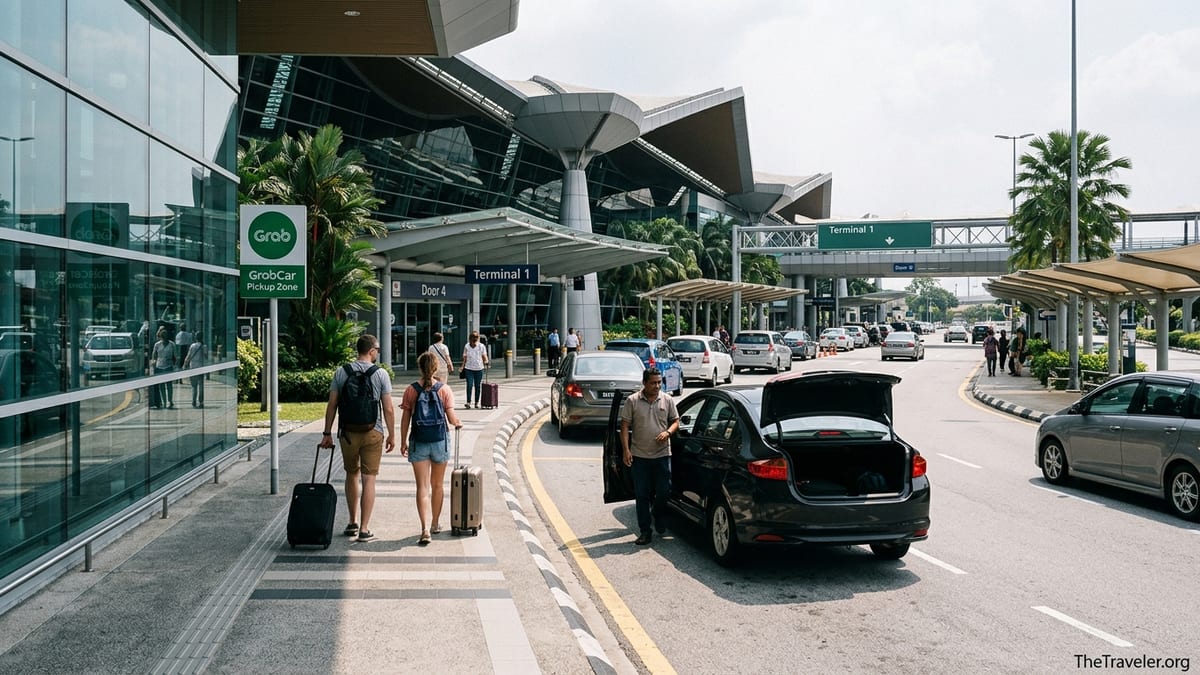
At Terminal 1, the main e-hailing pickup zone is on Level 1 near Door 4. Signage in the terminal refers to this level as the transport or ground transport level, distinct from the arrivals hall directly above. After exiting customs, you will typically be on Level 3. To reach the Grab area, follow signs for “Taxi / Bus / E-Hailing” and use the designated lifts that go down to Level 1. Many first-time visitors report missing the correct elevator bank and ending up at bus bays or private car parks, so it is worth paying close attention to the signs and the directions shown inside the Grab app.
A practical example: after exiting the international arrival gate in Terminal 1, you walk toward Door 5, then follow signage past cafes such as Coffee Bean and Tea Leaf to the elevator bank serving Level 1. Once you reach Level 1, you walk toward Door 4, which opens directly to the e-hailing pickup lane. This is where most GrabCar, GrabCar Plus and other categories will meet you. The app will normally display “KLIA T1 Level 1 Door 4” or a similar label as the pickup spot, and you can share a screenshot of that line with your driver via GrabChat if there is any confusion.
KLIA has also promoted an electric vehicle pickup option, sometimes associated with a Grab EV lounge near the arrivals area. In practice, if you book a GrabCar EV service and the app indicates KLIA T1, you may be directed to wait at a small lounge area first, then proceed to Door 4 when your car arrives. This is more common for domestic arrivals and during busy conference or event periods when EV rides are promoted. If you do not see a lounge, do not worry; the normal Level 1 Door 4 pickup zone remains the default for regular Grab rides.
Because Terminal 1 serves many long-haul flights, it is common to see surges around early-morning arrivals from Europe and late-evening bank times from the Middle East and East Asia. This means you might step out into the humid KL air at 7:00 a.m. and see Grab fares to Bukit Bintang jump from a normal range of around 75 to 100 ringgit to well over 120 ringgit. Having a clear understanding of where to go physically in the terminal saves you valuable minutes, reducing the risk that a quoted fare times out or a driver cancels before you reach the pickup zone.
Grab Pickup Zones at Terminal 2 (klia2)
Terminal 2, widely branded as klia2, was built for low-cost carriers and has an integrated mall complex called Gateway@klia2. Here, Grab and other e-hailing services meet passengers in the Transportation Hub on Level 1, by Doors 4 and 5. After leaving the arrival hall, you will pass through the mall level. From there, you follow signs marked “Taxi / Bus / E-Hailing / Transportation Hub” leading down escalators or lifts to Level 1. The key is to continue down until you see references to “Transportation Hub Level 1” rather than stopping at intermediate parking levels.
On the ground, a typical route looks like this: after customs, you walk straight into the Gateway@klia2 area, then follow signs for the transportation hub. As you descend, you pass bus ticket counters and sometimes convenience stores such as KK Super Mart. Grab passengers are typically directed to wait outside Door 4 or Door 5 on Level 1. KLIA-related informational sites note that the Grab meeting point is next to KK Super Mart at Door 5, which becomes a handy landmark if your driver asks where you are standing. When your driver approaches, you will see their car entering a lane shared by e-hailing vehicles and some airport taxis, so be ready to signal them quickly.
Because klia2 handles a heavy volume of short-haul regional flights, arrival peaks tend to be spread more evenly through the day, with particularly busy pockets around midnight and early morning for flights from across Southeast Asia and East Asia. This means Grab availability is usually good but can thin out if several large AirAsia flights land at once or if storms slow road traffic. In high-demand windows, fares from klia2 to central Kuala Lumpur can creep into the 90 to 140 ringgit range, compared with quieter daytime fares that sometimes dip into the 70s or low 80s. Watching the app for five to ten minutes while you walk to the transportation hub can give you a quick sense of whether you are booking during a peak.
One detail to note at Terminal 2 is that the e-hailing area is integrated with bus and airport taxi operations. You may see touts or unlicensed drivers casually offering rides as you walk through the hub. In Malaysia, it is safest to decline these offers and stick to the Grab app so that your journey is logged, priced transparently and covered by the platform’s safety features. If a driver claims to be your Grab but has a different license plate than the one in the app, do not get in. Instead, message them through GrabChat or cancel the ride and rebook.
Realistic Grab Fares, Surcharges and Surge Pricing
For most of 2026, typical Grab fares from KLIA to central Kuala Lumpur sit in a broad range of about 75 to 120 Malaysian ringgit for a standard GrabCar, depending on your exact destination, time of day and demand level. Travelers regularly report paying around 80 ringgit for a mid-afternoon ride from either terminal to Chinatown or Bukit Bintang, including tolls. During busy hours or heavy rain, this can climb closer to 110 or 130 ringgit, especially if you are heading to neighborhoods a bit farther from the core, such as Mont Kiara or Petaling Jaya.
Grab’s pricing is dynamic. The base fare is influenced by distance and time, airport surcharges and tolls, with a surge multiplier added when demand spikes. Since late 2024, a mandatory airport surcharge has generally been applied to rides originating at KLIA, which may appear as a separate line item in your fare breakdown or be baked into the quoted fare. This charge is relatively modest per ride but helps explain why a similar distance within greater Kuala Lumpur might cost less than an airport trip of comparable length. In addition, expressway tolls between the airport and city often add roughly 10 to 20 ringgit, depending on route.
To see how this looks in practice, imagine landing at KLIA Terminal 1 at 3:00 p.m. on a weekday and opening Grab to book a ride to a hotel near the Petronas Twin Towers. You might see several options: a basic GrabCar around 85 ringgit, a larger GrabCar 6-seater in the 140 to 170 ringgit range, and perhaps a GrabCar Plus slightly above 100 ringgit. An early-morning arrival at 7:00 a.m. on a rainy Monday might show the same GrabCar category at 120 to 140 ringgit, clearly indicating a surge. If your schedule allows, waiting ten to fifteen minutes often sees the fare drop back into more normal territory as additional drivers arrive in the airport queue.
Because the quoted fare is usually fixed once you confirm, watching the app for a few minutes as you walk from the gate to the pickup area can save you money. If you see a one-way jump from, for example, 95 ringgit down to 80 ringgit within a short period, that is a sign that demand is normalizing. Conversely, if the price continues to climb and approaches 150 or 160 ringgit for a standard car, it may be time to consider alternatives such as the KLIA Ekspres train or a fixed-fare airport taxi, especially for solo travelers.
Luggage, Car Types and Choosing the Right Grab Service
Your luggage and group size significantly shape which Grab category makes sense from KLIA. A standard GrabCar in the Kuala Lumpur area is typically a compact or mid-size sedan, similar to a Perodua Bezza, Toyota Vios or Honda City. These cars comfortably fit two adults with two large suitcases and a couple of backpacks. Three adults with three large checked-size suitcases can usually fit if one bag sits in the front seat, but it becomes tight. If you are a family of four with multiple large suitcases, or a small group of friends carrying sports gear or musical instruments, booking a 6-seater or “XL” type service is more realistic.
As an example, a couple arriving from Europe with two 23-kilogram suitcases and two carry-ons can safely choose a standard GrabCar from either terminal. They should expect the driver to place the two big bags in the trunk and the smaller ones in the footwells. A group of four backpackers each with a 40-liter pack and a small daypack can also use a standard car, because soft bags are easy to slide into any leftover space. On the other hand, a family of five with three large hardshell cases, a stroller and several cabin bags should assume they will need a 6-seater service such as GrabCar 6, which often costs about 40 to 60 ringgit more than a standard sedan but avoids the risk of a last-minute cancellation due to insufficient space.
Drivers in Malaysia are usually accommodating but are not expected to overload or carry luggage that blocks rear visibility or creates a safety risk. If the driver arrives and reasonably believes that your bags cannot fit safely, they may ask you to cancel and rebook a larger vehicle. To avoid this, look at the estimated vehicle type shown in the app before confirmation, and consider messaging the driver via GrabChat after booking to say how many people and large suitcases you have. Clear communication, such as “2 pax, 2 large luggage, 2 cabin” or “4 pax, 4 big bags,” helps the driver decide if their vehicle is appropriate.
Travelers with bulky sports equipment or musical instruments should plan ahead. For example, a cyclist arriving with a bike box or a diver carrying gear for a trip to Sabah may be better off using an airport taxi with a larger trunk or arranging a pre-booked private transfer with a van. While some Grab drivers are happy to carry oversized items if they fit, there is no guarantee that the car that arrives will be suitable. In borderline cases, it may be more sensible to take the KLIA Ekspres into the city and book a Grab only for a short final hop to your hotel, where you have more flexibility to wait for the right vehicle size.
Using the Grab App at KLIA: Practical Tips and Safety
Before you land, it is wise to install the Grab app, create an account and add at least one payment method such as a credit card. Grab also allows cash payment in Malaysia, but app-based payment is usually smoother, especially if you arrive late at night when ATMs are busy or currency exchange counters are closed. When you arrive at the airport and connect to Wi-Fi or a local SIM, open the app and let it update your location. KLIA’s terminals are large concrete structures, so GPS can be imprecise indoors. Always double-check that your selected pickup pin matches the right terminal and level, for example “KLIA Terminal 1, Level 1 Door 4.”
When booking, enter your hotel or exact address in the destination field rather than a vague area name. The app will show you a fare estimate along with an approximate arrival time. During busy periods, it is common to see estimated driver arrival times of 10 to 15 minutes, especially late at night when fewer cars are circulating. If the app shows “Searching for drivers” for more than a few minutes, consider nudging the pickup point slightly on the map or checking that you have not accidentally set it to the wrong terminal or building inside the airport complex.
Once a driver accepts your booking, note the car model, color and license plate, and use GrabChat to coordinate if necessary. Language is rarely a barrier in Kuala Lumpur, as most drivers speak some English and GrabChat offers translation features, but short, simple messages help: “At Door 4, Level 1,” or “Black Toyota Vios?” When the car arrives, confirm the license plate matches before you get in. Grab’s safety features include trip tracking, the ability to share your live location with a trusted contact and in-app reporting tools, all of which are useful for solo travelers or those arriving late at night.
Connectivity at KLIA is generally good, with free airport Wi-Fi and strong coverage by local mobile networks. However, at very busy times, Wi-Fi can be overloaded, especially near arrival gates. If you plan to rely heavily on Grab and other apps, consider buying a local SIM or eSIM that activates upon landing. This gives you more reliable data for booking your ride, navigating to the pickup area and communicating with your driver if you get turned around in the terminal.
Alternatives to Grab: Taxis, Train and When They Make Sense
Grab is not always the best or cheapest way into Kuala Lumpur, especially for solo travelers landing during quiet hours. The KLIA Ekspres and KLIA Transit rail services connect both terminals to KL Sentral in about 30 to 40 minutes. As of mid 2026, the standard adult one-way fare is around 40 ringgit, with occasional discounts available through the operator’s app or promotions linked to major events. From KL Sentral, a short Grab or metered taxi ride to areas like Bukit Bintang or KLCC typically adds another 15 to 30 ringgit, making the total cost still competitive with a direct Grab from the airport, especially when the app is surging.
Airport taxis operate on a coupon or fixed-fare system, particularly from official counters in the arrival halls and the transportation hubs. For example, a standard budget taxi to the KLCC area may cost around 90 to 110 ringgit, depending on vehicle class and time of day. Larger premier taxis and limousines cost more but are a good option for groups with heavy luggage who prefer to pay at a counter and walk straight to a waiting car. Coupon fares are posted at the counters, and you pay before boarding, which eliminates the risk of haggling or meter manipulation.
There are also airport coach services and occasionally promotional shuttle buses linking KLIA with major city hotels or hubs. These typically cost less than the train but take longer due to intermediate stops. For budget travelers arriving at off-peak times, a bus to KL Sentral or a central bus terminal, followed by a short Grab, can be the cheapest overall combination. However, buses do not run as late into the night as Grab or airport taxis, so always check the last departure times if your flight lands after 10:00 p.m.
In practice, the choice often works like this: if you are one person or a couple arriving during daytime or early evening and the Grab fare to your hotel is 110 ringgit or higher, the KLIA Ekspres or Transit plus a short rideshare in town usually makes more financial sense. If you are three or more people, or it is very late at night and you value door-to-door comfort, a direct Grab from KLIA remains attractive, provided the price is within your comfort range. If you are uncomfortable with apps or prefer to pay in cash with an official receipt, the airport taxi counters are a safe and straightforward alternative.
The Takeaway
Navigating Grab pickups at Kuala Lumpur International Airport is much easier once you break it down by terminal and level. At Terminal 1, you are heading for Level 1, Door 4, while at Terminal 2 you make your way to the Transportation Hub on Level 1 by Doors 4 and 5, next to landmarks like KK Super Mart. The Grab app itself provides helpful cues, but knowing what to expect in advance makes it far less stressful to move from baggage claim to car, especially after a long flight.
On the money side, most travelers in 2026 pay somewhere between 75 and 120 ringgit for a standard GrabCar from KLIA or klia2 to central Kuala Lumpur, with higher prices during surges or to more distant suburbs. Watching the app for a few minutes, checking for airport surcharges and tolls in the fare breakdown, and choosing the right vehicle size for your luggage will keep your journey smooth and predictable. When prices spike or availability is thin, the KLIA Ekspres or Transit train and fixed-fare airport taxis remain very solid alternatives.
If you arrive with the app installed, your payment method set up and a clear idea of where to stand for pickup, Grab can be one of the most convenient ways to start or end your time in Malaysia. Combine it with a bit of flexibility around surge pricing and a willingness to use the train or taxis when they make more sense, and you will move between the runway and the city skyline with minimal hassle.
FAQ
Q1. Where exactly is the Grab pickup point at KLIA Terminal 1?
At KLIA Terminal 1, the main Grab pickup point is on Level 1 near Door 4. After exiting customs on the arrivals level, follow signs for ground transport or e-hailing, take the elevator down to Level 1, then walk toward Door 4, where Grab cars and other e-hailing vehicles meet passengers.
Q2. Where is the Grab pickup area at Terminal 2 (klia2)?
At Terminal 2, the Grab pickup area is in the Transportation Hub on Level 1, typically around Doors 4 and 5. You access it by walking through the Gateway@klia2 mall from arrivals, then following signs down to the Transportation Hub until you reach the e-hailing zone near KK Super Mart and the bus bays.
Q3. How much does a Grab from KLIA to central Kuala Lumpur usually cost?
In 2026, a standard GrabCar from either KLIA terminal to central Kuala Lumpur typically costs about 75 to 120 ringgit, including tolls, depending on your exact destination, the time of day and how busy the system is. During surges caused by heavy demand or bad weather, fares can rise above this range.
Q4. Is Grab cheaper than the KLIA Ekspres train?
For one person, the KLIA Ekspres or KLIA Transit train to KL Sentral plus a short Grab or taxi to your final destination often works out cheaper or similar in price to a direct Grab from the airport. For two or more people traveling together, especially with luggage, a Grab from KLIA can be better value, provided fares are not heavily surged.
Q5. Can I pay my Grab driver in cash at KLIA?
Yes, Grab allows cash payment in Malaysia. When you book your ride, select cash as the payment method in the app. You then pay your driver in cash at the end of the trip. Many travelers still prefer to add a card and pay in-app for convenience and to avoid needing exact change after a long flight.
Q6. What if my luggage does not fit in a standard GrabCar?
If you have several large suitcases, sports equipment or a stroller, consider booking a larger car type such as a 6-seater or XL option. If a driver arrives and sees that your bags cannot fit safely, they may ask you to cancel and rebook a larger vehicle. To avoid this, message your driver after booking to state the number of passengers and large bags.
Q7. How long does a Grab ride from KLIA to the city take?
Travel time from KLIA to central Kuala Lumpur usually ranges from 45 to 70 minutes. During light traffic, a ride to areas like KLCC or Bukit Bintang can take under an hour. In rush hour or heavy rain, it can stretch beyond an hour, particularly if you are heading to more congested neighborhoods.
Q8. Is it safe to use Grab late at night from KLIA?
Grab is widely used by locals and visitors alike, and using it from KLIA late at night is generally considered safe. The app logs your trip, shows driver details and allows you to share your live location with a trusted contact. As with any rideshare, confirm the license plate and car model match the app before getting in.
Q9. What should I do if Grab prices are very high when I land?
If you see unusually high Grab fares, first wait a few minutes to see if demand eases as more drivers arrive. If prices remain high, consider taking the KLIA Ekspres or Transit train to KL Sentral and then a short Grab to your hotel, or use the official airport taxi counters for a fixed-fare ride.
Q10. Can I use other e-hailing apps besides Grab at KLIA?
Yes, Malaysia has other e-hailing services, and they also use the designated e-hailing zones at KLIA and klia2. However, Grab is by far the most widely used and usually offers the best coverage. If you choose another app, the pickup locations are typically similar, and you should follow the signs to the same ground transport areas.