


More news on this day
Severe storms, heat waves, and winter blizzards are increasingly throwing airline schedules into chaos, leaving travelers stranded and confused about what, if anything, carriers are required to provide when weather is to blame.
Get the latest news straight to your inbox!
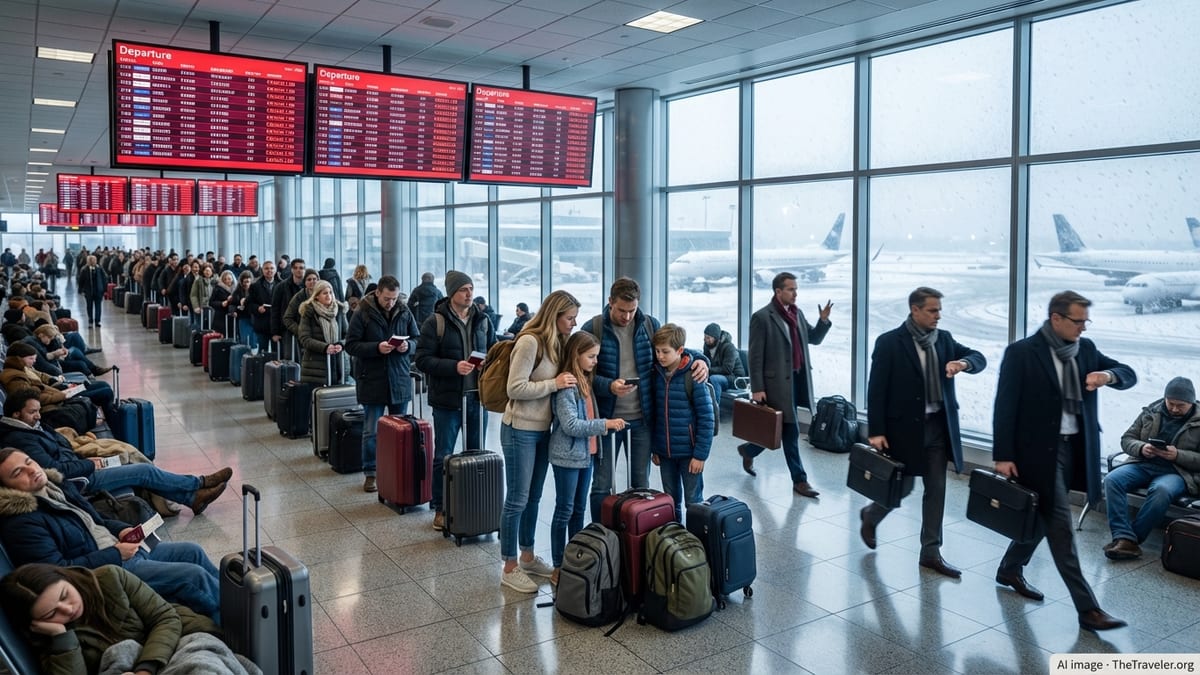
Weather Delays vs. Airline Delays: Why the Cause Matters
When a flight is disrupted, airlines and regulators draw a sharp line between problems the carrier can control and those it cannot. In the United States, the Department of Transportation (DOT) groups causes into broad categories that include air carrier issues, the national airspace system, security, and extreme weather. Cancellations and delays attributed to weather typically fall into the “extreme weather” or related airspace categories, signaling that the disruption was outside the airline’s direct control.
This distinction is crucial because it determines what passengers can reasonably expect. According to DOT guidance and the agency’s Airline Cancellation and Delay Dashboard, U.S. airlines generally commit to providing meals, hotels, and other amenities only when the disruption is within their control, such as crew scheduling problems or IT failures. For weather-related disruptions, those same commitments usually do not apply, unless the airline has chosen to offer more generous protections as a matter of policy.
In Europe and many other regions, the framework is similar. Regulation (EC) No. 261/2004, which sets common rules for compensation and assistance in the European Union, treats severe weather and related safety shutdowns as “extraordinary circumstances.” Published summaries of EU case law note that events such as major volcanic eruptions and associated airspace closures qualify as extraordinary, relieving airlines of the obligation to pay monetary compensation even when mass cancellations occur. However, the regulation still maintains separate obligations to provide care and assistance.
United States: Refunds, Rebooking and Limited Perks in Bad Weather
For U.S. travelers, the key legal protection in any cancellation, including for weather, is the right to a refund when the airline cancels a flight or makes what DOT terms a “significant” schedule change and the passenger chooses not to travel. DOT’s public guidance states that this refund requirement applies regardless of the reason for the disruption and includes nonrefundable tickets if the passenger declines rebooking. The refund must cover the unused portion of the ticket and any fees tied to the affected flight, such as seat selection or checked baggage.
Beyond refunds, what airlines must offer in bad weather is less clear-cut. DOT’s online dashboard allows passengers to compare major U.S. carriers’ written commitments to provide meal vouchers, hotel accommodations, and ground transportation when delays and cancellations are within the airline’s control. For weather-related disruptions, the dashboard shows that most airlines explicitly exclude guaranteed hotels or meal vouchers, indicating that overnight accommodation and other assistance are offered on a voluntary, case-by-case basis rather than as a legal requirement.
Rebooking policies in the United States tend to be more consistent. Publicly available airline contracts and DOT summaries show that when a carrier cancels a flight, it must either refund the fare or rebook the traveler on the next available flight on its own network at no additional cost. During widespread weather events, many airlines also publish temporary travel waivers that waive change fees and fare differences for affected dates and routes, but these waivers are policy choices rather than statutory rights.
European Union: Strong Duty of Care, Even Without Compensation
Passengers flying to, from, or within the European Union under Regulation (EC) No. 261/2004 encounter a different balance of rights. Under this regime, airlines must provide fixed cash compensation when long delays or cancellations are caused by factors within their control, such as technical or operational issues. For extraordinary circumstances like severe weather, however, the regulation allows carriers to decline compensation if they can show that the event could not have been avoided even with all reasonable measures.
What does not disappear in bad weather is the airline’s duty of care. Official summaries of EU261 and related court decisions highlight that carriers must still offer assistance once delays reach specific thresholds. That typically includes meals and refreshments in reasonable relation to the waiting time, hotel accommodation when an overnight stay becomes necessary, and transportation between the airport and the hotel, as well as means of communication such as phone calls or emails.
European case law has confirmed that this duty of care can be extensive. In at least one leading decision related to the 2010 volcanic ash crisis, the Court of Justice of the European Union concluded that airlines had to continue providing care obligations, such as accommodation and meals, even though the natural disaster was deemed an extraordinary circumstance relieving them of cash compensation. As a result, travelers affected by weather in Europe often have stronger rights to on-the-spot support, even if they are not entitled to a payout.
Canada and Other Markets: Evolving Rules on Weather Disruptions
Canada’s Air Passenger Protection Regulations (APPR), which apply to flights to, from, and within Canada, organize airline obligations partly around whether a disruption is within the airline’s control, within its control but required for safety, or outside its control. Official guidance from the Canadian Transportation Agency lists bad weather, security incidents, and certain air traffic control decisions among situations outside the airline’s control, affecting what passengers can claim when storms cancel flights or close runways.
When a cancellation or long delay stems from factors outside a carrier’s control, Canadian rules focus on rebooking and basic standards of treatment. CTA guides indicate that airlines must communicate the reason for the disruption in plain language and, in many cases, help passengers complete their itinerary as soon as possible, often on the next available flight operated by the same carrier or a partner. Compensation for inconvenience is more limited in weather scenarios, but proposals to strengthen the APPR contemplate making standards of treatment, such as the provision of food and water, mandatory for a wider range of disruptions.
Other regions are gradually tightening or clarifying their rules as climate-related disruptions become more frequent. Comparative tables published by Transport Canada and other regulators show that while regimes differ, a common pattern is emerging: cash compensation is often reserved for situations the airline can control, but obligations to offer clear information, rebooking, and at least some level of care during long waits are spreading, regardless of the trigger.
What Travelers Can Expect and How to Protect Themselves
Across jurisdictions, the most reliable entitlement in bad weather is the option to abandon the trip and obtain a refund when the airline cancels a flight or makes a significant schedule change. U.S. DOT guidance underscores that this right is not dependent on the cause of the disruption, and similar refund provisions appear in other regimes when the carrier cannot provide reasonably comparable alternative transportation within a set timeframe. Travelers who accept vouchers or credits instead of refunds may lose some flexibility, so examining the terms before agreeing is important.
When choosing to continue the trip, passengers can generally expect rebooking at no additional cost, but the timing and routing depend heavily on availability and local rules. In Europe, rebooking and duty-of-care obligations in severe weather are among the strongest, while in the United States the level of support often reflects each airline’s policies rather than a uniform legal standard. Canadian and other frameworks land somewhere in between, with rebooking duties and limited support in events deemed outside the airline’s control.
Travelers looking to minimize risk during storm seasons are increasingly advised by consumer groups to review airline customer service plans, check official regulator dashboards, and consider travel insurance that covers weather disruptions. Public information from transport authorities shows that regulators in the United States, Canada, and Europe are actively revisiting passenger-rights regimes, suggesting that what airlines must provide in bad weather could tighten further in the coming years as extreme conditions disrupt air travel more often.
U.S. DOT Airline Cancellation and Delay Dashboard
European Union Air Passenger Rights (EU261)
Canadian Transportation Agency: Flight Delays and Cancellations Guide