


More news on this day
Flights operated by Emirates and Etihad are facing a new wave of delays, diversions and selective cancellations at Dubai and Abu Dhabi airports as heightened US-Iran tensions ripple through Gulf airspace.
Get the latest news straight to your inbox!
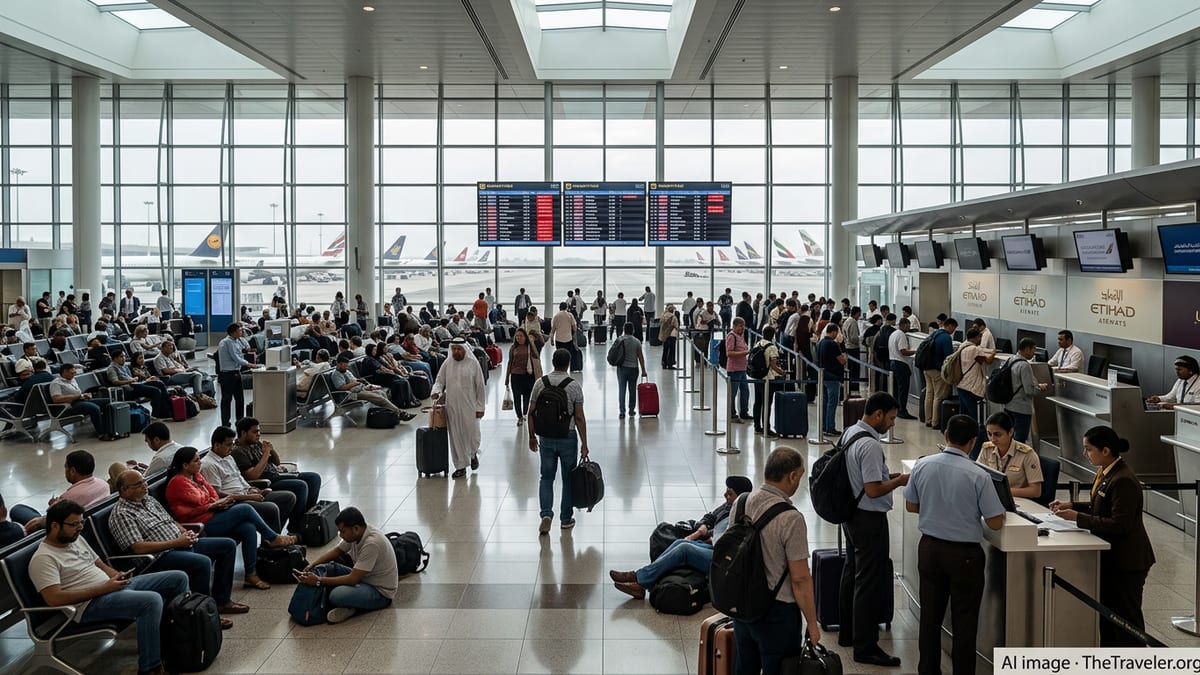
Fresh disruptions at Dubai and Abu Dhabi hubs
Schedules at Dubai International Airport and Abu Dhabi’s Zayed International Airport remain under pressure, with a growing list of delayed and cancelled services as the regional security situation evolves. Recent military exchanges between the United States and Iran, including strikes on Iranian targets and retaliatory missile and drone attacks on American interests in Bahrain, Kuwait and Jordan, have added volatility to already busy late-summer operations.
Published coverage from UAE media outlets shows that, while both airports remain fully open, passengers are encountering a patchwork of on-time, late and cancelled flights. Airport boards and airline trackers in recent days point to long-haul sectors arriving behind schedule, regional rotations being retimed and a small number of flights diverted due to airspace or airport constraints along the route.
Reports indicate that the impact is uneven. Many departures and arrivals for Emirates and Etihad continue to operate, but passengers on certain routes are being advised to expect extended journey times and last-minute schedule changes. Travellers are being urged to check live flight-status tools before leaving for the airport, even if their itineraries were confirmed earlier in the week.
Emirates delays and selective cancellations
Emirates services into Dubai have been particularly affected on busy Europe and North America corridors. According to recent updates, inbound flights from major European gateways including London Heathrow, London Gatwick, Manchester, Amsterdam, Rome, Bologna, Geneva, Munich, Lyon, Lisbon and Warsaw have been arriving later than scheduled, reflecting knock-on effects from airspace constraints and congestion along preferred routings.
Transatlantic sectors have also seen disruption. Coverage from local outlets notes late arrivals from Toronto, Houston, San Francisco and Los Angeles, with schedule changes appearing on airport boards and airline apps at short notice. These delays are occurring as carriers adjust routings and flight levels to comply with evolving advisories over parts of the Gulf and surrounding regions.
At the same time, Emirates has implemented targeted cancellations on specific routes. A notable example is flight EK206 from New York to Dubai, listed as cancelled for September 3. Separate reporting highlights that the airline’s Dubai to Kuwait network remains suspended, while Dubai to Bahrain services operate on a reduced pattern, with just a limited number of frequencies restored as conditions allow.
Despite the disruption, publicly available information shows the majority of Emirates flights continuing to operate, particularly core trunk routes connecting Dubai with Europe, Asia and Africa. However, the shifting mix of delays, retimings and isolated cancellations underscores the need for passengers to recheck itineraries close to departure.
Etihad among the hardest-hit Gulf carriers
Abu Dhabi-based Etihad Airways appears to be among the most affected regional carriers, with multiple long-haul and regional services delayed or adjusted in recent days. Travel advisories highlight late departures from Zayed International Airport to destinations including London Heathrow, Lisbon, Manchester and Moscow, alongside a string of delays across the Indian subcontinent and wider Asia.
Recent schedules show Etihad flights to Delhi, Karachi, Ahmedabad, Peshawar, Chennai, Colombo, Nairobi, Phuket, Bangkok and several other cities operating behind time, reflecting both the regional security backdrop and general airspace congestion. In one case, an Abu Dhabi to Manila service was reported as diverted due to an airport closure, with the corresponding return sector expected to arrive significantly later than planned.
Etihad has previously extended cancellations on certain Kuwait and Bahrain services as hostilities in the region intensified, and published coverage suggests those selective suspensions and reductions continue to be reviewed in light of the latest developments. While many routes are still operating, the cumulative effect of delays, diversions and specific cancellations has made Etihad’s schedule particularly sensitive to further changes in regional airspace status.
Travellers connecting through Abu Dhabi are being encouraged, via public advisories, to build in longer buffers for connections and to monitor flight trackers closely on the day of travel, as departure and arrival times continue to fluctuate.
Airspace warnings and foreign carrier suspensions
The disruption to Emirates and Etihad services is unfolding against a wider backdrop of international airspace warnings and route suspensions across the Middle East. The European Union Aviation Safety Agency has extended its conflict-zone information bulletin for Gulf airspace until at least September 30, citing continuing risks associated with US-Iran tensions and advising operators to exercise caution when planning routings in the region.
This regulatory stance complements a series of schedule decisions by non-Gulf airlines. Multiple international carriers, including Air Canada, KLM, British Airways and Finnair, have pushed back or extended suspensions on certain Middle East routes. Some have paused services to Dubai and other Gulf gateways into September and beyond, while others have thinned frequencies or rerouted flights to avoid higher-risk corridors.
Most recently, Air France temporarily paused Dubai flights until at least September 4, while continuing to serve other destinations in the region. Other airlines have taken more targeted approaches, such as delaying planned resumptions of Dubai routes or permanently removing specific city pairs from their networks in response to the fluid security situation.
Despite these measures, regional airspace and the main UAE airports remain operational. The overall picture is one of constrained but ongoing connectivity, where Emirates, Etihad and fellow Gulf carriers continue flying a substantial portion of their schedules, even as foreign airlines adjust their exposure to conflict-affected areas.
What passengers flying via the UAE should expect now
For travellers using Dubai or Abu Dhabi as origin, destination or transit points, the most immediate impact is uncertainty around exact departure and arrival times. Recent days have brought a pattern of rolling delays on prominent Emirates and Etihad routes, as well as selective cancellations on services to and from countries closer to recent military activity, including Bahrain and Kuwait.
Publicly available information from airline trackers and airport advisories indicates that, in many cases, delays are being measured in one to several hours rather than full-day disruptions. However, passengers with tight connections, especially those linking long-haul sectors with shorter regional hops, remain vulnerable to missed onward flights if schedules slip further.
Travel advisories consistently recommend that passengers check their airline’s website or mobile app for real-time updates, even when travelling on routes that appear to be operating normally. Many carriers are allowing fee-free rebooking or flexible changes on affected itineraries, in line with standard disruption policies triggered by security-related airspace issues.
Industry observers note that, as long as US-Iran tensions remain elevated and conflict-zone advisories stay in place, airlines operating in and out of the UAE will likely continue to tweak schedules, adjust routings and manage capacity on short notice. For now, Emirates and Etihad flights are largely continuing, but with a higher-than-usual risk of delays and last-minute operational changes that travellers will need to factor into their plans.
UAE travel advisory: Flights delayed and cancelled at Dubai and Abu Dhabi airports
UAE flight update: Emirates, Etihad, flydubai, Air Arabia cancellations as Iran tensions escalate
Middle East flights: Which airlines are flying and which remain suspended?