


Walk La Rambla once and it can feel like pure spectacle: flower stalls, human statues, football fans at Canaletes, cruise-ship crowds pouring toward the sea. Walk it twice, and you start to realize it is something stranger and more complex than a typical European high street. La Rambla is where medieval Barcelona, the gridded Eixample and the city’s future visions for public space literally collide. That tension is exactly what makes it different from anywhere else in Barcelona.
Get the latest updates straight to your inbox!
A Stage Set Between Two Very Different Barcelonas
La Rambla is only about 1.2 kilometers long, running from Plaça de Catalunya down to the Christopher Columbus monument at Port Vell, but it links two urban worlds that feel completely different. At the top, you step out of the broad, orderly avenues of the Eixample, with its Modernista facades and big-brand shopping on Passeig de Gràcia. Within a few minutes you are plunging toward the medieval maze of the Gothic Quarter on one side and the once-working-class Raval on the other. Few other Barcelona areas act as such a sharp hinge between old and new.
By comparison, Passeig de Gràcia feels polished and controlled, with flagship stores, wide sidewalks and formal tree lines that never really surprise you. El Born and the Gothic Quarter, meanwhile, are all about narrow lanes and hidden squares that slowly reveal themselves. La Rambla is different because it keeps both energies in play at once. You can stand at the Font de Canaletes, look uphill to the ordered grid of the Eixample and downhill toward the port, and feel like you are standing on the city’s front line.
Historically, La Rambla was literally a frontier. It began as a dry riverbed outside the medieval walls that separated the old city from the outlying settlement that would become El Raval. As the walls came down and the city expanded, the former stream was straightened, planted and gradually monumentalized. That unusual origin left it with a width and central promenade that feel more like a linear plaza than a regular street, something you do not get in the tighter Gothic core or the vehicle-heavy avenues of Eixample.
For today’s traveler, this geography has a practical implication: La Rambla is one of the few places where you can move easily between Barcelona’s main personalities. You might spend the morning in a rooftop bar near Plaça de Catalunya, drop down La Rambla past the opera house and La Boqueria, then duck into side streets for lunch in El Raval or the Gothic Quarter. It works less as a destination in itself and more as a constantly busy corridor that no other local hotspot quite replicates.
An Ever-Changing Urban Theater, Not Just a Shopping Street
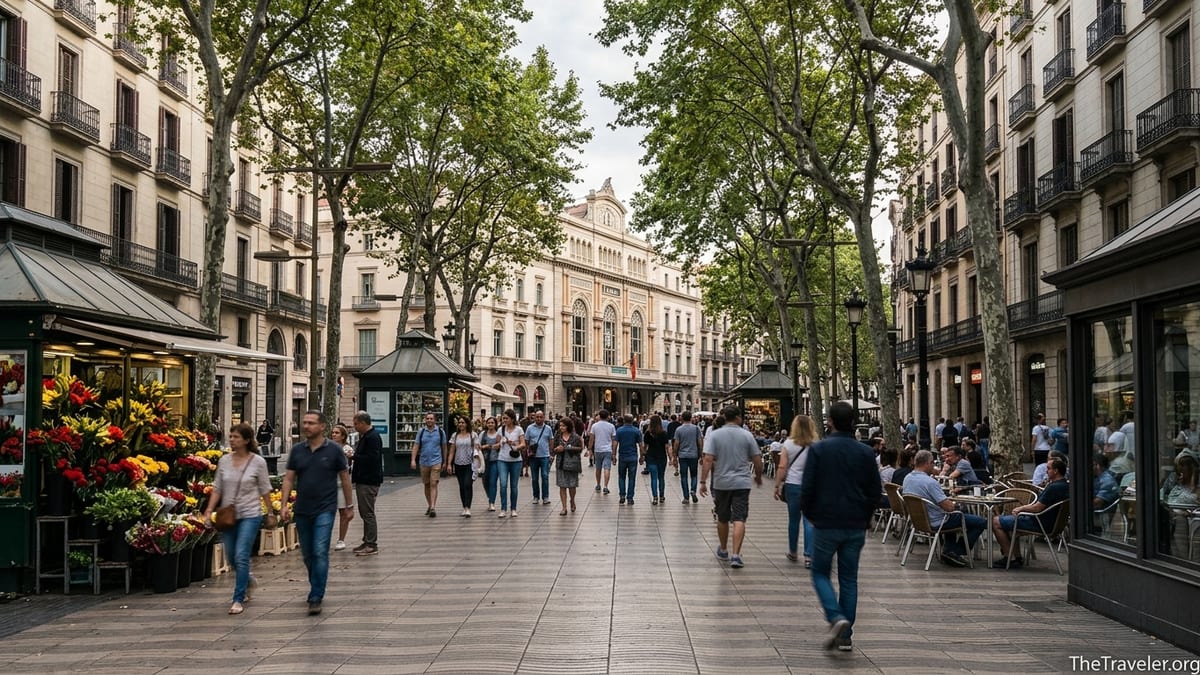
What makes La Rambla feel different on the ground is that it behaves more like an open-air theater than a conventional high street. The central pedestrian promenade is physically separated from traffic by service lanes on either side, so you are always walking on a kind of stage with planted trees acting as a loose canopy above you. Street performers cluster at different sections, flower sellers display their bouquets at eye level and cafe terraces spill out under awnings. It is a space designed as much for lingering and watching as for simply getting from A to B.
Other famous areas in Barcelona have their own spectacles, but they tend to be more specialized. Passeig de Gràcia is where you go to admire Gaudí’s Casa Batlló and La Pedrera, then maybe pop into a luxury fashion boutique. El Born’s appeal lies in its independent designer stores and wine bars tucked into small stone-fronted premises. La Rambla, by contrast, is messy and mixed. In the same 100-meter stretch you might see a group of teenagers buying cheap football scarves, a group of art students sketching the Liceu opera house and grandparents from a nearby neighborhood slowly doing their evening paseo.
Because it is such a stage, La Rambla also absorbs city-level events in a way most other streets do not. During the annual La Mercè festivities in late September, sections of the promenade host parades, human towers and outdoor concerts. When FC Barcelona wins a major title, fans traditionally converge on the Canaletes fountain near the top of La Rambla to celebrate, even if current renovation works are temporarily displacing that ritual to alternative locations. The boulevard becomes a barometer of how the city is feeling.
For visitors, this theatrical quality can be exhilarating or exhausting depending on the time of day. Arrive around 8 or 9 in the morning and you might share the promenade with dog walkers and residents heading to work. Drop by around midday when multiple cruise ships have docked, and it feels like the world has emptied onto the paving stones. Few other zones in Barcelona swing so dramatically between casual neighborhood stroll and high-intensity tourist spectacle within the span of a day.
A Concentration of Iconic Landmarks in One Short Walk
Another way La Rambla stands apart from other popular areas is the sheer density of recognizable landmarks packed into such a short distance. Starting at the top, near Plaça de Catalunya, you encounter the Font de Canaletes, a decorative fountain wrapped in local lore. Tradition holds that if you drink from it, you are destined to return to Barcelona. It is also the symbolic meeting point for FC Barcelona supporters, which makes it both a civic monument and a passionate football gathering spot.
Walk a little further and on the right-hand side you reach the famous Mercat de Sant Josep, better known as La Boqueria. While markets exist across the city, from Sant Antoni to Santa Caterina, La Boqueria’s wrought-iron entrance and bustling central aisle have become global shorthand for Barcelona food culture. At the same time, in recent years it has wrestled with the challenges of balancing genuine local produce with colorful fruit cups and takeaway meals aimed at passing visitors, a debate that has driven new rules requiring stalls to dedicate a significant portion of their offer to fresh goods.
Continuing downhill, you pass the Gran Teatre del Liceu, Barcelona’s historic opera house, with its ornate facade and grand interior. Opposite lie clusters of flower stalls, which long ago earned this part of the street the name Rambla de les Flors. Lower down still, the promenade widens to reveal the palm-lined Plaça Reial just off to the right, a square whose arcades fill with terrace bars, nightlife and weekend antiquarian markets. Finally you reach the Mirador de Colom, the Columbus monument, which marks the symbolic gateway between city and sea.
Other parts of Barcelona each have a few standout hits, but La Rambla compresses multiple big-ticket sights into a single, continuous experience. Using it as a sightseeing spine means you can move between the Museum of Contemporary Art in El Raval, the Gothic Cathedral, the marina at Port Vell and the designer stores of Passeig de Gràcia without ever being far from that central promenade. As a result, it functions almost like an outdoor concourse for the historic core.
Tourism, Authenticity and a Street in Mid-Renovation
Perhaps the most striking way La Rambla differs from other popular districts is how intensely it embodies Barcelona’s struggle to balance mass tourism with everyday urban life. For years, critics have pointed to the proliferation of souvenir stands, chain restaurants and over-priced terraces along the boulevard as evidence that it has tilted too far toward visitors. Locals often recommend friends do a single walk down La Rambla to understand the atmosphere, then quickly branch into side streets for more authentic bars and shops.
This tension is not unique. The Gothic Quarter and El Born also grapple with rising rents, short-term holiday rentals and crowded lanes in high season. Yet La Rambla tends to be where policy experiments are most visible. Ongoing multi-year renovation works are reconfiguring parts of the promenade, with new paving, more greenery and simplified crossings designed to slow traffic and make the space feel more like a civic avenue than a strip of tourist commerce. City authorities have even created an advisory council made up of cultural figures, neighborhood representatives and urbanists tasked with ensuring that, once works finish, the street can win back more local residents.
Mercat de la Boqueria, too, has become a symbol of this recalibration. To counter the perception that it has become a “theme park” market, management and the municipal government have introduced rules that oblige stalls to maintain a significant proportion of their space for fresh ingredients rather than purely ready-to-eat snacks, and renovation projects are planned through the next few years. Parallel food markets in less visited neighborhoods, such as Mercat de Sant Antoni or Mercat de l’Abaceria in Gràcia, tend to have a higher share of local shoppers and fewer selfie sticks, which makes La Boqueria’s transformation especially high profile.
If you are visiting now, you may encounter fenced-off sections, temporary diversions and active work sites especially near Canaletes and some central stretches. That experience is quite different from strolling in pedestrianized superblocks such as parts of Consell de Cent in the Eixample, where recent redesigns were largely completed before heavy international attention. On La Rambla, the process of change itself becomes part of what you see: new benches, test cultural spaces, and revised kiosk layouts sometimes sitting side by side with older structures and long-established flower stalls.
A Magnet for Crowds, Street Life and Petty Crime
La Rambla’s very success as a gathering place also gives it a reputation that sets it apart from other scenic corners of Barcelona. It is one of the city’s most densely walked stretches, especially between Plaça de Catalunya and La Boqueria in late morning and early evening. Large tour groups, school trips, cruise passengers and independent travelers all funnel into the same central space, which naturally attracts sellers of everything from novelty hats to skip-the-line tour tickets.
With crowds also come pickpockets. While Barcelona is generally safe in terms of violent crime, petty theft around its most visited spots is a long-running issue, and regular visitors and residents frequently mention La Rambla, Plaça de Catalunya and the metro as particular hotspots. Compared with, say, the relatively relaxed atmosphere around neighborhood squares in Gràcia or Poblenou, the Ramblas demand a higher level of awareness. Common tactics include jostling in dense clumps of people, distraction games like “accidental” spills, or overly friendly introductions late at night near the lower end of the boulevard.
This does not mean you should avoid La Rambla. It does mean treating it as you would the busiest areas of Rome or Paris. Wear bags cross-body with zippers closed, keep wallets out of back pockets, and be cautious when strangers initiate physical contact or insist on street games. Many visitors walk the street multiple times with no incident, but few other Barcelona areas combine such density of tourists and opportunistic thieves in such a small space. If you are traveling with children or elderly relatives, consider visiting earlier in the day when the atmosphere is more family-friendly and crowds are easier to manage.
Elsewhere in Barcelona, risk is spread out differently. The nightlife cluster around Port Olímpic, the tight lanes around some Gothic Quarter bars, and late-night metro trains also see their share of theft, but none are quite as continuously visible or central as La Rambla. It has become a global reference point in conversations about petty crime in popular cities, which in turn shapes the precautions locals advise visitors to take there.
Prices, Practicalities and Everyday Traveler Decisions
Spend an hour on La Rambla and you quickly notice another difference from more local neighborhoods: pricing. A coffee at a terrace directly on the promenade can easily cost several euros more than the same order two streets back. It is not unusual to see basic beers at outdoor tables along the main stretch priced significantly higher than in a bar in El Raval or the Gothic Quarter’s back lanes. That is typical of global tourist boulevards, but the contrast in Barcelona feels especially sharp because you can step off the Ramblas and be paying neighborhood rates within a couple of minutes.
Food quality is similarly mixed. Some long-standing spots such as classic tapas bars on the periphery of La Boqueria or time-worn cafes near the Liceu have loyal local followings and fair prices. Others, especially places with aggressively promoted paella menus and oversized sangria pitchers, mainly target day-trippers and tour groups. Compare that with areas like Sant Antoni or Poble-sec, where many restaurants earn their living from repeat local customers and therefore compete on quality as much as on visibility. On La Rambla, the constant flow of first-time visitors means some venues can rely more on location than on reputation.
Practical decisions about where to stay also highlight how La Rambla differs from other popular parts of town. Hotels and short-stay apartments directly on the boulevard offer unbeatable convenience if you want to be in the middle of everything and have easy access to metro stations like Liceu and Drassanes. But that comes with trade-offs in noise, crowds and, in some buildings, late-night shouting or music drifting up from the street. Just a few blocks away in the Gothic Quarter, El Raval or the Eixample, you are more likely to find quieter streets while still being within a ten-minute walk of the action.
One practical strategy is to treat La Rambla as a scenic transit route rather than as your primary dining or shopping street. Use it to orient yourself, visit La Boqueria early in the morning when produce stalls are active and aisles are less congested, and then deliberately choose side streets for your main meals or major purchases. In doing so, you benefit from the boulevard’s connectivity and energy without overpaying for the most heavily touristed options.
Culture, Memory and the Emotional Weight of the Street
Beyond the visible bustle, La Rambla carries a cultural and emotional significance that distinguishes it from other well-known areas. It appears in Catalan literature, music and popular memory as a place where “everything can happen.” Generations of residents remember first dates along the promenade, political demonstrations passing under its trees or childhood walks to see the Christmas lights. When major political or social events shake Barcelona, gatherings often flow onto or across La Rambla, turning it into a civic sounding board.
The street has also been marked by tragedy, including the 2017 vehicle attack that started near the top of the boulevard and led to a wave of public mourning. Memorial messages, flowers and artworks filled the paving stones in the weeks that followed, underscoring just how symbolically central the street had become to the city’s identity. While security measures have since been adjusted, and everyday life has largely resumed its usual rhythm, many locals still feel a particular emotional charge when walking past certain sections.
Compare this with more specialized areas such as the Sagrada Família environs or the beach promenades of Barceloneta. Those spaces are iconic in their own right, but much of their meaning for visitors revolves around single themes: religion and architecture in one case, seaside leisure in the other. La Rambla is layered differently. It is a place of protest and fiesta, grief and celebration, tourist commerce and local tradition, often all in the same week.
For travelers, recognizing that depth can shift how you experience the boulevard. Instead of seeing only caricatured sights like overcosted sangria or human statues, you might choose to pause at Canaletes and imagine generations of football fans gathering there, or look up at the ornamental facades above the souvenir rows and picture their 19th-century residents. La Rambla rewards the kind of slow looking that many visitors instead reserve for museums.
The Takeaway
La Rambla is not Barcelona’s prettiest spot, nor its most relaxed. Other neighborhoods offer better food value, quieter streets or more polished architecture. Yet none combine so many layers of history, symbolism, practical utility and raw human energy in such a short stretch. That is what makes it fundamentally different from other popular areas in the city.
If you treat it purely as a box to tick, you may leave with the impression of an over-touristed promenade. If you walk it at different times of day, explore the alleys that branch off and approach it as the city’s central stage rather than its main attraction, it becomes something else: a lens through which to understand modern Barcelona’s contradictions and aspirations. In that sense, La Rambla is less a destination than a constantly evolving performance that every visitor should see at least once.
FAQ
Q1. Is La Rambla worth visiting if I am short on time in Barcelona?
If you have only a day or two, a single walk down La Rambla is still worthwhile because it connects Plaça de Catalunya, the Gothic Quarter, El Raval and the waterfront in one continuous route. You can see major landmarks like La Boqueria, the Liceu opera house and the Columbus monument in under an hour, then quickly branch off into quieter streets for meals and museums.
Q2. How is La Rambla different from Passeig de Gràcia?
Passeig de Gràcia is a broad, elegant avenue known for Gaudí architecture and luxury shopping, with relatively orderly crowds. La Rambla is more chaotic and theatrical, mixing souvenir stands, markets, performers and dense foot traffic. It feels less curated and more like an open-air stage, with a sharper mix of locals and visitors and a stronger sense of everyday city drama.
Q3. Is La Rambla safe to walk, especially at night?
La Rambla is generally safe in terms of violent crime, but it is one of Barcelona’s main hotspots for pickpocketing and petty theft, especially in crowded sections and late at night near the lower end toward the port. Keep valuables secure, avoid displaying expensive items and be cautious if strangers initiate physical contact or distraction games. If you prefer a gentler atmosphere, visit in the morning or early evening.
Q4. When is the best time of day to experience La Rambla?
Early morning offers a quieter, more local feel as shopkeepers open and commuters pass through. Late morning to mid-afternoon is the busiest, particularly when cruise ship passengers arrive. Evenings can be lively and atmospheric, with illuminated facades and street performers, but also more crowded. Visiting twice at different times can show you two very different Rambla experiences.
Q5. Are the restaurants and cafes on La Rambla good value?
Many terraces directly on La Rambla charge premium prices for average-quality food and drink, taking advantage of the constant flow of first-time visitors. You will often find better quality and more reasonable prices by walking just a few minutes into the Gothic Quarter, El Raval or nearby Plaça Reial. Some long-standing bars and cafes on the periphery of the boulevard are exceptions and remain popular with locals.
Q6. How does La Rambla compare to El Born or the Gothic Quarter?
La Rambla is a wide, linear promenade designed for passing crowds and performances, while El Born and the Gothic Quarter are dense labyrinths of medieval streets. In El Born you are more likely to find independent boutiques and wine bars tucked into old buildings; in the Gothic Quarter, small plazas and historic churches emerge unexpectedly around corners. La Rambla works best as the busy spine that connects these quarters rather than as an isolated neighborhood.
Q7. What should I know about La Boqueria before visiting?
La Boqueria, opening off La Rambla, is famous for its historic iron structure and colorful displays, but it is also very popular with tourists. If you go early in the morning on a weekday you are more likely to see locals shopping for fresh produce, fish and meat. Later in the day, expect more juice stands, ready-to-eat snacks and tour groups. Prices for prepared foods can be higher than in neighborhood markets, so consider using it as a visual highlight and shopping stop rather than your main dining spot.
Q8. Are there ongoing works or changes on La Rambla right now?
La Rambla is in the midst of a multi-year renovation aimed at widening pedestrian space, adding greenery and improving crossings. Depending on when you visit, you may encounter temporary fences, machinery and rerouted flows, especially near Canaletes and some central sections. These works can slightly disrupt the classic postcard view but are intended to make the boulevard more welcoming for residents as well as visitors.
Q9. Is it a good idea to stay in a hotel directly on La Rambla?
Staying on La Rambla means unbeatable access to major sights and public transport, and it can be convenient if you want everything at your doorstep. However, noise from crowds, street music and late-night revelers can be significant, particularly on lower floors. If you are a light sleeper or traveling with young children, you may prefer accommodation a few streets away in the Gothic Quarter, El Raval or the Eixample, where it is quieter but still walkable.
Q10. How should I incorporate La Rambla into a wider Barcelona itinerary?
A practical approach is to use La Rambla as a north-south backbone. Start at Plaça de Catalunya, walk down to La Boqueria and the Liceu, then detour into the Gothic Quarter or El Raval for specific sights and meals. Continue toward the Columbus monument and cross into Port Vell or Barceloneta for the waterfront. In this way, La Rambla becomes a scenic connector that links many of Barcelona’s key districts in a single, coherent walk.