


Few names in European art and architecture trigger the same mix of awe, urgency and practical anxiety as the Sistine Chapel. Travelers cross continents for a glimpse of Michelangelo’s ceiling, plan their Rome itineraries around Vatican Museum time slots, and trade tips on avoiding the queues that snake around the walls of Vatican City. Yet the Sistine Chapel is more than a checklist masterpiece. It operates today in a way that no other famous European chapel quite does, blending working papal chapel, global pilgrimage site and tourist magnet into a single, tightly controlled space. Understanding what truly sets it apart helps you appreciate it on a deeper level than a quick look up at The Creation of Adam before being hustled to the exit.
Get the latest updates straight to your inbox!
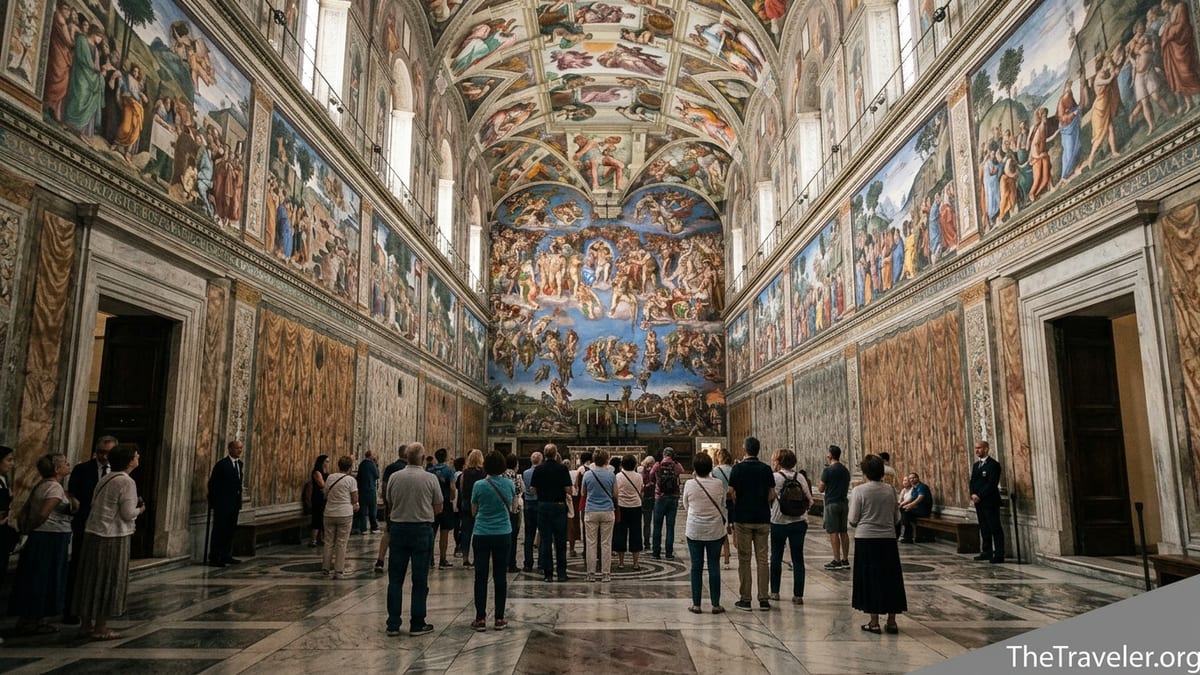
A Working Papal Chapel, Not Just a Monument
Most of Europe’s famous chapels are essentially museums with a liturgical past. Paris’s Sainte-Chapelle is now managed by France’s monuments authority; London’s King’s College Chapel serves the university and a local worshipping community, but daily life in Cambridge carries on largely unaffected by what happens beneath its stained glass. The Sistine Chapel, by contrast, remains the ceremonial heart of the Catholic Church. It is where cardinals gather in conclave to elect a new pope, where papal liturgies and choirs perform on major feast days, and where protocol, security and secrecy still shape how the space can be used.
This dual identity has very real consequences for visitors. When the College of Cardinals meets in conclave, the chapel is sealed and the Vatican Museums reroute visitor flows entirely. Even outside those rare moments, the fact that it is a functioning papal chapel dictates strict rules: complete silence, no photography, a modest dress code and a constant presence of Vatican staff and guards who regularly call for quiet over the murmur of the crowd. In Sainte-Chapelle you are encouraged to linger and take photos; in the Sistine Chapel you are reminded that you are, first of all, a guest in a place of worship, even if your ticket was sold as part of a museum tour.
The modern experience reflects this status. Standard Vatican Museums tickets, which in 2026 are around 25 euros when booked directly through official channels and about 35 to 40 euros for popular skip-the-line options that bundle a hosted entrance, all funnel you eventually into the Sistine Chapel at the end of a one-way route. You do not simply stroll into the chapel from St Peter’s Square as you might wander into a parish church in Rome. You approach through a carefully choreographed museum system, one designed to protect both the art and the living function of the space.
Other famous chapels might close for the occasional university graduation or special concert, but no other European chapel combines such global religious importance with such tightly regulated access. The Sistine Chapel stands at the intersection of faith and governance in a way that gives every visit a slightly charged, almost backstage feel.
A Single, Coherent Vision by Michelangelo
Many great European chapels are collaborative projects. Sainte-Chapelle’s stained glass windows were designed and executed by multiple workshops over several years; the Scrovegni (Arena) Chapel in Padua is dominated by Giotto, but side walls and vaulting were finished by assistants and later restorers. In contrast, the Sistine Chapel’s identity in the modern imagination is defined overwhelmingly by one artist: Michelangelo Buonarroti. Between 1508 and 1512 he covered the vast barrel-vaulted ceiling, roughly 40 meters long by 13 meters wide, with a unified fresco program that still reads as the singular vision of a sculptor turned reluctant painter.
That coherence is part of what makes walking into the chapel so striking. Once your eyes adjust past the crush of visitors, you realize that the seemingly separate Medallions, Prophets, Sibyls and the nine central Genesis panels are locked into a carefully planned architectural framework. Recent scholarship has emphasized how meticulously Michelangelo mapped the chapel’s dimensions and curvature, designing painted architectural elements that align convincingly with the real cornices and windows high above the marble floor. The effect is immersive. Even compared to Giotto’s Scrovegni Chapel, which wraps the viewer in a narrative cycle, Michelangelo’s ceiling feels more like stepping into a single monumental sculpture that happens to be painted.
The presence of The Last Judgment on the altar wall, completed later between the 1530s and 1540s, intensifies that sense of a unified, almost overwhelming artistic environment. Travelers arriving today encounter not a patchwork of styles added century after century, but a Renaissance artist’s work in dialogue with itself across ceiling and wall. Other chapels may be more harmonious architecturally or more lavish in stained glass, yet none present such a concentrated argument for one artist’s imagination at monumental scale.
For visitors, this changes how you plan your time. In King’s College Chapel you might focus on the choir stalls or organ screen, or in Florence’s Brancacci Chapel you can move quite close to individual Masaccio scenes. In the Sistine Chapel you are faced instead with the challenge of mentally stitching together an entire theological and visual program from a distance, craning your neck among hundreds of people. Knowing beforehand that you are looking at a single macro-work rather than isolated highlights helps you make sense of the visual density once you are there.
A Theater of Color Restored for Mass Tourism
If you last visited before the 1990s, you would have seen a very different Sistine Chapel. Centuries of candle smoke, incense and imperfect restorations had darkened Michelangelo’s palette almost to monochrome. The major cleaning campaign carried out between 1979 and 1999 radically changed both the art historical understanding and the traveler’s experience, revealing electric blues, sharp greens and warm skin tones that shocked scholars who had imagined a more muted Michelangelo. Recent research and ongoing monitoring by the Vatican continue to refine how we interpret those colors and protect them from the environmental stress caused by millions of visitors each year.
That balancing act is unique in Europe. The Vatican Museums regularly welcome more than six million visitors annually, and almost all of them pass through the Sistine Chapel. Humidity and temperature are constantly tracked; sophisticated ventilation and filtration systems are adjusted to keep carbon dioxide and microparticles from forming a dull haze on the plaster. In early 2026 the Vatican even began a targeted three-month cleaning of The Last Judgment fresco, not a full-scale restoration but a gentle removal of accumulated surface deposits caused largely by modern tourist traffic. Few other chapels in Europe are subject to such continuous, science-driven environmental management simply to cope with the volume of people wanting to stand beneath one ceiling.
Practical realities reflect this. On a peak summer morning, you may shuffle into the chapel shoulder to shoulder, with staff periodically asking groups to move toward the center or away from the exits to keep circulation flowing. Even on a quieter winter afternoon, you will rarely find fewer than a hundred people in the room. By comparison, it is still possible to visit Giotto’s Scrovegni Chapel on a timed ticket that limits the group to a few dozen, or to catch an evening organ recital in King’s College Chapel where the audience is spread out comfortably in the nave. The Sistine Chapel has become almost a theatrical space where crowd management is part of the mise-en-scène.
For travelers, this means adjusting expectations. The vivid colors you see today are the result of careful restoration and ongoing conservation, but they come at the price of tightly controlled viewing conditions. Your time may feel rushed, and you might find security announcements cutting across your attempt at a silent encounter with The Creation of Adam. This tension between preservation and access is sharper here than in almost any other European chapel, precisely because of the chapel’s global fame.
A Chapel Hidden Inside a Museum Maze
Another difference becomes obvious long before you tilt your head back: the route you must take to reach the Sistine Chapel. Rather than sitting in a city square or at the end of a college lawn, the chapel is buried deep within the Vatican Museums complex. In practice this means that even with an early timed entry slot, you will typically walk through at least an hour of galleries, courtyards and corridors before you arrive beneath Michelangelo’s ceiling. There are shortcuts that docents and some guided tours can use to shave time off the approach, but there is no direct side door that regular visitors can slip through.
This affects both logistics and mood. In Sainte-Chapelle, you climb a spiral staircase and the stained glass immediately envelops you. In the Palatine Chapel in Aachen, you step directly from the cathedral transept into Charlemagne’s octagonal space. In the Vatican, you might start in the Pinecone Courtyard, pass through the Gallery of Maps and the Raphael Rooms, and finally join a bottlenecked corridor that empties into the Sistine Chapel. Along the way you mingle with tour groups of every language and size, each guide herding people along so they do not miss their allotted time in the key rooms.
Ticketing mirrors this complexity. In 2026, a basic pre-booked Vatican Museums ticket that includes Sistine Chapel access typically costs around 25 euros through official channels, with standard skip-the-line products from reputable resellers often quoted in the 35 to 40 euro range. Fully guided small-group tours that combine the museums, Sistine Chapel and a privileged-entry shortcut into St Peter’s Basilica can easily run from 80 to well over 120 euros per adult, depending on group size and extras. This is a very different model from, for instance, visiting the Scrovegni Chapel, where a single timed ticket secures both a short environmental acclimatization period and a fixed fifteen minutes inside the frescoed space.
For travelers, the key is to factor the museum maze into your timing and energy. A visit to the Sistine Chapel is never just ten minutes looking up; it is part of a longer three to four hour museum experience for most visitors. That integration into a vast museum ecosystem, with its own security protocols and commercial pressures, sets it apart from stand-alone chapels where you can drop in and out more casually.
Rules, Rituals and the Famous “No Photos” Policy
Every historic chapel has rules, but the Sistine Chapel enforces them with unusual intensity. The no-photography policy is strict, with guards actively intervening if they see smartphones raised. Flash photography is banned in many churches to protect pigments, but here even discreet, non-flash shots are not tolerated during public visiting hours. The rationale is a mix of conservation concerns, crowd control and the desire to preserve a certain reverence in a room that might otherwise become a sea of outstretched arms and glowing screens.
By comparison, visitors in Sainte-Chapelle, the Medici Chapels in Florence, or the Basilica of Santa Croce can generally photograph freely, with flash restrictions clearly posted but lightly policed. In the Sistine Chapel, enforcement is part of the rhythm of the room. Soft but insistent shouts of “Silenzio, per favore” and “No photo” punctuate the constant murmur, a reminder that this is not just another stop on an Instagram itinerary. The atmosphere can feel surprisingly intense, especially for those who have built up a lifetime of expectations around a single ceiling.
Silence is another key distinction. In many European chapels, even those inside working churches, quiet whispered conversations or audio guides are common. In the Sistine Chapel, audio guides are switched off as you enter, and even guided tours are required to give their main explanations before or after the visit, not while standing beneath the frescoes. Guides often brief their groups in the Gallery of Maps or the Room of the Immaculate Conception, then instruct them to enter the chapel, look in silence and meet at a prearranged point outside.
For travelers, this can create a moment of disorientation. You emerge from the comparative noise of the museums into a crowded but hushed space where you are suddenly alone with your thoughts and a few hundred strangers, all looking up. It is perhaps the closest a mass tourism site gets to enforcing a quasi-contemplative experience, something that makes the Sistine Chapel feel more like a ritual than a regular sightseeing stop.
How the Sistine Chapel Compares to Other Iconic Chapels
To understand what truly makes the Sistine Chapel different, it helps to set it against specific European counterparts. Sainte-Chapelle in Paris offers one of the world’s finest ensembles of medieval stained glass, wrapping visitors in jewel-colored biblical scenes. King’s College Chapel in Cambridge showcases late Gothic fan vaulting and a choral tradition that defines Christmas broadcasts across the English-speaking world. Giotto’s Scrovegni Chapel in Padua is one of the earliest fully realized narrative fresco cycles, its blue vault scattered with stars over scenes from the lives of Joachim, Anna, the Virgin and Christ.
What these chapels share is artistic excellence tied to a particular medium or period: glass in Sainte-Chapelle, late Gothic stonework and music in King’s, proto-Renaissance painting in Scrovegni. The Sistine Chapel, uniquely, fuses several strands at once. It is a Renaissance fresco cycle of unmatched scale and ambition, a still-active papal liturgical space, and the climactic destination of one of the world’s busiest museum routes. No other chapel simultaneously plays such a central role in global religious governance, mass tourism and art history.
The visitor management models also diverge sharply. Scrovegni’s timed-entry system restricts groups to small numbers for about fifteen minutes, preceded by a few minutes in a climate-controlled antechamber. King’s College Chapel can be experienced both as a tourist site during daytime opening hours and as a worship space during choral services, with no ticket required for some religious events. Sainte-Chapelle, while popular, still rarely approaches the shoulder-to-shoulder density of the Sistine Chapel at midday in July. This means that the sensory experience in the Vatican is marked not just by what you see, but by how you move and breathe in the space.
For many travelers, the comparison becomes personal. You might recall the calm of listening to Evensong in King’s, the almost private feeling of stepping into the small upper chapel at Aachen outside peak hours, or the tightly controlled but intimate fifteen minutes with Giotto in Padua. The Sistine Chapel, by contrast, feels crowded, managed and at times overwhelming. Yet that intensity itself is part of what sets it apart: you are acutely aware that you are sharing the room with the rest of the world, all of you momentarily focused on the same painted sky.
Planning Your Visit: Costs, Timing and Realistic Expectations
Because of its unique status and demand, planning a visit to the Sistine Chapel requires more strategy than most chapels in Europe. In 2026, buying official Vatican Museums tickets online typically involves a mandatory booking fee on top of the base admission, bringing the total to around 25 euros per adult. These tickets automatically include access to the Sistine Chapel as the final part of the museum route. Third-party skip-the-line tickets and simple hosted-entry options usually start in the mid-30 euro range and can climb higher in peak season, while comprehensive guided tours that combine the museums, chapel and St Peter’s Basilica often cost from about 80 euros to well over 120 euros per person.
Tours promising “skip the line” generally skip only the ticket-purchase queue, not the airport-style security check at the museum entrance. In practice this means you may still stand in a shorter line for 10 to 30 minutes, depending on the time of day and season. Once inside, you are on a one-way path through the museum. If your primary goal is the Sistine Chapel, some visitors choose early morning or late evening special openings offered by select operators, which can be significantly more expensive but allow you to experience the chapel with fewer people.
Timing within the day matters. Mid-morning and early afternoon, especially on days close to major religious holidays or when cruise ship excursions are in port at Civitavecchia, see the heaviest crowds. Early morning first-entry slots and late afternoon entries often feel marginally less congested, though they are rarely quiet. Wednesday mornings can be complicated when the papal audience takes place in St Peter’s Square, affecting traffic and security in the area; in high season, planning your Vatican day for another weekday can simplify logistics.
Setting realistic expectations may be the most important part of your planning. Unlike many chapels where you can sit for half an hour in relative stillness, here you may find yourself standing, moving slowly with the crowd, and tilting your head back for brief, intense bursts of looking. Audio explanations are best absorbed beforehand, via a good guidebook or podcast, so that once you are inside you can simply scan for key scenes such as The Creation of Adam or The Separation of Light from Darkness rather than trying to decode the entire ceiling on the spot. Accepting the constraints in advance allows you to focus on the wonder of the art rather than the frustration of the crowd.
The Takeaway
In a continent full of extraordinary chapels, the Sistine Chapel stands apart because it is not easily categorized. It is at once a working papal chapel, a monumental artwork by one of history’s greatest artists and the heavily managed finale of a world-famous museum. Where other chapels invite lingering contemplation or quiet surprise, the Sistine Chapel delivers a compressed, high-intensity encounter shaped by conservation science, security protocols and global demand.
Understanding these differences before you go can transform your visit. Instead of being thrown off by the crowds, the rules and the circuitous approach, you can see them as part of what makes this place singular: a space where decisions taken under that painted sky still ripple outward through world news, where color and form have been painstakingly revived for twenty-first-century eyes, and where millions of travelers each year share a fleeting moment of collective awe. In that sense, the Sistine Chapel is not just different from other European chapels. It is a reminder that some of the world’s most famous sacred spaces now exist at the crossroads of devotion, heritage and mass tourism, and that navigating that intersection thoughtfully is part of being a modern traveler.
FAQ
Q1. Do I need a separate ticket for the Sistine Chapel, or is it included with the Vatican Museums?
The Sistine Chapel is included in all standard Vatican Museums tickets and most tours. You cannot buy a ticket for the chapel alone or enter it directly from the street.
Q2. How much should I budget for a visit to the Sistine Chapel in 2026?
Plan on around 25 euros per adult for an official pre-booked Vatican Museums ticket that includes the Sistine Chapel, and 35 to 40 euros or more if you choose a skip-the-line or guided option from a reputable operator.
Q3. What is the best time of day to visit the Sistine Chapel to avoid crowds?
First-entry morning slots and late afternoon entries are typically a bit less crowded than mid-morning or early afternoon, although the chapel is rarely quiet. Special early or evening tours cost more but can reduce crowding further.
Q4. Why is photography not allowed in the Sistine Chapel?
Photography is banned to protect the frescoes and to keep crowd behavior manageable. Guards enforce a no-photo and no-video policy, even without flash, so expect to experience the art only with your eyes.
Q5. How long will I actually spend inside the Sistine Chapel?
Most visitors spend between 10 and 20 minutes inside, depending on crowd levels and how strictly staff manage the flow. The entire Vatican Museums visit typically takes two to four hours including the walk to and from the chapel.
Q6. Is the Sistine Chapel still used for religious services today?
Yes. It is a working papal chapel used for important liturgical celebrations and, most famously, for the conclave in which cardinals elect a new pope. During such events it is closed to visitors.
Q7. How does the Sistine Chapel differ from places like Sainte-Chapelle or King’s College Chapel?
Unlike those chapels, which are primarily historic or academic sites, the Sistine Chapel is simultaneously a major artwork, an active papal liturgical space and the finale of a very busy museum route, with stricter rules and heavier crowds.
Q8. What should I wear when visiting the Sistine Chapel?
You must follow the Vatican dress code, which requires shoulders and knees to be covered for both men and women. Light trousers or longer skirts and covered shoulders are usually sufficient.
Q9. Can children visit the Sistine Chapel, and is it suitable for families?
Children are welcome, and reduced-price tickets are available for younger visitors. Families should be prepared for long walks through the museums, crowds and the need for quiet inside the chapel itself.
Q10. Is it worth booking a guided tour instead of just a basic ticket?
Many travelers find guided tours worthwhile because they provide context before and after the chapel, help navigate the museum route efficiently and sometimes use special entrances, though they are more expensive than standard tickets.