


From a distance, Ftelia Beach looks like a simple crescent of sand on the wild north coast of Mykonos, known mainly to windsurfers and people who book sunbeds at its bohemian beach clubs. Stay a little longer, though, and you discover that this is one of the island’s most quietly fascinating corners: a place where Neolithic ruins sit above turquoise water, where the wind carves patterns in the dunes, and where you can still, with a bit of planning, find space and silence even in high season.
Get the latest updates straight to your inbox!
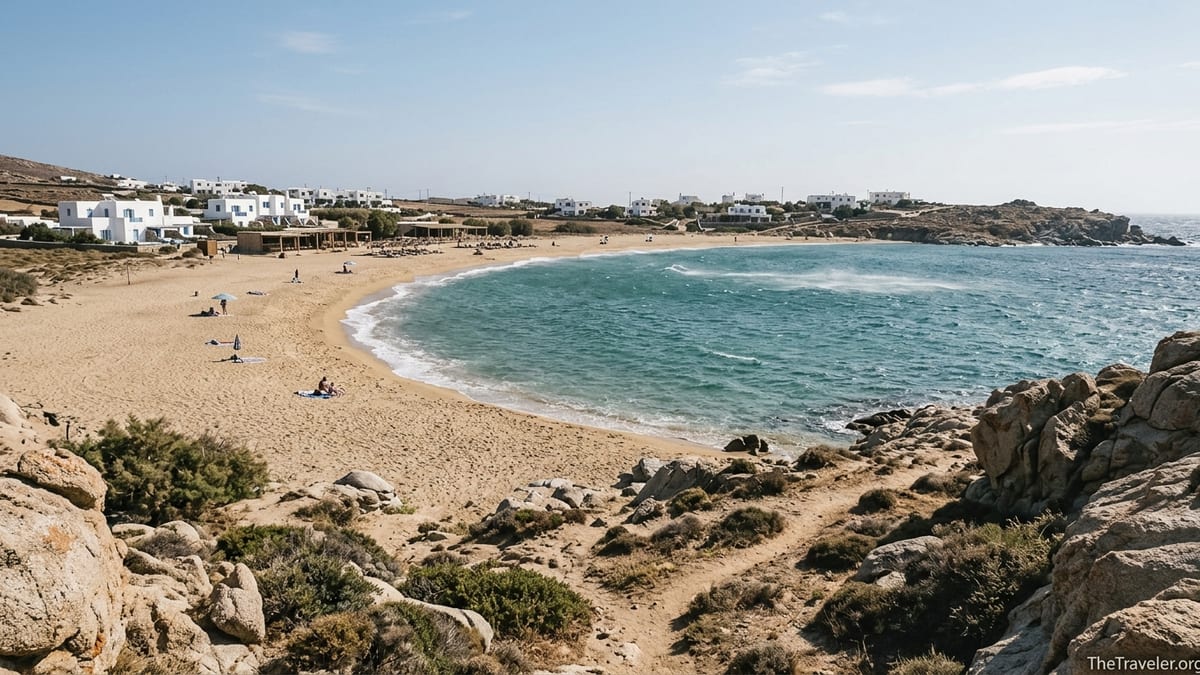
The Wild Personality of Ftelia’s Bay
Most visitors arrive at Ftelia expecting another polished south-coast style beach: neat rows of sunbeds, calm water and a constant soundtrack. What catches them by surprise is the rawness of the bay. Ftelia opens directly to the north, where the Meltemi wind funnels through the central Aegean, so the sea here is rarely glassy. On many summer afternoons, whitecaps whip across the bay and fine sand lifts from the shoreline, leaving ripples and ridges underfoot. This is not a beach for perfectly coiffed hair and fragile beach umbrellas; it is a beach that reminds you you are on a real island in an open sea.
That wildness actually defines the experience. Walk to the middle of the bay, away from the music of the beach clubs, and you are likely to find just a handful of people scattered along the sand, even in July or August. The constant hum of the wind muffles conversation and music, creating a strangely peaceful soundscape. On especially windy days, you might see only a few determined windsurfers and kitesurfers launching from the shore, using the chop as their playground while everyone else retreats to calmer beaches on the south coast.
Because of the wind, the water feels different too. The sea at Ftelia is typically a degree or two cooler than the south-facing beaches, with a quicker drop-off that suits strong swimmers more than toddlers. Families who come here usually do so in the morning, when the wind is softer, letting children paddle at the edge before the afternoon gusts arrive. If you are used to the silky shallows of Ornos or Platis Gialos, the first plunge at Ftelia can be a bracing surprise.
This combination of wild sea and broad, undeveloped sand means Ftelia often feels like an escape within an island that can otherwise be crowded. While nearby hotspots like Super Paradise and Psarou fill with yachts and partygoers, locals and seasoned Mykonos regulars often slip to Ftelia on windy days specifically for its emptier feel, happy to trade perfect Instagram shots for something more elemental.
The Archaeological Site Almost Everyone Walks Past
Perhaps the most remarkable thing about Ftelia is something many visitors never even see. At the northern end of the beach, just above the shoreline, lies one of the most significant Neolithic settlements in the Cyclades, dating from roughly the mid-fifth millennium BC. Low stone walls, foundation lines and fragments of daily life from 7,000 years ago are spread across the slope above the sand, largely unsigned and easy to ignore if you do not know they are there.
Archaeological work here has revealed evidence of permanent occupation and sophisticated activity, including stone tools, ceramics and traces of metalworking. Some specialists consider Ftelia one of the most important Late Neolithic sites in the region, a coastal hub connected to other Cycladic communities that were moving obsidian, pottery styles and agricultural know-how between islands. Yet for most modern beachgoers, the fenced-off walls are just “some old stones” glimpsed from a distance on the way to a sunbed.
Access to the core excavation area is restricted, but you can still appreciate the scale and setting from outside the fences. If you park at the eastern end of the bay and walk slowly uphill before reaching the sand, low walls in pale granite start to emerge, forming arcs and rectangles. Imagine, for a moment, that when these walls were in use the sea level was several metres lower than it is today, and the shoreline likely lay farther out, forming a fertile coastal plain rather than the narrow strip of modern sand. It takes very little effort to overlay that past on the present scene.
For a deeper look, combine a beach day at Ftelia with a short visit to the Archaeological Museum of Mykonos near the Old Port in town. Some finds from prehistoric sites in the region, including Ftelia and the nearby islet of Rhenia, are displayed there. Seeing Neolithic tools or figurines in glass cases in the morning, then eating lunch at a beach club while gazing up at the unassuming ruins in the afternoon, makes it much easier to grasp just how long this bay has been part of human stories.
Finding the Quiet Middle Ground Between Beach Clubs
Many people now know Ftelia mainly through its two headline venues at opposite ends of the bay. On one side, Alemagou styles itself as a rustic-chic beach bar and restaurant, with weathered timber roofs, sandy floors and a playlist that moves from laid-back midday to more energetic sets as the sun slips lower. Across the bay, newer projects like the Ftelia open beach experience offer curated music, designer sunbeds and a more contemporary aesthetic. Bookings in high season can be essential, and prices for front-row loungers with towel service often match the island’s better-known south-coast clubs.
What most visitors overlook, however, is that you do not need to commit to a beach club to enjoy Ftelia. The wide middle section of the bay remains largely unorganized, with generous stretches of free sand between the developed ends. On a typical August day, you might see one side buzzing with lunch reservations and Champagne, the other hosting a late-afternoon DJ set, while the central arc of beach has nothing but a scattering of towels and a few locals stretched out in the wind.
If you bring your own umbrella, a light windbreak and a cooler with water and snacks from a minimarket in Ano Mera or Mykonos Town, you can effectively create your own micro-beach here, with the clubs in sight but not in your ears. This self-sufficient approach appeals to travelers who like the idea of Ftelia’s energy but do not necessarily want to spend a full day ordering from a premium menu. It also means you can wander up for a coffee, a cocktail or a late lunch when it suits you, then retreat to your quieter patch of sand afterwards.
Because the bay is open, sound travels differently depending on the wind direction. On some days you may hear little more than a distant bassline; on others, especially when the air is still in early or late season, the music carries farther. If peace and quiet is your priority, arrive early in the morning and claim a spot in the middle, then plan to leave by late afternoon when the atmosphere at both ends usually becomes livelier.
How to Reach Ftelia and Why the Journey Matters
Ftelia is less straightforward to reach than the main south-coast beaches, which is part of why it stays relatively uncrowded. There is no regular direct bus service from Mykonos Town specifically to Ftelia, so most visitors arrive by rental car, ATV, scooter or pre-booked transfer. The drive from town takes around 15 minutes, climbing inland past dry-stone walls and scattered villas before dropping down to the bay. The last stretch is along a smaller local road that turns to gravel in some sections, though it is generally manageable for standard hire cars in good weather.
Taxi availability on Mykonos remains limited, especially in the evenings and at peak times. While some beach clubs at Ftelia can arrange private transfers for guests with reservations, relying on finding a taxi at random when you want to leave is risky. A pragmatic approach is to rent a small car for the day from an agency in Mykonos Town or near the new port, then combine Ftelia with a stop in Ano Mera for a village-square dinner on the way back. Daily rental rates vary widely, but in high summer a compact car often costs roughly what two or three separate taxi trips across the island would add up to.
Parking is another detail many people underestimate. Because the bay is relatively undeveloped, there are informal parking areas on packed earth behind the beach rather than a single paved lot. On calmer days these fill up with vehicles belonging to local residents, club staff and visitors who arrive for lunch. Arrive before late morning if you want to park close to the sand without threading your way through double-parked scooters and ATVs. Observe local practice by not blocking farm tracks or private driveways, and be prepared for dust; leaving windows slightly open helps with heat, but keep valuables out of sight.
Experienced visitors increasingly combine Ftelia with other northern beaches, treating the day as a small road trip. From Ftelia you can drive across the spine of the island towards Agios Sostis or Panormos, seeing a quieter, more rural side of Mykonos that first-time cruise passengers never glimpse. This inland route passes goat pens, small churches perched on rocky outcrops and occasional wide views across the island’s interior, and it reinforces the feeling that Ftelia belongs to a wilder Mykonos, distinct from the polished resort clusters to the south.
Reading the Wind: When Ftelia Is At Its Best
Because Ftelia faces north, understanding the local wind patterns is the single most important factor in planning a visit. The Meltemi, the dry northern wind that defines Aegean summers, typically strengthens from late morning and can blow at forceful speeds on clear days. For windsurfers and kitesurfers, this is precisely the appeal of Ftelia; they time their sessions to peak gusts and seek out the days when other beaches are too choppy for comfortable swimming.
For swimmers and sunbathers, the goal is usually the opposite. The bay is at its most inviting on days when the wind swings slightly or drops in intensity, which often happens in late May, early June and again in September, as well as during occasional lulls in mid-summer. Early mornings are almost always calmer, with flatter water and softer light, so if you are sensitive to sand blowing around your towel, aim to arrive between 9 and 11 a.m. and plan a long lunch break once the wind picks up.
On very windy days, even seasoned Mykonos regulars will admit that Ftelia can be a test. Fine grains of sand sting bare skin, umbrellas strain as if they might lift from the shore, and the sea becomes a restless mix of white-capped waves. This is when most casual visitors abandon plans and head south to more sheltered beaches such as Ornos or Elia. Yet a minority of travelers deliberately choose Ftelia in these conditions, knowing that the wind will keep numbers down, leaving a sense of space that is rare elsewhere on the island in August.
It is worth asking staff at your hotel or in Ano Mera village about expected wind conditions before you go. Locals quickly learn how to read the forecasts and can tell you, for example, that “tomorrow morning will be great for Ftelia, but by afternoon it will be tough.” Planning around those small windows of calmer weather can mean the difference between a frustrating visit and a perfect, uncrowded swim in clear, moving water.
Hidden Perspectives: Walking the Headlands and Dunes
Another thing most visitors miss at Ftelia is the chance to see it from above and from the edges. The majority stay close to their sunbeds or towels, moving little further than the walk from the car park to the waterline. Yet modest paths lead onto the rocky headlands at both ends of the bay, offering elevated vantage points and quieter corners shaded by the occasional low shrub or rock overhang.
If you start at the western side near the beach club there, a faint trail climbs over the rocks and curves around the point. Within ten minutes you are looking back at the full curve of Ftelia, with the granite hills behind and the blue of Panormos Bay beyond. Early in the season you may see small wildflowers clinging to the slopes; later in the summer, the landscape turns to golden browns and grays, with the sea as the main splash of color. Bring proper footwear, as the rock underfoot is uneven and, in places, polished smooth by wind and occasional rain.
Behind the central arc of the beach, low dunes and sandy mounds shelter pockets of vegetation. These areas are easily damaged, and some sections may be signed to discourage trampling, but if you stick to existing paths you can appreciate how this small dune system softens the step between hard inland ground and the open shore. When the afternoon wind rises, standing here watching gusts ripple through the grasses and scrub can be as absorbing as watching waves.
Sunset at Ftelia is more subtle than on west-facing beaches such as Agios Ioannis. The sun disappears behind inland hills rather than sinking directly into the sea, but that has its own charm. As the light mellows, the granite boulders pick up warm tones and the whitewashed buildings on the slopes above the bay glow briefly before fading into dusk. From a headland vantage point you can watch the two beach clubs transition into evening mode while the rest of the bay gradually empties, a reminder of how localized the island’s energy pockets really are.
Combining Ftelia With Ano Mera and the Island’s Interior
Ftelia’s location near the center of the island makes it a natural partner for exploring inland Mykonos, something many visitors never consider. Just a short drive away lies Ano Mera, the island’s main traditional village, with its monastery complex, everyday shops and tavernas around a leafy square. Instead of rushing back to Mykonos Town after a day at the beach, you can rinse off the salt and wind at your car, pull on a shirt or dress, and be seated at a shaded table in Ano Mera within fifteen minutes.
In high season, when Mykonos Town’s harbor-front restaurants are buzzing with cruise visitors and late-night crowds, Ano Mera often feels almost local. Families gather for evening meals, children play near the square, and prices for grilled fish, local cheeses and shared meze plates are often gentler than on the seafront in town. Pairing a wind-swept day at Ftelia with a simple dinner here gives a more rounded sense of the island’s rhythms, counterbalancing the more obviously glamorous side of Mykonos.
Ftelia also works well as a stop on a wider circuit of the northern and eastern beaches. With a rental car, it is easy to start with a morning swim at more protected spots, continue to Ftelia for lunch and wave-watching in the early afternoon, then move on to somewhere like Kalo Livadi or Agrari for a later, calmer swim. This kind of progression lets you experience the contrasts in coastline, wind and atmosphere without backtracking constantly through the same busy junctions near Mykonos Town.
Many visitors leave Mykonos having only seen the narrow band between the old port and a cluster of well-known southern beaches. Making the short detour to Ftelia and its surrounding countryside reveals the island’s rockier spine, its patchwork of small fields and its network of quiet chapels. Very little of that appears in glamorous marketing images, but it is what gives Mykonos its underlying character, beneath the surface layer of international beach-club culture.
The Takeaway
What most visitors miss at Ftelia Beach is not a single hidden bar or a secret swimming cove. It is the way all of its elements fit together: the battered beauty of a north-facing bay, the Neolithic walls that keep silent watch over modern sunbeds, the spatial freedom of a wide sandy arc with just a few clusters of development, and the proximity to parts of Mykonos that still feel shaped by everyday island life rather than by global trends.
If you approach Ftelia expecting polished perfection and windless water, you may leave disappointed. If you come prepared for gusts, open space and a certain rawness, you are more likely to recognise why locals and long-term devotees hold this bay in such regard. Bring your own shade, arrive early, walk the headlands, glance up at the ancient stonework, and consider ending your day in Ano Mera rather than rushing straight back to town. In doing so, you will have experienced a side of Mykonos that many people never realise is there.
FAQ
Q1. Is Ftelia Beach suitable for families with children?
Ftelia can work for families, especially in the morning when the wind is lighter, but the bay is exposed and the water can become choppy later in the day. Parents should be comfortable with moderate waves and keep a close eye on younger children, choosing calmer days when the Meltemi is not blowing strongly.
Q2. Can I visit Ftelia Beach using public transport?
There is no reliable direct bus route from Mykonos Town to Ftelia, so most visitors come by rental car, ATV, scooter or pre-arranged transfer. You can sometimes combine a bus to Ano Mera with a short taxi ride, but that requires planning and may not be practical in peak hours.
Q3. Do I need to book a sunbed at a beach club to enjoy Ftelia?
No. While the beach clubs at either end of the bay offer loungers and full service, the central part of Ftelia remains free public beach. Bringing your own umbrella, towels and water lets you enjoy the setting without committing to a reserved bed or a full day of food and drink purchases.
Q4. When is the best time of day to visit Ftelia Beach?
Early to mid-morning is usually the best window for calmer water and softer wind, especially in July and August. If you want a quieter experience, arrive before late morning, enjoy a swim and perhaps an early lunch, then consider moving on once the wind and music intensify in the afternoon.
Q5. Is it safe to swim at Ftelia given the strong winds?
On most days, Ftelia is safe for confident swimmers who are comfortable with some chop and small waves, but it is less ideal for absolute beginners. Conditions can change quickly with the wind, so always assess the sea when you arrive, stay within your limits and avoid swimming alone far from shore when the Meltemi is strong.
Q6. Can I visit the archaeological site above Ftelia Beach?
The core excavation area is fenced, and access to the interior is usually restricted. However, you can walk around the perimeter, see the low stone walls and foundations from outside, and appreciate the setting from paths leading up the slope. For artifacts and detailed interpretation, combine your visit with a stop at the Archaeological Museum in Mykonos Town.
Q7. Are there food and drink options if I do not use the beach clubs?
The main options immediately on the sand are the beach clubs and their associated restaurants. If you prefer not to dine there, it is wise to bring snacks and plenty of water with you, or plan to stop in nearby Ano Mera before or after your beach time for a more traditional, village-style meal.
Q8. What should I pack for a day at Ftelia Beach?
Given the wind and relative lack of natural shade, a sturdy beach umbrella or small windbreak, secure hat, high-SPF sunscreen and good sunglasses are particularly useful. Footwear suitable for rocky paths is helpful if you plan to walk the headlands, and a light cover-up or long-sleeved shirt can make windier afternoons more comfortable.
Q9. How crowded does Ftelia get compared with other Mykonos beaches?
Even in peak season, Ftelia is usually less crowded than the main south-coast beaches, largely because of its exposure to wind and its more limited public transport options. The beach clubs themselves can be busy at lunchtime and towards sunset, but the open middle section of the bay often feels spacious by Mykonos standards.
Q10. Can I combine a visit to Ftelia with other attractions in one day?
Yes. A popular itinerary is to spend the morning at Ftelia, then drive to Ano Mera for a village walk and early dinner before returning to Mykonos Town. Others pair Ftelia with nearby northern beaches or with a short cultural stop in town, such as the Archaeological Museum, turning the day into a mix of beach time and low-key exploration.