


Lower Manhattan is one of the most rushed-through square miles on earth. Cruise ship passengers spill from tour buses, commuter crowds surge toward the subway, and most visitors march briskly between the 9/11 Memorial, Wall Street and the Staten Island Ferry. Yet within a 15-minute walk of these landmarks are quiet plazas, powerful historic sites and riverfront corners that reveal a completely different side of New York. Linger instead of sprinting, and Lower Manhattan turns from checklist to neighborhood.
Get the latest updates straight to your inbox!
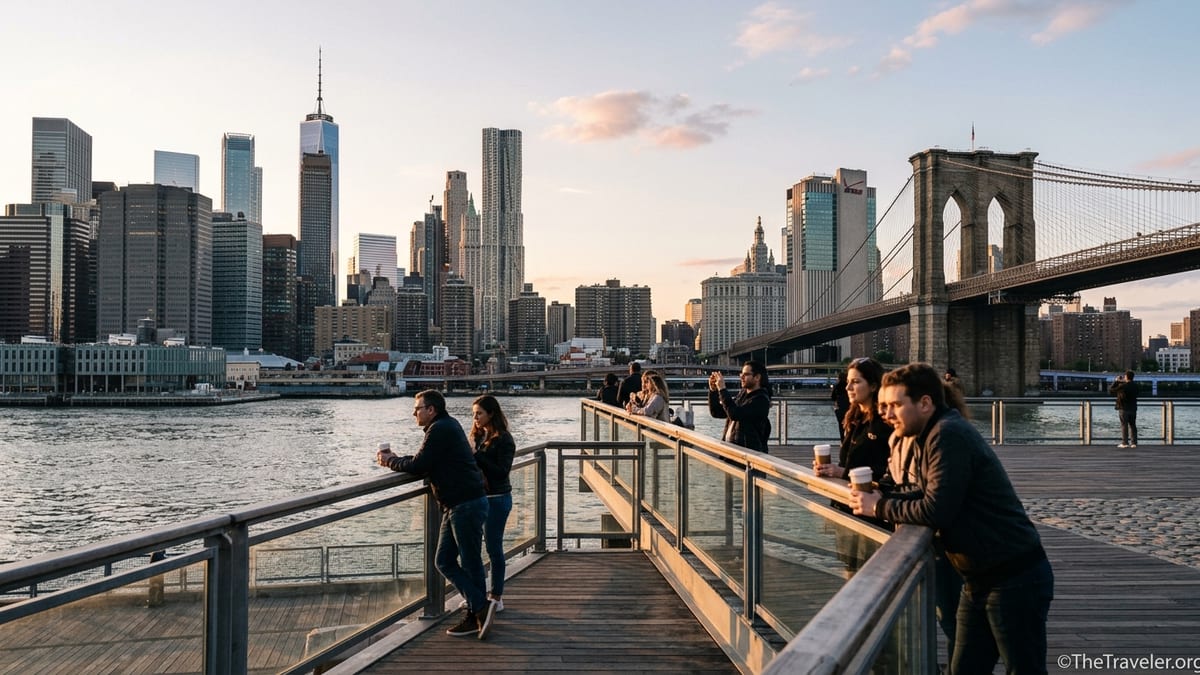
The Myth of “Nothing to See” Below Canal Street
Spend an hour around the World Trade Center and you will hear it: a guide hurries a group back onto a bus with a promise that “there’s not much else down here.” Many travelers treat Lower Manhattan as a single-issue stop, arriving for the 9/11 Memorial or a quick photo of the Charging Bull before heading uptown. Yet walk just a few blocks east toward the East River or north toward the Civic Center and the atmosphere changes from frantic to almost local, with school kids cutting through plazas and office workers eating takeaway on stone benches.
Part of the problem is perception. On a map, Lower Manhattan is squeezed into a tight wedge, hemmed in by water on three sides. Visitors assume it must be nothing but banks and glass towers. In reality, this compact area layers 17th-century street patterns, 19th-century mercantile brickwork and contemporary public art. It holds one of the most significant African burial grounds in the United States, a revitalized working waterfront, small-scale food courts inside landmarked buildings and one of the most cinematic courthouse squares in the country.
Another reason people miss these places is logistics. Group tours are timed to the minute and rarely include detours that cannot be monetized. Even independent travelers often pre-book timed tickets to One World Observatory or a harbor cruise and leave no breathing room to wander. Yet some of the most memorable experiences here cost nothing more than a MetroCard swipe: a quiet half hour in a national monument, a sunset on the East River, a self-guided stroll through narrow streets that still follow old Dutch cow paths.
If you give Lower Manhattan even half a day beyond the obvious highlights, you will begin to see how much of New York’s story is written in its cobblestones and waterfront piers. What follows is a guide to corners most visitors ignore, with concrete ideas for how to fold them into a realistic itinerary.
The Seaport and Pier 17: Waterfront New York, Not Just Wall Street
Walk ten minutes east from Wall Street down Fulton Street and you suddenly hit open sky. The South Street Seaport area, once a gritty wholesale fish market, has been remade into a waterfront district where the city feels close to the water again. Historic brick warehouses now house bars, independent shops and small galleries, and the streets are still paved with uneven cobblestones that make you slow your pace whether you intend to or not.
At the heart of this area is Pier 17, a contemporary glass and steel structure that projects about 300 feet into the East River. On its rooftop, five stories up, an open-air venue hosts a seasonal concert series with sweeping views of the Brooklyn Bridge, the Brooklyn shoreline and the lower Manhattan skyline. On show nights, you can expect major touring acts and ticket prices broadly comparable to other New York venues, but what sets this space apart is the feeling that the city is wrapped around you on three sides rather than framed behind a stage set.
You do not need a concert ticket to enjoy the pier, though. During the day, much of the rooftop and the lower decks function as public space. Office workers come up here with takeaway salads to eat on wood benches, families push strollers along the wide boardwalk and photographers set up tripods for long exposures of the bridge. On a clear afternoon in summer, you might buy an iced coffee for around five dollars from a kiosk on the pier and spend an hour simply watching the traffic pattern of ferries and sailboats on the river.
What surprises many visitors is how easy it is to fold the Seaport into an existing downtown itinerary. If you are visiting the 9/11 Memorial, it is a pleasant 15-minute walk east along Liberty Street and Maiden Lane to reach the water. From there, you can loop back through the Financial District or continue south along the river toward the Staten Island Ferry. The key is remembering that Lower Manhattan has two shorelines, and the East River side often feels more relaxed than the harbor side.
African Burial Ground: New York’s Hidden Story in Plain Sight
Perhaps the most profound site in Lower Manhattan is one that thousands of people walk past every day without even noticing. A few blocks north of City Hall, near the corner of Duane Street and African Burial Ground Way, lies the African Burial Ground National Monument. Managed by the National Park Service, it marks the resting place of more than four hundred Africans, free and enslaved, buried here in the 17th and 18th centuries when this edge of the city lay outside the colonial boundary.
The outdoor memorial is a low, gently curving structure of stone and grass that invites contemplation. Steps lead down into a ringed space that feels both enclosed and open to the sky, a deliberate contrast to the towering office buildings around it. In one corner, a carved ancestral chamber acknowledges the people whose remains were disinterred during construction of a federal building in the 1990s and then reinterred with ceremony. Plaques along the perimeter sketch the story of how Africans built much of early New York’s infrastructure while living under the constraints of slavery and racism.
Across the street, inside the Ted Weiss Federal Building, a small but powerful visitor center uses artifacts, audio testimonies and reconstructed scenes to tell more of this story. Typical visits last 60 to 90 minutes, and entry is free. Rangers sometimes offer short talks or guided walks that you can join informally if you happen to be there at the right time. For a visitor who may only know of slavery in the context of the American South, this is often an eye-opening stop that permanently changes how they see New York’s wealth and architecture.
Practically speaking, the African Burial Ground is easy to combine with other downtown sights. It is a five-minute walk from the Brooklyn Bridge entrance on Centre Street and less than ten minutes on foot from City Hall Park. One thoughtful way to structure a day is to visit the 9/11 Memorial in the morning, walk up through City Hall for a coffee, then spend the early afternoon at the burial ground before crossing the Brooklyn Bridge near sunset. You move from modern tragedy to older, often overlooked suffering and then literally walk out over the water that made the city possible in the first place.
Foley Square and the Civic Center: A Real-Life Law & Order Set
If you have ever watched an American legal drama, you have probably seen Foley Square without realizing it. This open plaza, just north of City Hall, is ringed by some of the most recognizable courthouses in the country. On one side rises the New York State Supreme Court building at 60 Centre Street, a grand neoclassical structure with a wide flight of stone steps and tall Corinthian columns that have served as the backdrop for countless film and television scenes.
Around it stand the Thurgood Marshall United States Courthouse, home to the federal Court of Appeals for the Second Circuit, and the distinctive Manhattan Municipal Building with its elegant archways and statue-topped tower. It is entirely possible to wander into this square on a weekday morning and find defense attorneys talking quietly with clients on benches, news crews setting up cameras for a high-profile trial or newly married couples emerging from the City Clerk’s office in the Municipal Building with fresh marriage certificates.
For visitors, Foley Square offers a very different energy from the Financial District. Instead of tourists clustering around a single statue, you see the daily machinery of government at work. There are no ticketed attractions here, but there is plenty to see if you slow down. Study the carved friezes on the Supreme Court facade, which reference historic legal codes. Listen for the mix of languages as families wait anxiously on the steps. Sit for ten minutes under a tree in Thomas Paine Park, which wraps around the square, and watch how office workers claim the same benches every lunch hour.
This area also connects smoothly to other lesser-known stops. From Foley Square it is a short walk west along Worth Street to the African Burial Ground monument, or east along Pearl Street to the base of the Brooklyn Bridge pedestrian entrance. Because it sits slightly uphill from the towers of the Financial District, the skyline views looking south can be unexpectedly dramatic, especially on clear winter afternoons when the low sun picks out every cornice.
Old Streets, New Flavors: Everyday Life Between the Landmarks
Between the headline sights, Lower Manhattan’s ordinary blocks can be just as rewarding. Streets like Stone, Pearl and Water still follow the outline of the original shoreline, curving irregularly rather than obeying the strict grid of Midtown. Many of the buildings here are only four or five stories tall, with iron fire escapes and slightly crooked rooflines. At street level, you will find a mix of casual eateries, small wine bars and neighborhood services that reveal who actually lives and works downtown.
On a weekday, a simple way to experience this side of the neighborhood is to wander down to Stone Street around lunchtime. Picnic tables fill the narrow cobbled lane, shared by bankers in rolled-up shirtsleeves, city employees from nearby offices and a scattering of in-the-know visitors. Menus tilt heavily toward burgers, mussels, pizzas and a wide range of beers on tap, with main dishes often in the 20 to 30 dollar range. It is not the cheapest meal in New York, but the setting, between 19th-century brick facades and under a canopy of string lights, feels distinctly un-corporate.
A few blocks north, hidden inside the base of glass office towers, you can duck into indoor food courts that cater to local workers. Here the options narrow toward quick-service poke bowls, Mediterranean bowls, dumplings and salad bars where you pay by weight. A made-to-order bowl might run you around 15 dollars, less if you keep toppings simple. Grab a seat by a window and you will see how downtown residents have embraced the area as a place to live rather than just to work, with parents shepherding kids in soccer gear and neighbors chatting over coffee.
Because the Financial District empties out on weekends, this can be the best time for visitors to explore. Streets that are packed with suits on a Wednesday are almost eerily quiet on Sunday mornings, giving you space to admire architectural details or photograph reflections in mirrored lobbies without jostling. Small cafes often stay open, particularly around Wall Street and Broad Street, and you can sip an espresso for four or five dollars at a sidewalk table while feeling like you have stumbled into a private city.
Designing a Better Half Day in Lower Manhattan
Many visitors feel they only have a morning or afternoon to spare downtown, especially on shorter trips. With a bit of planning, you can still move beyond the obvious without stretching your schedule or your budget. Think in loops rather than straight lines: start inland among the skyscrapers, move toward the water, then circle back through a different set of streets so you are always seeing something new.
One realistic route begins at the 9/11 Memorial. After spending time at the pools and museum, walk northeast along Church Street to City Hall Park, pausing for a quick coffee from one of the kiosks that cluster near the subway entrances. From there, head north to Foley Square to take in the sweep of courthouse architecture, then continue a few blocks west to the African Burial Ground memorial and visitor center. After an hour or so there, angle southeast down Nassau or William Street, letting the narrower, older streets guide you to the Seaport and Pier 17 for late-afternoon light on the river.
If you are staying into the evening, consider timing your visit to Pier 17 with a rooftop concert or an outdoor screening. Ticket prices and schedules vary widely by performer and date, but you can often find general admission spots that cost roughly the same as other major venues in the city. Even without a ticket, the district stays lively, with riverside bars serving draft beers in the eight to ten dollar range and casual seafood spots offering clam rolls and fish tacos that you can eat overlooking the East River.
Another approach is to use Lower Manhattan as a transition rather than a destination. Spend your morning in SoHo or Tribeca, then walk south across Canal Street and let yourself drift through Chinatown toward the Brooklyn Bridge. Cross into Brooklyn on foot for those classic skyline views, then return by subway to Fulton Street and finish the day with a quiet hour at the African Burial Ground or a slow stroll through the Seaport’s cobblestone lanes. You will still see the icons, but each one will be anchored in a broader sense of place.
The Takeaway
Lower Manhattan is not just a collection of postcard images; it is the oldest and densest layer of New York’s story. Rushing in and out for a single monument or a quick skyline photo means missing the waterfront where merchants once traded, the square where modern legal battles unfold and the ground where enslaved and free Africans were buried long before the city imagined itself as a global capital.
By carving out even a few unhurried hours here, you can connect those layers in a way that guidebooks and bus windows never quite manage. You can feel the stone under your feet on a cobbled lane, hear the mix of languages echoing off courthouse steps and stand in a quiet memorial courtyard ringed by glass towers that only exist because of the labor remembered there. None of this requires special tickets or insider status; it simply demands that you refuse to treat Lower Manhattan as a place to be rushed through.
The next time you plan a New York itinerary, resist the urge to relegate downtown to a quick tick-box stop. Build in time for the African Burial Ground, for Foley Square, for a coffee on Stone Street or a slow walk along Pier 17. These are the experiences that will stay with you when the memory of another crowded elevator ride to an observation deck has faded.
FAQ
Q1. Is Lower Manhattan safe to explore beyond the main tourist sights?
Lower Manhattan is generally considered safe to explore, especially during the day and early evening. As in any big city, stay aware of your surroundings, keep valuables secure and stick to well-lit streets at night, particularly when the Financial District quiets down after office hours.
Q2. How much time should I plan to see the lesser-known spots you mention?
If you want to visit the African Burial Ground, Foley Square and the Seaport with Pier 17 at a relaxed pace, plan for at least half a day. A full day allows time for coffee or a meal on Stone Street, a walk over the Brooklyn Bridge and unhurried visits to museums or memorials.
Q3. Are these places suitable for children and families?
Yes. The Seaport and Pier 17 are particularly family-friendly, with wide open spaces and riverside views. The African Burial Ground deals with sensitive historical themes, but school-age children often find it educational and moving, especially when paired with age-appropriate explanations from adults.
Q4. Do I need to book tickets in advance for the African Burial Ground or Foley Square?
The outdoor memorial at the African Burial Ground and Foley Square are public spaces that you can visit without tickets. The African Burial Ground visitor center is free; at busier times, ranger-led programs may require advance reservations, but you can still explore the exhibits on your own without booking.
Q5. What is a good budget for food and drinks in this part of the city?
Prices vary, but as a rough guide, expect to pay around 4 to 6 dollars for a coffee, 12 to 18 dollars for a quick-service lunch bowl or sandwich, and 20 to 30 dollars for a sit-down main course on Stone Street or at waterfront restaurants. Drinks at bars and rooftop venues tend to start around 8 to 10 dollars for beer and go higher for cocktails.
Q6. How do I get to Pier 17 and the Seaport from the World Trade Center area?
From the World Trade Center, you can walk east along Fulton Street or a parallel street toward the East River in about 15 minutes. The route is straightforward: you pass through the canyon of the Financial District and emerge at the waterfront, with the Seaport’s brick buildings and Pier 17 directly ahead.
Q7. Can I combine a Brooklyn Bridge walk with these lesser-known sites?
Yes, very easily. The Manhattan entrance to the Brooklyn Bridge is a short walk from both City Hall Park and Foley Square. Many visitors walk the bridge toward Brooklyn in one direction, then take the subway back to Fulton Street or the Seaport and continue exploring Lower Manhattan on foot.
Q8. Are there good photo spots that are not packed with crowds?
The upper levels and riverside edges of Pier 17 offer excellent views of the Brooklyn Bridge and skyline, especially earlier in the day before evening events. Foley Square can also be surprisingly uncrowded, giving you clear angles on grand courthouse architecture without the crush you might find at more famous landmarks.
Q9. What should I wear for a day exploring Lower Manhattan on foot?
Comfortable walking shoes are essential, since you will likely cover several miles on a mix of smooth pavement and old cobblestones, especially around Stone Street and the Seaport. In cooler months, bring layers to handle wind off the water near the piers, and in summer, a hat and sunscreen help with strong afternoon sun along the river.
Q10. Is it worth visiting Lower Manhattan on a weekend, or should I stick to weekdays?
Weekdays show you the neighborhood at full speed, with offices humming and food courts packed at lunch, while weekends are quieter and better for photography and slow wandering. Both offer rewards; if your schedule allows, visiting once on a weekday and once on a weekend gives you two very different but equally revealing views of downtown.