


The phrase “Tuscan countryside” instantly conjures a specific image: soft, rolling hills traced by cypress-lined roads, hilltop villages glowing at sunset, and vineyards and olive groves stretching toward a hazy horizon. While Italy is full of beautiful rural regions, from the Prosecco hills to the trulli country of Puglia, it is Tuscany that has become the global shorthand for an idyllic countryside escape. Travelers who drive the winding roads south of Siena or wake to the mist in Val d’Orcia often say it feels like stepping into a painting. There are clear reasons for that reaction, rooted not just in scenery but in history, agriculture, architecture and the way people still live on this land today.
Get the latest updates straight to your inbox!
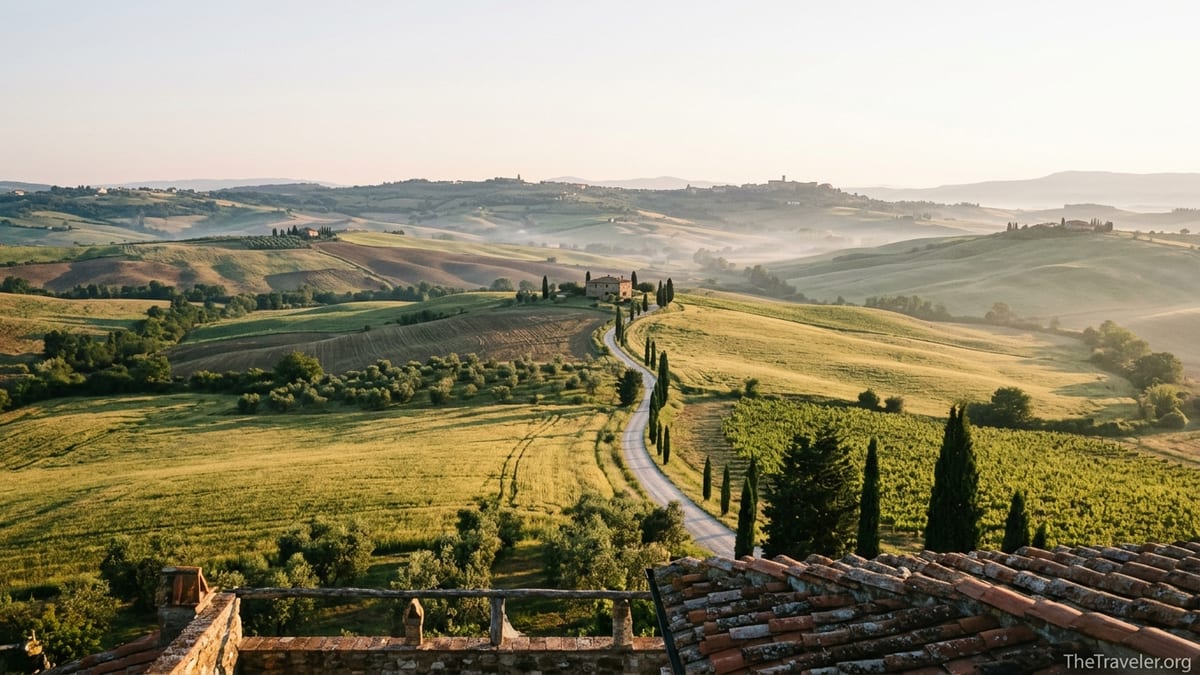
A Landscape So Perfect It Became a UNESCO Icon
If there is a single place that explains why Tuscan landscapes are considered among the most beautiful in Italy, it is Val d’Orcia. This swath of countryside south of Siena, dotted with villages like Pienza, Montalcino and San Quirico d’Orcia, is protected as a UNESCO World Heritage cultural landscape. UNESCO highlights the way its rolling hills, farmhouses, cypress trees and hill towns together embody a carefully shaped Renaissance vision of an ideal rural world, where agriculture, aesthetics and daily life coexist in harmony.
Driving the country roads between Pienza and San Quirico, you see exactly what that means. Wheat fields form wide golden bands that curve over the hills, punctuated by dark vertical cypresses marking an old farmhouse driveway or a ridge-line lane. Vineyards march in precise rows around estates that produce Brunello di Montalcino and Vino Nobile di Montepulciano. Even seemingly wild patches of woodland have been shaped over centuries to protect soil and provide firewood, giving the valley a balanced, almost composed look that feels deliberate without seeming artificial.
For visitors, this harmony is not a theoretical concept. It is an everyday backdrop. You might sip a glass of wine on a terrace in Montalcino while looking over an entire patchwork of vineyards and grain fields, or walk along a gravel lane outside Pienza with the classic S-shaped dirt road and lone farmhouse you have seen on calendars coming into view in front of you. Even simple activities like stopping at a roadside lay-by for a photograph or watching tractors harvest hay in late summer turn into quiet encounters with what many people now think of as the quintessential Italian countryside.
Cypress Roads, Clay Hills and Other Signature Tuscan Vistas
The Tuscan countryside is instantly recognizable because of a handful of visual signatures, and many of them are concentrated in a relatively small area. One is the cypress-lined driveway or ridge road, perfectly straight or gently curving, framing a farmhouse or leading to a hilltop estate. Around Val d’Orcia and the nearby Crete Senesi south of Siena, places like Poggio Covili or the road by the La Foce estate have become informal icons. Travelers pull into small gravel parking spots along the road, step out, and find themselves looking at the exact combination of pale dirt lane, dark trees and smooth hills that fills coffee table books around the world.
Another distinctive element is the clay landscape of the Crete Senesi, just southeast of Siena. Here, the soil is rich in clay that was once the bed of a Pliocene sea, creating a soft, grey-beige palette. Low hills rise and fall like waves, sometimes almost bare except for a solitary farmhouse or a single oak. In some pockets, such as the Biancane of Leonina, erosion has carved domes and gullies in the clay, creating shapes that locals compare to the backs of elephants. In late afternoon light after a passing shower, these hills can glow with iridescent tones of silver, green and blue, a stark contrast to the deep greens of Chianti or the golden fields just a few kilometers away.
These visual motifs repeat across the region in endless variations. The lone cypress standing guard over a bend in the road near Monticchiello, the cluster of pencil-thin trees marking a low ridge near San Quirico, or the farmhouse surrounded by concentric rings of olive trees above Montalcino: each has its own personality, but together they create a visual language that is unmistakably Tuscan. For photographers and casual visitors alike, part of the beauty lies in how often an unplanned corner, seen while turning off for an agriturismo or a winery, looks like it was waiting to be framed.
Where Human Design and Nature Have Grown Together
One reason Tuscan landscapes stand out among Italy’s countryside is that they are not purely natural panoramas. They are the result of many centuries of human intervention. In the late Middle Ages and Renaissance, powerful city-states like Siena and Florence invested in the countryside around them, experimenting with land management that combined productivity with beauty. Estates were laid out with straight access roads lined by cypress trees, not only as windbreaks but as strong visual statements. Farmhouses were built on hilltops or slopes to catch breezes and overlook fields, giving farmers a practical advantage and creating perfect silhouettes in the process.
This long dialogue between people and land is visible as you move through different micro-regions. In Chianti, between Florence and Siena, you see an almost continuous patchwork of vineyards and olive groves, dotted with stone hamlets and castles. In Val d’Orcia, grain fields, grazing meadows, woodlots and vineyards alternate, often with small mixed farms that still raise sheep for pecorino cheese alongside their crops. Terraces carved into hillsides near Montepulciano or Cortona speak of generations of farmers building and maintaining low stone walls to keep soil in place. None of this feels manicured in the way of a planned resort. Instead, the sense is of a land where daily work has, over time, composed a landscape that is both useful and visually harmonious.
For travelers, staying in the countryside makes this interplay tangible. At an agriturismo outside Pienza, you might wake to the sound of tractors in the distance and watch workers move along vineyard rows as morning mist lifts from the valley. In autumn, you can see grapes being harvested and carried past groves of olives that will be picked a few weeks later. A walk on unpaved “white roads” often takes you past fields where hay bales are stacked in careful lines, or past a shepherd moving a small flock of sheep. These everyday scenes reveal that the views are not museum pieces; they are the setting of a living rural economy.
Light, Seasons and the Constantly Changing Tuscan Mood
What makes many visitors fall in love with the Tuscan countryside is not only the shape of the hills or the iconic trees, but the way light plays across them through the day and across the seasons. In spring, roughly from April to early June, hills in Val d’Orcia and around Siena turn a near-electric green as young wheat and grass cover the slopes. On cloudy days, shadows from passing clouds paint broad stripes of light and dark across the land. A simple drive from Siena to Asciano can offer dozens of “stop the car” moments as the green fields brighten and fade under a shifting sky.
By late June and July, the same hills turn gold as cereal crops ripen. Rows of cypress trees stand out more sharply against pale fields, and the countryside often takes on a dry, Mediterranean feel, especially in the late afternoon when the sun sets behind a light haze. This is when travelers sitting on a terrace in Montalcino or San Gimignano often experience the “Tuscan sunset” of their imagination: long shadows, soft colors and a gentle drop in temperature that makes outdoor dinners linger. Harvest season in September adds warm tones in the vineyards, with leaves turning yellow and red around Chianti and Montepulciano.
Even winter has its own kind of beauty. Between November and February, early morning fog often settles in the valleys, leaving hilltop towns like Pienza or Montefollonico floating above a sea of mist. From a farmhouse balcony, you might see only the tops of cypress trees and distant ridgelines emerging from the white. The Crete Senesi in particular can look stark and sculptural at this time of year, with plowed clay fields and bare trees giving a monochrome, almost abstract quality to the landscape. For photographers and travelers seeking quiet rather than heat, these seasons can be as rewarding as high summer.
Experiencing the Countryside: From Agriturismi to Scenic Drives
Another reason Tuscan landscapes feel especially beautiful to many visitors is how accessible they are. Much of the most photogenic countryside is intersected by minor paved roads and gravel “strade bianche” that are easy to drive with a rental car. For example, the road between San Quirico d’Orcia and Pienza offers classic viewpoints with small lay-bys where you can safely pull over, while the loop roads around Asciano in the Crete Senesi give constantly changing vistas of clay hills and isolated farmhouses. Unlike some alpine or coastal scenery that must be viewed from a distance, the Tuscan countryside surrounds you at close range as you move.
Staying at an agriturismo is one of the most immersive ways to live inside these landscapes for a few days. These are working farms or rural estates that offer guest rooms or apartments, often with breakfast and dinners made from local produce. Around Val d’Orcia and Chianti, many agriturismi sit on gentle ridges or at the end of cypress-lined drives, giving guests sunrise and sunset views from the terrace or pool. Prices vary widely, from simple farmhouse rooms that might start around the cost of a mid-range hotel in a nearby town, to upscale estates with spa facilities and extensive vineyards that cost significantly more. In almost every case, though, the main luxury is the view: sitting with a glass of local wine while swallows dart over fields that change color by the hour.
For those without a car, some areas still offer rewarding glimpses of the countryside. Hill towns like Cortona, Montepulciano, Volterra and San Gimignano have public viewpoints where you can look out over miles of vineyards and olive groves. Many wineries near larger towns arrange transfers for tastings and lunches, combining food and wine with panoramic terraces. In Chianti, for instance, visiting a winery outside Greve or Radda often includes a chance to stroll through vines and photograph the surrounding hills. The relative density of small towns, vineyards and farms in Tuscany means that even short excursions often pack in both experiences and scenery.
Comparing Tuscany with Other Italian Countryside Regions
Italy has no shortage of beautiful rural areas. The Prosecco hills in Veneto roll beneath the Alps, Piedmont’s Langhe country is laced with vineyards and hazelnut groves, and southern regions like Puglia and Basilicata offer olive plains and rugged badlands. Yet Tuscany’s countryside is often perceived as more iconic. One reason is its balance. The hills are high enough to create drama, but gentle enough to feel inviting and walkable. The mix of fields, vines, woods and villages is varied, but rarely chaotic. Hill towns are frequent enough that the land never feels empty, yet the spaces between them are open.
There is also a cultural factor. Renaissance painters from Siena and Florence helped fix an image of idealized rolling countryside in European art, and they took inspiration from the real landscapes they saw around them. When modern travelers look out at Val d’Orcia or Chianti, they are often unconsciously recognizing patterns they have already seen in paintings, photographs and films. Compared with the steep terraces of the Amalfi Coast or the rugged Dolomites, Tuscany’s countryside offers a softer, more human-scale beauty that many people find emotionally accessible. It is the kind of landscape where you can imagine both working the land and sitting on a low stone wall at dusk simply to watch the light fade.
At the same time, Tuscany contains surprising internal contrasts that keep it interesting even for repeat visitors. The lunar clay of the Crete Senesi feels completely different from the densely cultivated Chianti hills, even though they lie within the same region. The wide, open fields around the Maremma coast have a wilder, more expansive feel than the intimate valleys around Lucca or the Casentino. This variety within a coherent visual language is part of what keeps travelers returning and often exploring new corners while still recognizing the same underlying Tuscan character.
The Takeaway
Tuscan landscapes are widely considered among the most beautiful countryside views in Italy because they combine many kinds of beauty into one coherent whole. There is the natural curve of the hills, the play of light and shadow through the seasons, and the distinct textures of clay soils, vineyards and olive groves. Layered on top of that is a long history of human care and design, from cypress-lined roads and terraced fields to stone farmhouses that sit perfectly on ridgelines. The result is a countryside that feels both deeply lived in and carefully, almost unconsciously, composed.
For travelers, this beauty is not confined to postcards or film scenes. It is experienced on early-morning walks down gravel lanes, on slow drives between Siena and Pienza, at long lunches on farmhouse terraces and in quiet winter evenings watching fog rise from the valleys. Whether you stay in an agriturismo in Val d’Orcia, taste wine in Chianti or simply gaze out from a town wall in Montepulciano, you are participating in a landscape that has been admired, painted and farmed for centuries. That continuity, more than any single viewpoint, is what makes the Tuscan countryside feel uniquely and enduringly beautiful.
FAQ
Q1. What makes the Tuscan countryside different from other regions in Italy?
The Tuscan countryside stands out for its balance of gentle rolling hills, iconic cypress-lined roads, historic hill towns and a long tradition of mixed farming that has shaped the land into a harmonious mosaic. Other regions may have more dramatic mountains or coasts, but Tuscany’s rural landscape feels especially human in scale and carefully yet naturally composed.
Q2. Where can I see the classic “postcard” Tuscan views?
Many travelers find the most classic views in Val d’Orcia and the Crete Senesi south of Siena, especially on the roads between Pienza, San Quirico d’Orcia, Montalcino and Asciano. Cypress-lined drives, smooth hills and stone farmhouses are common here, and there are numerous small roadside pull-offs where you can stop for photographs.
Q3. Do I need a car to enjoy the Tuscan countryside properly?
A car offers the most freedom to explore small roads, agriturismi and viewpoints, but it is still possible to enjoy rural scenery without driving. Hill towns such as Montepulciano, San Gimignano and Cortona have terraces overlooking fields and vineyards, and some wineries and farm stays arrange transfers from nearby towns for tastings or overnight stays.
Q4. When is the best season to see Tuscany at its most beautiful?
Beauty is subjective, but many visitors love late spring for its intense green hills and wildflowers, and early autumn for golden fields and grape harvest colors. Summer offers long, warm evenings and clear views, while winter and early spring bring misty mornings and stark, sculptural landscapes in places like the Crete Senesi.
Q5. What is an agriturismo and why is it recommended in Tuscany?
An agriturismo is a working farm or rural estate that offers accommodation, often with meals made from local or home-produced ingredients. In Tuscany, many agriturismi sit in panoramic locations surrounded by fields or vineyards, allowing guests to experience sunsets, morning fog and daily farm life directly from their room or terrace.
Q6. Are the famous cypress-lined roads and clay hills natural or man-made?
The hills themselves are natural, shaped long ago by geological processes, but the pattern of cypress trees, farmhouses and fields is largely the result of human choices over centuries. Landowners planted cypress avenues as windbreaks and statements of identity, while farmers terraced slopes and divided fields in ways that still define the landscape today.
Q7. How does the landscape change between areas like Chianti and Val d’Orcia?
Chianti, between Florence and Siena, is more densely planted with vineyards and olive groves, interspersed with woods and small villages. Val d’Orcia tends to have broader, more open fields of grain and pasture, with vineyards concentrated around towns like Montalcino and Montepulciano. The Crete Senesi, nearby, adds unusual grey clay hills that give a very different mood while still feeling distinctly Tuscan.
Q8. Can I hike or bike through the Tuscan countryside?
Yes, hiking and biking are popular ways to explore the countryside. Networks of white gravel roads and footpaths connect farms and villages, especially in areas like Val d’Orcia and Chianti. Routes range from gentle rolling lanes suitable for casual cyclists to more demanding climbs between hill towns, and guided walks or bike rentals are widely available.
Q9. Is the Tuscan countryside overly crowded with tourists?
Some particularly famous viewpoints and villages can feel busy in peak summer, especially midday. However, much of the countryside remains quiet, especially early in the morning, in the evening and outside the main season. Choosing agriturismi and back roads slightly away from the best-known spots usually brings a sense of calm even in popular areas.
Q10. How many days should I spend in the Tuscan countryside to appreciate it fully?
Even a two or three night stay gives a taste of sunrise, sunset and at least one full day of exploring. To experience different areas, such as both Chianti and Val d’Orcia, many travelers find four to six days ideal. This allows time for slow drives, walks, winery visits and relaxed evenings without rushing from one viewpoint to the next.