


Walk through Dubrovnik’s stone gates and you are almost guaranteed to end up on Stradun. The broad limestone promenade cuts cleanly across the Old Town, catching the afternoon light and the footfall of almost everyone who passes through the city walls. More than a pretty street, Stradun works as Dubrovnik’s front room, marketplace and ceremonial stage all at once, which is why so many visitors come away feeling that this one strip of polished stone is the true heart of the Old Town.
Get the latest updates straight to your inbox!
A Street That Literally Created a City
It is hard to understand why Stradun feels central to Dubrovnik until you realize that the street effectively created the city as visitors know it today. Centuries ago, a narrow sea channel separated the rocky island settlement of Laus from the mainland village of Dubrava. That gap was gradually filled in and reclaimed, and the new strip of land became the straight axis that joined the two communities. What is now Stradun was once water, and its transformation turned scattered houses into a single, organized town.
By the 13th century this filled-in corridor had become Dubrovnik’s main thoroughfare, formalized by city statutes that set out street widths and building rules. Later, after the devastating earthquake of 1667 destroyed much of Ragusa, as Dubrovnik was then known, the rebuilding effort focused on Stradun. Rows of stone houses went up with similar heights, aligned facades and standardized floor plans. Today, when you walk from Pile Gate to Luža Square, the rhythm of those Baroque-fronted houses on either side feels deliberate because it is. Stradun was planned to be the city’s backbone, and it still functions that way.
You can see the impact of that planning in practical terms. The street stretches for roughly 300 meters, broad by medieval standards, allowing crowds to flow in both directions even on a busy August afternoon when cruise ship passengers and independent travelers converge. It links two of the Old Town’s main gates, which means anyone coming or going, from a local returning with shopping to a school group heading home, uses Stradun as their default route. The concentration of footsteps is not just romantic imagery; it is literally how the city is stitched together.
The Polished Stone Stage Everyone Walks Across
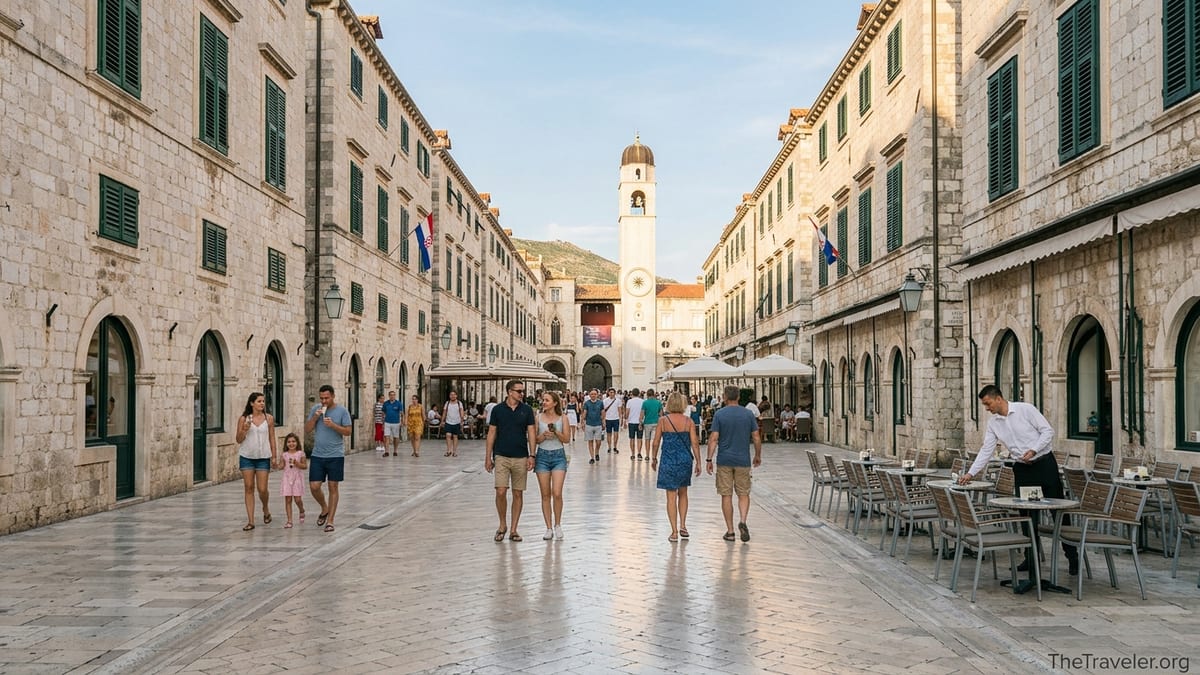
Stradun’s limestone surface is one of the reasons it feels unforgettable. The pale stone blocks have been burnished smooth over centuries, taking on a sheen that catches both sunlight and streetlamp glow. On a bright June morning you will see the reflections of bell towers and laundry lines flickering across the pavement. After a passing shower, the stones darken and turn almost mirror-like, creating the impression of walking through a film set, even though this is simply how the material responds to weather and time.
That polished texture affects behavior. People instinctively slow down, whether to avoid slipping in thin-soled sandals after a summer storm or simply to absorb the light bouncing up from the street. Couples often pause in the center line to frame photos where the limestone seems to stretch endlessly towards the Onofrio Fountain one way and the bell tower the other. Street sweepers move along in the early morning, washing and brushing the stones so that, by the time cafes open for breakfast, Stradun looks almost indoor-clean despite the thousands of shoes that will cross it that day.
There is also a psychological element to the way the street functions as a stage. Musicians set up at intervals along the length of Stradun, from a lone violinist playing Dalmatian folk songs near the Franciscan Monastery to a saxophone player closer to Luža Square in the evenings. Children chase pigeons in front of St Saviour Church, their footsteps echoing slightly between the facades. Even something as simple as carrying gelato from one end to the other becomes part of the continuous, shared performance of being in Dubrovnik on that particular day.
Daily Life Concentrated in One Walkable Spine
What makes Stradun feel like the Old Town’s heart is not only its beauty, but also how much daily life it compresses into a single, walkable line. Early in the morning, before the main tour groups arrive, you can watch shopkeepers lifting metal shutters, delivery workers wheeling crates of bottled water and produce into side alleys, and local residents slipping out with dogs on leashes. At this hour, you might grab a coffee at a Stradun-side cafe for around 2 to 3 euros and see more Croatian being spoken than English.
As the day builds, Stradun becomes a thoroughfare for visitors heading to specific sights. Guided walking tours inevitably pause by the Large Onofrio Fountain at the Pile Gate end, where travelers refill water bottles for free from the stone spouts. A few steps away, the Franciscan Monastery pharmacy, one of the oldest in Europe, draws small groups inside for a quick look at historic jars and remedies before they are ushered back to the street. At the opposite end, close to Luža Square, people peel off to visit Sponza Palace, the Church of St Blaise or the nearby cathedral, all accessed within a minute or two of stepping away from Stradun.
Food and shopping habits also revolve around the street. A simple espresso or macchiato at a table directly on Stradun generally costs more than at a cafe tucked into a side lane, and menus for light lunches such as salads, pastas or grilled fish typically start around 15 to 20 euros at the most central spots. Many visitors accept the markup for the front-row view, while budget-conscious travelers often do a first pass along Stradun to window-shop, then detour north to quieter streets like Prijeko for slightly gentler prices. Souvenir stands selling lavender sachets, olive wood boards and Game of Thrones-themed trinkets line the side alleys just off the main street, turning Stradun into the visual anchor for much of the Old Town’s commerce.
Where Landmarks Converge at Each End
Another reason Stradun feels like the Old Town’s heart is that so many of Dubrovnik’s emblematic landmarks cluster at its ends. At the western entrance, just beyond Pile Gate, the Large Onofrio Fountain acts as a natural gathering point. Travelers step through the gate, pause to orient themselves by the circular fountain and then funnel directly onto Stradun. The nearby Franciscan Monastery, with its cloister and historic pharmacy, anchors this end of the street with a sense of quiet antiquity that contrasts with the crowds flowing by outside its walls.
Walk east, and the experience shifts gradually from a processional walkway to a more ceremonial center around Luža Square. Here, the 15th century Sponza Palace stands opposite the Church of St Blaise, with the city bell tower rising beside them. Orlando’s Column, a slender stone pillar dating from the early 1400s, marks the symbolic civic center. When you stand in Luža Square and look back down Stradun, the line of sight runs directly to the Pile Gate, underscoring how the street is physically and visually aligned with Dubrovnik’s monumental architecture.
Many visitors use Stradun as a built-in orientation tool. If you have just walked the city walls, for example, you will notice that the path often gives you overhead views of Stradun’s entire length, making it an easy reference point whenever you descend into the narrower side streets. The fact that almost any detour, whether to the Dominican Monastery near the Ploče side or to small churches up stepped alleys to the north, seems to return you to Stradun reinforces its role as the Old Town’s navigational anchor.
The Social Rhythm: From Morning Coffee to Midnight Promenade
Stradun’s atmosphere changes noticeably as the day unfolds, giving it a pulse that locals recognize and visitors quickly tune into. In the morning, the street belongs to early risers, retirees chatting over coffee and a growing trickle of tour groups. By late morning in peak season, sunlight bounces hard off the stone and the central section can feel almost crowded wall to wall. Many residents time errands to avoid this window, opting for side streets instead.
In late afternoon, as the sun begins to sink and the stone cools, Stradun takes on a different energy. Families returning from the nearby city beach cross the street in flip-flops carrying wet towels and inflatable toys. Street performers might appear near the fountain or in front of St Blaise, drawing circles of onlookers. Cafes start to fill again as people stop for an aperitif; an Aperol spritz or glass of local white wine such as Pošip typically costs around 7 to 10 euros at a prime terrace table on the main drag.
Evenings are when Stradun most clearly feels like Dubrovnik’s living room. Residents and visitors alike participate in the traditional evening promenade, strolling up and down the street in smart-casual clothes, greeting friends and people-watching. The soundscape shifts from daytime chatter to a softer blend of clinking glasses, distant live music and conversations in multiple languages. Around 10 or 11 pm in summer, when the cruise crowds have largely departed and the heat has lifted, you may have some sections almost to yourself, enjoying the reflections of lamplight on the still-busy but calmer stones.
Festivals, Fireworks and Public Rituals
Stradun’s role as the heart of the Old Town is most obvious when Dubrovnik gathers for collective events. During the Dubrovnik Summer Festival, usually held in July and August, the street turns into an open-air corridor connecting performance venues. You might leave a classical concert at the Rector’s Palace and find actors in costume spilling onto Stradun, or stumble upon a small choral performance echoing off the stone facades near Luža Square. The street becomes not just a route between events but an informal stage in its own right.
On major holidays and civic occasions, Stradun hosts processions that tie present-day Dubrovnik to its historic rituals. For the Feast of St Blaise in early February, banners and relics are carried along the street while locals watch from windows or lean out from the shallow stone thresholds that front many buildings. Around New Year, temporary stages and lighting rigs appear, and crowds pack the central section of Stradun to hear live music and count down to midnight, with fireworks bursting above the city walls.
Sporting celebrations and public gatherings also gravitate here. When Croatia plays in major football tournaments, big screens sometimes appear in or near the Old Town, and fans flood onto Stradun after important victories, flags draped over shoulders, car horns sounding from outside the walls. These moments underline that the street is more than a scenic backdrop; it is where shared emotions in Dubrovnik naturally spill into view.
Stradun as a Gateway, Not Just a Destination
For visitors, one of Stradun’s most practical roles is that of a gateway to different layers of Dubrovnik life. While the main street certainly holds its share of souvenir shops and higher-priced cafes, it is also the jumping-off point for discovering quieter corners. Step north up any of the steep side lanes and within a minute or two you may find yourself in a residential pocket where laundry hangs between windows and small cats sleep on stone steps. Prices in bars and eateries here are often a few euros lower for the same glass of wine or plate of grilled vegetables.
Head south from Stradun and, in a short walk, you can be at the base of the city walls or descending towards the harbor. Many visitors use a simple strategy: walk the length of Stradun once to get a sense of orientation and atmosphere, then deliberately choose a side street at random to see where it leads. Even during the busiest weeks in July and August, when accommodation and restaurant prices inside the walls are at their highest, it is possible to leave the crush behind by stepping just a block or two away from the main artery.
At the same time, Stradun frames expectations about cost and value. A coffee and pastry at a bakery just off the street might total around 5 to 7 euros, while a full sit-down breakfast with eggs or pancakes at a Stradun-facing restaurant can run closer to 15 euros per person. Travelers on tighter budgets often stay in apartments or guesthouses outside the Old Town and treat Stradun as their daily entry ritual: walk in from Gruž or Lapad, pass through Pile Gate, stroll the length of the street to soak up the ambiance, then head elsewhere for main meals and shopping.
The Takeaway
Stradun feels like the heart of Dubrovnik’s Old Town because, in many ways, it is where the city’s story comes together. The street exists thanks to a filled-in sea channel that turned scattered settlements into a unified town. Its smooth limestone surface, standardized facades and balanced proportions reflect centuries of urban planning, disaster and rebuilding. Every day, it carries residents on errands, guides first-time visitors to major sights, and hosts everything from casual evening strolls to solemn processions and New Year fireworks.
For travelers, walking Stradun is less about ticking off a landmark and more about experiencing how a historic city organizes itself in real time. You see how daily life adapts to seasonal crowds, how local routines intersect with global tourism, and how architecture and stone still shape movement and mood. Whether you spend ten minutes or several hours there, Stradun offers a clear sense of place that grounds the rest of your visit. Step away to explore side streets, climb the walls or swim in the Adriatic, but you will almost certainly find yourself drawn back to this polished strip of limestone at least once more before you leave.
FAQ
Q1. What exactly is Stradun, and how long is it?
Stradun, also known as Placa, is the main pedestrian street running through Dubrovnik’s Old Town, stretching for roughly 300 meters between Pile Gate and the Luža Square area near Ploče Gate.
Q2. Do I have to pay to walk along Stradun or enter the Old Town?
There is no fee to enter Dubrovnik’s Old Town or to walk along Stradun. You pay only for specific attractions, such as the city walls or certain museums.
Q3. When is the best time of day to visit Stradun?
Early morning and later evening are usually the most enjoyable times. Mornings tend to be quieter and cooler, while evenings offer a lively promenade atmosphere without the harsh midday sun.
Q4. Are food and drinks on Stradun very expensive?
Prices are generally higher on Stradun than on nearby side streets. Expect to pay around 2 to 3 euros for a basic coffee and 7 to 10 euros for a spritz or glass of wine at a central terrace, with full meals typically higher than a block or two away.
Q5. Is the polished stone on Stradun slippery?
The limestone paving can feel slick, especially after rain or when you wear smooth-soled shoes. Walking at a comfortable pace and choosing footwear with some grip is usually enough to stay steady.
Q6. What are the main sights I can reach from Stradun?
From Stradun you are within a few minutes’ walk of the Large Onofrio Fountain, the Franciscan Monastery, Sponza Palace, the Church of St Blaise, the cathedral, Luža Square and several entrances to the city walls.
Q7. Is Stradun still used by locals or only tourists?
Stradun is very popular with visitors, but locals still use it for everyday errands, socializing, festivals and processions, particularly outside the busiest midday hours in peak season.
Q8. How crowded does Stradun get in summer?
In July and August, especially when multiple cruise ships are in port, Stradun can feel very crowded from late morning through mid-afternoon. Many travelers choose early starts, midday breaks or off-season visits to experience it more comfortably.
Q9. Can I find more affordable places to eat and drink near Stradun?
Yes. Prices generally drop once you step into side streets north or south of Stradun, where you will find smaller konobas, wine bars and bakeries that offer better value while still being very close to the main street.
Q10. How much time should I plan to spend on Stradun during a visit?
Walking the full length takes only about 10 minutes, but most visitors spend at least an hour or two, especially if they stop for coffee, photos or visits to nearby sights, and many return several times over the course of their stay.