


Before that one evening on Stradun, I thought I already knew Dubrovnik. I had walked the walls in the heat, shuffled through cruise-ship crowds, paid too much for an indifferent coffee, and quietly filed the Old Town away as “beautiful but overrun.” Then the light softened, the day-trippers disappeared, and a few simple hours along the city’s shining main street changed everything I thought I understood about Dubrovnik.
Get the latest updates straight to your inbox!
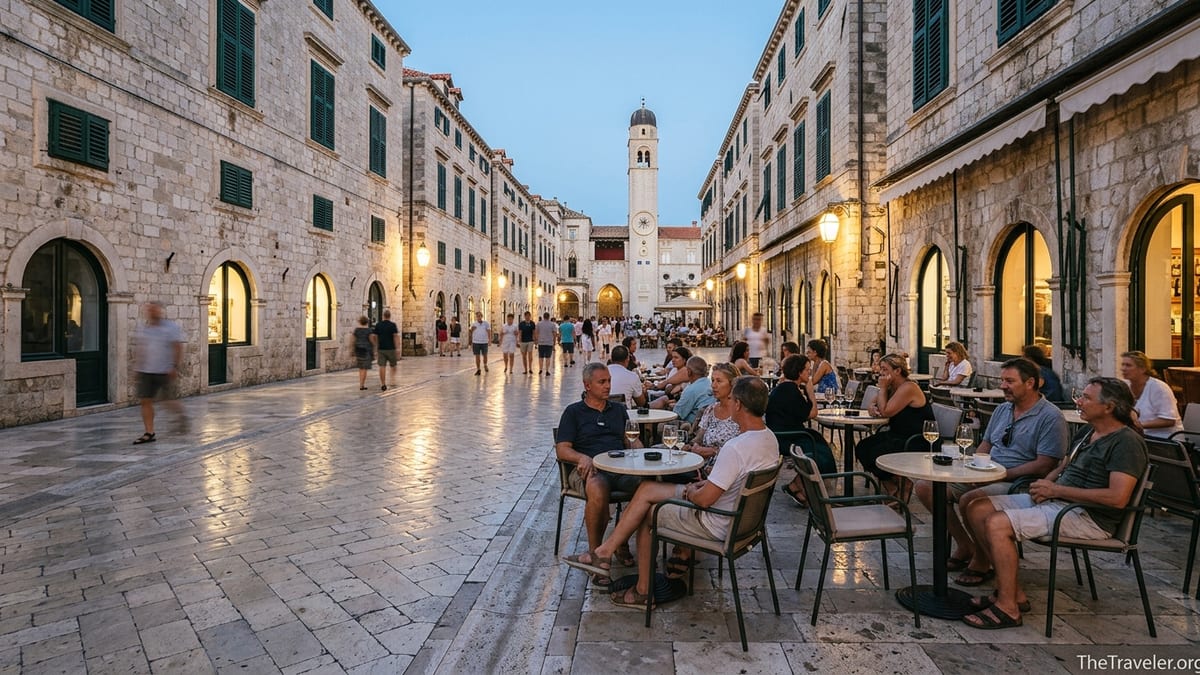
Meeting Stradun After the Crowds Go Home
Stradun, also known as Placa, is the 300-meter limestone spine of Dubrovnik’s Old Town, a polished marble corridor framed by baroque façades and stone shutters. By mid-morning in high season, it turns into a moving river of tour groups and day-trippers. I had only seen it like that: loud, glossy, and slightly exhausting. The turning point came when I returned around 7:30 in the evening in late September, just after the last cruise tenders had taken their passengers back to the ships anchored off Lokrum Island.
The difference was almost shocking. The same stones that had felt like a transit corridor all afternoon suddenly looked like a living room rug, softly reflecting the peach light lingering on the bell tower of the Franciscan Monastery at the Pile Gate end. A couple of local kids chased a football across the square in front of the Sponza Palace. A shopkeeper leaned in his doorway, chatting in Croatian with a friend. I realized that for the first time that day, I was hearing the city instead of the crowd: footsteps on stone, cutlery on plates, a snatch of Dalmatian pop from an apartment window.
Standing halfway down Stradun, I could finally appreciate the symmetry of the street. It began as a marshy channel that once separated the island settlement of Ragusa from the mainland, later filled and paved into a grand promenade. In the evening calm, it was easy to imagine merchants walking this same line centuries ago, closing wooden shutters and sweeping stone thresholds at the end of the trading day. That sense of continuity simply does not register when you are shoulder to shoulder with hundreds of strangers clutching audio guides.
That evening I walked Stradun from the Pile Gate to Luža Square and back again, not with an objective, but at the slow pace of someone visiting a friend’s neighborhood. Without the push of people behind me, I started noticing tiny details I had missed: an almost invisible groove worn into a step by centuries of passing boots, a sculpted saint over a doorway, a laundry line strung precariously high between two upper stories. Dubrovnik stopped being a medieval theme park and started being a place where people actually live.
Finding a Seat and Letting the Street Perform
The second shift in perception came when I stopped treating Stradun as something to walk and started treating it as something to watch. I slid into a table at Café Festival, one of the classic terraces facing the street near the center of the promenade, where locals recommend coming for morning sun but where the evening light is equally flattering. A glass of local Pošip white wine cost around 7 to 8 euros, more than I might pay elsewhere in Croatia, but that night it felt like a ticket to the best show in town.
From my chair I could see almost the entire length of Stradun. Families from nearby Lapad strolled in slowly, pushing prams. An older couple, clearly locals by the fluent nods they exchanged, claimed their usual table and ordered espresso even at that late hour. A group of young Croatians in work clothes appeared, likely staff from the restaurants in the side streets taking a quick break. None of them were rushing. It felt like the city had taken a deep breath after a long performative day and now, finally, relaxed into itself.
One thing that becomes clear when you linger on Stradun in the evening is that price and value are not the same thing. Yes, a coffee might be 4 or 5 euros where it would be half that in a side street or outside the walls. But you are paying, quite literally, for your front-row seat on centuries of history. After half an hour, I stopped mentally converting kuna to euros and started noticing how the limestone under my feet glowed almost silver as the streetlights came on.
Later I moved further along to Cele, the historic café and lounge bar near the Luža Square end of Stradun. Its terrace, frequently captured on postcards, fills with a mix of tourists and locals drawn by the people-watching. By then the sky over the bell tower had turned a deep cobalt. A live DJ set blended in with the murmur of conversation, and a Negroni cost roughly 12 euros, again not cheap, but the view was priceless: the polished street now mirroring the warm light spilling from shopfronts and the movement of passing silhouettes.
Stepping Off Stradun into Shadowed Alleys
The biggest surprise of that evening was how much Stradun taught me about the rest of the Old Town. Take a few steps away from the marble and you quickly enter a different Dubrovnik. From Luža Square, I ducked into a narrow side alley toward Uska Ulica and found Soul Caffe, an intimate bar tucked away just far enough from Stradun that the constant hum fell away. The terrace there is wedged between stone walls, lit by candles and strings of warm bulbs, and a carefully made espresso was closer to 3 euros instead of the higher prices on the main drag.
Sitting in that quiet alley, I realized that Stradun is less a destination and more a reference point. Bars like Buzz Bar, on a narrow street running off the main promenade, and spots near Petilovrijenci Street such as Mama’s Urban Street Food show another side of the city. Here, prices drop a little, menus become more relaxed, and the clientele shifts from tour groups to hospitality workers finishing a shift and young locals meeting for a drink. You are still only a minute or two’s walk from the shining marble boulevard, but the mood changes completely.
This contrast helped me reframe the constant complaint I had heard about Dubrovnik being “too touristy.” Yes, there is plenty of that on Stradun: souvenir shops selling the same magnets and ceramic cats, restaurants with laminated multilingual menus, and photo tours queueing beneath street lamps. Yet just one or two alleys away you can find a different rhythm entirely, where people linger over a beer, talk politics, or watch a football match projected onto a courtyard wall.
It also underscored the importance of timing. In the peak of a July afternoon, even the side streets can feel overwhelmed, but on this September evening, they had the feel of a small town’s back lanes. An elderly woman watered potted plants on her windowsill. A black cat threaded its way around chair legs. Somewhere above, a television news broadcast drifted out of an open window. the city was no longer a set piece, but a series of overlapping lives.
Looking Back at Stradun from Above
Earlier that same day I had walked the city walls, following the 2-kilometer circuit that crowns Dubrovnik’s fortifications. Tickets now cost around 35 euros for adults, a steep price that has become a recurring topic of debate, but the views are difficult to argue with. From the Minceta Tower, the highest point, Stradun appears as a pale ribbon slicing through a tightly packed sea of terracotta roofs, stretching from the Pile Gate to the bell tower and the old harbor.
At midday the street had looked like a theme-park parade from that vantage point, dense with umbrellas and slow-moving groups. But as evening fell and I revisited the same stretch of wall near the Ploče Gate, the scene below transformed. The marble was still faintly warm from the day, and the crowd had dissolved into small clusters of people: a wedding party taking photos, a solo traveler framing the bell tower in their phone, two teenagers sharing an ice cream near Onofrio’s Fountain.
Being up there at dusk also helped me understand why Stradun feels so different at night. The stone buildings that frame it act like a canyon, blocking the harshest midday sun but trapping heat and sound. In the cooler air of evening, voices soften and the breeze from the Adriatic drifts across the rooftops. You can see small details from above that you do not notice down on the marble: rooftop terraces with a single table and two chairs, laundry lines strung with white shirts, and tiny satellite dishes mounted on centuries-old stone.
When the streetlights flickered on, stripes of golden light cut across Stradun at regular intervals, creating alternating pools of brightness and shadow. Watching from above, I felt as though I were seeing the Old Town reset itself. Shopkeepers stacked last displays, waiters pulled in outdoor menus, and one by one, shuttered windows glowed as families sat down to dinner. The city walls ticket felt less like an expensive tourist obligation and more like a backstage pass to observe the city’s changing moods.
Reconciling Overtourism with Real Life
Before that evening, it was easy to reduce Dubrovnik to a cautionary tale of overtourism. High-season statistics suggest that the Old Town sees many more visitors per resident than almost anywhere else in Europe, and conversations along Stradun often revolve around price shock: 10-euro gelato, 15-euro cocktails, and restaurant bills that rival those in major Western European capitals. In the heat and crowds, it is tempting to experience the city only as a marketplace.
On my evening walk, the narrative grew more complicated. Near St. Blaise’s Church, I saw a group of local teenagers sharing a single pizza on the church steps, clearly using Stradun the way teenagers use any central square anywhere: as a stage to see and be seen. A municipal worker in an orange vest methodically swept the marble, removing the day’s detritus of coffee cups and receipts. A woman carrying grocery bags emerged from a side door I had previously assumed belonged only to a rental apartment.
All of this drove home the point that even in a city saturated with visitors, life continues in the margins and the off-hours. The same family that rents a room to tourists might be racing their kids to school along Stradun at eight in the morning. The waiter who serves a 70-euro seafood platter at lunchtime might sit on those same stones after midnight, smoking with friends and scrolling through his phone. My evening on Stradun reminded me that tourism and local life are not separate layers; they are interwoven, sometimes uncomfortably, but constantly.
It also changed how I felt about spending money in such a popular place. Paying a premium for a drink at a long-established café on Stradun can feel exploitative if you think only in terms of your individual bill. But seen through the lens of that evening, some of those euros were supporting bar staff, musicians, cleaners, and the maintenance of historic buildings. The key, I realized, is balance: have the one or two “view drinks” on Stradun that give you this perspective, then seek more modestly priced dinners in backstreets or in neighborhoods like Lapad or Gruž where local life dominates.
Practical Ways to Experience Your Own Evening on Stradun
That evening did more than just soften my feelings toward Dubrovnik; it reshaped how I would advise anyone to plan their time in the city. If you only have one full day, consider flipping the typical script. Instead of entering the Old Town at ten in the morning with everyone else, start early with the city walls at opening time, then retreat to the beaches or to Mount Srđ during the hottest, busiest hours. Save Stradun itself for late afternoon and evening, when the cruise crowds thin and the stones begin to glow.
A simple, grounded plan might look like this. Arrive at Pile Gate around 5:30 p.m. and walk the length of Stradun once, just to get your bearings. Peek into the side alleys, but resist the urge to sit down right away. Continue to the old harbor at the far end, watch small boats shuttling in and out, then wander back along the street and choose a café terrace that feels comfortable. At a place like Café Festival or Cele, expect to pay around 4 to 5 euros for espresso and 7 to 10 euros for a glass of wine or an Aperol spritz. Allow yourself at least half an hour to simply sit and observe.
Afterward, step away from Stradun for dinner. A few minutes’ walk up a flight of stairs might lead you to a quieter konoba where a plate of grilled fish or pasta with local mussels costs closer to what you would pay elsewhere along the Dalmatian coast. If you prefer something casual, head towards Petilovrijenci Street near the Pile Gate end, where places like Mama’s Urban Street Food serve burgers and seafood in a more relaxed setting, often at slightly gentler prices than the main drag.
Finally, consider returning to Stradun once more after dinner, around 10 p.m. The street will be darker, the stone now reflecting the warm glow of lanterns and restaurant lights. Musicians sometimes set up near Onofrio’s Fountain, and groups gather for night tours or ghost walks. Even if you do not join them, the atmosphere is infectious. Walk its length one last time and pay attention to how different it feels from that first afternoon impression. That contrast, more than any single sight, is what changed how I saw Dubrovnik.
The Takeaway
One evening on Stradun did not magically erase the challenges Dubrovnik faces, from overtourism to rising prices and the pressure on local residents. What it did was restore a sense of proportion. It reminded me that even the most photographed destinations can still surprise you, that timing and perspective matter as much as any guidebook list, and that cities live most vividly in the in-between hours when the stage lights dim.
If your first reaction to Dubrovnik is frustration at the crowds, give it another chance at dusk. Find a table, order a drink even if it stretches your budget a little, and let Stradun perform for you. Watch how the street fills with local families, off-duty staff, and slower-moving visitors. Notice how the marble changes color, how the soundscape softens, how the shadows deepen in the alleys. In those details, you may find, as I did, a more generous view of the city and of your own role as a traveler within it.
In the end, Stradun taught me that places are rarely just one thing. Dubrovnik can be a postcard and a home, a cruise stop and a community, a crowded stage and a quiet backdrop. To see it clearly, you might only need one well-timed evening walk along a luminous strip of stone, listening as the city finally speaks in its own voice.
FAQ
Q1. What is the best time of day to walk along Stradun?
The most rewarding time is early evening, roughly between 6 p.m. and 9 p.m., when cruise-ship crowds thin, temperatures drop, and the marble street begins to glow under softer light.
Q2. Are cafés on Stradun really more expensive than in other parts of Dubrovnik?
Yes, prices on Stradun are typically higher. Expect to pay around 4 to 5 euros for coffee and 7 to 12 euros for wine or cocktails, compared with noticeably lower prices in side streets or neighborhoods like Lapad.
Q3. Is it worth paying extra to sit at a terrace directly on Stradun?
For at least one drink, many travelers find it worthwhile. You are paying for a front-row seat on the city’s main stage, with superb people-watching and views of historic façades and the bell tower.
Q4. How can I avoid the biggest crowds on Stradun?
Arrive early in the morning or in the early evening. Midday, especially when multiple cruise ships are in port, is the busiest time. Checking ship schedules and planning around them can make a noticeable difference.
Q5. Are there quieter places to eat and drink close to Stradun?
Yes. Step into nearby alleys toward streets like Uska Ulica or Petilovrijenci, where bars and small restaurants such as Soul Caffe or casual street-food spots offer a calmer atmosphere and often gentler prices.
Q6. Can I combine an evening on Stradun with walking the city walls?
Many visitors walk the walls in the morning, when they open and temperatures are lower, then return to Stradun in the late afternoon or evening. This combination offers strikingly different views of the same historic core.
Q7. Is Stradun suitable for travelers with limited mobility?
Stradun itself is flat and fully pedestrianized, paved with smooth stone, so it is one of the more accessible parts of the Old Town. Be aware that many side streets involve stairs, and the polished surface can be slippery when wet.
Q8. Do locals still use Stradun, or is it only for tourists?
Despite heavy tourism, locals still use Stradun as their main promenade, especially in the evenings. You will see families with children, teenagers meeting friends, and hospitality workers finishing shifts alongside visitors.
Q9. What should I budget for an evening out on and around Stradun?
A realistic budget for one drink on Stradun plus dinner on a nearby side street might be 30 to 50 euros per person, depending on your choice of restaurant and whether you add dessert or an additional drink.
Q10. Is it safe to walk Stradun late at night?
Dubrovnik’s Old Town is generally considered safe, and Stradun remains well lit and patrolled late into the night. As in any busy destination, keep an eye on your belongings, but most visitors feel comfortable strolling until closing time of nearby bars and cafés.