


From a distance, Stradun looks like the kind of street seasoned travelers learn to avoid. It is the shining limestone catwalk that slices through Dubrovnik’s medieval Old Town, lined with café terraces, gelato stands and souvenir shops. On a busy afternoon in July, cruise passengers and tour groups can turn it into a moving river of sunhats and selfie sticks. It is easy to assume this is just another overpriced, over-photographed tourist strip. I arrived expecting to walk it once and spend the rest of my time in side alleys. Instead, Stradun quietly upended my assumptions.
Get the latest updates straight to your inbox!
First Impressions: A Polished Stage for Tourists
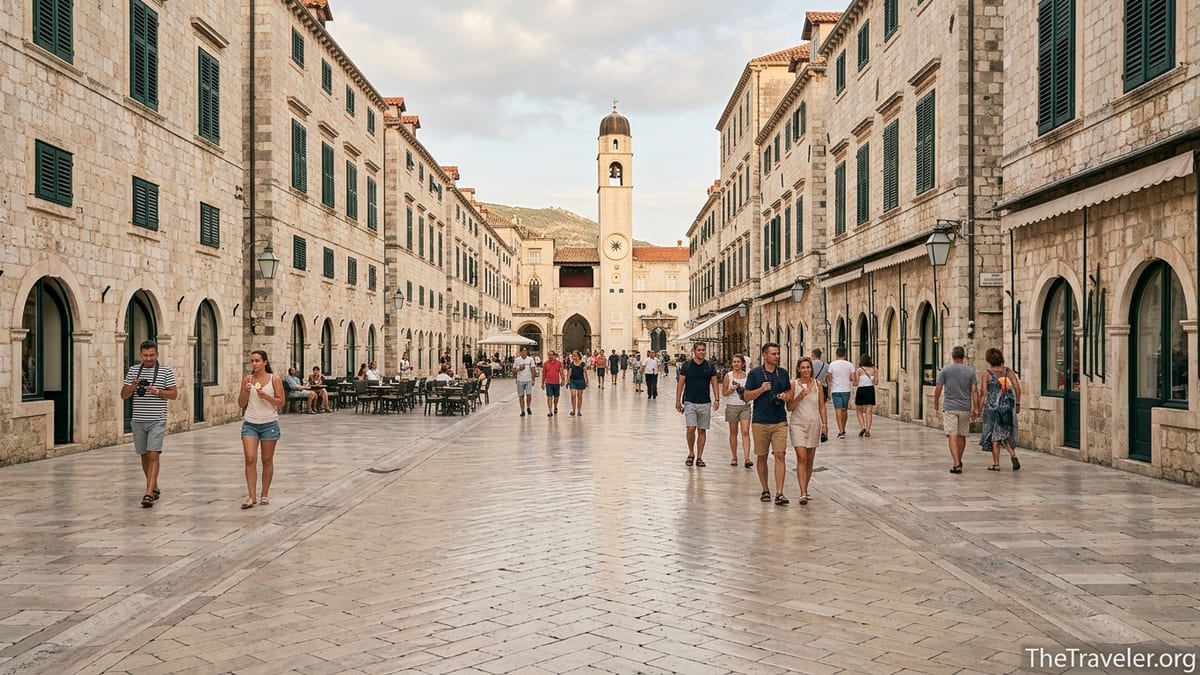
Most people meet Stradun for the first time the same way I did: stepping through Pile Gate and blinking into the light. The street unfolds in front of you in a perfectly straight line, about 300 meters of pale stone running toward the bell towers and arches of Luža Square. The limestone is so polished by centuries of footsteps that in late afternoon it can shine like glass. Cafés and ice cream counters spill onto the street, menus in multiple languages advertise seafood platters, and shop windows display magnets, lavender sachets and Game of Thrones trinkets. At first glance, it looks like a textbook example of a city that has given itself over to tourism.
Prices do little to challenge that first impression. A basic espresso at one of the most prominent terraces can hover around 3 to 4 euros, while a simple beer or spritz often sits closer to 6 to 8 euros, noticeably higher than similar drinks in less famous Croatian towns. A quick look at a menu on the main drag one evening showed seafood risottos approaching 30 euros and cocktails that would not be out of place in central London. Add in the crowds that swell when one or two large cruise ships disembark, and Stradun can feel like a corridor engineered for short visits and quick spending.
It is understandable that many travelers arrive armed with advice to avoid eating here, to dart down side streets for better value, and to treat Stradun as a pretty but hollow backdrop. Yet that view only captures one layer. Stradun turned out to be the axis around which my understanding of Dubrovnik shifted, precisely because the street is used by so many different kinds of people for so many different purposes.
The turning point came when I stopped seeing Stradun as a destination and started treating it as a living thoroughfare. Walking it at different times of day, watching who used it and how, and slipping into the spaces attached to it revealed a street that still belongs to Dubrovnik as much as it does to anyone passing through with a camera.
A Short History Beneath the Limestone
Before Stradun became the polished promenade it is today, it was water. The street follows the line of a channel that once separated the island settlement of Ragusa from the mainland. Over time, that channel was filled in, and the city grew around this new, level artery. The official name, Placa, appears in old city statutes, while the more common name Stradun comes from Venetian roots meaning “big street” or “wide road.” It has been Dubrovnik’s spine for centuries, and almost every major chapter in the city’s history has left a mark along its length.
The uniform facades you see today are not accidental. Much of Dubrovnik was devastated by a massive earthquake in 1667. When the city rebuilt, regulations encouraged a more consistent architectural style: stone townhouses with almost identical widths and heights, shuttered windows and simple shopfronts at ground level. Walk Stradun now and you see a repeated rhythm of arches, doorways and upper stories that turns the whole street into an elegant stone canyon. At night, when warm light spills from the arches and reflects on the paving, it is one of the most atmospheric urban scenes in Europe, regardless of how many souvenir stands it hosts.
History here is tangible in small, practical details. Near the western end, just inside Pile Gate, stands the Large Onofrio Fountain, a 15th-century structure that once brought fresh water into the city. Today the carved stone spouts are still running, and locals remind visitors that Dubrovnik’s tap water is safe to drink. Watching cruise passengers refill their bottles under the same domed fountain that once supplied water during sieges gives Stradun a different weight. Even the most hurried day-tripper, whether they realise it or not, is using the same urban infrastructure that kept a maritime republic alive.
At the eastern end, the street opens toward Luža Square, the baroque Church of St. Blaise, Sponza Palace and the clock tower. In between are plaques and subtle memorials to the shelling the Old Town endured in the early 1990s. If you look up instead of at the menus, the stonework still tells a story of a city that has been damaged and repaired repeatedly yet kept its core layout intact.
Moments When Stradun Belongs to the Locals
Stradun’s reputation is largely shaped by the busiest hours. Visit around 11 a.m. on a day when two large cruise ships are in port and you will edge forward shoulder to shoulder. Tour guides raise colored umbrellas, groups stop abruptly to take photos, and queues form for gelato and takeaway pizza. But the same street at 7 a.m. is markedly different. On a spring morning, I watched a city still waking up: cafe workers hosing down the paving stones, delivery staff wheeling crates of soft drinks and pastries through side doors, and residents walking their dogs at a brisk pace before the heat and crowds set in.
Early morning also reveals one of Stradun’s most compelling details: the sound. Without the hum of tourist chatter and rolling suitcases, you can hear the echo of footsteps on stone and the occasional church bell cascading through the canyon of buildings. I passed an elderly man sitting alone on a bench near Onofrio’s Fountain, reading a newspaper, as a pair of teenagers in school uniforms cut across the street to vanish into an alley. For those few minutes, it felt like any small European city starting its day, tourism simply one layer among others.
Evening brings another shift. After sunset, day-trippers head back to buses at Pile Gate or to the cruise terminal at Gruž. Terraces fill again, but now with a slower, more local rhythm. Families stroll up and down, children chasing each other on the smooth paving. On a Thursday night in late September, I noticed groups of friends using Stradun as a meeting point before disappearing into side-street wine bars. When a light rain fell, the limestone turned mirror-slick, reflecting the yellow glow of street lamps and umbrellas. Stradun finally looked like the romantic image in travel brochures, but populated mostly by people who knew exactly where they were going.
Certain events underscore how central this street remains to local life. In December and January, the Dubrovnik Winter Festival decorates the Old Town with lights and stalls, and Stradun hosts concerts and performances. During the Feast of St. Blaise in early February, processions and ceremonies pass through the street, the same stones supporting religious and civic life that once celebrated Dubrovnik’s days as a republic. Even if you visit outside those dates, photographs and posters in shop windows hint at a calendar of events that belong more to residents than to the tourist economy.
Beyond Souvenirs: What to Actually Do on Stradun
Approaching Stradun as a thoroughfare rather than a shopping mall changes how you spend time here. One of the most rewarding stops is almost hidden in plain sight: the Franciscan Monastery and its historic pharmacy, tucked just inside Pile Gate on the northern side of the street. The entrance door is easy to miss between ice cream counters and tour groups, but step inside and the noise drops away. For a modest ticket fee, often under 10 euros, you can wander a peaceful 14th-century cloister and a small museum that displays centuries-old pharmaceutical jars and instruments. The adjacent pharmacy still operates as a working chemist for locals, reportedly one of the oldest in Europe.
Back outside, the simplest and best free activity on Stradun is people-watching. Sit on the low stone benches near Onofrio’s Fountain with a takeaway coffee from a side-street café that charges closer to 2 euros instead of the higher terrace rates. Across from you, you might see a walking tour in English pass a group in Italian, behind them a wedding party hurrying toward the Rector’s Palace for photographs, and a delivery cart stacked with crates negotiating the gaps. The street operates as an open-air theatre where daily logistics and tourism choreography intertwine.
Just off the main drag, a few minutes’ detour can lead to more grounded experiences. Turn north between the uniform facades and you quickly encounter stairs, laundry lines and tiny bars with a handful of tables. One afternoon, I swapped a 7-euro beer on Stradun for a perfectly good 4-euro draft in a quiet alley where a local football match played on television and the bartender chatted about the new booking system planned for the city walls. To the south, narrow streets slope down toward the old harbor, where casual bakeries sell slices of burek or simple sandwiches for a fraction of restaurant prices on the main street.
Stradun is also the most practical orientation tool you have. Almost everything a first-time visitor wants to see in the Old Town lies at one end of it or just a short detour away: the city walls entrances, the old harbor, Sponza Palace, the Church of St. Blaise, and the cable car station a short walk beyond Ploče Gate uphill. Returning to Stradun between explorations gives you a clear reference point, and after half a day you can navigate by instinct rather than constantly checking a map.
How Stradun Shapes a Day in Dubrovnik
Most visitors, especially those arriving on cruise ships, have limited time in Dubrovnik. The temptation is to treat Stradun as something to “do” in ten minutes on the way between the city walls and the harbor. Yet the street is such an efficient spine that planning your entire day around walking it slowly can actually reduce stress. Think of a typical summer day with a ship in port for eight hours. Many guides suggest heading straight to the city walls soon after opening, when temperatures are lower. Tickets for the walls currently hover around 40 euros for adults, and there are now firm hints that from 2026 access will require advance booking to manage crowds.
After a one-and-a-half- to two-hour circuit on the walls, most visitors descend near Pile Gate and naturally spill onto Stradun. Instead of joining the first large group following a flag, you can turn this into a decompression stroll: refill your bottle at Onofrio’s Fountain, step into the shade of the Franciscan cloister, then walk halfway down the street and escape briefly into a side alley café where prices and noise levels are gentler. By seeing Stradun as a sequence of small experiences rather than a single attraction, you give your day a rhythm that alternates between intensity and calm.
In the afternoon, when the sun sits high and Stradun’s reflective stones amplify the heat, the street becomes useful again as a corridor leading you quietly out of the busiest zone. From the eastern end, you are just a few minutes’ walk from the old harbor and the small ferry pier for Lokrum Island. Many travelers use the hottest part of the day for a swim and shade on Lokrum, returning around 4 p.m. when the light softens. Walking back up Stradun at that hour, the crowds begin to thin, and you can appreciate details you missed earlier: carved coats of arms above doorways, tiny niches with saints, and the way the street subtly rises then descends along its length.
As evening approaches, Stradun is again the natural route back toward accommodation or transport. Buses and taxis cluster outside Pile Gate, and ride-hailing apps like Uber and Bolt, increasingly popular here, often pick up nearby. Because private cars are restricted inside the Old Town, everyone funnels through the same portals, which means you will almost certainly end and begin your day on this street. Accepting that, instead of fighting it, makes the whole experience smoother.
Costs, Crowds and How to Use the Street Wisely
No honest description of Stradun can ignore its role in Dubrovnik’s debate over crowds and costs. Visitors frequently remark that prices here feel “double” what they pay in other parts of Croatia, and while that is an exaggeration, the difference is real. A simple scoop of gelato that may cost 1.50 to 2 euros in a coastal town further north can push over 3 euros here, especially at the most central counters. A sit-down coffee on Stradun will almost always cost more than the same coffee one block away. This is the price of real estate measured in Instagram posts.
The good news is that the street is only a few steps wide in practical terms. Slide into an alley on either side and prices usually drop by 20 to 40 percent. In one case, I compared menus: a margherita pizza listed at 16 euros on Stradun versus 11 euros on a shaded terrace a one-minute walk away. Beer that cost 7 euros on the main drag was 5 euros at a bar reachable in less than 60 seconds. The lesson is not to avoid Stradun entirely, but to use it as a route while eating and drinking one or two streets removed whenever possible.
Crowd management is an evolving story. Years of international coverage about overtourism pushed Dubrovnik’s authorities to limit cruise ship numbers and daily passenger caps in the Old Town. Recent seasons have seen tighter control: generally no more than two large ships at anchor at once, and efforts to spread arrivals across the day. Local initiatives branded under slogans like “Respect the City” aim to protect residents’ quality of life. These measures do not eliminate crowds, but they make Stradun on a typical morning in June more manageable than it was at the height of Dubrovnik’s Game of Thrones fame.
For visitors, timing is everything. Stradun feels very different before 9 a.m., between roughly 1 p.m. and 3 p.m. when some cruise passengers retreat to ships or beaches, and after 7 p.m. when many day-trippers have gone. A simple strategy is to walk the street in full at least three times: early morning, mid-afternoon and late evening. You will see three almost separate cities layered on the same polished stones.
Local etiquette also matters. Noise from wheeled suitcases over limestone has become enough of a concern that city authorities have floated bans and restrictions within the Old Town. Even where not strictly enforced, it is considerate to carry or roll luggage quietly, especially early or late. Dress codes around religious sites just off Stradun are conservative, and basics like not sitting on church steps to eat takeaway pizza or blocking narrow alleys for photos go a long way to keeping tensions low between visitors and residents.
The Takeaway
My early notes from Dubrovnik include a line that now makes me wince: “Stradun = tourist trap, get in and out quickly.” It was written after a first hot walk amid crowds and overpriced ice cream. By the time I left, that sentence felt not just unfair but inaccurate. Stradun is where Dubrovnik introduces itself to the world, and like any well-used public stage it can feel commercial and crowded. Yet underneath the souvenir stands and sunset cocktails, it still does what it has always done: connect gates to harbor, churches to palaces, locals to one another.
Spend a day using Stradun rather than skimming past it and you will see those layers. You will watch schoolchildren weave through tour groups, priests cross from one side to the other in the shadow of the clock tower, and elderly residents sitting on benches greeting friends by name as visitors stream by. You might refill your bottle at a Renaissance fountain, buy headache tablets in a 14th-century pharmacy, then slip down an alley to a bar that has nothing to do with Instagram.
Many famous streets in Europe have turned almost entirely into outdoor malls. Stradun comes close in places, and you will pay for the privilege of a table with a front-row view. But for all its gloss, it remains anchored in a city that is trying, imperfectly, to balance daily life with global attention. If you give it more than a cursory walk, Stradun has a way of reminding you that even the most photographed streets can still be used and loved by the people who live on them.
FAQ
Q1. Is Stradun in Dubrovnik worth visiting if I usually avoid touristy streets?
Yes. While Stradun is busy and often expensive, it is also the historical spine of Dubrovnik’s Old Town, lined with major landmarks, local meeting spots and access points to quieter side streets.
Q2. What is the best time of day to walk Stradun?
Early morning before 9 a.m. and evenings after about 7 p.m. are ideal, when cruise crowds thin, temperatures drop slightly and the atmosphere feels more local.
Q3. Are food and drinks on Stradun really more expensive than elsewhere in Dubrovnik?
Generally yes. Expect higher prices on the main street, especially for sit-down drinks. Stepping one or two streets away usually brings noticeably lower prices for similar items.
Q4. Can I drink the tap water from Onofrio’s Fountain on Stradun?
Tap water in Dubrovnik is considered safe to drink, and many visitors refill their bottles at Onofrio’s Fountain, which still serves as a public water source.
Q5. How long does it take to walk Stradun from end to end?
Walking the roughly 300-meter length without stopping takes only a few minutes, but allowing 20 to 40 minutes lets you enjoy the architecture and observe daily life.
Q6. Is Stradun accessible for travelers with limited mobility?
Stradun itself is flat and step-free, paved with smooth limestone. However, many side streets are steep and stepped, so it helps to plan routes that stay close to the main promenade.
Q7. Are there any genuinely local places left on or just off Stradun?
Yes. While many businesses cater to tourists, you will still find long-established pharmacies, bakeries, small bars and everyday shops in the streets immediately off Stradun.
Q8. How does Stradun connect to other major sights in Dubrovnik?
Stradun links Pile Gate in the west with the eastern end of the Old Town, putting you within a short walk of the city walls entrances, old harbor, Sponza Palace and key churches.
Q9. Is it safe to be on Stradun at night?
Stradun is generally busy and feels safe in the evening, with families strolling and terraces open late, though standard city precautions with valuables still apply.
Q10. How can I experience Stradun without feeling overwhelmed by crowds?
Visit early or late in the day, duck frequently into side alleys for breaks, avoid eating on the main drag, and treat Stradun as a corridor you return to rather than a place to linger all day.