


On a map, Antibes can look like a simple pause between Nice and Cannes, the kind of station where travelers decide to stay on the train. That is a mistake. This compact, fortified town has quietly become one of the French Riviera’s most balanced bases, combining historic streets and real-life markets with a full spread of beaches, culture and easy day trips. Skip Antibes and you risk missing the Riviera at its most livable scale.
Get the latest updates straight to your inbox!
A Riviera Base That Actually Feels Like a Town
Antibes sits roughly halfway between Nice and Cannes, with a population big enough to support year-round life yet small enough to feel walkable. From the railway station, you can reach the old town in around 10 to 15 minutes on foot, and once inside the medieval walls almost everything is accessible without transport: the Marché Provençal, the Picasso Museum, the marina, and city beaches like Plage de la Gravette and Plage du Ponteil are all within a short stroll. Travelers who have based in Antibes often note how different the nightlife feels compared with Nice: bars and restaurants are busy in summer, but the streets rarely tip into the chaotic or anonymous.
For many visitors, that balance between energy and calm is decisive. In recent traveler reports, people paying around 600 euros a month for a studio in central Antibes described being five minutes from the beach and close to everyday shops and bakeries, something much harder to find at the same price in Nice. Holiday rentals follow the same pattern: a modest one-bedroom apartment inside the old town can still, at the time of writing, cost less than a similar property with sea views in central Nice, while keeping you within walking distance of the train station and the Cap d’Antibes buses. The result is a base that lets you enjoy Riviera highlights without feeling you are stuck in a resort bubble.
Crucially, Antibes functions well outside peak season. From October to April, when some beach clubs elsewhere pack up their loungers, the town’s permanent population keeps cafés, markets and neighborhood restaurants open. Locals still shop at the covered market, office workers pick up lunch in boulangeries around Place Nationale, and the marina remains busy with yacht crews. If you want to see the French Riviera as somewhere people actually live, instead of a string of seasonal hotels, Antibes gives you an unusually clear view.
Old Town Charm Without the Crowds of Nice
Every Riviera town boasts an “old quarter,” but Antibes’ Vieille Ville is unusually coherent. Within the 16th-century ramparts lie narrow lanes of shuttered houses, stone archways and tiny squares shaded by plane trees. Streets like Rue Sade, Rue du Haut Castelet and Rue Aubernon offer the kind of Provençal atmosphere many travelers imagine when they book a trip to the South of France: laundry strung across alleys, cats sleeping on windowsills, and a bakery like Boulangerie Veziano supplying fougasse and socca to a steady line of regulars.
Compared with Vieux Nice, Antibes’ old town streets are often noticeably less congested. You will still find gelato counters and souvenir shops in summer, but they are mixed with hardware stores, greengrocers and small bookshops that serve local residents. In practical terms this means that in July you may be jostling for space in some parts of Nice long after midnight, while in Antibes you are more likely to hear the clink of glasses from a wine bar on Rue de Fersen than late-night shouting under your window.
The Marché Provençal, just behind the seafront, shows that balance clearly. Most mornings in season it fills with stalls selling olives, goat cheeses, honey, socca, fresh fish and fruit. On a typical day you can assemble a picnic of bread, tapenade, cured ham and a wedge of tome for the price of a simple café lunch elsewhere on the Riviera. Later in the afternoon and evening, the same market hall flips into restaurant terraces and wine bars. You can dine on grilled fish or pasta at one of the bistros set up under the iron roof, often at prices slightly lower than similar tourist-facing places in Nice’s Cours Saleya, while still enjoying live music and a lively crowd.
Beach Variety on a Manageable Scale
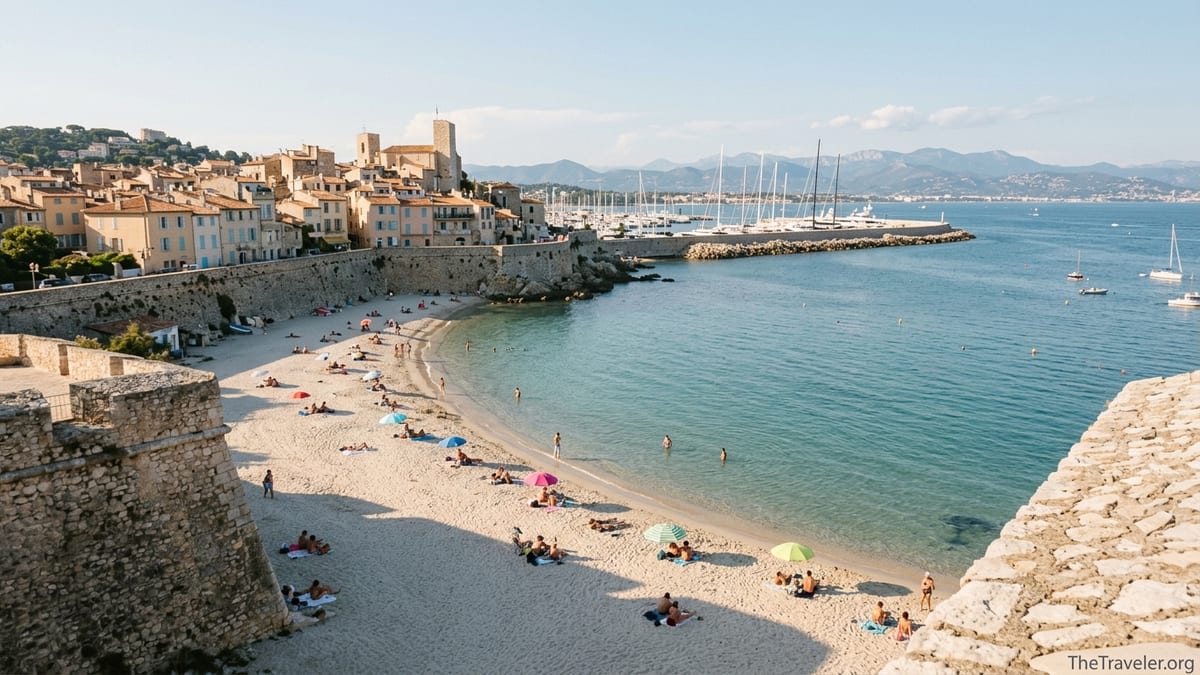
One of Antibes’ biggest advantages is how many different beach experiences you can reach on foot. Plage de la Gravette, tucked under the ramparts just a few minutes from the market, is a protected arc of sand sheltered from waves and wind. Recent local beach reports describe families setting up here in summer with parasols and picnics, enjoying shallow, usually calm water where children can paddle while parents keep an eye on them from a towel. The backdrop is pure Riviera: the tower of the Picasso Museum, old town rooftops beyond the walls, and the masts of superyachts poking up from Port Vauban.
Walk 10 to 15 minutes further and you reach Plage du Ponteil and Plage de la Salis, two longer sandy strips with views across the bay to the Alps on clear days. These are classic town beaches, busy with locals after work and visitors staying in nearby apartments. Facilities are straightforward rather than flashy: public showers, snack kiosks, simple beach bars and a few stretches of private loungers for rent. A sunbed and umbrella set in high season typically costs less here than at the smart beach clubs in Cannes or Juan-les-Pins, making it easier to spend full days by the water without burning through your budget.
If you prefer quieter or wilder settings, you can walk out towards Fort Carré and beyond. From the old town it is around 20 to 30 minutes on foot via the marina to reach the pebbly shores near the fortress and onward to Plage de la Fontonne. These beaches back onto the coastal road and have few facilities, but they attract swimmers and walkers looking to escape the densest summer crowds. On the opposite side of town, a short bus ride or a half-hour coastal walk takes you to Cap d’Antibes, where coves like those near Baie des Milliardaires and smaller rocky inlets offer deep, clear water that feels worlds away from the bustle of the promenade.
Cap d’Antibes: Luxury, Nature and a World-Class Coastal Path
Cap d’Antibes itself is one of the Riviera’s most emblematic peninsulas, a small 1.6 square kilometer headland covered in pine forests, estates and secluded bays. It has long attracted wealth and glamour: the legendary Hôtel du Cap-Eden-Roc, established in the 19th century, sits at the tip and in high season fills with discreet black cars and guests arriving from yachts. Even if you are not staying there, simply glimpsing its terraced gardens and seawater pool from the coastal path gives a sense of how deeply luxury is woven into this landscape.
The beauty of Antibes, however, is that you do not need a celebrity budget to enjoy the Cap. The Sentier du Littoral, also known as the Tire-Poil coastal path, wraps around much of the peninsula’s southern edge. Starting near Plage de la Garoupe, the trail follows the rocks above the sea, passing old stone walls, villas hidden in pine trees and small coves where locals slip into the water for a quick swim. It normally takes around two hours to walk the main loop at a relaxed pace, though you will want longer if you stop for photos or a picnic. Solid shoes, water and sun protection are essential; on hot days the white rock reflects the sun and there is little shade.
Along the way you have constant views out to the Lérins Islands and back towards the snow-capped mountains that frame the Riviera in shoulder season. There are few better reminders of how compact this region is: within a single panorama you can see winter ski terrain and summer sailing grounds. At the end of the walk, many people reward themselves with a drink on the terrace of a beach bar at Garoupe or by taking a quick bus or taxi back into Antibes for dinner. Staying in town makes this kind of spontaneous half-day hike easy to fit between slower mornings at the market or museum visits.
Culture Beyond the Beach: Picasso, Fort Carré and Local Life
Antibes offers more than sun and sand. High above Plage de la Gravette, the Picasso Museum occupies the Château Grimaldi, a medieval fortress that became the artist’s workspace for several months in 1946. Today the building houses paintings, drawings and ceramics from that period, along with later donations and modern art works. Official tourism information for the museum shows opening hours typically from 10 am to 1 pm and 2 pm to 6 pm, closed on Mondays, with standard adult tickets in the region of 10 to 12 euros. These details can vary with exhibitions, so it is worth checking locally, but the point is that this is an affordable, compact museum you can visit in an hour before heading back out to the sea walls.
The terrace of the museum is a highlight in its own right, with sweeping views across the Baie des Anges towards Nice and over the marina. This vantage point underlines just how strategically important Antibes has been over the centuries, guarding the coastline and anchoring maritime trade. Another reminder of that history is Fort Carré, the star-shaped fortress built on a small hill beyond the port. You can either walk there in roughly 20 to 30 minutes or take a short bus ride. Guided visits inside usually run at set times and cost only a few euros; even if the fort is closed when you arrive, the surrounding grounds provide a panoramic view of the town, Cap d’Antibes and, on clear days, the Italian border mountains.
Cultural life continues at street level. Small galleries cluster in the old town, often focusing on local painters and photographers who capture Antibes’ light in less obvious ways than postcard stalls. In summer, open-air concerts and theater performances appear in squares and at the port, while Juan-les-Pins next door hosts its celebrated jazz festival under the pines. Staying in Antibes means you can wander home on foot after midnight rather than chasing the last train back from another coastal town.
Easy Day Trips Without Needing a Car
One of the most practical reasons to choose Antibes is its transport connections. The town lies on the main coastal rail line, with regular TER regional trains linking it directly to Nice, Cannes, Monaco and Menton. Travelers currently report paying roughly 5 to 8 euros for a one-way ticket between major stops like Nice and Antibes or Antibes and Cannes when bought at station machines or via the SNCF and regional apps. Return fares between Nice and Cannes are frequently mentioned around 18 to 20 euros. For longer stays, the Pass Sud Azur Explore and similar regional passes allow unlimited travel on TER trains, trams and many buses across the Alpes-Maritimes for set periods, making it easy to hop between beach towns without constantly queuing for tickets.
From Antibes you can reach Nice in about 20 to 25 minutes by TER, Cannes in around 10 to 15 minutes, and Monaco in under an hour, depending on the stopping pattern. This means day trips do not require early starts or long returns; you can, for instance, spend the morning at the market in Antibes, take a late-morning train to Cannes for lunch and an afternoon stroll along the Croisette, then be back at Plage de la Gravette for a sunset swim. Buses also link Antibes with nearby resorts and hilltop villages, though at peak times trains are usually faster and more reliable than coastal roads clogged with traffic.
Arriving from Nice Airport is straightforward too. At the time of writing, common options include a bus from the airport area directly towards Antibes or a short tram ride to Nice Saint-Augustin station followed by a TER train along the coast. Independent travelers discussing recent trips often recommend skipping rental cars entirely, pointing out that parking is costly and tight in many Riviera towns while public transport is frequent and relatively affordable. For families with small children, strollers fit easily on trams and trains, and the flat, compact layout of Antibes old town makes walking realistic even with little legs.
Costs, Crowds and Seasons: A More Balanced Riviera Experience
The French Riviera has a reputation for high prices, and Antibes is not immune. In July and August, hotel rates climb sharply and sea-view rooms in boutique properties around the ramparts can rival central Nice or Cannes. Yet there are still pockets of relative value. Because Antibes is popular with year-round residents and seasonal workers from nearby tech hub Sophia Antipolis, it has more modest apartment blocks set a few streets back from the water. This creates a rental market where, outside the absolute peak weeks, you can sometimes find better deals than in Nice’s most coveted neighborhoods while retaining sea access and good transport.
Food and drink follow a similar pattern. A coffee at a bar a couple of streets inland from the port may cost only a little more than in a non-touristy French town, while waterfront terraces overlooking superyachts will naturally charge a premium. Travelers on recent budgets report eating well in Antibes on a mix of takeaway market picnics, casual pizzas or moules-frites in the old town for moderate prices, and the occasional splurge at a beachfront restaurant on the Cap. Because there is a genuine local community, you are never limited solely to tourist menus; a brasserie that caters to office workers at lunchtime will usually offer a reasonably priced plat du jour even in summer.
Crowds are inevitable in July and August, but in Antibes they tend to concentrate at the beaches and on a few central streets. Step a couple of blocks inland and you quickly reach quieter residential lanes where bougainvillea spills over garden walls and neighbors chat under the shade of plane trees. In the shoulder seasons of May–June and September–October, the town arguably hits its sweet spot: warm enough for swimming, cool enough for the Cap d’Antibes coastal path, and busy without feeling saturated. Many repeat visitors deliberately return at these times, describing Antibes as a place that rewards lingering rather than ticking off sights.
The Takeaway
Antibes does not shout as loudly as Nice, Cannes or Monaco in Riviera brochures, and that subtlety is exactly why it works so well. Here you can wake up to cathedral bells rather than highway noise, walk to a covered market for picnic supplies, and choose between a sandy town beach, a pebbly stretch by a fortress or a pine-scented coastal trail on a limestone headland. You have a Picasso Museum in a medieval castle, a major marina at your doorstep and quick trains to the rest of the coast, all without spending your entire stay in a high-rise resort city.
For travelers looking for a base that balances seaside holiday with real local life, Antibes offers a rare equilibrium on an increasingly polished coastline. Skipping it might save you a stop on the train, but it could also mean missing the point of the French Riviera altogether: a place where everyday routines still unfold among some of Europe’s most spectacular views.
FAQ
Q1. Is Antibes a better base than Nice for exploring the French Riviera?
Antibes suits travelers who prefer a smaller, walkable town with easy train access to Nice, Cannes and Monaco, plus a mix of sandy beaches and historic streets. Nice offers more nightlife, museums and big-city energy, while Antibes feels calmer and more village-like.
Q2. When is the best time of year to visit Antibes?
The most balanced months are May, June, September and early October, when the weather is usually warm, the sea is swimmable and crowds are lighter than in July and August. Winter is quieter but still pleasant for markets, museums and coastal walks.
Q3. Do I need a car if I stay in Antibes?
Most visitors do not need a car. Antibes sits on the main coastal rail line, with frequent TER trains to Nice, Cannes, Monaco and other towns, plus local buses. Parking can be expensive and stressful, so many travelers rely on public transport and walking.
Q4. Are the beaches in Antibes sandy or pebbly?
Central Antibes has several sandy beaches, including Plage de la Gravette, Ponteil and Salis, which are ideal for families. To the west near Fort Carré and towards Biot you will find more pebbly stretches, and around Cap d’Antibes there are rocky coves and small sandy pockets.
Q5. How expensive is Antibes compared with other Riviera towns?
Antibes is not cheap, especially in high season, but it can be slightly more affordable than some central areas of Nice or Cannes. You can keep costs in check by choosing accommodation a few streets back from the water and eating at neighborhood bistros or picnicking with produce from the market.
Q6. What are the must-see sights in Antibes for a short stay?
For a first visit, prioritize the old town and ramparts, the Marché Provençal, the Picasso Museum in the Château Grimaldi, a walk to Fort Carré for views, and at least one swim at Plage de la Gravette or Salis. If you have more time, add the coastal path on Cap d’Antibes.
Q7. Is Antibes suitable for families with children?
Yes. The compact old town, pedestrian-friendly streets and sheltered sandy beaches make Antibes very family friendly. Children can paddle safely at Plage de la Gravette, and short train or bus rides open up easy day trips without long car journeys.
Q8. How long should I stay in Antibes?
Three full days is enough to explore the town, beaches and Cap d’Antibes at a relaxed pace. Many travelers choose five to seven nights, using Antibes as a base for day trips to Nice, Cannes, Monaco and nearby hill villages while still having time to simply enjoy the local rhythm.
Q9. What is the nightlife like in Antibes?
Nightlife in Antibes is lively but not intense. Expect wine bars, terrace cafés and a handful of late-opening spots in the old town and near the port, especially in summer. For large clubs and more crowded bar scenes, people often take an evening train or taxi to Cannes or Nice.
Q10. Is Antibes safe for solo travelers?
Antibes is generally considered safe, including for solo travelers walking in the old town and along the seafront. Normal precautions apply, especially at night and around busy transport hubs, but many visitors report feeling comfortable walking back to their accommodation after dinner or evening drinks.