


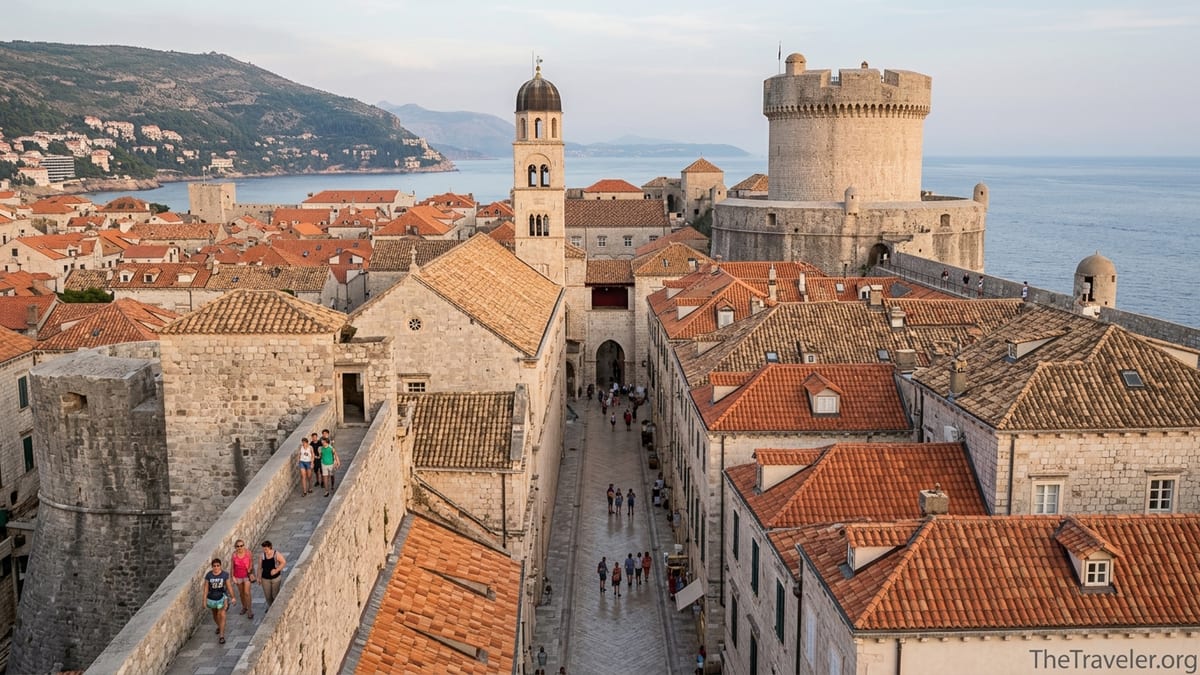
Walk into Dubrovnik’s UNESCO listed Old Town and two silhouettes instantly compete for your attention. At one end of the main street, Stradun, the elegant City Bell Tower rises above Luža Square, ringing the hours over baroque facades and café terraces. High above the opposite side of town, the massive Minčeta Tower crowns the city walls, a round stone fortress that has become one of Dubrovnik’s most photographed viewpoints. Both are iconic. Yet for many visitors with limited time or budget, the real question is simple: which landmark leaves a bigger impression, the Bell Tower or Minčeta Tower?
Get the latest updates straight to your inbox!
Two Icons in One Small Old Town
Dubrovnik’s historic center is compact, but its skyline is packed with recognizable shapes. The slim City Bell Tower anchors the eastern end of Stradun, the polished limestone street that runs from Pile Gate to the old harbor. Originally built in the 15th century and reconstructed in 1929, the tower rises to around 31 meters and still features the famous bronze “zelenci” figures striking the bell. It is visible from almost anywhere in the Old Town, functioning as both timekeeper and visual compass.
Minčeta Tower could not be more different in character. Perched at the highest point of the city walls on the landward, northern side of the Old Town, it is a squat, muscular round fortress with a thick base and Gothic crown. Completed in the mid 15th century and later reinforced as artillery technology evolved, it was a key element of Dubrovnik’s land defenses. Today, for most travelers, Minčeta is synonymous with the best panoramic views of terracotta roofs and the Adriatic, and is often the single image they carry home from Dubrovnik.
Because of their roles, most visitors will encounter the Bell Tower repeatedly as they wander the streets, while Minčeta requires a deliberate decision to buy a city walls ticket and climb up. This difference in effort and cost shapes how each landmark is experienced, and often how strong a memory it leaves.
To understand which might impress you more, it helps to look at what each offers in terms of history, atmosphere, views, and value for money in the real conditions travelers face in Dubrovnik today.
History and Symbolism: Timekeeper vs Fortress
The City Bell Tower has been marking the rhythm of daily life in Dubrovnik for centuries. The original tower dates to the mid 1400s, built during the height of the Republic of Ragusa. After suffering structural problems and earthquake damage, it was reconstructed in 1929 following the Renaissance design, preserving its symbolic role over Luža Square. The bell chimes mark the hours and major religious festivals, and locals still glance up instinctively when they hear it. The tower frames many of the city’s key civic spaces, including Sponza Palace and the Church of St. Blaise, weaving it into almost every public celebration.
Minčeta Tower, by contrast, symbolized survival. As the highest point in the defensive system, this round fortress guarded Dubrovnik from landward attacks. It was first built as a square fort in 1319, then completely reshaped in the 15th century to better resist artillery, with contributions from renowned architects such as Michelozzo and Juraj Dalmatinac. Its very bulk sends a message: this was a city that expected to be attacked and fully intended not to fall. Even today, guidebooks and tourist brochures often describe Minčeta as a symbol of Dubrovnik’s “unconquerable” spirit.
Travelers who enjoy understanding how a place functioned as a republic and trading power often find Minčeta’s story more compelling. Standing on its ramparts, you can trace the line of walls, spot Fort Lovrijenac across the bay, and imagine how foreign ships and armies once approached. In comparison, the Bell Tower speaks more about civic pride and daily rhythm than military might, though for visitors who love city life and street culture, that quieter symbolism can be equally resonant.
In pure historical weight, both are significant, but Minčeta tends to feel more dramatic, especially when you factor in its commanding position over the city and its role as a visual shorthand for Dubrovnik in modern media and photography.
Views and Photo Potential: Street Life vs Sky-High Panoramas
From a photographer’s perspective, these two landmarks offer very different opportunities. The City Bell Tower is best captured from ground level in Luža Square or halfway down Stradun. In the late afternoon, when the sun lowers behind Pile Gate, soft light washes the limestone facades and the tower takes on a warm glow. Travelers often sit at nearby café terraces, paying roughly 4 to 6 euros for an espresso or 7 to 9 euros for a glass of local white wine, and snap photos of the tower rising behind passing crowds and street performers. It is ideal for candid, people focused shots that blend architecture and atmosphere.
Minčeta Tower, on the other hand, is about expansive panoramas. Once you have bought a city walls ticket, typically around 35 to 40 euros per adult depending on season, you climb stone staircases to reach the northern section of the walls where Minčeta stands at the highest point. From the top, you can see almost the entire Old Town: orange roofs tumbling toward the sea, church domes, the harbor and Lokrum Island offshore. Many guidebooks and travel blogs use a Minčeta vantage point shot as their cover photo for Dubrovnik, and social media is full of travelers posting sunrise or late afternoon images from here.
In practice, the difference in impression is clear when you compare actual traveler behavior. Many visitors will photograph the Bell Tower several times as they walk, but often as part of a wider scene rather than as a dedicated photo stop. By contrast, the climb to Minčeta is usually a focused goal. People time their city walls walk to reach the tower either early in the morning to avoid heat and crowds, or late in the day when the sun sets behind the hills and casts a golden light on the roofs. It is common to see travelers wait patiently for gaps in the crowds to get that iconic shot leaning over the stone merlons.
If visual impact and “wow factor” views are your priority, Minčeta clearly has the edge. The Bell Tower frames great street scenes and sunset silhouettes, but Minčeta delivers the wide, cinematic panoramas that often define a Dubrovnik trip album.
Cost, Access and Effort: Free Encounter vs Ticketed Experience
When deciding which landmark will leave a bigger impression for you personally, budget and energy matter. The City Bell Tower is, for practical purposes, free to enjoy. You will pass under or near it almost every time you walk through the Old Town. There is no separate ticket just to stand in Luža Square, listen to the bell, and photograph it from different angles. Even on a tight budget, you can soak up its presence simply by wandering the streets at different times of day, perhaps grabbing an inexpensive takeaway burek for about 3 to 4 euros from a nearby bakery and sitting on the steps to people watch.
Minčeta Tower is accessible only with a Dubrovnik City Walls ticket or Dubrovnik Pass, which for many travelers is one of the biggest single line items of their visit. Recent seasons have seen adult walls tickets priced around 35 to 40 euros, with children’s tickets around 15 euros and under 7s usually free. Hours and tariffs vary between winter and peak summer, and they are adjusted periodically, so it is wise to check the latest rates at the official city walls sales counters or in the Dubrovnik Pass materials when you arrive.
The effort level is also very different. Experiencing the Bell Tower primarily means choosing when to linger near it. You might stroll past in the cool of the morning, then return in the evening when the square fills with buskers and wedding parties spilling out of nearby churches. There are no long climbs involved, only the gentle slopes and steps of the Old Town streets.
Reaching Minčeta requires a sustained climb. The full city walls circuit is almost 2 kilometers and involves repeated staircases. Most visitors report taking between 1.5 and 3 hours depending on how often they stop for photos. If you have knee issues or are traveling in peak summer heat, this can be a challenge. Sensible shoes, water, and sun protection are essential, particularly on windless July and August afternoons when stone surfaces radiate heat and shade is scarce.
Because of this cost and physical effort, Minčeta tends to feel like an “event” in your trip rather than something you simply notice along the way. For many travelers, that investment increases its emotional impact. They remember the heat, the climb and the reward at the top, whereas the Bell Tower becomes part of the everyday backdrop of their Dubrovnik stay.
Atmosphere on the Ground: Square vs Stronghold
The settings of these two landmarks could not be more different, and that shapes how memorable they feel. The City Bell Tower stands at the lively intersection of several of Dubrovnik’s most important streets and buildings. Luža Square is where open air concerts take place during the Dubrovnik Summer Festival, where processions form during religious holidays, and where cruise groups often gather behind raised umbrellas. On a typical summer evening, you might hear live music echoing off the stone, children chasing pigeons around the square, and the clatter of plates from nearby restaurants charging 18 to 25 euros for a main course of grilled fish or seafood risotto.
At different times of day, the tower’s atmosphere shifts. Early mornings in shoulder season can be remarkably calm, with just delivery trolleys and a few locals heading to work. In those quiet hours, hearing the bell strike can feel almost intimate, as if the city is waking up. In peak season afternoons, when temperatures climb and day trip groups pack the square, the Bell Tower becomes a fixed point in a sea of movement, lending a sense of order to the chaos.
Minčeta Tower, though often crowded along the walls, feels more removed from daily life. When you are standing on its ramparts, city sounds filter up faintly: a bell from a nearby church, shouts from kayakers in the harbor, the rumble of buses outside Pile Gate. Yet you are physically separated from the bustle. Stone parapets and narrow walkways create a sense of being inside the old military machine, moving where sentries once walked. In shoulder seasons and on cooler days, there are moments when the crowds thin and you can stand almost alone, watching clouds drift over the red roofs.
For visitors who crave a sense of escape and perspective, Minčeta’s atmosphere often feels more transporting, as if you have stepped briefly out of the modern tourist city and into its defensive past. For those who thrive on street life, crowds, and café culture, the Bell Tower’s square side setting can be more energizing and memorable. Your personal travel style plays a large role here in which landmark leaves the deeper emotional trace.
Pop Culture, Storytelling and Emotional Impact
In the age of streaming series and social media, many people arrive in Dubrovnik already primed to feel something specific at these sites. Fans of film and television often recognize Minčeta Tower from fantasy series that used Dubrovnik’s walls as stand ins for fictional cities. Walking the final steps toward the tower, they recreate scenes, take posed photos, or join themed walking tours that highlight these filming locations. For this audience, Minčeta is not only a medieval fortress but also a tangible link to stories they love, which can magnify its impact.
The City Bell Tower features less in pop culture but more in day to day travel narratives. Trip reports and blogs frequently mention “meeting under the bell tower” as a rendezvous point, or describe hearing its chimes drifting into their hotel room at night if they stayed in a guesthouse within earshot. Some travelers recall particular moments, such as watching a sudden summer shower clear over the square while the bell rang, or listening to a festival performance beneath it. These small, personal stories accumulate and make the tower memorable not as a dramatic one time view, but as a recurring character throughout their stay.
Emotionally, Minčeta tends to produce stronger immediate reactions: gasps at the views, a sense of triumph after the climb, the quiet moment of looking down at the density of the Old Town and realizing just how small it is. The Bell Tower, meanwhile, often leaves a slower, more cumulative impression that reveals itself only when you look back on your trip and realize how many of your favorite memories are set within sight or sound of it.
Both, in their own ways, allow you to feel connected to Dubrovnik’s story. Minčeta puts you in the boots of a guard scanning the horizon for danger; the Bell Tower places you among citizens and visitors sharing the present moment in a city that has survived a great deal and still tells the time.
So Which Leaves the Bigger Impression?
Ask a dozen recent visitors which made a bigger impression, the City Bell Tower or Minčeta Tower, and you will hear patterns emerge. Travelers who value iconic vistas, architectural drama, and “bucket list” experiences almost always name Minčeta. They remember the heat on the stones, the cost of the ticket, the climb up tight staircases, and finally the sweeping view that makes it all feel worthwhile. For them, Minčeta is the postcard image that justifies the long journey to Dubrovnik.
Visitors who travel more slowly, spending several days in the Old Town, sometimes lean toward the Bell Tower when they reflect carefully. They mention early morning walks to buy pastries, evening concerts and festival evenings in Luža Square, children counting the chimes, and spontaneous meetings arranged “under the clock.” In their memories, the Bell Tower is woven into countless small scenes that together define the mood of their trip, even if it never delivered a single spectacular “wow” moment.
Realistically, most travelers will experience both, and each will stand out for different reasons. Minčeta provides the high point both literally and metaphorically: the place you are most likely to take your favorite panoramic photograph and the experience for which you will adjust your schedule and budget. The Bell Tower, by contrast, becomes the steady background presence that anchors each day. In that sense, Minčeta may leave the sharper, more dramatic impression, but the Bell Tower may leave the deeper, more intimate one.
If your time or energy is limited, and you must prioritize, think about what you value most. If you want that unforgettable bird’s eye view and do not mind paying for the city walls ticket, choose Minčeta and time your visit early or late in the day. If you prefer to feel the pulse of Dubrovnik at street level and are watching your budget, allow yourself multiple unhurried moments around the Bell Tower at different hours, listening for the chime that has punctuated life here for centuries.
FAQ
Q1. Can I visit Minčeta Tower without walking the entire city walls?
In practice, access to Minčeta Tower is through the city walls circuit, and your ticket is for the full walk rather than the tower alone. You can shorten your route by entering at the nearest gate and heading straight for Minčeta, then exiting at the next staircase down, but you will still pay the full city walls price.
Q2. Is there an entrance fee to see the City Bell Tower?
There is no separate ticket just to see or photograph the City Bell Tower from Luža Square or Stradun, and most visitors enjoy it entirely free of charge as part of strolling the Old Town. If you join certain guided tours that include nearby museums or churches, you will pay for the tour itself, but the tower as a visual landmark does not carry its own standalone entrance fee.
Q3. Which landmark is better if I have limited mobility?
The City Bell Tower is the more accessible choice for most travelers with mobility issues, as it can be appreciated from level streets and nearby terraces without climbing. Minčeta Tower requires ascending multiple stone staircases along the city walls, which can be steep and uneven, and there are no elevators, so it may not be suitable for those with significant mobility challenges.
Q4. When is the best time of day to experience Minčeta Tower?
The most rewarding times are early morning shortly after the walls open or late afternoon toward sunset, when light is softer and temperatures are lower. Midday in high summer can be extremely hot and crowded on the exposed stone, which makes the climb and the time spent on top of Minčeta more tiring.
Q5. Will I see the Bell Tower even if I skip paid attractions?
Yes, you will almost certainly see the Bell Tower multiple times just by walking through the Old Town, as it rises above one end of Stradun and over Luža Square. Even travelers on a strict budget who avoid ticketed sites regularly remark that the tower is one of the most familiar and photographed landmarks of their stay.
Q6. Is the city walls ticket, including Minčeta, worth the price?
For most first time visitors, the cost of the city walls ticket is considered worthwhile because it includes not only Minčeta Tower but the full loop of fortifications and access to additional viewpoints and a separate fortress. Those on a tight budget should weigh the ticket against other expenses, but many who initially hesitate later describe the wall walk and Minčeta’s panoramas as the highlight of their Dubrovnik trip.
Q7. Can I hear the Bell Tower chime throughout the Old Town?
You will hear the Bell Tower most clearly in and around Luža Square and the eastern half of Stradun, but its chimes carry through much of the Old Town, especially in the early morning or late evening when ambient noise is lower. Guests staying in nearby apartments often mention the bell as part of their daily rhythm in Dubrovnik.
Q8. Which landmark is better for photography if I have only one evening?
If you can manage the climb and have a city walls ticket, Minčeta Tower usually offers the most striking photographs in one concentrated session, especially in late afternoon light. If you prefer a more relaxed and free option, spending that evening in Luža Square and along Stradun photographing the Bell Tower against the changing sky will still give you atmospheric and memorable images.
Q9. Are there guided tours that focus on Minčeta Tower or the Bell Tower?
Several walking tours of Dubrovnik’s city walls highlight Minčeta Tower as one of their main stops, often combining historical explanation with photo breaks. In the Old Town, general history and culture tours frequently use the City Bell Tower area as a meeting point or segment of the route, integrating its story into broader narratives about the Republic of Ragusa and daily life in Dubrovnik.
Q10. If I am visiting Dubrovnik only for a few hours, which should I prioritize?
If your time is very short, such as during a cruise stop of a few hours, enjoying the City Bell Tower and surrounding streets may be the most efficient choice, since it requires no ticket purchases or long climbs. If you have at least half a day and are comfortable walking in the heat and crowds, prioritizing the city walls and Minčeta Tower can give you the kind of panoramic overview that many travelers feel justifies even a brief visit.