


I walked past Dubrovnik’s Bell Tower three times before I really saw it. In the evening light it just felt like part of the familiar postcard: the polished limestone of Stradun, a blur of tour groups, the baroque facade of St Blaise’s Church. The tower at the far end was simply background architecture, a convenient landmark for meeting friends. It took a chance comment from a local guide to make me stop, look up, and realize that the Bell Tower is one of the most revealing storytellers in the Old Town.
Get the latest updates straight to your inbox!
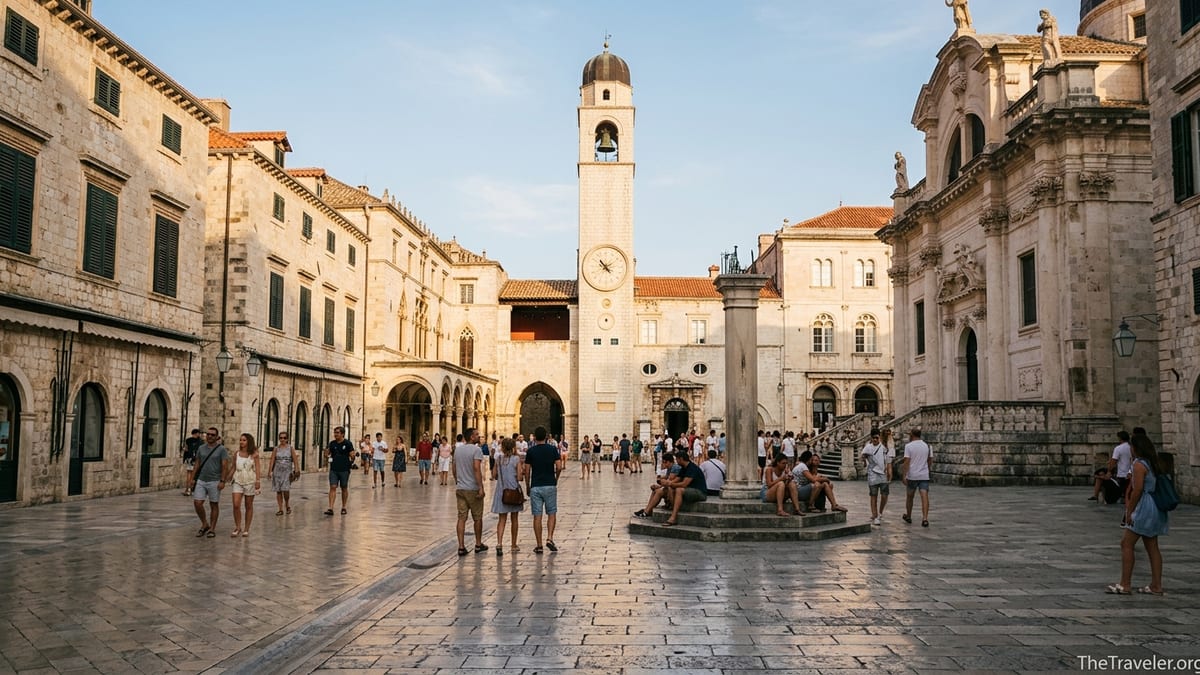
The Tower You Keep Photographing Without Noticing
If you have walked Dubrovnik’s Old Town even once, you have almost certainly photographed the Bell Tower without realizing it. Stand anywhere along Stradun, the city’s main street, and your eye is naturally drawn to the slender stone shaft that closes the perspective at the eastern end. At about 31 meters high, it is one of the tallest structures in the historic core, visible above the tiled roofs long before you reach Luza Square at its base.
Arriving through Pile Gate on a busy July afternoon, I remember thinking mostly about the city walls and the promise of a sunset view. The Bell Tower was just a navigation tool: “Walk straight until the clock tower, then turn left for the port.” Around me, visitors were doing the same, using it as a meeting point or a background for selfies, but very few people stopped in front of it. Street performers clustered near the Orlando Column, buskers eyed the crowds, and the tower behind them seemed almost modest compared with the ornate Sponza Palace to its side.
What finally made me pause was the sound of the bell marking the hour. It was lower and less metallic than I expected, with a weight that seemed disproportionate to the small square. A guide nearby was explaining to her group that the bell was cast in 1506 by a master from the island of Rab, and that the two bronze figures striking it had their own names and personalities. That hint of character turned the tower from generic landmark into something strangely intimate, and I realized I had almost walked past one of the city’s most layered symbols.
Many travelers come to Dubrovnik focused on the walls or the Game of Thrones filming locations. The Bell Tower, standing quietly at the meeting point of Stradun and Luza Square, rarely features as a headline attraction. Yet it is one of the simplest ways to understand how this small republic measured time, managed danger, and asserted its independence in a volatile corner of the Adriatic.
A 15th-Century Timekeeper Rebuilt for a 20th-Century City
The Bell Tower’s story begins in 1444, when the Republic of Ragusa, as Dubrovnik was then known, was at the height of its maritime power. The city’s leadership decided to build a civic tower that would mark the hours for merchants, sailors, and councillors moving between the Rector’s Palace, the customs house, and the loggia of Sponza. The tower’s clean lines and restrained stonework contrasted with the more decorative Gothic and Renaissance facades around it, reflecting the republic’s preference for order over ostentation.
For more than two centuries the tower stood watch over Luza Square. Then, in 1667, a devastating earthquake struck Dubrovnik, toppling churches and palaces and killing thousands. The Bell Tower survived but was badly damaged. Over the following decades and centuries, repeated tremors and slow structural fatigue began to tilt it toward Stradun. By the early 1800s, residents could see the lean with the naked eye, and visitors’ diaries mention the unnerving angle of the city’s “lame clock.”
In 1928, long after the republic itself had disappeared from the map, engineers and city planners made a difficult decision. The original tower, weakened beyond safe repair, was demolished. In its place, a new structure was completed in 1929, carefully modeled on the Renaissance design and dimensions. The reconstruction was funded with a mix of local and state resources, and the project quickly became a point of pride for Dubrovnik’s citizens, who saw the new tower not as a replacement but as a continuation of the old symbol.
The Bell Tower’s troubles were not over. In 1979, another strong earthquake in the wider region damaged the tower again, this time in more subtle but dangerous ways. Detailed structural surveys in the 1980s led to a sophisticated reinforcement program: the tower was tied into neighboring buildings with hidden cables and anchored with reinforced concrete slabs at key levels. When you stand beneath it today, it looks serenely untouched, but inside it is a 20th-century engineering project carefully disguised as a 15th-century clock tower.
Maro and Baro: The Green Men Who Struck the Hours
The detail that finally made me fall for the Bell Tower was not the stonework, but the two small figures that live just below the bell. Locals call them Maro and Baro, or collectively the “Zelenci” – literally “the green ones” – a reference to the green patina that has settled on their bronze bodies. From street level they appear as a pair of squat, slightly comical men with raised hammers, but once you learn their story they become guardians of the city’s time.
The original figures were cast in the late 15th century and were designed as “jacquemarts,” mechanical bell strikers that move with the clock mechanism. Every hour, Maro and Baro would step forward and hit the bell, announcing the passage of time to officials, traders, and citizens. In an era when portable timepieces were rare, these two figures regulated not only daily life but also the rhythms of commerce and governance. They effectively turned Luza Square into a public timekeeping stage.
By the early 20th century the originals were weathered and fragile, and with the demolition and reconstruction of the tower in 1928–1929, they were retired from active duty. Replicas were placed on the new tower, while the historic Zelenci were moved indoors. Today, if you visit the Cultural History Museum in the Rector’s Palace, you can see the originals up close. Their faces are unexpectedly expressive, their limbs slightly uneven, reminding you that these were not industrial products but handmade sculptures intended to be seen from the street below.
Standing in Luza Square at noon, you can still watch the modern Maro and Baro lift their hammers. The movement is small and easy to miss if you are distracted by ice cream or a phone screen. But pause for a moment, and you witness a ritual that has been repeated, in one form or another, for more than five hundred years. For families traveling with children, this tiny performance can be a simple way to turn history into something tangible: count down to the hour together, watch the figures move, then walk over to the museum later to meet their older, more weathered counterparts.
Luza Square: The Stage Beneath the Bell
Part of what makes the Bell Tower so easy to overlook is that it shares an incredibly crowded stage. Luza Square, the open space at its feet, is one of the densest clusters of landmarks anywhere in Dubrovnik. To the right as you face the tower is the elegant Sponza Palace, one of the few major buildings to survive the 1667 earthquake with its original form largely intact. To the left is the Church of St Blaise, the Baroque celebration of the city’s patron saint, its stairs often hosting wedding parties and festival processions.
In the center of the square stands Orlando’s Column, a carved knight whose forearm was historically used as a standard measure of length for merchants. Legend credits him with rescuing Dubrovnik from a medieval siege, but historians now see the column more as a statement of political allegiance and trading privileges. During the city’s annual summer festival, the Libertas flag is raised from this column, fluttering beneath the gaze of the Bell Tower’s clock, a subtle reminder that civic freedom and disciplined timekeeping were once linked in the republic’s identity.
Practical life in Luza Square today is less dramatic but no less intense. In high season, you might pass a walking tour group gathered just under the tower, their guide holding a colored umbrella, explaining how the bell signaled curfews or fires. On a hot afternoon, people cluster where a strip of shade moves slowly across the stones, while children chase pigeons between St Blaise’s steps and the base of Orlando’s Column. Nearby cafes and bars spill onto side streets; it is common for visitors to sit at a terrace just off the square, order a coffee that costs only slightly more than elsewhere in town, and treat the whole scene as a kind of live theatre.
If you stand with your back to the tower and look down Stradun, you begin to understand why this particular spot became the city’s main civic stage. Historically, ships arriving at the old harbour would funnel their cargo and news straight through Luza Square, past the customs house and trading loggias. Today, cruise ship passengers enter the Old Town through Pile Gate and walk toward that same point, guided by the Bell Tower at the far end of the polished street. The stage has changed, but the choreography is surprisingly familiar.
Listening to the Bell in a City of Events
To appreciate the Bell Tower, it helps to experience it at different moments of the day. Early in the morning, just after sunrise, Stradun is still being washed and hosed down. Delivery carts rattle over the stones, shopkeepers roll up metal shutters, and the light catches the upper part of the tower before it reaches the square. At this hour, the bell’s strike feels almost private. The sound hangs in the cooler air, echoing gently off the walls without competition from tour groups or street musicians.
By late afternoon in summer, when the sun slips behind the city walls and Stradun begins to glow in reflected light, the atmosphere changes. Strollers drift toward Luza Square, looking for a breeze from the old port. Parents arrive with children, ice creams in hand, and photographers set up near Orlando’s Column to capture the classic perspective back down the street. When the bell rings on the hour, its tone threads through conversations and camera shutters. Most people barely register it, but if you pay attention, you will hear the subtle way the sound anchors the scene, like a punctuation mark in a page of busy text.
During major events, the tower plays a more obvious role. During the Dubrovnik Summer Festival, which typically runs from July into August, performances spill out into the open air, and Luza Square hosts concerts and ceremonies beneath the tower’s clock. When the Libertas flag is raised at Orlando’s Column to open the festival, the Bell Tower looks on from just meters away, its clock face and green strikers forming part of the backdrop broadcast on television and shared in media coverage, even if they go mostly unmentioned in captions.
For visitors planning a trip, it is worth checking whether your dates coincide with local events that pass through Luza Square. Even if you are not attending a performance, you can still feel the way the tower becomes part of the city’s collective heartbeat, marking rehearsals, sound checks, and the nightly dispersal of crowds. On quieter days in the shoulder seasons, that same tower presides over a gentler rhythm: a handful of tours, a florist’s stall, locals cutting across the square on their way to errands, all subtly coordinated by the hour strikes above.
Seeing the Bell Tower in Context: Practical Visiting Tips
Because the Bell Tower cannot currently be climbed like some church towers elsewhere in Europe, your experience of it will mostly be from the ground. That makes composition and timing especially important if you want to appreciate it fully. One effective approach is to treat your walk through the Old Town as a slow approach to the tower rather than a rushed transit. Start at the Pile Gate entrance and give yourself at least half an hour to stroll down Stradun, pausing at Onofrio’s Fountain, the Franciscan Monastery, and a side alley or two before you let the Bell Tower pull you forward.
If you are staying outside the Old Town, consider timing one of your entries for just before the hour, especially at 10:00, 12:00 or 18:00 when the bell’s strikes feel most naturally integrated into daily life. Find a spot near the edge of Luza Square rather than directly under the tower. From slightly back, you can see the clock face, the hammering figures, and the people’s reactions all at once. This is also an ideal place for people-watching; a takeaway gelato or a drink from a nearby bar is a small price for turning the square into your own open-air cinema for twenty minutes.
Budget-conscious travelers sometimes worry that everything around Stradun and Luza Square is prohibitively expensive. While it is true that a coffee at a prime terrace right on the square can cost more than in backstreets, you can still enjoy the Bell Tower experience without overspending. One option is to grab a sandwich or pastry from a bakery on a side street and simply lean against a wall in the square’s shade. Another is to time your visit in the early evening and combine it with a walk to the old harbour nearby, where prices are often more reasonable once you get a block or two away from the main flow.
If you are interested in the tower’s deeper history, combine your stop in Luza Square with a visit to the Cultural History Museum inside the Rector’s Palace, a few steps away. There you can see the original Maro and Baro figures, as well as exhibits that explain how the republic governed itself from this compact cluster of buildings. When you return to the square afterward and look up at the tower, it feels less like an anonymous clock and more like an old colleague you now know by name.
How a Single Tower Reframes the Old Town
Once you understand the Bell Tower’s backstory, the rest of Dubrovnik’s Old Town looks slightly different. The walls are no longer just a dramatic backdrop for sunset photos; they become the fortifications that protected the republic whose time was marked by this tower. Sponza Palace is not just a pretty facade but the building that once housed customs officials who depended on the clock to regulate trading hours. Even Orlando’s Column gains a new layer of meaning as part of the same civic vocabulary of measurement and order.
On my second evening in the city, I found myself timing my walk through the Old Town so I would be in Luza Square at nine. The day-trippers had mostly gone back to their cruise ships, and the air had cooled. A trio of street musicians was playing softly near the church steps, and a few children were using the tower’s base as a seat while their parents checked maps. When the bell rang, everything paused for a heartbeat. Conversations slowed, the musicians smiled at each other, and one of the children looked up, finally noticing the green men with their hammers.
That moment captured what makes the Bell Tower worth your attention. It is not the tallest tower you will ever see, nor the most ornate. You cannot climb it for a panoramic view, and it rarely appears as the main character in travel brochures. Yet it embodies the city’s habit of enduring through damage and repair, of holding onto rituals even as the buildings around them are rebuilt. From its first stones in 1444, through earthquakes, demolitions, and restorations in 1929 and the late 1980s, it has remained a constant vertical note in the city’s horizontal sprawl of streets and roofs.
For travelers, learning the tower’s story is a reminder to slow down and look twice at familiar scenes. The next time you lift your camera on Stradun, ask yourself whether you are photographing an anonymous skyline or a specific, hard-earned survivor that has been measuring life here long before tourism arrived. The answer can change how you feel about every other church, palace, and courtyard you encounter in Dubrovnik.
The Takeaway
It is surprisingly easy to overlook the Bell Tower in Dubrovnik. Its pale stone blends into the limestone canyon of Stradun, and its role as a simple clock can seem less compelling than the drama of the city walls or the ornate baroque churches. Yet once you learn that this tower has been marking time since the mid-15th century, rebuilt stone by stone after earthquakes, and animated by a pair of green bronze men with their own names, it becomes impossible to ignore.
Stopping in Luza Square to listen for the bell, to watch Maro and Baro lift their hammers, and to imagine the merchants and sailors who once relied on this sound, costs nothing and takes only a few minutes. In return, it gives you a thread that connects many of Dubrovnik’s most famous sights into a single, coherent story. For a city that can feel overwhelming at first glance, that small act of attention might be the most rewarding experience of your visit.
FAQ
Q1. Where exactly is the Bell Tower in Dubrovnik?
The Bell Tower stands at the eastern end of Stradun in Luza Square, next to Sponza Palace and facing Orlando’s Column and St Blaise’s Church.
Q2. Can visitors climb the Dubrovnik Bell Tower?
No, the Bell Tower itself is not open for climbing. For elevated views of the Old Town, visitors usually walk the city walls or climb towers such as Minčeta on the fortifications.
Q3. What is the best time of day to see or photograph the Bell Tower?
Late afternoon and early evening work well, when the light is softer on Stradun and the tower, and crowds in Luza Square begin to thin slightly.
Q4. Who are Maro and Baro on the Bell Tower?
Maro and Baro are the two bronze “green men” figures that strike the bell. The originals date from the 15th century and are now kept in the Cultural History Museum, while replicas work on the tower.
Q5. How old is the Dubrovnik Bell Tower?
The original tower was built in 1444. It was demolished in 1928 due to structural problems and rebuilt in 1929 following the original design, then reinforced again after earthquake damage in the late 20th century.
Q6. Does the Bell Tower still keep time for the city?
Yes, the clock and bell are still functioning. The bell strikes the hours and remains part of the city’s daily soundscape, especially noticeable in and around Luza Square.
Q7. Is there an entrance fee to see the Bell Tower?
No ticket is required to view the Bell Tower from Luza Square or Stradun. It is an outdoor landmark visible as you walk through the Old Town.
Q8. What other sights are near the Bell Tower?
Nearby landmarks include Sponza Palace, the Church of St Blaise, Orlando’s Column, the Rector’s Palace, and the entrance to the old harbour, all within a few minutes’ walk.
Q9. How long should I plan to spend around the Bell Tower?
If you are simply passing through Luza Square, you might spend 10 to 20 minutes. Combining the tower with visits to nearby palaces, churches, or the museum can easily fill one to two hours.
Q10. Is the Bell Tower related to Dubrovnik’s Game of Thrones filming locations?
The Bell Tower itself did not play a major on-screen role, but it stands very close to several Old Town streets and squares that appeared in the series, making it a useful reference point for themed walking tours.