


Most visitors reach Dubrovnik’s Bell Tower at the end of Stradun, snap a quick shot in Luža Square, then follow their guide toward the city walls. Yet within a few minutes’ walk of this landmark, there are quieter corners and unexpected viewpoints that can transform your images from standard postcards into something far more personal. With a bit of timing and curiosity, you can frame the Bell Tower and its surroundings in ways most travelers never see.
Get the latest updates straight to your inbox!
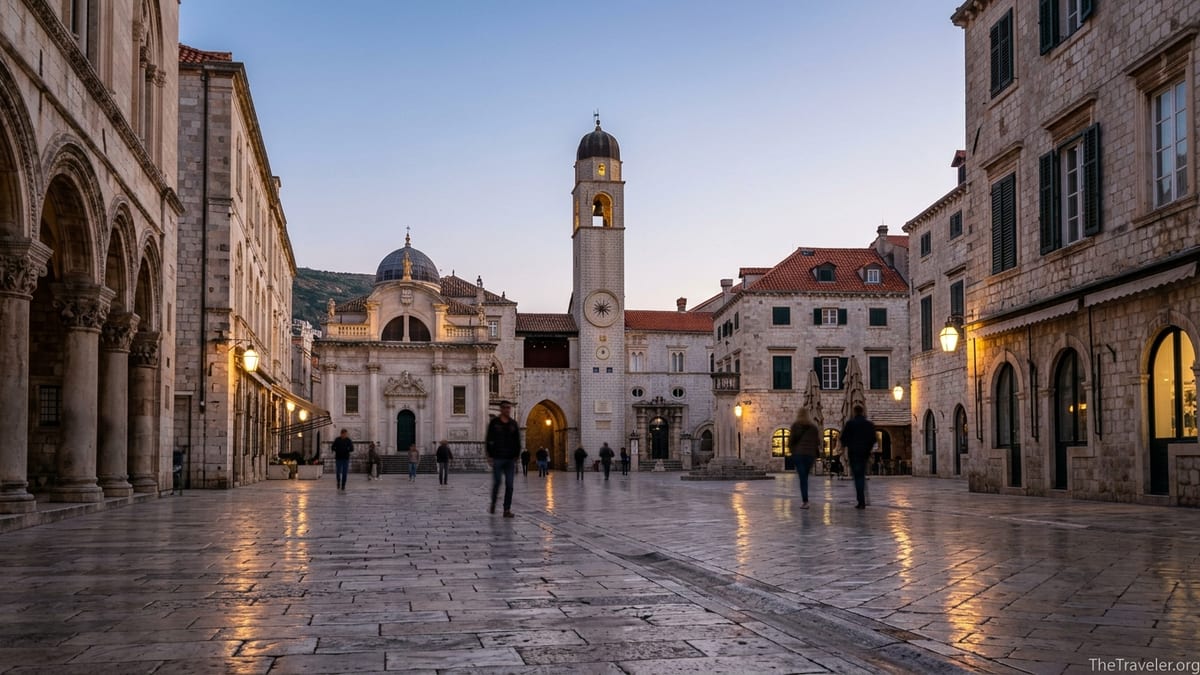
Luža Square: Working the Angles, Not the Crowds
Luža Square is the classic stage for the Bell Tower, framed by Sponza Palace, St Blaise Church and Orlando’s Column. It is also one of the busiest corners of the Old Town, especially between late morning and early evening when cruise groups flood down Stradun. To photograph the tower here without a sea of umbrellas and selfie sticks, treat the square less like a single photo spot and more like a small grid of micro locations. Each corner gives a subtly different angle, and moving just a few meters can turn a cluttered shot into a clean composition.
Arrive shortly after sunrise, when café chairs are stacked and the limestone is still damp from overnight cleaning. Stand near the steps of St Blaise Church and shoot across the square toward the Bell Tower, letting the church balustrade form a diagonal leading line into the frame. A 24 to 35 millimeter lens works well for capturing both tower and square without too much distortion. If you are traveling in summer, when sunrise is early and you are unlikely to be here at dawn, try the opposite approach and come at blue hour, around 30 minutes after sunset, when the tower’s clock face is lit and the crowds have thinned to a soft blur.
Another overlooked angle is along the edge of Sponza Palace, facing back toward Stradun. From here, you can compress the scene with a short telephoto lens, around 70 to 85 millimeters, isolating the Bell Tower against a backdrop of shopfronts and hanging lanterns. Wait for a local in neutral clothing or a waiter carrying a coffee tray to walk through the lower part of the frame, giving a sense of scale and everyday life. Because this part of the square is slightly tucked back from the main flow, you will often have time to compose carefully, even in the middle of the day.
Side Alleys Off Stradun: Framing the Bell Tower From the Shadows
From the Bell Tower, most visitors continue straight along Stradun. Photographers should do the opposite and slip into the narrow side alleys that peel away from the square. Within a dozen steps, the noise drops, light narrows into shafts, and you can use the alleys to frame the tower like a stage backdrop. This contrast between shaded stone and the bright tower creates depth that phone snapshots from the square rarely capture.
Look for an alley on the north side of Luža Square that gives you a view back toward the tower, its clock just visible between lines of laundry and shuttered windows. On a typical summer afternoon you might find a resident watering plants on a balcony or a cat asleep in a doorway. With a 35 or 50 millimeter lens, position yourself so the walls on either side create a natural vignette, drawing the eye toward the tower at the end. In mid afternoon, when the sun is high, the alley itself will be in shade, which helps control contrast and keeps details in the marble walls.
Another effective technique is to work low to the ground. Kneel or sit at the edge of a worn stone step and angle the camera upward so that the polished paving fills the foreground, with the tower rising in the distance. The scuffs and grooves in the limestone become texture that leads the eye forward. This is particularly striking after rain, when reflections shimmer in the stone and the tower’s silhouette is echoed in the puddles. Travelers with only a smartphone can still achieve this look by using the wide lens, switching to a low perspective, and tapping to expose for the sky so the tower does not blow out.
Gundulić Square to Jesuit Stairs: Layered Views Above the Bell Tower
A few minutes uphill from Luža Square, Gundulić Square and the Jesuit Stairs offer vertical views that most visitors rush past on walking tours. Early each morning, Gundulić Square hosts a small produce market, with stalls selling figs, cherries and local honey under striped awnings. Stand at the upper side of the square and look back toward the Bell Tower. Between the awnings and rooftops you can often catch the top of the tower peeking above the skyline, giving a layered, lived in feel that is very different from the formal view in Luža.
Continue up the Jesuit Stairs toward St Ignatius Church. Midway up, pause and turn around. The Bell Tower is usually just out of sight, but its position is implied in the axis of the stairway that leads down toward the heart of the Old Town. This is an ideal place for environmental portraits. Ask a willing travel companion to descend slowly while you shoot from above with a 50 millimeter lens, catching their silhouette against the sweep of steps and the hazy suggestion of rooftops beyond. Even without the tower physically in the frame, the lines of the staircase guide the viewer toward where it stands, making this an indirect but effective Bell Tower image.
At the top, in the small square in front of St Ignatius Church, the crowds thin even on busy days. Here you can work with wider focal lengths to capture the baroque church facade, the curve of the Jesuit college, and the red roofs stretching toward the sea. Look for moments when church bells ring from multiple towers, including the Bell Tower below, and capture locals crossing the square after mass. If you arrive near sunset, warm light will wash across the upper terraces, while the lower Old Town begins to slip into shadow, creating a gentle gradient of tone in your images.
City Walls Sections With Overlooked Bell Tower Sightlines
Dubrovnik’s city walls are famous for panoramas of terracotta roofs and the Adriatic, but many photographers do not realize that certain short stretches are ideal for subtle Bell Tower compositions. Once you are on the walls, resist the temptation to rush toward the highest viewpoints. Instead, pay attention to the lower eastern sections that run roughly parallel to Stradun and Luža Square. From here, you can line up the Bell Tower with clusters of chimneys, rooftop terraces and church domes, creating multi layered cityscapes.
An especially rewarding spot lies on the wall above the northern side of Luža Square. Lean gently on the parapet and look back toward the square, using a 70 to 135 millimeter lens to compress the rooftops into bands of color and shape. On hot days, white laundry often flutters between windows, and satellite dishes sit side by side with medieval stonework. Time your visit for late afternoon, when the sun slides behind Mount Srđ and side light reveals every tile and ridge on the roofs around the tower.
Another underused angle appears as the wall walk curves toward the Old Port. Here the Bell Tower lines up with the small harbor, bobbing fishing boats and the pale stone of the customs buildings. If your wall ticket is valid for the whole day, consider making a quick morning circuit, then returning again near closing time. Late in the day, admission queues are shorter, and you can wait for clean compositions without constant foot traffic behind you. Tripods are generally not practical on the walls due to narrow walkways and visitor flow, so rely on image stabilization and slightly higher ISO settings instead.
Old Port and Porporela Breakwater: Bell Tower Over Water
From Luža Square, follow the short passage under the Bell Tower toward the Old Port. Within a minute you emerge at the harbor, where fishing boats and small excursion vessels sit moored under the city walls. This is one of the few places where you can photograph the Bell Tower rising directly above the waterline, an angle many visitors miss because their focus turns to boat tours and island views. Stand near the inner corner of the harbor, facing back toward the Old Town. With a moderate wide lens, place the Bell Tower in the upper right of the frame, balancing it with hulls and ropes in the foreground.
For a more expansive version of the same idea, walk out to the Porporela breakwater at the harbor mouth. In late afternoon and early evening, locals come here to swim and watch the light change on the Old Town. From the end of the breakwater, the city walls curve away, and the Bell Tower appears as part of a jagged skyline of domes and battlements. This is a perfect spot for long exposure images as daylight fades. Rest your camera on the low stone wall, set a small aperture such as f/11 and a shutter speed of a few seconds, and let the sea blur into a soft surface while the tower and walls stay crisp.
If the weather turns cloudy or hazy, do not put the camera away. On overcast days, the contrast between sky and stone is softer, which helps preserve detail in the limestone and prevents blown highlights on the tower. You can also switch to black and white and focus on shapes rather than color. The curve of the harbor, the vertical thrust of the Bell Tower and the repetition of battlements along the wall become graphic elements that work especially well in monochrome prints.
Residential Staircases and Backstreets: Everyday Life Beneath the Tower
Some of the most atmospheric photographs around the Bell Tower are found on the residential staircases that climb the slopes of the Old Town behind the square. These stepped streets can be steep, with polished stone that becomes slick when wet, so flat shoes are essential. Start from Luža Square and head toward the northern backstreets, following whichever stairway looks most inviting. Within a few turns, the sound of tour groups fades and you are surrounded by potted plants, laundry lines and open doorways where families chat in the evenings.
As you climb, occasionally look back over your shoulder. In several places, glimpses of the Bell Tower appear between roofs and balconies, giving you a sense of how deeply it is woven into daily life. Try framing the tower above an outdoor table where someone has just finished lunch, or above a line of shirts drying in the afternoon breeze. A short telephoto lens, around 85 millimeters, allows you to isolate these vignettes without intruding on anyone’s privacy. Always be discreet and respectful, especially if shooting near open windows or doorways.
These backstreet staircases are also excellent locations for shooting after dark. As wall lights come on and windows glow, the Bell Tower often stands as a cool, pale silhouette against the warmer tones of the streets below. Use available light only and embrace a bit of grain. High ISO photographs can look beautiful in this setting, conveying the mood of warm summer nights when the stone still radiates heat and the bells mark the passing hours.
Practical Tips for Photographing Around the Bell Tower
Because this part of Dubrovnik is heavily visited, timing is your most effective tool. Cruise excursions typically concentrate in late morning and mid afternoon, so plan your Bell Tower images for early morning, late afternoon or night. Sunrise sessions are ideal for wide shots in Luža Square, while blue hour and early evening suit harbor views and city walls perspectives. Check approximate sunrise and sunset times for your travel dates and build at least one dedicated photography walk around them.
Weather also shapes your results. Clear midsummer days create strong contrast, deep shadows in the alleys and bright highlights on the Bell Tower’s pale stone. If you are visiting in high season, consider shooting in aperture priority mode at f/5.6 to f/8 and underexposing slightly by one third or two thirds of a stop to retain detail in the sky. In spring and autumn, when clouds are more common, you can afford a more balanced exposure and focus on texture and color. Light rain can be a gift, turning the marble streets into reflective surfaces that double the impact of the tower and surrounding facades.
Finally, think about what you want your images to say. Standard Bell Tower photos emphasize the monument itself; the more rewarding shots often use it as a secondary element that ties together people, streets and sea. Whether you are composing with a full frame camera and multiple lenses or relying on a single smartphone, move slowly, watch how locals use the space, and look for moments when the tower appears almost as a supporting character within a larger story of daily life in Dubrovnik.
FAQ
Q1. Can I go inside or up to the top of Dubrovnik’s Bell Tower?
Public access inside the Bell Tower itself is limited, and most visitors photograph it from Luža Square, nearby alleys, the city walls or the Old Port instead.
Q2. What is the best time of day to photograph the Bell Tower in Luža Square?
Early morning shortly after sunrise or late evening around blue hour offer the best combination of soft light, illuminated clock faces and fewer crowds.
Q3. Do I need special camera gear for these hidden photo spots?
No. A basic camera or smartphone is enough. A small wide angle lens for squares and a short telephoto for details will simply give you more flexibility.
Q4. Are tripods allowed around the Bell Tower and on the city walls?
In busy areas and on the walls, tripods can be impractical or discouraged because of narrow walkways. A compact monopod or image stabilization is usually more workable.
Q5. Is it safe to walk the backstreet staircases near the Bell Tower at night?
The Old Town is generally considered safe, but the stone steps can be very slippery. Walk carefully, avoid deserted corners late at night and stay aware of your surroundings.
Q6. How crowded does Luža Square get during peak season?
In summer, especially when cruise ships are in port, the square can feel packed from late morning through mid afternoon, so plan your photography walks for quieter hours.
Q7. Can I photograph local residents in the backstreets around the Bell Tower?
Yes, but always be respectful. Avoid pointing cameras directly into homes, and if someone is clearly identifiable, it is courteous to ask permission before shooting.
Q8. Are there good Bell Tower views included on standard walking tours?
Many walking tours pass through Luža Square, the Jesuit Stairs and sections of the city walls, but guides often move quickly, so you may want extra time to explore angles on your own.
Q9. What footwear is best for exploring these lesser known photo spots?
Comfortable shoes with good grip are essential. The polished limestone streets and staircases around the Bell Tower can be slick, especially after rain.
Q10. Can I still get good photos of the Bell Tower if the weather is cloudy or rainy?
Yes. Overcast light is flattering for stone textures, and after rain the reflective streets around Luža Square create beautiful mirrored views of the tower.