


Ask travelers what they remember most about day trips from Florence, and it is rarely a checklist of sights. Instead they talk about a conversation with a winemaker in Chianti, a late-afternoon stroll on Lucca’s walls, a plate of tagliatelle in Bologna or the smell of the sea drifting through a Cinque Terre village. Florence is an extraordinary city, but its greatest secret is how easily you can step beyond the famous landmarks into slower, more intimate corners of central Italy for a single unforgettable day.
Get the latest updates straight to your inbox!
Why Florence Makes Day Trips Feel Effortless
Florence’s appeal as a day-trip base is not only about the destinations around it, but about how simple it is to reach them. From Santa Maria Novella station, regional trains and buses fan out to Tuscan hill towns, wine valleys and the Ligurian coast. Travelers routinely use Florence as a hub, leaving after breakfast and returning in time for a late aperitivo on Piazza Santa Maria Novella. With regional tickets to cities like Pisa and Lucca often starting around 10 to 15 euros return, and frequent departures on the Tuscan “Memorario” timetable, many visitors find that they can choose their destination the night before and still travel comfortably the next morning.
For places like Siena, travelers often compare the regional train, which usually takes around 1 hour 30 minutes with a change at Empoli, to the direct bus that runs from Florence’s bus station near the center. Many end up choosing the bus because it is slightly quicker door to door and drops them close to Siena’s historic core, which means more time wandering the alleys around Piazza del Campo and less time in transit. Others happily pay more for a private transfer to maximize comfort, especially in high summer when air-conditioned vehicles and door-to-door pick-up can feel like a luxury worth the extra cost.
Crucially, day trips from Florence do not require complex logistics. A traveler might book a guided Chianti wine tour online a few weeks in advance for about 80 to 120 euros per person, including tastings and a Tuscan lunch, while keeping other days flexible for last-minute choices like a coastal escape to Cinque Terre or a food-focused run to Bologna. This combination of good public transport and an active tour market is what many visitors say allows them to see more of central Italy without constantly packing and unpacking.
Medieval Hill Towns: Atmosphere Beyond the Postcard
Siena, San Gimignano and smaller hill towns in Chianti and Val d’Orcia consistently rank among travelers’ favorite day trips from Florence, not only for their looks but for the feeling of stepping into another era. Visitors talk about the sound of their footsteps on stone as they climb towards Siena’s Piazza del Campo, where the sloping shell-shaped square creates a natural amphitheater for people-watching. Many remember simple moments: buying a slice of ricciarelli almond cookie from a bakery just off the piazza, sitting on the brick pavement with a coffee, or hearing church bells echo across the rooftops.
San Gimignano, sometimes nicknamed a medieval Manhattan for its towers, often surprises people who arrive expecting only crowds and souvenir stalls. Travelers who go in the late afternoon, especially outside high season, describe quiet lanes leading away from the main Corso, where local residents hang laundry from windows and cats sleep on warm thresholds. Joining a small-group tour that combines San Gimignano with a family-run winery in Chianti is a common choice. Typical itineraries cost in the region of 120 to 160 euros per person and include transport, a tasting of several Chianti Classico wines and a home-style lunch on a farmhouse terrace overlooking vines and olive groves.
Even lesser-known hill towns are gaining attention from repeat visitors. Cortona, made famous by a popular memoir but still far calmer than Florence, can be reached in roughly 1 hour 20 minutes by train to Camucia-Cortona followed by a local bus or taxi uphill. Travelers praise the views over Lake Trasimeno and the slower rhythm in the stone lanes, where an espresso at the bar might cost under 2 euros and locals still greet each other by name. What they remember is not a single monumental sight, but the accumulated sense of being briefly woven into everyday life in a Tuscan town.
Wine Country: Meeting the Makers in Chianti and Val d’Orcia
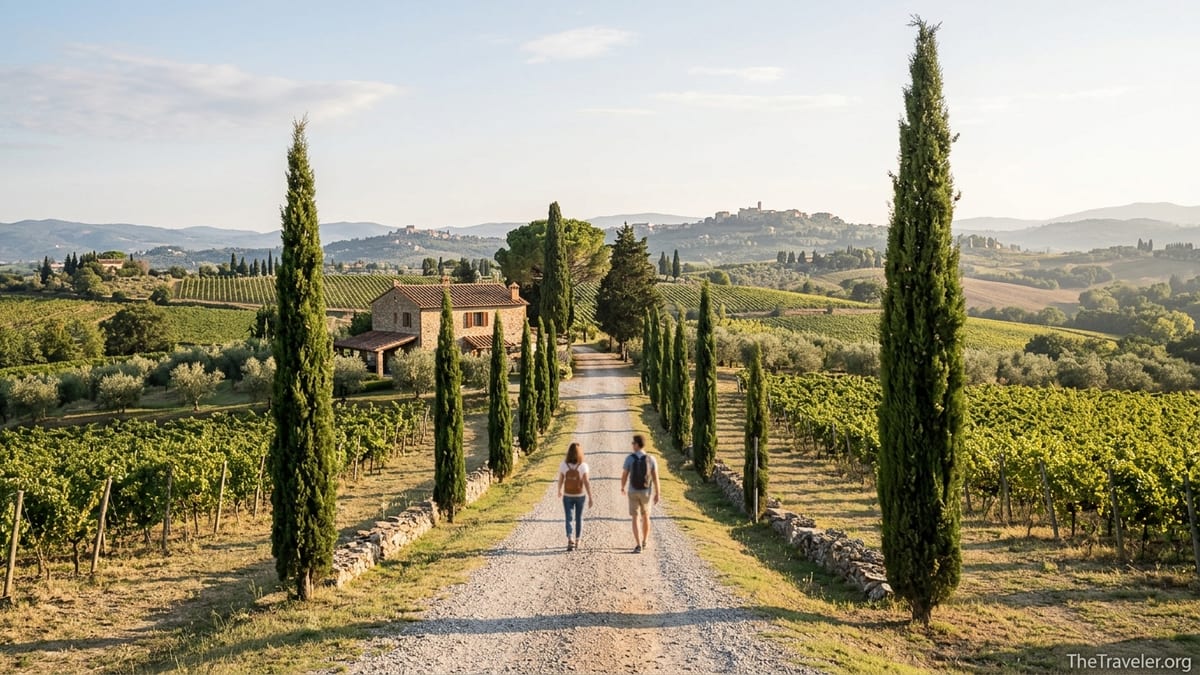
For many visitors, the highlight of leaving Florence for a day is trading museums for vineyards. Chianti Classico lies just 30 to 60 kilometers south of the city, close enough that travelers can stand between rows of Sangiovese vines by mid-morning. Reviews from recent years consistently praise small-group winery tours that depart Florence by minibus, stop at two or three estates for tastings, and include a lunch of local specialties like pappardelle al cinghiale, pecorino cheese and bruschetta drizzled with peppery new olive oil. Prices vary, but half-day options often start around 60 euros, while more in-depth full-day “Chianti safari” style tours, visiting three wineries and including a farmhouse meal, typically run closer to 120 to 150 euros.
What travelers love most is the personal contact. It is common for the owner or winemaker to lead a short cellar tour, explaining the difference between Chianti Classico aging in large Slavonian oak casks and Super Tuscan wines resting in smaller French barriques. Guests might taste six to eight wines, from a fresh Chianti Classico annata to a rich Gran Selezione, often paired with cured meats from neighboring farms. Some tours stop in a small village such as Greve or Panzano, where visitors can wander the main square, peek into a famous butcher’s shop, or sit at a café with an espresso while elderly locals play cards nearby.
Further south, the Val d’Orcia offers a more cinematic version of Tuscany, with rolling wheat fields, lone cypress trees and hilltop towns like Montalcino, Pienza and Montepulciano. Because the area is about 1.5 hours or more from Florence by car, many travelers book private day trips that cost more per person but allow a slower pace, often combining a Brunello di Montalcino tasting with a stroll through Pienza’s Renaissance streets. Visitors describe long lunches in agriturismi surrounded by fields, where a fixed-price menu for around 30 to 40 euros includes handmade pasta, roasted meats, vegetables from the garden and house wine served in simple jugs.
Even those who do not consider themselves wine experts often say a day in the Tuscan countryside was the moment their trip to Florence became a deeper Italian experience. Instead of just tasting wine, they remember watching the late-afternoon light slide across the hills as they drive back to the city, still carrying the smell of barrel rooms and wild herbs on their clothes.
Slow Cities: Lucca, Bologna and the Pleasures of Everyday Italy
Not every day trip from Florence is about vineyards or dramatic skylines. Increasingly, travelers seek out “slow cities” where the pleasure lies in wandering streets that feel lived-in rather than curated. Lucca, about 1 hour 20 minutes away by regional train, has become a favorite for those who like to mix light sightseeing with simple rituals. Visitors arrive at the station, walk ten minutes to the fortified walls, then rent a bicycle to circle the 16th-century ramparts under shade trees. Biking a full loop takes roughly half an hour of easy pedaling, with views over terracotta roofs and church towers. Many stop at a small café on the walls for a cappuccino or a glass of wine, noting that prices are often a little lower than in Florence’s historic center.
Bologna, reachable in about 35 minutes on high-speed trains from Florence, offers a different kind of escape. Food lovers in particular rave about using Florence as a base for a day devoted entirely to Emilia-Romagna’s cuisine. A typical itinerary begins at the covered markets near the medieval towers, where stalls are piled high with fresh pasta, mortadella, wedges of Parmigiano Reggiano and glistening tortellini. Lunch might be a plate of tagliatelle al ragù and a glass of Sangiovese for 15 to 20 euros, eaten at a simple osteria under Bologna’s characteristic porticoes. Travelers often mention that even just a few hours here give them a sense of a university town with a strong local identity, quite different from Florence’s Renaissance focus.
These slow cities also appeal to travelers who want a break from crowds. In Lucca, it is still possible to find a bench on the walls at midday and read a book without much noise beyond birds and distant church bells. In Bologna, side streets just a few blocks from the main piazzas quickly become quieter, filled with students on bikes and residents shopping at neighborhood grocers. Visitors come back to Florence saying that these day trips, which revolve around markets, cafés and conversations rather than famous monuments, made them feel closer to daily Italian life.
Coastal Escapes: The Allure and Reality of Cinque Terre
Cinque Terre appears on almost every Florence itinerary, even though it lies in neighboring Liguria. Travel time is significant, often close to 2.5 hours each way by a combination of trains from Florence to La Spezia and then onward to the villages. Yet many travelers still describe a Cinque Terre day trip as a highlight, especially if they are prepared for the long day and plan wisely. Recent practical guides suggest leaving Florence on an early train, often around 7:30 in the morning, choosing just two or three villages to explore rather than all five, and timing walks and swims to avoid the heaviest crowds between late morning and mid-afternoon.
What people remember most are sensory details that feel far from inland Florence. Stepping off the train at Vernazza or Manarola, they are greeted by the smell of the sea and the sight of pastel houses stacked on cliffs. Travelers write about jumping into the water from rocks in Riomaggiore, tasting a paper cone of fried seafood for 8 to 10 euros, or sipping a glass of local white wine on a terrace while trains rattle in and out of the tiny station below. Those who purchase a combined hiking and train pass for the day can mix short stretches of the coastal path with hops between villages, stopping whenever they find a quiet viewpoint or a café with shade.
Many visitors choose guided day tours from Florence that combine coach travel with regional trains and sometimes a boat ride along the coast. These excursions tend to be full-day affairs, often priced somewhere between 120 and 180 euros per person, including transport, a guide and some free time in several villages. Travelers frequently praise the logistics: early departures from central Florence, an air-conditioned bus across Tuscany, then a guide who manages train connections along the Cinque Terre so guests can focus on scenery instead of timetables. While some locals caution that visiting Cinque Terre as a day trip can feel rushed, those who treat it as a special long outing rather than a casual excursion usually return satisfied, especially outside the hottest summer months.
Hidden Tuscany: Thermal Baths, Cooking Classes and Rural Life
As classic destinations grow busier, more travelers are seeking quieter experiences within reach of Florence that still fit into a single day. One growing trend is spending a day at Tuscan thermal baths. Towns such as Bagno Vignoni, San Giovanni Terme Rapolano or Montecatini Terme offer spa complexes with naturally heated pools, saunas and wellness treatments. A day pass to outdoor pools often costs around 20 to 40 euros, and visitors can combine a few hours of soaking in mineral-rich waters with a leisurely lunch in town. Returning to Florence in the evening, many say they feel as if they have taken a short retreat rather than a sightseeing trip.
Rural cooking classes are another experience travelers now recall as a highlight. Many agriturismi in the hills around Florence organize half or full-day classes where guests learn to roll fresh pasta, prepare simple sauces and bake traditional desserts such as cantucci. A typical class, often priced in the region of 90 to 130 euros per person including lunch and wine, might start with picking herbs or vegetables from the garden and end with everyone sitting down at a long table on the terrace. Visitors talk about learning to make pici or tagliatelle from a nonna who speaks little English but communicates through gestures and laughter, creating memories that are as much about human connection as about recipes.
Other hidden corners include the Casentino and Mugello valleys, less-known areas of Tuscany covered in forests, small monasteries and scattered stone hamlets. Reaching them usually requires a car or an organized tour, which keeps them quieter than Chianti’s main wine roads. Travelers describe hiking to a monastery such as Camaldoli, then eating lunch in a simple trattoria where a full meal with house wine might cost under 25 euros. These places rarely appear on first-time Florence itineraries, but for those with several days in the city, they offer a completely different mood: cool chestnut woods, medieval castles and a sense of old rural Tuscany that has changed slowly over time.
How Travelers Actually Structure Their Day Trips
Beyond the destinations themselves, what many visitors love about day trips from Florence is how they structure the rhythm of their trip. A common pattern is to spend two or three intense days doing museums and churches in Florence, then insert a countryside or small-city day as a pause. That might mean a midweek Wednesday in Chianti between visits to the Uffizi and the Duomo, or a Sunday in Lucca cycling the walls when many Florentines are also out for a passeggiata. Travelers say these alternating days keep them from feeling overwhelmed by art and history, and help them appreciate Florence even more when they return in the evening.
Practical planning also shapes the experience. Many travelers buy regional train tickets to places like Pisa, Lucca or Bologna the day before their trip, often spending under 20 euros per person for a return journey. For more complex destinations such as Val d’Orcia or Cinque Terre, they tend to book small-group tours or private drivers several weeks in advance, especially in May, June, September and October when demand is highest. Leaving early is a recurring theme: people who take the 7:00 to 8:00 a.m. departures from Florence consistently describe cooler temperatures, less crowded streets on arrival, and the pleasure of having a village square almost to themselves for a morning coffee.
The small choices shape memories. A traveler might decide to skip the interior of Pisa’s cathedral to spend twenty extra minutes sitting in the grass, watching families pose with the Leaning Tower and listening to buskers. Someone on a wine tour may linger at the vineyard’s edge while others finish shopping, taking in the patterns of the vines and distant farmhouses. These pauses, made possible by itineraries that are not packed to the limit, are what many people later cite as their favorite parts of the day.
The Takeaway
Day trips from Florence are often marketed with dramatic images: leaning towers, medieval skylines, turquoise seas and rolling vineyards. Those views are real and compelling, but what travelers remember most tends to be quieter. It is the barista in Lucca who remembers their order on the second cappuccino, the winemaker in Chianti who pulls out a barrel sample “just to taste,” the elderly couple in Siena who give directions and insist on walking part of the way with them. Florence’s location and transport links make it easy to reach many corners of Tuscany and beyond in a single day, but it is these human and sensory connections that turn an excursion into a story.
Whether you choose a classic destination like Siena or Pisa, a leisurely day in Lucca or Bologna, a wine-focused escape to Chianti or Val d’Orcia, or a longer adventure to Cinque Terre, the key is to leave room in your schedule for unplanned moments. With an early start, realistic expectations and a willingness to wander side streets instead of chasing every landmark, your day trips from Florence can become some of the most vivid memories of your time in Italy.
FAQ
Q1. Can I really visit Cinque Terre as a day trip from Florence?
Yes, it is possible, but it is a long day. You should expect roughly 5 to 6 hours of total travel time and plan to visit only two or three villages. Taking an early train from Florence and traveling outside the busiest summer months will make the experience more enjoyable.
Q2. Is the train or bus better for a day trip from Florence to Siena?
Both are viable, but many travelers prefer the direct bus because it is slightly faster door to door and arrives closer to Siena’s historic center. Regional trains usually require a change at Empoli and take around 1 hour 30 minutes, which some visitors still enjoy for the scenery.
Q3. How much should I budget for a Chianti wine tour from Florence?
Half-day group tours that include transport and tastings often start around 60 euros per person, while full-day experiences with multiple wineries and a farmhouse lunch typically range from about 100 to 150 euros. Private tours cost more but offer extra flexibility.
Q4. Are day trips from Florence suitable for families with children?
Yes, many are. Places like Lucca, with its pedestrian-friendly walls and parks, work especially well for families. Some wineries in Chianti welcome children and provide outdoor space to play, and coastal days in Cinque Terre can be fun if you plan around naps, shade and swimming breaks.
Q5. Do I need to book day trips in advance or can I decide last minute?
For simple train-based trips to Pisa, Lucca or Bologna, you can often decide the day before and still find seats on regional trains. For popular guided experiences such as Chianti wine tours or Cinque Terre excursions, it is wise to book at least a couple of weeks ahead in high season to secure your preferred date.
Q6. What should I wear for day trips from Florence?
Comfortable walking shoes are essential, especially for cobbled streets and hill towns. In summer, light breathable clothing, a hat and sunscreen are important, while evenings may call for a light sweater in spring and autumn. For winery visits, casual but tidy outfits are perfectly acceptable.
Q7. Are there quieter alternatives if I want to avoid crowds?
Yes. Instead of the busiest destinations, consider smaller towns in Chianti, the Casentino or Mugello valleys, or thermal spa towns like Bagno Vignoni or Rapolano Terme. These areas see far fewer tour groups but still offer classic Tuscan scenery, good food and a slower pace.
Q8. Can I combine multiple places in one day, like Pisa and Lucca?
Combining Pisa and Lucca works well because both are on the same rail line and each is compact enough for a half day. Many travelers visit Pisa’s Leaning Tower area in the morning, then continue to Lucca for an afternoon of cycling the walls and exploring the old town before returning to Florence in the evening.
Q9. Is renting a car a good idea for day trips from Florence?
Renting a car can be very rewarding for exploring rural areas such as Val d’Orcia or remote villages, but it comes with challenges. Driving in Florence itself is stressful due to restricted traffic zones and limited parking, so many visitors choose to rent from locations on the city’s edge or rely on guided tours instead.
Q10. How early should I leave Florence for a successful day trip?
Leaving between 7:00 and 8:30 in the morning usually works well. Early departures mean cooler temperatures, fewer crowds at major sights, and more flexibility if you want to linger over lunch or add an extra stop before returning to Florence in the evening.