


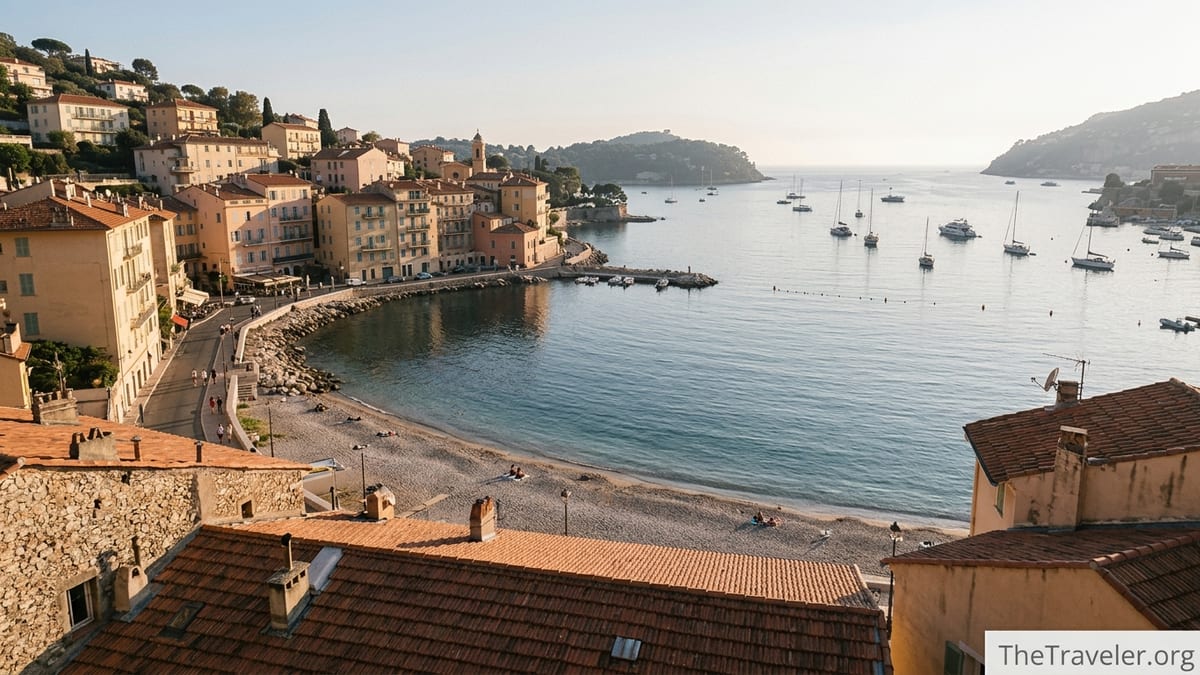
Villefranche-sur-Mer looks like a watercolor postcard: sherbet-colored houses, a perfect curve of beach and yachts floating in a deep blue bay. Many travelers arrive assuming it will be an effortless Riviera daydream, only to discover a few practical surprises about transport, crowds, prices and even the pebbly beach. With a little advance knowledge, though, Villefranche can be one of the most rewarding stops on the Côte d’Azur. Here is what most visitors wish they had known before they arrived.
Get the latest updates straight to your inbox!
Understanding the Layout Before You Arrive
The first surprise in Villefranche-sur-Mer is how compact yet vertical it is. The village unfolds in three tiers: the waterfront quay where cruise tenders arrive, the tangle of old town lanes just behind it and the railway line that runs along the bay slightly higher up, with Plage des Marinières stretching beside it. Distances on the map look tiny, but there are staircases everywhere. A "five-minute walk" from the train station to the old town can feel longer if you are wheeling a heavy suitcase or pushing a stroller along steps and cobbles.
Many cruise passengers step off the tender, see the pretty strip of restaurants in front of them and assume that is the whole town. In reality, some of Villefranche’s most atmospheric corners, like the vaulted Rue Obscure and the quiet lanes above the waterfront, sit a few staircases up. First-time visitors often say they wish they had explored higher instead of lingering only by the water. Planning for short but frequent climbs helps you make better use of limited time, especially on a half-day visit.
If you are staying overnight with large luggage, it is important to know exactly where your accommodation sits in this vertical puzzle. An apartment that looks "close to the beach" on a booking map might actually be up a steep flight of steps with no vehicle access. Travelers who arrive by train with 23-kilogram rolling suitcases frequently find themselves hauling bags up from the seafront under the midday sun. Checking in advance whether your hotel or rental offers step-free access, a lift or at least help with bags can make your arrival far easier.
The modern marina-style infrastructure many travelers expect from a big port simply does not exist here. There is no vast terminal building, no covered shopping arcade and no long taxi rank. Villefranche is a real village that happens to host cruise passengers and day-trippers, and its scale and infrastructure reflect that. Once you accept that you are in a lived-in community rather than a purpose-built resort, the quirks become part of the charm.
Getting In and Around: Trains, Taxis and Tender Boats
Another thing many visitors wish they had understood earlier is how crucial the train is. The regional TER line that links Villefranche-sur-Mer to Nice, Monaco, Menton and Cannes is the backbone of local transport. From Villefranche station, the ride to Nice-Ville usually takes around 7 to 10 minutes, and to Monaco around 15 minutes. Trains run fairly frequently in the daytime, and a single ticket typically costs only a few euros. For day-trippers based in Nice, this makes Villefranche one of the easiest and cheapest excursions along the coast.
The walk between the village and the train station is straightforward but not entirely flat. From the seafront, you follow the curve of the bay, then climb a short staircase to reach the elevated platforms that overlook Plage des Marinières. This catches some visitors off guard, especially anyone with mobility issues. If you use a stroller or have trouble with steps, building extra time into your schedule is wise. Many travelers recommend downloading the SNCF Connect app before arrival so you can check real-time schedules, platform changes and any strikes or delays without hunting for a ticket office.
Taxis and ride-hailing services are more limited than many visitors expect from a Riviera hotspot. You may find a small cluster of taxis near the waterfront, particularly when a cruise ship is in town, but counting on a cab for your return to the ship or to the airport can be risky. In high season or at the end of the afternoon, demand often outstrips supply. Visitors who budgeted for a quick taxi to Nice airport are sometimes forced to hoof it to the station and jump on a crowded commuter train instead. If you need to catch a flight, it is much safer to plan on the train plus the tram in Nice, or to pre-book a private transfer.
For cruise passengers, tender boats are another point of confusion. Large ships anchor in the deep natural harbor off Villefranche and passengers are ferried ashore in small boats that deposit them right at the heart of the village. What surprises many guests is how long the tendering process can take when several excursions depart at once. On busy mornings, people have reported waiting 30 minutes or more to disembark, which eats into a short day in port. Returning to the ship near the all-aboard time can involve similar delays. Most seasoned cruisers now aim to be back at the tender dock at least an hour before the deadline, especially if they have relied on the regional train to return from Nice or Monaco, which can occasionally be disrupted by strikes.
Timing Your Visit: Crowds, Seasons and Daily Rhythms
From May to September, Villefranche-sur-Mer can feel far busier than its modest size suggests. Cruise ships schedule calls on many days in the warm months, and independent visitors pour in from Nice. Midday in July often brings a thick band of beach towels along Plage des Marinières, lines at the most photogenic ice cream kiosks and restaurant terraces that fill by 12:30 p.m. Many recent visitors say they wish they had realized just how crucial timing is to enjoy the village at its best.
If your schedule allows, arriving early makes a dramatic difference. Catching a morning train from Nice around 8:30 or 9:00 a.m. in summer can put you on the waterfront before most cruise tenders are unloading. At that hour, the alleyways of the old town are still cool and quiet, bakery counters are full and the beach has plenty of space. Similarly, late afternoons and early evenings often feel more relaxed after day-trippers have drifted back to Nice. Travelers who stayed for dinner in the village frequently comment that Villefranche recovers its small-town atmosphere once the day crowds recede.
Shoulder seasons such as late April, early June and late September offer another way to beat the crush while still enjoying warm, swimmable water. Outside the peak of school holidays, hotel and rental prices in Villefranche and nearby Nice are often a bit softer, and you are more likely to find a waterfront table without reserving weeks ahead. Winter can be surprisingly pleasant as well, with plenty of sunshine and far fewer people, though some beach services and smaller restaurants may close or keep shorter hours. Visitors who arrived in February or March often mention how refreshing it was to see local life without the layer of high summer tourism.
Daily rhythms also catch some first-timers unprepared. Lunchtime in France tends to be more fixed than in many Anglophone countries, and even in a touristy village like Villefranche most kitchens close between mid-afternoon and early evening. It is common for restaurants that serve lunch from about 12 p.m. to 2:30 p.m. to shut down food service until 7 p.m. or later. Travelers who disembark from a cruise at 3 p.m. looking for a sit-down meal are often disappointed to find only ice cream, panini or simple snacks available. Knowing this in advance lets you plan to eat on board at odd hours or to time your shore visit around a proper seaside lunch.
Beaches and Swimming: What the Postcards Do Not Show
The curve of Plage des Marinières is one of the most photographed scenes on the French Riviera. Up close, though, many first-time visitors are surprised to discover that this is not a fine sand beach. Like most of the coastline between Nice and Menton, Villefranche’s main beach is made up of pebbles and coarse sand. The stones are smoother than the round rocks on Nice’s main city beach, but they can still be uncomfortable under bare feet. People who arrived expecting soft sand often end up buying inexpensive rubber water shoes from kiosks near the station so they can stroll into the sea without hopping in pain.
The water in the bay is usually calm and sheltered, and the depth drops off quite quickly. This helps keep the swimming area clear of boats, but it can surprise weaker swimmers and parents with small children. The first few meters are shallow, then the bottom slopes more steeply than on many typical family beaches. Hiring a foam float or bringing a small inflatable can give nervous swimmers extra confidence. The village’s other small coves, including those closer to the old town, are rockier and less comfortable for all-day lounging, but they can be lovely for a short dip or a quiet moment between sightseeing.
Facilities on Plage des Marinières are better than many visitors expect from a simple village beach, but they are not limitless. In peak season, you can usually find at least one beach bar or snack hut selling drinks, sandwiches and ice cream, as well as sections with loungers and parasols for rent at typical Riviera prices. Paying for a pair of sunbeds and an umbrella for the day can easily cost the equivalent of a casual restaurant lunch for two, which frustrates travelers on tighter budgets. Others note that the free sections of beach, while perfectly usable, can be crowded and lack shade.
There are also some local etiquette points that newcomers are often unaware of. Smoking on the beach is officially restricted in parts of the Riviera, but enforcement can be inconsistent, and some travelers are surprised by the number of people who still smoke near their towels. Dogs may be allowed in specific zones but not everywhere, and a small cove that locals use for dog walking can be less clean than the main family area. In summer, experienced visitors often aim to swim in the morning, then retreat into the old town or take a train along the coast for the hottest and busiest hours, returning to the water in late afternoon when the sun softens.
Food, Prices and Avoiding Disappointment
One of the most common refrains from visitors is that they wish they had known where to eat and what to expect from prices. The waterfront strip right opposite the tender dock is wonderfully convenient and offers postcard views, but it also includes some of the most tourist-oriented establishments in the village. Menus are often translated into several languages, with familiar items like pizza, burgers and generic pasta dishes offered at a premium. People sometimes walk away from an expensive but average meal there thinking Villefranche is overrated, when in fact the experience just did not match the setting.
A short wander up into the streets behind the quay can make a big difference. Tucked-away bistros and family-run restaurants often serve more careful cooking at similar or only slightly higher prices than the volume-driven places at the water’s edge. Recent travelers note that a simple but well-prepared plat du jour at a small brasserie in the old town might cost roughly the same as a bland tourist pizza on the front, but with more local character and better ingredients. Even something as simple as choosing the daily fish special accompanied by seasonal vegetables rather than defaulting to the most familiar dish on the menu can transform a meal.
Prices across the Riviera can be high by international standards, especially for drinks. Visitors regularly mention paying around the cost of a light meal elsewhere in Europe for two Aperol spritzes of average size on a prime-view terrace. A small espresso at a café bar, by contrast, can still be relatively reasonable. Many travelers adopt a strategy of having coffee and a pastry in Villefranche, saving big restaurant blowouts for Nice or smaller inland villages, or buying picnic supplies from a supermarket or local market and enjoying them on the beach or a bench overlooking the bay.
Another frequent source of disappointment lies in expectations around "fine dining". Villefranche is primarily a relaxed seaside village rather than a showcase for experimental cuisine. If you arrive expecting a string of Michelin-starred addresses, you may feel underwhelmed. Those looking for ambitious tasting menus might be happier booking a special-occasion meal in nearby Nice or Monaco, then using Villefranche for simpler pleasures: grilled fish, socca and pan bagnat from a local stand, a scoop of lemon sorbet enjoyed on the pier. Framing your expectations correctly goes a long way toward leaving satisfied rather than underwhelmed.
Culture Shock, Language and Everyday Etiquette
Villefranche-sur-Mer sits in one of the most international corners of France, and English is widely heard in restaurants and on the waterfront. That said, visitors often comment that they wish they had been more prepared for small cultural differences. Simple details like greeting shopkeepers with a "bonjour" when you enter, or saying "au revoir" when you leave, make interactions noticeably smoother. Staff used to a heavy influx of day visitors can appear brusque when dealing with hurried cruise passengers, but those same people often warm dramatically when approached with a bit of basic French courtesy.
Opening hours can also be more traditional than newcomers expect, particularly once you step away from the seafront. A small bakery in the back streets may close by early afternoon, and some independent boutiques shut entirely on Sundays or Monday mornings. Travelers who wander up into the old town at 2 p.m. expecting continuous shopping are sometimes disappointed by shuttered façades. Checking typical opening days and times before planning a major shopping session helps avoid frustration, especially outside the main summer season.
Cruise visitors sometimes experience a subtle disconnect between their highly organized life on board and the slower, more improvisational pace on shore. Lines at public toilets, pauses while a tiny grocery restocks its sandwich fridge or a café that insists on clearing and resetting your table before serving anyone else can feel exasperating when you are watching the clock. The more you can mentally allow for small delays and minor inefficiencies, the more you will enjoy the organic rhythms of village life, from children playing football in the square to older residents chatting on benches facing the sea.
In practical terms, cash still plays a role. Most restaurants and larger cafés accept cards, including contactless payments, but tiny snack stands, ice cream kiosks or independent market vendors sometimes impose minimum charges or prefer cash for small purchases. Having a modest amount of euros in your pocket avoids awkward moments at the exact time you spot the perfect slice of socca or a souvenir magnet. Visitors who arrived relying entirely on their phone wallet have occasionally been caught out when batteries died after a long day taking photos.
Planning Day Trips and Choosing a Base
Many travelers only glimpse Villefranche-sur-Mer on a cruise or as a quick side trip from Nice. Increasingly, though, visitors choose to base themselves here for several nights and use the train to explore the wider Riviera. Those who do often wish they had understood earlier just how easy certain day trips are and how tiring others can be without a car. Towns strung along the same train line, such as Nice, Beaulieu-sur-Mer, Monaco and Menton, are straightforward, with direct journeys and stations close to the main sights. Inland hilltop villages like Saint-Paul-de-Vence and Eze Village require more planning because buses are less frequent and the terrain is steep.
Staying in Villefranche rather than Nice can be a delight if you value quiet evenings and sea views. Guests who book apartments facing the bay often describe eating breakfast on the balcony as the highlight of their trip, watching cruise ships arrive and local fishermen head out. The trade-off is that you have far fewer late-night bars, shops and services at your doorstep. For people who want nightlife, shopping and an easy tram link to the airport, Nice is usually a more practical base, with Villefranche treated as a favorite side trip for beach time and a slower pace.
Time management for day trips is another area where visitors express regret. Trying to combine multiple Riviera highlights into a single day from Villefranche can become a blur of trains and buses. For example, squeezing Eze Village, Monaco and Menton into one outing leaves little time to actually enjoy Villefranche’s own beach and citadel. Many seasoned travelers suggest building at least one "no-transport" day into any stay of three nights or more, to let yourself simply roam the alleyways, swim and linger over a long lunch in the village without checking a timetable.
If you are arriving on a cruise and debating whether to head straight to Nice or Monaco, it is worth asking what you really want from the day. Nice offers broad city beaches and vibrant markets, while Monaco delivers casinos and dense urban spectacle. But travelers increasingly report that they spent most of their port day rushing to and from these famous neighbors and wished they had devoted more time to Villefranche itself. For some, the best compromise is a short morning hop by train to Nice’s old town or Monaco’s harbor, followed by a relaxed afternoon back on Plage des Marinières before returning to the ship.
The Takeaway
Villefranche-sur-Mer is not a resort built to anticipate every visitor’s needs. It is a compact Mediterranean village layered on steep terrain, with a small but busy beach, a working harbor and a constant flow of cruise tenders and commuter trains. That mix can confuse first-timers who arrive expecting either sleepy authenticity or slick resort polish. Most of the frustrations people describe, though, come down to mismatched expectations around crowds, transport, prices and the simple realities of a stone-and-pebble coastline.
With a bit of forethought, those same characteristics become strengths. Knowing that you will walk stairs rather than roll a suitcase across wide pavements helps you pack lighter. Understanding that the best meals are likely to be a block or two back from the quay encourages you to explore the old town. Accepting that the train is your friend opens up an easy string of coastal day trips. Plan for these realities, and Villefranche-sur-Mer delivers exactly what the postcards promise: luminous light, a deep natural harbor framed by terracotta roofs and the feeling of stepping into a smaller, slower world just a few minutes from one of Europe’s busiest coasts.
FAQ
Q1. Is Villefranche-sur-Mer a good base instead of staying in Nice?
Many travelers find Villefranche-sur-Mer an excellent base if they prioritize sea views and a quieter atmosphere. The train to Nice takes only around 7 to 10 minutes, so you can easily reach the larger city for markets, museums and nightlife, then return to the calm of the village in the evening. The trade-off is fewer shops and late-night options at your doorstep compared with staying in central Nice.
Q2. How long do I really need in Villefranche-sur-Mer?
If you are arriving on a cruise, a relaxed half day can cover a stroll through the old town, a visit to the citadel and a swim at Plage des Marinières. For independent travelers, one full day lets you combine sightseeing with beach time. Staying two or three nights allows you to enjoy the village at quieter times and use it as a base for short trips to Nice, Beaulieu-sur-Mer or Monaco without feeling rushed.
Q3. Is the beach in Villefranche sandy or pebbly?
Plage des Marinières is mostly pebbles and coarse sand rather than fine, powdery sand. The stones are smoother and smaller than those on Nice’s main city beach, but many visitors still prefer to wear water shoes or bring a beach mat. Once you know to expect pebbles, most people find the clear, calm water more than compensates for the lack of soft sand.
Q4. Do I need a car to explore from Villefranche-sur-Mer?
You do not need a car to visit the main coastal towns. The regional train connects Villefranche to Nice, Beaulieu-sur-Mer, Monaco, Menton, Antibes and Cannes, usually in under an hour, and tickets are inexpensive. Buses and occasional taxis can fill in the gaps. A car can be useful for inland hill villages with sparse public transport, but driving and parking along the coast can be stressful, particularly in peak season.
Q5. Is Villefranche-sur-Mer very expensive?
Prices reflect its location on the French Riviera. Drinks with a prime sea view and restaurant meals on the waterfront can be costly compared with inland France. However, everyday items like coffee at a bar, bakery pastries and supermarket picnics remain relatively affordable. Choosing to eat one main meal per day in a slightly backstreet restaurant and using the train instead of taxis helps keep overall costs manageable.
Q6. How crowded does Villefranche get in summer?
In high season, especially on days when large cruise ships are anchored in the bay, the waterfront and main beach can feel very busy from late morning to mid-afternoon. Trains may be crowded and restaurant terraces fill quickly. Early mornings and evenings are noticeably calmer. Traveling in late spring or early autumn reduces the intensity of the crowds while still offering pleasant weather.
Q7. What should I know about eating out in Villefranche-sur-Mer?
Restaurant kitchens often keep fairly fixed meal times, generally serving lunch around midday to mid-afternoon and then closing before reopening for dinner in the evening. Booking ahead is advisable for popular places, especially if you want a waterfront table at sunset. Exploring a block or two inland usually reveals smaller, more characterful spots where the cooking is more local in style than on the most touristy strip.
Q8. Is Villefranche-sur-Mer suitable for families with children?
Yes, many families enjoy staying here because the bay is relatively sheltered and the village is compact. The quick drop-off in water depth means close supervision is important for younger children, and the pebbly beach can be hard on unprotected feet, but the lack of heavy road traffic along the seafront and the short walking distances appeal to parents. Stairs and cobbled lanes can make strollers a bit of a workout.
Q9. How accessible is Villefranche-sur-Mer for people with limited mobility?
The terrain can be challenging. Much of the old town sits on a slope, connected by staircases and uneven cobblestone streets. The walk between the train station, beach and waterfront involves some inclines and steps. The flat seafront promenade is easier, and some cafés and restaurants are accessible at street level, but visitors with significant mobility issues often prefer to stay on the waterfront rather than venture up into the higher lanes.
Q10. What is the best way to get to Villefranche-sur-Mer from Nice Airport?
A common approach is to take the airport tram toward central Nice, then change to a regional train from Nice-Ville or Nice-Riquier station to Villefranche-sur-Mer. The total journey time is usually under an hour, depending on connections. Pre-booked transfers or taxis can be more direct but cost significantly more. Arriving with lighter luggage makes the short walk and steps between the station and most accommodations much easier.