


The image most travelers carry of the French Riviera is a blur of superyachts in Monaco, celebrity billboards in Cannes, and sun loungers packed shoulder to shoulder on Nice’s pebbly beaches. Villefranche-sur-Mer sits just around the headland from all that, on the same glittering coast, yet it changed my idea of the Riviera more than anywhere else. A few days in this small bay town quietly rewrote my expectations of what a Côte d’Azur trip could feel like.
Get the latest updates straight to your inbox!
Arriving in a Different Riviera
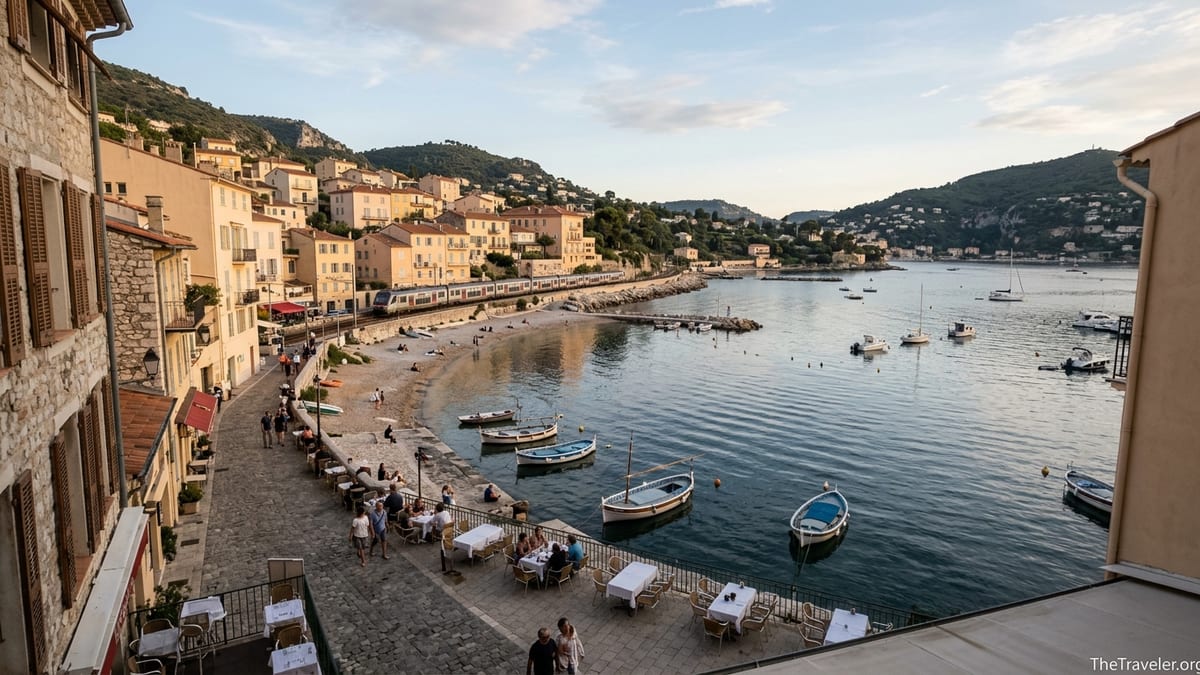
It takes about seven minutes by regional train to travel from Nice-Ville station to Villefranche-sur-Mer, but the psychological distance is much greater. One moment you are stepping around rolling suitcases on the Promenade des Anglais, the next you are walking down a ramp from the little station directly onto Plage des Marinières, with a curve of pastel houses cupping a deep natural harbor. You can arrive mid-morning from Nice, as many day trippers do, and within half an hour be floating in clear water with only the distant hum of trains behind you.
What surprised me first was the scale. Villefranche’s old town is tiny: a handful of steep lanes, a few sets of worn stone steps, a small church square, and the 16th century citadel overlooking the bay. You can walk almost the whole core of town in an hour, unlike Nice or Cannes where you might spend that long just crossing from the train station to the sea. Yet this compactness does not feel limiting. For a long weekend I rarely checked a map. I knew that if I kept going down I would hit the harbor, and if I went up I would eventually find the main road and the bus stops bound for Nice, Beaulieu or Monaco.
Even the way you move here is different. In Nice, I used trams, Ubers and long waterfront walks. In Villefranche, most of my “transport” was stairs and short strolls: from a simple rental apartment overlooking Rue du Poilu down to the boulangerie near the water for a morning baguette, or across the bay-front promenade to whichever café had the shadiest terrace. The effect is subtle but powerful. Instead of planning every day around transit and timetables, my days centered on tides, light and appetite.
On my first afternoon, I watched a cruise ship at anchor in the bay release boat after boat of passengers into the tender dock. For a couple of hours the harborfront filled with English, Italian and American voices reading menus and taking photos. By early evening they were gone again, leaving a town that felt like it had exhaled. It was the moment I realized Villefranche is both part of the Riviera’s mass tourism machine and, after certain hours, largely free from it.
Old Town Alleys Instead of Red Carpets
Like many visitors, I had imagined the Riviera as a line of polished promenades and luxury boutiques. Villefranche’s old town offers a different aesthetic: faded terracotta facades, paint peeling in the sun, laundry hanging between shuttered windows, cats asleep on stone steps that have seen centuries of feet. There are a few chic galleries and interior design shops, but they share space with basic corner groceries and a tabac where locals buy their newspapers and lottery tickets.
One morning I followed the curve of Rue Obscure, the town’s semi-covered medieval street that runs just behind the seafront. The ceiling is low in places, pierced by shafts of light where side passages climb back to the upper lanes. At one end an elderly resident had left a plastic chair outside her door to catch the breeze; at the other, a guide was quietly explaining the street’s defensive history to a small group of cruise passengers. In those few meters, you see the collision of everyday life and tourism that defines the modern Riviera, but in a much more intimate way than in Cannes or Monaco.
Even the churches tell a humbler story. The Chapelle Saint-Pierre, down by the fishing port, is a small 14th century chapel whose interior was famously reimagined by Jean Cocteau in the 1950s. You pay a modest entry fee at a tiny desk, then step into a space full of soft pinks, blues and sketches of fishermen and saints. It is a deeply local vision of spirituality and sea life that feels very far from the ostentatious cathedral in Monaco or the grand basilica in Nice.
What this old town shifted, for me, was the sense that the French Riviera had to be about spectacle. Instead of tuxedoed galas and red carpets, my memories are of buying a slice of pissaladière from a takeaway window on Rue du Poilu, then eating it on a low harbor wall while watching kids practice diving off the pier. The town is polished enough to be pretty, but frayed enough at the edges to feel like somewhere people actually live, not just pose.
Beach Days That Do Not Feel Like a Performance
Before Villefranche, my Riviera beach experiences had been dominated by Nice’s large pebbles and regimented private clubs that rent sunbeds for the day. On Plage des Marinières, which hugs the curve of the bay beside the train station, I discovered a softer version of beach life. The shore is a mix of fine pebbles and coarse sand, and while there are a couple of private sections with loungers and waiter service, most of the beach is free. Families spread out towels, locals swim laps across the bay before work, and teenagers cluster around the snack kiosks with paper cones of fries.
On my visit, a rented sunbed with umbrella in a midsize beach club here cost noticeably less than in central Nice, and a simple coffee or rosé on ice was closer to inland France prices than to Monaco’s. You can spend nothing at all by bringing a supermarket picnic from the small Carrefour on the main road or the Spar near the harbor, or you can claim a little comfort for a half-day splurge. Either way, the bay’s unique geography makes swimming more pleasant than on many other Riviera beaches: the harbor is deep, which means big cruise ships can anchor, but the inner curve where people swim shelves gradually and is sheltered from large waves.
The other difference I felt was psychological. On the private beaches in Cannes or the most central stretches of Nice, beach days sometimes feel like an event you dress for. In Villefranche, beach time is casual. Locals walk down in flip-flops and basic towels. There is no need for a designer beach bag, though you will see a few. I bumped into the same café waiter on his day off, swimming with friends and a cheap inflatable. Somehow that made my own time in the water feel less like a consumable experience and more like borrowing a piece of everyday life.
If you want more variety, coastal paths link Villefranche to neighboring Saint-Jean-Cap-Ferrat and Beaulieu-sur-Mer, where smaller coves and rockier swims await. One evening I walked part of the path towards Cap Ferrat, past hidden stairways that dropped to tiny local beaches with no facilities at all, only rocks, ladders into the sea and a scattering of people who clearly knew they were lucky. It was an antidote to the hyper-managed beach clubs I had associated with the Riviera.
Using Villefranche as a Base Changes Your Itinerary
Many people see Villefranche as a half-day stop from Nice. Staying several nights flips the logic of a Riviera trip. Instead of basing in the city and escaping to smaller towns when you crave calm, you sleep in the quiet place and commute into the bustle when you want restaurants and nightlife. Because trains run frequently along the coastal line between Cannes and Ventimiglia, this is far easier than it sounds in planning.
From Villefranche station, it is typically under 10 minutes by train to Nice and around 20 to Monaco, with Menton or Antibes within roughly 45 minutes to an hour depending on the service. During my stay I spent one afternoon wandering the alleys of Èze village via a bus connection from the coast, another day buying socca and ice cream in Old Town Nice, and a third visiting the gardens above Monte Carlo. In each case I returned in the evening to a place where the loudest sound after midnight was clinking cutlery from a harborfront terrace.
Practicalities support this slower approach. There are a handful of mid-range hotels and many short-term rentals set into the hills, some with small balconies overlooking the bay. It is worth understanding that what looks like a short distance on a map can involve serious staircases; booking somewhere near the harbor or lower old town is kinder on knees and luggage. For groceries, the small supermarkets in town are adequate for breakfasts and picnics, though prices can run higher than inland France. For variety or bigger shops, a quick train or bus into Nice opens up full-size markets and department stores.
What changed in me through this base choice was how I measured a “successful” day. Instead of checking off a long list of Riviera names, I was content with one outing and a swim. A morning in Antibes wandering its old town and Picasso Museum, followed by an hour on Villefranche’s beach and a simple seafood dinner on the harbor, felt richer than dashing through four famous towns in one exhausting loop.
A Different Relationship With Money and Glamour
The French Riviera has a reputation for conspicuous wealth, and you certainly see it in Villefranche’s marina, where superyachts sit alongside modest fishing boats. Yet staying here made that glamour feel more like background texture than the defining feature of the trip. Instead of budgeting for luxury club entries or designer shopping, my expenses revolved around simple pleasures: a morning espresso at a waterfront café, a plate of moules-frites at a mid-range brasserie, a scoop of lemon sorbet while watching the light change on the citadel walls.
Meals in Villefranche tend to be slightly cheaper than at equivalent spots on Nice’s prime seafront or Monaco’s harbor, especially if you avoid the most tourist-oriented menus and step one or two streets inland. Ordering the plat du jour at a local bistro, often fish caught nearby or a Niçoise classic like stuffed vegetables, usually offers good value. You can also tap into the local transport passes used by commuters rather than buying tourist excursions, keeping day trip costs modest compared to organized tours sold in big hotels.
One evening I took the train to Monaco for a few hours to see the famous casino and harbor. The polished marble, luxury boutiques and hyper-expensive wine lists were fascinating, but I found myself almost relieved to step back on the train to Villefranche. There, a carafe of house rosé on a terrace cost a fraction of a single glass in Monte Carlo, and the view of the bay felt, to me, just as spectacular. The contrast helped me understand that the Riviera’s charm does not require a luxury budget; it requires choosing where you want to sit, and why.
Villefranche also softened some of the pressure I had felt in Nice to “do it all.” Without a long checklist of famous museums or nightlife districts, it was easier to spend a whole evening lingering over dinner or sitting on a bench overlooking the harbor. Watching locals greet each other, servers chatting with regulars and children playing by the water reminded me that the Riviera is, for many, simply home.
Season, Crowds, and the Rhythm of a Small Port
Timing matters more here than it might in a bigger city. Between late spring and early autumn, cruise ships frequently anchor in the bay, sometimes one after another on the same week. When tenders begin shuttling passengers ashore, the quayside and lower streets swell with visitors, and restaurants can fill quickly at lunchtime. On one of my days, an early cruise arrival meant that by 10 am the café terraces around the harbor were almost full, and the line for ice cream snaked down the promenade.
By late afternoon, though, the rhythm changes. Once the last tender returns to the ship, the streets quieten noticeably. If you are staying in town, this is your moment: dinner reservations become easier, the beach empties out, and the golden light on the water feels more private. Planning your day around this pattern, perhaps by taking your own excursion to Nice or Beaulieu during peak cruise hours and returning after 4 pm, can make a big difference to how peaceful Villefranche feels.
Seasonally, the months from April to June and September into early October offer perhaps the best compromise. In shoulder season, many hotels and restaurants are open, water temperatures are tolerable for swimming, and the worst of the summer heat and crowds are absent. High summer brings longer swimming days and more evening buzz on the waterfront but also busier trains, higher accommodation prices and more competition for sun space on Plage des Marinières. In winter, a number of places close or reduce hours, yet the town retains a low-key charm and can work as a quiet base for coastal walks and day trips.
Learning to read this rhythm was another way Villefranche changed my relationship to the Riviera. Instead of assuming every day had to be perfect weather and uncrowded sights, I began to think like a resident: early swims before the cruise tenders, errands during the midday rush when I might be elsewhere along the coast, and slow, late dinners once things had calmed. It made the trip feel less like an invasion and more like a temporary participation in local life.
The Takeaway
Villefranche-sur-Mer did not alter the physical realities of the French Riviera: the same trains still link Cannes, Nice, Monaco and Menton; the same superyachts still gleam in the distance; the same sun paints the sea in sheets of silver each evening. What it changed was my framework. It showed me that you can experience this famous coast at human scale, from a small harbor town where mornings start with the smell of bread and the screech of swallows, not the sound of traffic or nightclub bass.
By choosing Villefranche as a base or at least as more than a short stop, you discover a Riviera where days are measured in swims and conversations rather than checklists. Where glamour is something you can dip into and then leave behind. Where the defining scenes are not just casino facades and red carpets but old stone alleys, kids jumping off piers, and the quiet of a medieval citadel at dusk. For many travelers, that shift might be the most valuable souvenir they bring home from this celebrated coast.
FAQ
Q1. Is Villefranche-sur-Mer a good base instead of staying in Nice?
Yes, if you prefer a quieter atmosphere with easy access to Nice and Monaco by train. You trade big-city convenience and nightlife for a smaller, more relaxed town feel and a sandy-pebble beach right at your doorstep.
Q2. How long should I stay in Villefranche-sur-Mer?
Two to four nights works well for most travelers. That gives you time for at least one full beach day, exploring the old town and citadel, plus a couple of day trips to places like Nice, Èze or Monaco.
Q3. Do I need a car to explore the French Riviera from Villefranche?
No. Regional trains and local buses run frequently along the coast between Cannes and Menton, stopping at Villefranche. For most visitors, public transport and walking are enough, and parking in town can be challenging in high season.
Q4. What is the beach like in Villefranche-sur-Mer?
Plage des Marinières is a long curve of mixed sand and small pebbles beside the train line. Much of it is free, with a few sections of paid sunbeds and simple beach cafés. The water is generally calm and clear.
Q5. When is the best time of year to visit Villefranche-sur-Mer?
Late April to June and September to early October usually offer the best balance of pleasant weather, open restaurants and manageable crowds. July and August are hotter, busier and more expensive, while winter is quiet with reduced services.
Q6. Is Villefranche-sur-Mer expensive compared to other Riviera towns?
It is not cheap, but everyday costs like café drinks and casual meals are often a bit lower than in Monaco and parts of central Nice. Self-catering some breakfasts and picnics helps keep budgets under control.
Q7. What are the must-see sights in Villefranche-sur-Mer itself?
The highlights include wandering the old town lanes, walking Rue Obscure, visiting the citadel and its ramparts, seeing the Jean Cocteau decorated Chapelle Saint-Pierre, and spending time on Plage des Marinières.
Q8. How crowded does Villefranche get when cruise ships are in port?
Harborfront streets and some restaurants can be noticeably busier for a few hours when tenders bring passengers ashore. Crowds usually peak late morning to mid-afternoon and ease again toward evening.
Q9. Is Villefranche-sur-Mer suitable for families with children?
Yes. The sheltered bay, relatively gentle beach slope, compact town center and frequent trains make it practical with kids. Just be prepared for hills and stairs if your accommodation is higher up.
Q10. How does Villefranche compare to Monaco or Cannes for nightlife?
Villefranche is much quieter. You will find relaxed bars and waterfront restaurants, but not big clubs or late-night scenes. For more intense nightlife, most people take the train or taxi into Nice or Monaco and return afterward.