


More news on this day
Rail travel on one of Britain’s busiest north–south corridors has been thrown into chaos after two passenger trains collided near Bedford on Friday, leaving a driver dead and scores of passengers injured as investigators begin piecing together what went wrong.
Get the latest news straight to your inbox!
Collision on a Key Route into London
Publicly available information indicates that the crash occurred on the evening of Friday, 19 June 2026, on the main line between Bedford and Luton, around 60 miles north of central London. The section of track forms part of the busy route into London St Pancras, used by long-distance and commuter services linking the capital with the East Midlands and beyond.
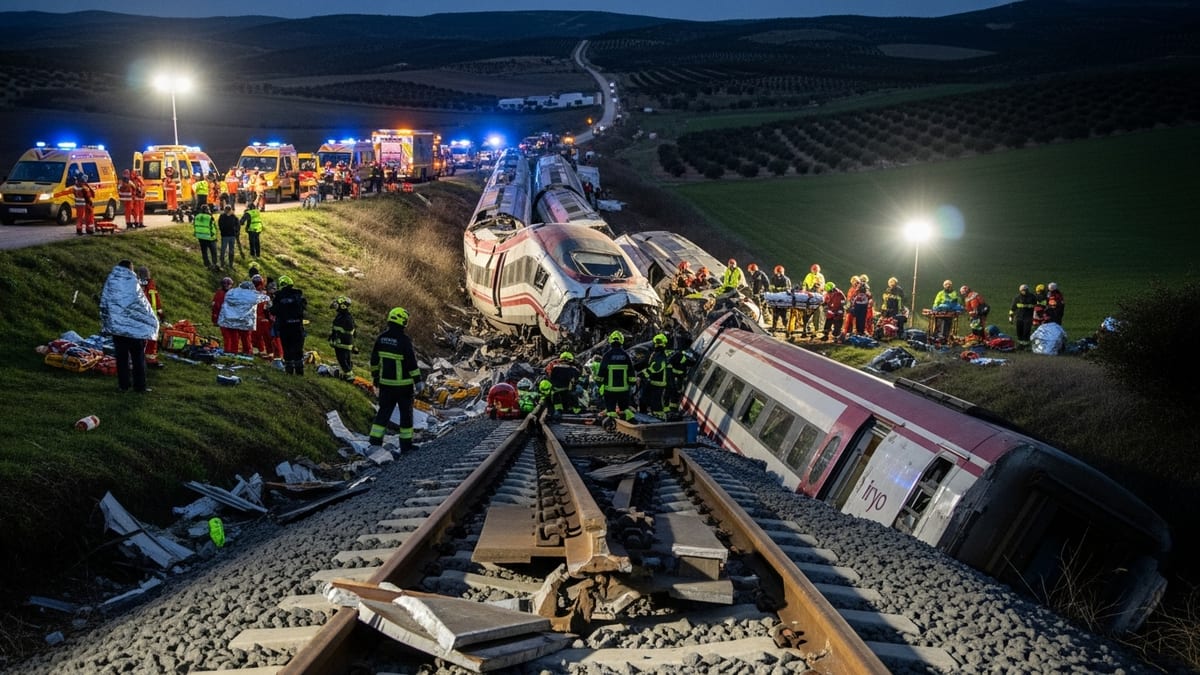
Reports from multiple outlets describe the incident as involving two southbound East Midlands Railway services traveling toward London. One train from Corby and another from Nottingham were operating on the same corridor when they collided on the approach to Bedford, with images from the scene showing crumpled carriages and extensive damage to the leading cab of one unit.
According to rail-tracking data cited in news coverage, the impact occurred shortly after 5:15 p.m. local time, at the height of the evening peak. The timing meant that both trains were carrying significant numbers of passengers, contributing to the scale of the injuries reported and magnifying the disruption along the line.
Emergency alerts treated the situation as a major incident on the railway south of Bedford, prompting an immediate suspension of services through the area. Long-distance and commuter trains to and from London St Pancras faced widespread cancellations and diversions, with knock-on disruption expected to affect weekend travel plans for many passengers.
Casualties and Scale of the Injuries
Published coverage indicates that at least one person, believed to be a driver, died in the collision. Early tallies from broadcasters and international news agencies describe a significant number of injuries among passengers and crew, with figures evolving as hospitals and emergency services update their assessments.
Several reports refer to dozens of injured passengers, including a substantial group classified as seriously hurt. Some accounts place the total number of injured people close to or above 80, including a mix of minor, serious and very serious cases. The most severe injuries appear to be concentrated in the front cars of the trains where the force of the impact was greatest.
Descriptions from passengers shared in media reports refer to individuals being thrown forward on impact, with broken bones and visible lacerations. Carriages closer to the rear of the trains appear to have fared better, though many travelers still required medical checks for shock, whiplash and other non life-threatening conditions.
Hospitals in the region, including facilities in Bedford and Luton, activated emergency protocols to receive a surge of patients. Public statements from local health providers asked residents not directly affected by the crash to avoid emergency departments unless absolutely necessary, enabling staff to focus on those arriving from the scene.
Major Emergency Response on the Line
The response to the Bedford crash drew a large, multi-agency operation along the railway corridor. Publicly available information shows that the East of England Ambulance Service dispatched numerous ground ambulances, specialist hazardous area teams and at least one air ambulance to the location, treating and triaging casualties on and around the tracks.
Fire and rescue services from Bedfordshire and surrounding areas deployed crews to assist with extracting passengers from damaged carriages, stabilizing the train units and ensuring there were no ongoing fire or electrical risks. Police and transport officers established cordons along nearby roads and farmland to secure access routes for emergency vehicles and to manage concerned relatives and onlookers.
Images circulated by news organizations show lines of emergency vehicles positioned along access tracks and field margins, with temporary treatment areas set up close to the railway. Rescuers used ladders, walkways and portable lighting to move safely between carriages and to guide passengers away from the scene as daylight began to fade.
Rail incident procedures were activated to coordinate between local services, national rail operators and infrastructure managers. Control centers worked to isolate power, assess the stability of the rolling stock and begin planning the complex recovery operation needed to remove damaged trains and repair track and signalling equipment.
Early Focus on How the Crash Happened
While it remains too early for definitive conclusions, initial reporting has outlined several areas likely to be central to the investigation. Rail-focused coverage and specialist commentary point to the possibility that one of the trains may have been stationary or moving slowly on the line when it was struck from behind by the other service, raising questions about signalling, braking and operational decision-making.
Some accounts reference a potential issue with onboard safety systems, with suggestions that a technical fault may have triggered a stop on the line prior to the collision. Other reports highlight unconfirmed comments about the condition of one of the drivers, though investigators are expected to rely on official medical assessments, train data recorders and signal logs rather than speculation.
The Rail Accident Investigation Branch is expected to conduct a detailed inquiry, reviewing digital event recorders, signal box data and communications between train crews and control centers. Infrastructure managers will also be scrutinizing the condition of track circuits, signals and automatic warning systems in the area, along with any recent maintenance or upgrade work.
Experts quoted in wider media coverage note that Britain’s rail network has a strong overall safety record, making a high-casualty rear-end collision on a major main line particularly serious. The investigation is likely to examine whether existing layers of protection functioned as intended and if any additional safeguards might have reduced the severity of the impact.
Ongoing Disruption for Travelers
For passengers, the Bedford crash has had immediate and far-reaching consequences, particularly for those relying on East Midlands Railway services into and out of London. Operator statements cited in travel reports describe severe disruption on the route between London St Pancras, Bedford and stations further north, with trains cancelled, diverted or terminating short of their usual destinations.
Rail updates suggest that services linking London with Nottingham, Derby, Sheffield and Corby are among the most affected, as trains are rerouted via alternative lines where capacity allows. Passengers traveling on connecting services, including those using other operators at St Pancras and nearby King’s Cross and Euston, are also being advised to check journey planners carefully and expect extended journey times.
Network managers have warned that damage to rolling stock, track and signalling equipment will take time to assess and repair, meaning disruption is likely to extend through the weekend and potentially into the following week. Engineers must first ensure the site is safe for detailed examination before cranes and specialist recovery vehicles can be brought in to move the trains.
Travel analysts point out that the affected corridor is a vital link not only for long-distance journeys, but also for daily commuting and airport access. With the summer travel season ramping up, the Bedford crash is expected to prompt renewed scrutiny of contingency planning on key intercity routes and how quickly normal service can be restored after a major incident.