


Few travel products divide opinion quite like hop-on hop-off buses. For some travelers, companies such as Big Bus Tours turn an overwhelming city into an easy loop of must-see sights. For others, these double-deckers crawl through traffic, burn precious daylight and cost more than they are worth. The truth sits somewhere in the middle. Used strategically, hop-on hop-off buses can save you serious time and mental energy; used blindly, they can slow your entire trip to a halt.
Get the latest updates straight to your inbox!
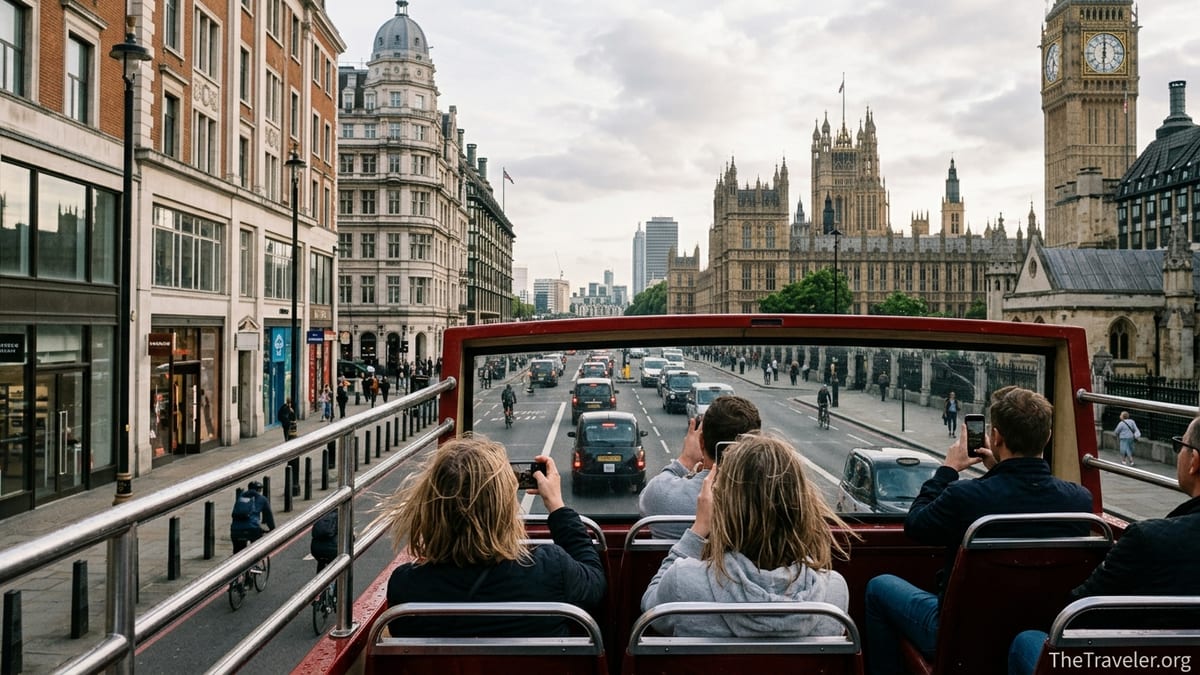
What Big Bus Tours Actually Offer
Big Bus Tours operates in major cities from London and Paris to New York and San Francisco, typically using open-top double-decker buses on fixed circular routes. In London, for example, Big Bus runs three day routes, with the core Red Route looping central highlights such as Buckingham Palace, Westminster Abbey, the London Eye, St Paul’s Cathedral and the Tower of London, plus additional branches that reach areas like Kensington and Notting Hill. Tickets usually come in 24 or 48-hour formats, counting from the first time you scan your pass, which encourages you to cluster your sightseeing within that time window.
These tours are built on two promises: you can hop on and off as often as you like at designated stops, and you get live or recorded commentary as you ride. In practice, that means you might board near Trafalgar Square, listen to background stories on Nelson’s Column and the National Gallery as you head down Whitehall, hop off at Westminster to visit the abbey, then catch another bus afterwards to continue over Westminster Bridge toward the South Bank. In a compact morning, you have strung together several high-value stops without wrestling with a map or Underground connections.
Beyond the core loop, Big Bus increasingly sells its tickets as bundles. In London and Paris, many passes now include extras like a short river cruise, a guided walking tour or a night tour. In Paris, the panoramic night tour is a non-stop 2-hour circuit that departs from Avenue de l’Opéra in the evening and swings past the Eiffel Tower, Notre-Dame and Montmartre as the monuments light up. That kind of add-on is not about transportation efficiency at all, but about packaging a classic city experience into a fixed, predictable window.
Understanding what these buses are optimized for is the starting point to deciding whether they will save you time or slow you down. They are designed to simplify decisions and bundle sightseeing, not to function as a fast, point-to-point transit system.
When Big Bus Tours Clearly Save You Time
Big Bus and similar operators shine brightest when you are short on time in a large, visually dense city and want an overview without intricate planning. Picture a first-time visitor landing in London on a Friday morning with only a weekend to spare. Instead of piecing together Tube lines and bus routes straight away, they could buy a 24-hour Big Bus ticket, walk from their Westminster hotel to the nearest stop around 9 am, and let the circuit carry them past Parliament, St Paul’s Cathedral, the City and the Tower of London. Hopping off at just two or three key sites still leaves them having “seen” a long list of landmarks from the top deck, camera out, headphones in, within a single day.
This time-saving effect is strongest when attractions cluster tightly around the official stops. On London’s Red Route, Westminster Abbey, the Houses of Parliament and the London Eye are all within a roughly 10-minute walk of each other; riding the loop between those, then walking short distances, is often faster than working out multiple Underground hops. In Paris, the central route that strings together the Louvre, Musée d’Orsay and the Eiffel Tower does something similar, letting you see three headline museums and monuments in one structured day, especially if you buy tickets in advance and use timed entries at the museums.
Another scenario where these tours save time is when public information is fragmented or in a language you do not speak comfortably. In Dubai, for instance, Big Bus routes connect the historic Al Fahidi district, Dubai Mall, the Marina and the Palm area, combining metro-accessible zones with more awkward beach and resort strips. A hop-on hop-off circuit can compress hours of taxi negotiations and wayfinding into an afternoon, aided by audio commentary in multiple languages. The focus here is not speed measured in minutes, but speed measured in how quickly you can navigate an unfamiliar urban sprawl without getting overwhelmed or stuck.
Finally, bundled extras can concentrate several experiences into a single ticket. In London, a 48-hour Big Bus ticket that includes a Thames river cruise and a guided walking tour effectively pulls three separate products into one logistics plan. You might ride the bus loop in the morning, disembark at Westminster Pier for an afternoon cruise to Tower Bridge, then join an evening walking tour in Covent Garden. Doing the same with uncoordinated bookings can add friction, because you have to align distant meeting points and timings yourself.
When Big Bus Tours Quietly Cost You Hours
Where travelers get burned is assuming these buses are rapid-transit systems on wheels. In high-traffic cities, hop-on hop-off buses move at the mercy of congestion and red lights. In New York, for example, daytime traffic on Midtown avenues can be so slow that a dedicated sightseeing loop across Times Square, the Theater District and down Fifth Avenue may take well over two hours to complete, even though the same distance might be walked in under 45 minutes or covered by subway in minutes. If you decide to stay on the bus “just to get a full loop,” you can easily sacrifice half a day to sitting in gridlock.
Frequency is another hidden time cost. Big Bus advertises intervals as low as every 15 to 20 minutes on core routes in London during peak season, with longer gaps on less-used links. In reality, bunching and traffic mean that two buses may arrive back-to-back, followed by a longer gap. If you hop off spontaneously at somewhere like Marble Arch for a quick coffee and miss a just-departed bus, you could wait 20 or 30 minutes for the next one on a busy afternoon, particularly outside the center or in shoulder seasons when operators reduce frequency.
Linear route designs can also waste time if you use the bus for every move, rather than combining it with local transit or walking. In Paris, if you ride from the Eiffel Tower all the way round via the Champs-Élysées, Place de la Concorde and the Louvre to get to Notre-Dame, the loop may be scenic but far slower than taking the Métro or walking part of the route along the Seine. Travelers sometimes do this without realizing that the bus is intentionally meandering to cover more landmarks, not to deliver you to your “next stop” efficiently.
Finally, some experiences bundled into hop-on hop-off products are better treated as stand-alone bookings for time efficiency. A night tour that leaves at a fixed time from a central departure point can add value if you align your dinner and daytime sightseeing around it. But if you have to cross town in rush hour, detouring from your natural route just to board that specific departure, you may be better off using regular public transport and enjoying lit-up monuments from the river or streets instead.
The Role of Season, Weather and Time of Day
How much time a Big Bus tour saves or wastes often depends on the calendar and the clock. In mid-summer, open-top double-deckers rolling through London or Paris under long daylight and clear skies can be a delight. You have hours of light, landmarks reveal their facades, and traffic often becomes slightly more forgiving outside of weekday commuter peaks. In contrast, a raw November afternoon in wind and drizzle can transform that same open-top seat into a miserable, time-sapping endurance test, especially if you find yourself waiting unsheltered at a stop as a delayed bus inches through traffic.
Season also affects operating hours and frequency. In winter, operators typically shorten days and run fewer buses, concentrating service in the late morning and early afternoon. That matters if you like early starts: arriving at a stop at 8 am in January might mean standing there until close to 9 am for the first departure. On a short city break, losing an hour each morning to waiting at a bus stop because you did not check seasonal schedules can undo much of the convenience advantage these tours are meant to provide.
Time of day within each season brings its own trade-offs. Morning loops often move faster before traffic builds, making them ideal for using the hop-on hop-off bus primarily as orientation and transport. Midday and late afternoon departures, particularly on weekdays, tend to suffer from heavier congestion around business districts and shopping streets. In New York, a downtown loop that seems breezy at 10 am can grind along by 3 pm as delivery trucks, cabs and rideshares clog intersections around SoHo and Chinatown.
Special events can magnify these patterns. Around London during the Trooping the Colour ceremony or a large protest, route diversions can lengthen circuits significantly or temporarily close certain stops, forcing you to walk extra blocks or switch to the Underground. During major sports events, street markets or holiday parades in cities such as Rome or Barcelona, it is common to see hop-on hop-off buses rerouted or slowed to a crawl. Checking your dates against local event calendars and operator service updates is essential if you want the bus to be a time saver rather than a rolling traffic jam.
Using Big Bus as a Strategic Tool, Not a Crutch
The travelers who get the most out of Big Bus and similar services tend to treat them as one tool in a wider kit. They use the bus as a structured orientation loop on day one, then pivot to public transport, rideshares or walking on subsequent days. A common and effective strategy in London is to ride the full Red Route once, ideally in the morning when traffic is lighter, listening to the commentary and taking notes on which neighborhoods appeal. After that, they might only use the bus for two or three key hops, such as from Trafalgar Square to the Tower of London, and rely on the Tube for cross-city moves.
Planning your “hops” ahead of time pays dividends. Before you board, mark two or three must-see anchors on the map where the bus genuinely aligns with your day: perhaps Westminster, the Tower area, and Kensington in London; or the Eiffel Tower, the Louvre area and Notre-Dame in Paris. Then commit to walking or using local transit for everything in between. For instance, once you hop off at the Louvre, it is almost always quicker to explore the Tuileries, Place de la Concorde and the Champs-Élysées on foot, looping back to a different bus stop later, rather than riding the bus in short segments between each.
It also helps to separate the sightseeing value of the bus from its transport value. Maybe you decide that you want exactly one full, top-deck loop with commentary as a relaxing “city highlight reel,” then afterwards you will treat the bus only as a backup ride when you are tired or the weather turns. This mindset prevents you from reflexively staying on board just because “it is included,” a habit that quietly eats time.
Finally, avoid overloading a single day with too many bus segments. If your schedule in New York lists five separate hops on a sightseeing bus between Midtown, the Financial District, Brooklyn viewpoints and back to Times Square, you are effectively outsourcing your entire day to traffic. Reworking that plan to use the bus for just one or two scenic runs, and the subway or ferries for the rest, nearly always frees up hours while still giving you those elevated skyline views.
Real-World City Examples: London, Paris and New York
In London, Big Bus’s three main routes give a useful illustration of when hop-on hop-off saves time. The Red Route focuses on central highlights with frequencies reported around every 15 to 20 minutes in high season, while the Blue Route stretches further west and can take over three hours to complete a full circuit. A traveler staying near Victoria who wants to see Buckingham Palace, Westminster Abbey and the Tower of London in one day can reasonably use the Red Route to link these, especially if they time their boarding just after a bus has arrived and choose stops with short walks to entrances. However, trying to ride the full Blue Route in addition on the same day would likely turn into a long, slow loop that leaves little time inside attractions.
Paris shows how bundled products can change the calculation. A Big Bus night tour offers a two-hour, non-stop circuit past the Eiffel Tower, Notre-Dame and other icons lit after dark. For a short-stay visitor who might otherwise spend an evening puzzling over Métro connections and river-cruise timetables, having a fixed departure point and a guaranteed window of illuminated views can be efficient, even if the actual loop is not the fastest way between any two points. During the day, though, riding a hop-on hop-off route along the Seine when you only need to travel between the Louvre and the Latin Quarter can be slower than simply crossing the river on foot and taking one Métro stop to Saint-Michel.
New York, with its dense subway network and heavy surface traffic, is the strongest example of where sightseeing buses can easily slow you down if misused. Midtown and downtown loops may pass Times Square, the Empire State Building, the Flatiron District, the World Trade Center and Battery Park in one continuous ride. That sounds efficient on paper, but anyone who has watched crosstown buses creep along 42nd Street or Canal Street in the afternoon knows how quickly minutes turn into hours. Using a hop-on hop-off ticket primarily for one or two long, scenic rides, then switching to the subway to travel between neighborhoods, tends to preserve the time-saving benefits without subjecting your entire day to surface congestion.
In all three cities, the pattern is the same: hop-on hop-off works best when it traces roughly the same path you would follow anyway, connects major sights that cluster around convenient stops, and operates at times of day with manageable traffic. As soon as you find yourself staying seated “just because the loop is there,” you are on the verge of letting the bus dictate your schedule instead of the other way around.
How to Decide If a Big Bus Tour Fits Your Trip
A useful starting question is: what problem are you actually trying to solve? If you want a stress-free overview on your first day, with minimal navigation effort and built-in commentary, then a 24-hour Big Bus pass in cities like London, Paris or Dubai can be an excellent fit, especially if your accommodation is within a short walk of one of the early-morning stops. If, however, your main goal is to maximize the number of museum hours or restaurant visits in a tight schedule, the slow pace of surface traffic might clash with your priorities.
Next, map your must-see list against the route. Take a sample itinerary: in London, perhaps your non-negotiables are the Tower of London, Borough Market, the Tate Modern and an evening in Soho. Big Bus will deliver you neatly to the Tower and Westminster, but it may not align perfectly with your outbound or late-night journeys to and from Soho, where the Underground and regular buses run late and often faster. In this case, a hop-on hop-off pass can be a good supplement for one sightseeing-heavy day, rather than the backbone of your whole visit.
Budget is another factor. Hop-on hop-off passes cost more than a day’s worth of standard public transport in most cities. If money is tight, you need to be sure you will extract enough value in saved planning time, stress reduction and bundled extras. A traveler based next to a central Underground station in London, who is comfortable reading Tube maps and does not care about commentary, might be better served by a simple transit pass and a walking tour. A jet-lagged family with children, staying a bit further from the center, might find that paying more for Big Bus buys them reduced friction and fewer “where are we going now?” arguments.
Finally, consider your travel style. If you like wandering side streets, lingering in cafés and making spontaneous detours, an over-planned day tethered to a bus timetable can feel suffocating. In that case, you might use hop-on hop-off only for orientation and long cross-city moves, freeing the rest of your time for unstructured exploration. If you prefer the clarity of having your whole day mapped to a known circuit, the predictability of a Big Bus route can be reassuring, even if it is not always the fastest option between A and B.
The Takeaway
Big Bus Tours and other hop-on hop-off services are neither magic time-saving machines nor guaranteed time wasters. They are structured sightseeing tools with specific strengths and weaknesses. Embraced for what they do best, they can compress an overwhelming city into a set of digestible loops, padded with commentary and bundled experiences. Miscast as rapid transit, they can tie you to traffic-clogged streets, long waits and a sense of watching your limited vacation hours slide by from a bus seat.
The key is to make an intentional choice. Look at your must-see list, your time frame, the city’s public transport options and the specific routes and frequencies on offer during your dates. Decide whether you want an orientation loop, a bundled package of views and extras, or a point-to-point workhorse, and match your expectations accordingly. Used sparingly and strategically, Big Bus can absolutely save you time. Used indiscriminately, it has an uncanny ability to slow your trip in ways you only recognize after the bus doors have already closed.
FAQ
Q1. Are Big Bus Tours worth it for a short city break?
They can be, especially if you have one or two days in a large, complex city and want an easy overview with minimal planning. If your priority is maximizing time inside specific museums or restaurants, you may get better value from public transport combined with walking.
Q2. Do hop-on hop-off buses actually save time compared with the metro or subway?
Usually they do not beat metro or subway speeds. Their time advantage comes from simplified navigation and bundled sightseeing, not raw travel time, so they work best when you value convenience and commentary over minute-by-minute efficiency.
Q3. When is the best time of day to ride a Big Bus loop?
Morning departures typically move faster and are less crowded, especially on weekdays before traffic and tour groups build up. If you plan to use the bus mainly for transport, start early and keep afternoon rides to a minimum.
Q4. How many stops should I realistically plan to use in one day?
For most travelers, three to five well-chosen hops in a single day is realistic. More than that and you risk spending more time waiting at stops and crawling through traffic than actually exploring the places you came to see.
Q5. Are night tours on open-top buses a good use of time?
They can be, especially in cities like Paris or London where landmarks are dramatically lit. A fixed, two-hour panoramic loop can efficiently deliver night-time views without you having to juggle multiple connections, as long as the departure point fits naturally into your evening plans.
Q6. What should I check before buying a Big Bus ticket?
Look up the current route map, operating hours and estimated frequency for your travel dates, and compare those with your hotel location and must-see list. Also check whether any major events or roadworks might cause diversions that could lengthen journey times.
Q7. Is it better to ride a full loop first or hop on and off immediately?
Riding one full loop at the start can be smart for orientation, especially in a new city. After that, treat the bus as occasional transport between clusters of sights, rather than automatically using it for every move.
Q8. How do Big Bus Tours compare with local public buses?
Local buses are usually cheaper and can be faster for specific routes, but they rarely offer commentary or convenient, tourist-focused stop groupings. Big Bus trades higher cost for clearer sightseeing structure and bundled extras, which some travelers find worth the premium.
Q9. Do hop-on hop-off buses run in bad weather?
They generally operate in rain and cold, though the top deck may be less comfortable and the lower deck can feel crowded. In very severe weather, services can be reduced or suspended, so checking same-day service information is important if timing is critical.
Q10. Can families with children benefit from Big Bus Tours?
Yes, many families find them helpful because children can rest between sights while still seeing landmarks from the top deck. The trade-off is that long waits, heavy traffic and limited flexibility can be more tiring for kids if you rely on the bus for every journey.