


Few modern travel debates are as practical as this one: should you rely on big hop-on hop-off sightseeing buses, or simply use the city’s regular public transport to explore? From London to Paris and New York, operators such as Big Bus Tours and City Sightseeing promise panoramic views and simple, tourist-friendly routes. Yet metros, trams and local buses are often faster, cheaper and more flexible. The reality for most travelers sits somewhere between the two. Here is a grounded look at when big bus tours can stand in for public transport for sightseeing, and when they absolutely cannot.
Get the latest updates straight to your inbox!
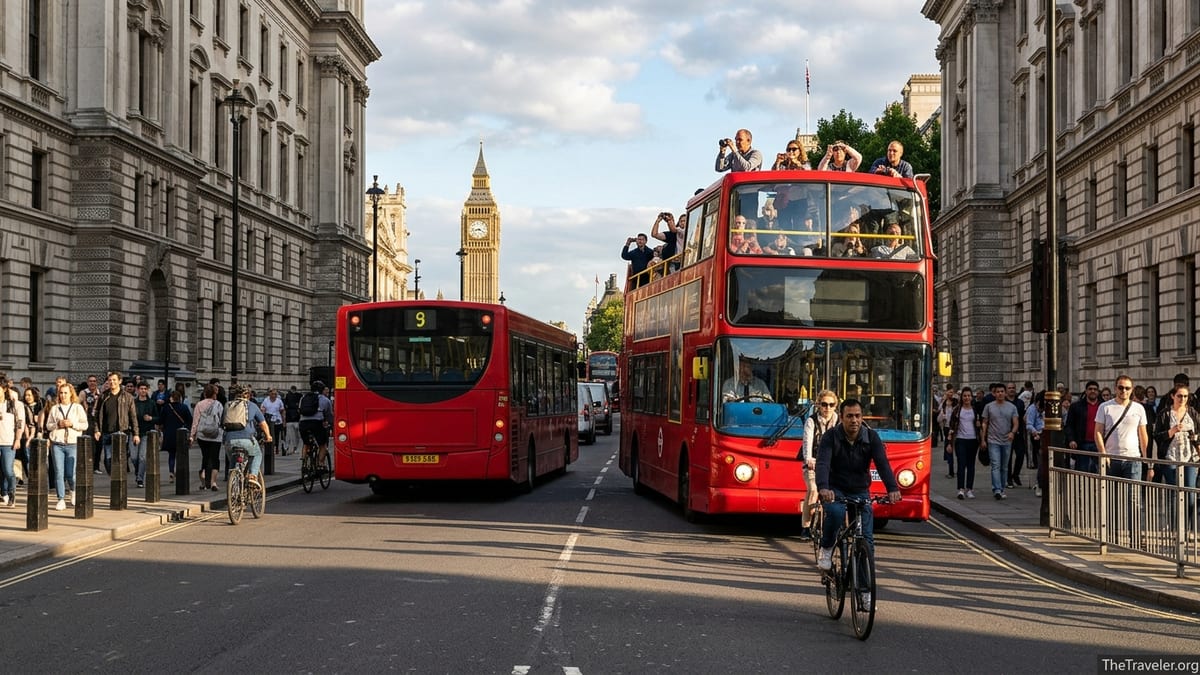
What Big Bus Tours Actually Offer Today
Hop-on hop-off buses are no longer a niche product. Companies like Big Bus Tours now operate in more than 20 major cities, including London, Paris, New York, Dubai and Hong Kong. A typical ticket buys you unlimited rides on a fixed sightseeing loop for a set period, usually 24, 48 or 72 hours, with open-top decks, audio commentary and stops at headline attractions rather than residential neighborhoods.
In London, for example, Big Bus generally runs three main daytime routes with more than 40 stops reaching places like Buckingham Palace, the Tower of London, Westminster Abbey, the London Eye, Harrods and Kensington Gardens. A one-day ticket usually includes extras such as a Thames river cruise segment and walking tours around Westminster or the City. Similar patterns appear in other cities: in Paris, Big Bus runs a core loop around the Eiffel Tower, Louvre, Champs Elysées and Notre Dame, sometimes bundled with a Seine river cruise.
For many visitors, the appeal is simplicity. Instead of decoding tube maps or bus numbers, you follow a color-coded sightseeing map, get on at a central stop near your hotel, listen to a running commentary in your language and hop off where you want to explore. The service is marketed much more as a sightseeing product than as a transport network, and that distinction is key when comparing it with public transit.
Big Bus and its competitors also sell different tiers. In Paris, for instance, a 24-hour “discover” ticket for adults often starts from roughly 30 to 40 euros, while more extensive “essential” or “explore” passes that include extra days or river cruises cost more. London pricing for 24-hour tickets frequently sits in the 40 to 50 pound range for adults, with family bundles making the per-person cost lower. These are tourism prices, not commuter fares, and they shape how realistically a big bus ticket can substitute for daily city transport.
Cost Comparison: Bus Pass vs Local Transport
Price is where hop-on hop-off buses most clearly diverge from public transit. In many cities, the cost of a one-day sightseeing bus ticket is equivalent to several days of unlimited travel on the local network. In London, for example, a 24-hour hop-on hop-off pass with a major operator typically costs several times more than the daily cap on Transport for London’s contactless system, which limits how much you pay for buses and the Underground in a single day regardless of how often you ride.
Travelers frequently share that a family of four might spend well over 100 pounds on a one-day sightseeing bus ticket, while the same family could move around London all day on buses and the tube for a fraction of that. Similar patterns appear in continental Europe, where a one-day Big Bus pass in Paris can cost several times more than a combined metro and bus day ticket. Public transit passes often include airport train connections, local trams and night buses, all for a single integrated fare.
On the other hand, the sightseeing ticket bundles in added value that public systems do not provide. Commentary in multiple languages, curated sightseeing routes and inclusion of things like river cruises or guided walks can justify the mark-up for some visitors, especially on a very short trip. A first-time visitor in London with only one full day might view a 24-hour hop-on hop-off pass plus river cruise as a fair price for seeing most key landmarks with minimal planning.
The bottom line is that for pure transportation, big bus tours are rarely cost-effective compared with metro or city bus passes. Their economics only make sense if you actively want the structured sightseeing experience, audio guide and included extras, rather than simply moving around town efficiently.
Coverage, Frequency and Practicality on the Ground
Another way to test whether big bus tours can replace public transport is to look at coverage. Public networks are designed to serve the entire city: residential areas, business districts, hospitals, outlying neighborhoods and tourist zones. Hop-on hop-off lines focus almost entirely on tourist corridors. In central London, for example, Big Bus stops cluster along the Thames, through the West End and around major attractions, while large parts of north and east London have no sightseeing bus coverage at all.
Frequency is different too. Many operators advertise buses every 15 to 30 minutes on main routes in peak season, but this can be affected by traffic, events or weather. By contrast, busy metro lines in cities like London, Paris or New York often run every few minutes throughout the day, and city buses may have dedicated lanes that allow them to bypass congestion that slows open-top sightseeing buses. In practice, this means you often spend more time waiting and sitting in traffic on a hop-on hop-off bus than on local transit.
Real-world experiences illustrate this. Some visitors in London report spending hours stuck in traffic on a hop-on hop-off loop during summer, watching regular red city buses sail past using bus lanes. In New York, where gridlock around Midtown and Downtown is common, a sightseeing bus crawling along 5th Avenue can be significantly slower than taking the subway for even a short distance. In cities with efficient tram networks, such as Prague or Amsterdam, trams can be both faster and more frequent than any sightseeing coach.
There are exceptions. In waterfront cities with limited metro coverage, such as parts of Dubai or Miami, a hop-on hop-off bus can offer relatively direct seaside or marina routes that would otherwise require multiple bus transfers. In places like Hong Kong, where a sightseeing service operated by a local bus company adds designated heritage or skyline loops, tourists may gain convenient point-to-point trips between hilltop viewpoints and harborfront promenades. Still, even there, the city’s metro and normal buses remain more extensive.
Experience and Comfort: Views, Commentary and Stress Levels
Where big bus tours come closest to replacing public transport for sightseeing is in the qualitative experience. Sitting on the open-top deck on a warm afternoon, watching landmarks glide by while hearing an audio guide explain history and architecture, feels vastly different from standing on a crowded metro. For many travelers, it is enjoyable in its own right, not just a means of getting from A to B.
The elevated view can be particularly valuable in cities with historic or dense streetscapes. In Paris, seeing the alignment of the Champs Elysées with the Arc de Triomphe, or the way the Eiffel Tower rises above Haussmann facades, is easier from a double-decker roof than from street level. In London, open-top routes along the Thames embankment let you see details on Big Ben, the Houses of Parliament and St Paul’s Cathedral that you might miss on foot.
The commentary is another point of difference. Most major hop-on hop-off companies now provide recorded audio in multiple languages via headphones, sometimes supplemented by live guides on select departures. These narrations typically highlight both major historical facts and quirky anecdotes: which balcony a famous speech was delivered from, where a novelist once lived, or which bridge offers the best sunset view. To gain similar context using public transport, you would need to supply your own guidebook or app, or join a separate walking tour.
However, comfort has trade-offs. Open-top decks can be cold, windy or wet when the weather turns, and covered lower decks may be as cramped as any city bus. In high season, popular routes can be busy enough that you wait for a second or third bus to get a top-deck seat. By contrast, underground trains keep running regardless of rain and are often cooler in hot climates. For travelers who prioritize reliability and speed over views, public transport wins easily.
City-by-City: Where Big Buses Work Best
The practicality of using hop-on hop-off buses as your main sightseeing transport varies widely between cities. In compact historic centers like Dublin or Edinburgh, where many major sights cluster along a relatively short axis, a sightseeing bus loop can effectively form a ring around the city core, stopping near castles, cathedrals, museums and waterfront areas. A 24-hour ticket might realistically cover most of what a first-time visitor wants to see, with only short walks from each stop.
In sprawling metropolises like London or New York, big bus routes are less comprehensive. You might be able to cover the classic postcard landmarks in a day or two, but many interesting neighborhoods sit well outside the sightseeing loops. In New York, for instance, hop-on hop-off lines often focus on Manhattan, with optional add-ons up to Harlem or across to Brooklyn. Using them as your only transport could mean missing large parts of Queens, the Bronx or local residential areas that give the city its character.
In some destinations, local transit is simply too efficient and cheap for sightseeing buses to compete as a replacement. Cities such as Prague, Berlin and Barcelona have dense, integrated metro, tram and bus systems, often with affordable day passes that cover the entire network. Visitors there frequently report that public transport lets them see more in less time, especially during busy periods when sightseeing buses get stuck behind regular traffic.
On the other hand, there are places where hop-on hop-off really shines as a quasi-transport solution. In desert or extremely hot climates, like Dubai in summer, walking long distances between metro stations and beach or marina areas is often impractical. A sightseeing bus linking air-conditioned malls, beachfront promenades and viewpoints may be a comfortable way to move around. Similarly, in cities where language barriers and complex bus systems intimidate short-stay visitors, a clearly branded hop-on hop-off line can feel like a safe and predictable substitute.
Sustainability, Crowding and the Urban Impact Question
Beyond personal convenience, there is the question of how hop-on hop-off tours affect the cities they operate in. Large open-top buses on central streets add to congestion, compete for limited curb space near landmarks and can generate noise and emissions if fleets are not modernized. In already crowded historic cores, local residents often see long lines of parked sightseeing buses as a nuisance rather than a benefit.
Public transport systems, by contrast, are usually part of a broader urban mobility plan. Many cities are expanding tram lines, introducing electric buses and redesigning streets to favor pedestrians and cyclists over cars. Integrating tourists into those networks can be more sustainable than running a parallel set of tourist-only vehicles. When visitors use metro and regular buses, they reinforce demand for frequent services that also benefit locals.
Some tour companies are responding by upgrading fleets to cleaner vehicles or coordinating more closely with city authorities. In a few destinations, sightseeing buses use partially electric or low-emission coaches and limit idling times near attractions. Yet the fundamental model remains separate from public transit: they are branded, ticketed and scheduled independently, often without the same level of regulation applied to municipal operators.
For travelers concerned about their footprint, this raises a practical question. If the local metro or tram gets you nearly the same views and access at a lower environmental cost, it may be the better choice. If mobility or accessibility needs make the step-free boarding and minimal walking associated with hop-on hop-off buses attractive, then choosing operators that use newer, cleaner fleets and avoiding unnecessary loops can help mitigate impact.
How to Combine Big Bus Tours and Public Transport Smartly
Rather than asking whether big bus tours can completely replace public transport, a more useful approach is to see how they can complement each other. One common strategy is to take a hop-on hop-off loop on your first full day in a city. You ride at least one complete circuit without getting off, listening to the commentary and noting which stops and neighborhoods interest you most. After that initial orientation, you rely on metro, trams or local buses for the rest of your stay to revisit specific areas and explore less touristy corners.
In London, for example, you might book a 24-hour hop-on hop-off ticket that includes a Thames river cruise. On day one, you complete a loop from Green Park past Buckingham Palace, Westminster, the Tower of London and back via the West End, then take the boat segment. On day two and beyond, you buy an Oyster or contactless fare cap and use regular buses and the Underground to return to favorite spots like Camden, Shoreditch or Greenwich that sit off the sightseeing routes.
In Paris, a similar pattern can work. You begin with a day on a hop-on hop-off bus to see the Eiffel Tower, Trocadéro, the Louvre, Notre Dame’s surroundings and the Champs Elysées, then switch to metro line 1 or RER trains for faster cross-city journeys. For neighborhoods like Montmartre or Canal Saint-Martin that are not well covered by sightseeing lines, public transport remains the obvious choice.
This hybrid method also smooths out risks. If heavy traffic or an equipment issue delays your sightseeing bus, you are not stranded because the city’s regular buses or metro are still available. Conversely, if a metro strike or industrial action affects local services, hop-on hop-off tours may continue running, giving you at least some way to move between key sights, even if more slowly.
The Takeaway
The idea that big hop-on hop-off buses could fully replace public transport for sightseeing sounds appealing in theory: one ticket, one system, no need to think about routes or fares. In reality, they serve a different purpose. They are rolling sightseeing platforms designed to showcase landmark districts, not comprehensive urban transport networks meant to move people efficiently across an entire city.
For short stays, especially first visits to complex destinations, a 24 or 48-hour hop-on hop-off ticket can be an efficient orientation tool and a comfortable way to tick off headline sights. It can substitute for some public transport journeys, particularly between clusters of major attractions. But when it comes to cost, coverage, speed and integration with everyday city life, metro lines, trams and local buses remain irreplaceable.
Most travelers will get the best experience by combining the two: start with an open-top loop for the views and context, then rely on public transport to dig deeper and move quickly. Seen this way, big bus tours are not competitors to urban transit but complementary layers on top of it. They are at their best when treated as curated sightseeing rather than a full replacement for the city’s own buses and trains.
FAQ
Q1. Can a hop-on hop-off bus really replace the metro or city buses for sightseeing?
In most cities, no. Hop-on hop-off routes cover the main tourist corridors but not entire neighborhoods, and they run less frequently than metros or regular buses, so they work better as a supplement than a full replacement.
Q2. Are big bus tours good value compared with public transport passes?
They can be, but only if you want the sightseeing extras. A one-day hop-on hop-off ticket often costs several times more than a local metro or bus day pass, so the added commentary, views and bundled cruises need to matter to you.
Q3. In which cities do hop-on hop-off buses work particularly well?
They tend to work best in compact cities with concentrated sights, such as Dublin or Edinburgh, or in hot or sprawling destinations like Dubai where walking long distances between attractions is uncomfortable.
Q4. When is public transport a better choice than a sightseeing bus?
Public transport is usually better when you want to move quickly, visit local neighborhoods beyond the main tourist sites, keep costs down, or travel during rush hours when sightseeing buses get stuck in traffic.
Q5. Is it worth doing both a hop-on hop-off bus and buying a transit pass?
Yes for many travelers. A common strategy is to use a hop-on hop-off loop on your first day to get oriented, then rely on a metro or bus pass for the rest of your stay.
Q6. Do sightseeing buses operate late at night like public transport?
Usually not. Most hop-on hop-off services stop running in the early evening, though some cities offer separate night tours. Local buses and metros typically provide later or night services.
Q7. Are hop-on hop-off buses accessible for travelers with mobility issues?
Many operators use low-floor or ramp-equipped buses, but accessibility can vary by city and stop. Public transport networks often have more consistent information on step-free stations and accessible vehicles.
Q8. How much time should I allow to complete a full sightseeing bus loop?
Most full loops in big cities take around two to three hours without getting off, depending on traffic. Allow extra time in high season or during major events, when congestion can significantly slow progress.
Q9. Do hop-on hop-off tickets include entry to attractions?
Standard tickets usually only cover the bus ride and any listed extras like river cruises or walking tours. Some companies sell bundles that include attraction entry, but these are separate products and cost more.
Q10. What is the smartest way to use a hop-on hop-off bus on a short trip?
The most efficient approach is to ride one full circuit first to hear the commentary and see the layout of the city, mark the stops that interest you, then use later buses and local transport to focus on your top sights.